
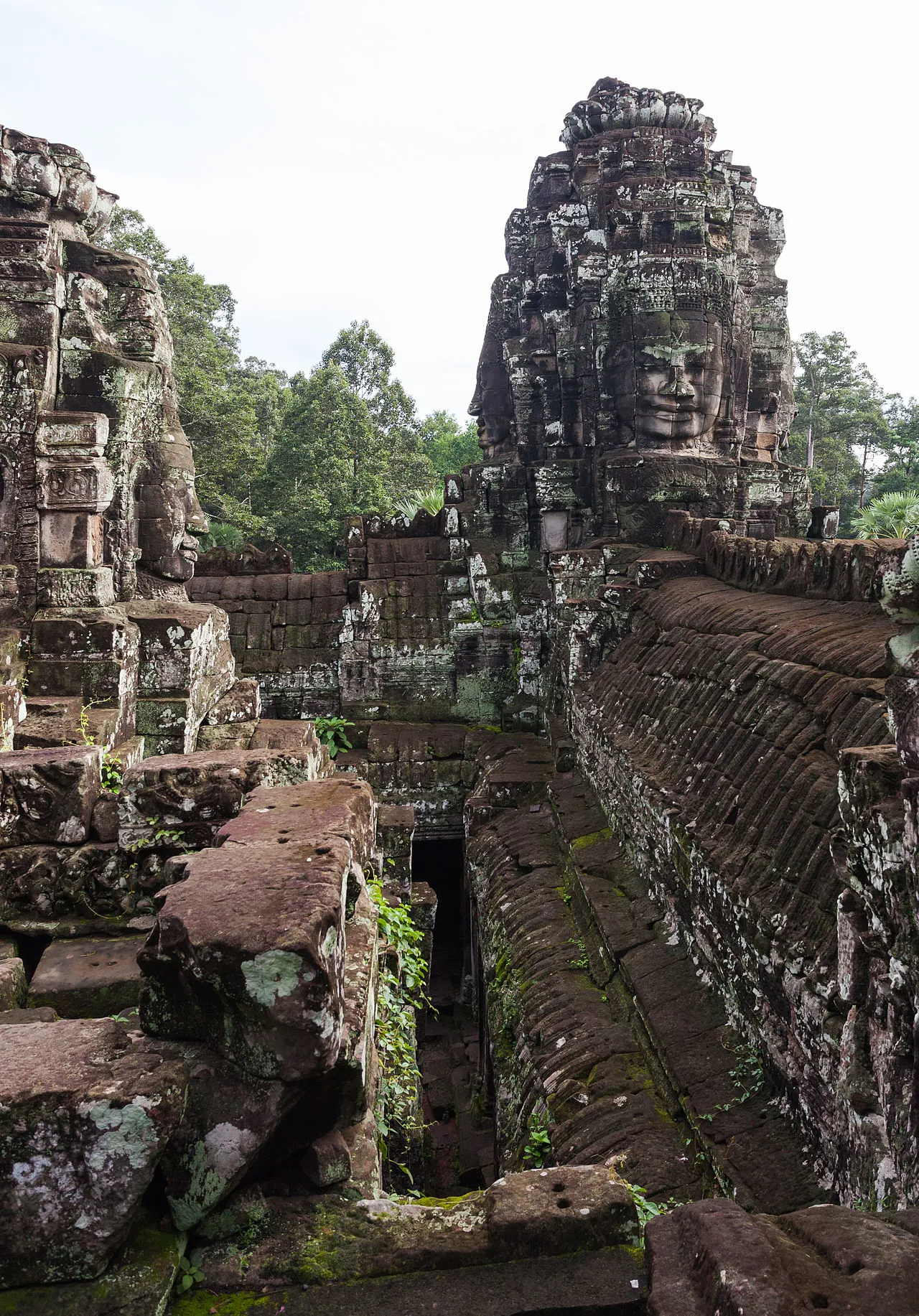
Tips for Visitors
Order of visits: If combining with Angkor Wat in one day, do Angkor Wat at sunrise (5 AM), take a break during peak heat (11 AM–1 PM), then visit Angkor Thom and Bayon in the afternoon (2–5 PM). Face tower photography: The inner sanctuary face towers are best photographed at mid-morning when overhead light illuminates the stone; afternoon light is dramatic but high-contrast. Hidden interior passage at the Terrace of the Leper King: Ask your guide to show you the lower passage with the second, inner carved wall — most visitor groups walk the exterior only. Crowd management: The Bayon receives its first tour buses between 9–10 AM; a 7:30 AM start gets you the face towers in relative solitude.
When to Visit
Angkor Thom South Gate: Opens with the Angkor Park at 5 AM; best photographed in early morning light. Bayon: 7:30 AM – 5:30 PM; best visited 7:30–9 AM before tour groups arrive in volume. Terrace of the Elephants: Viewable at any time during park hours.
Admission and Costs
Included in Angkor Archaeological Park pass: $37 (1 day) / $62 (3 days). Licensed guide (full Angkor day): $35–60. Tuk-tuk between Angkor Wat and Angkor Thom: approximately $3–5 (included in full-day tuk-tuk hire).
The Case for a Guide
Angkor Thom and Bayon are more complex than Angkor Wat because their iconographic programme is Buddhist rather than Hindu — the shift in religious symbolism between the two sites is the central story of Khmer civilization's 12th-century transformation.
- The 216 faces identity: The scholarly debate about whether the faces represent Jayavarman VII, Avalokitesvara, or a deliberate fusion of both identities is still unresolved — a guide presents both interpretations and explains what's at stake in the identification
- Bayon bas-relief sequence: The outer gallery is designed to be walked counterclockwise — a guide follows the intended sequence, identifying the naval battle panels (which depict specific Cham warship types), the marketplace scenes, the village life vignettes, and the mythological panels with equal clarity
- The Baphuon reclining Buddha: The 11th-century Baphuon temple's west-face exterior contains a massive reclining Buddha assembled from redistributed sandstone blocks in the 15th century — a guide points out this astonishing recycled monument that most visitors walk past without noticing
- City gate iconography: The five Angkor Thom gates each have specific cosmological meanings and slightly different sculptural programmes on their guardians; a guide explains why you enter via the south gate and exit via the north gate for the intended experience
Frequently Asked Questions
Who built Angkor Thom and the Bayon?
Angkor Thom (Great City) was built by King Jayavarman VII, who ruled the Khmer Empire from approximately 1181 to 1218 CE — the empire's greatest and last major king. He constructed the walled capital of Angkor Thom across 9 km² as both a strategic fortification after the Cham invasion of 1177 and a religious statement that he — as a devout Buddhist — was the bodhisattva (enlightened being) whose face looked out over his kingdom from every tower of the Bayon. The 216 stone faces are widely believed to be idealized portraits of Jayavarman VII himself, combined with the features of the Bodhisattva Avalokitesvara.
What are the bas-reliefs at Bayon about?
Bayon's bas-reliefs are divided between two galleries and are stylistically distinct from Angkor Wat's. The outer gallery depicts historical events — Jayavarman VII's military campaigns against the Cham people, naval battles on the Tonle Sap lake, and scenes of everyday Khmer village life (a cook preparing meals, a market with Chinese traders, a cock-fight, a woman giving birth) that provide an extraordinary sociological window into 12th-century Cambodian society. The inner gallery depicts mythological and religious scenes. The detail of ordinary life in Bayon's outer reliefs is unmatched in Angkor.
What else is inside Angkor Thom?
Angkor Thom's 9 km² enclosure contains more than the Bayon. The Baphuon temple is a massive 11th-century pyramid temple (currently under extensive restoration) representing Mount Meru in three tiers. The Terrace of the Elephants is a 350-metre-long royal reviewing platform carved with life-size elephant processions and Garuda figures. The Terrace of the Leper King is carved on both sides — one face visible to the public, a second face hidden in the interior passage. The five city gates are each topped with tower faces identical to those on the Bayon.