
Country guide
What makes Cambodia a must-visit destination?
Cambodia's defining feature is scale — the scale of the Khmer Empire's architectural ambition, which produced temple complexes at Siem Reap covering hundreds of square kilometres; and the scale of the country's 20th-century tragedy, which reduced one of Southeast Asia's most sophisticated civilizations to near collapse and whose marks remain visible in every city and province.
Angkor Wat alone can absorb days of careful attention — its 1,200-metre bas-relief gallery is the longest continuous carved narrative in the world, encoding Khmer cosmology, military history, and royal mythology in stone that only begins to make sense with expert guidance. Beyond Angkor, Ta Prohm demonstrates what centuries of jungle reclamation look like when conservators decide to preserve rather than clear the trees. The capital, Phnom Penh, carries a different weight — the Royal Palace, the National Museum's Khmer sculpture collection, and the Tuol Sleng Genocide Museum require a guide who can hold the full arc of Cambodian history.
- Language
- Khmer Widely spoken across Cambodia
- Currency
- Riel (៛) & US dollar Legal tender across Cambodia
- Time zone
- UTC+7 Local time in Cambodia
- Power plugs
- Types A, C, G · 230V Sockets used across Cambodia
- Getting around
- Buses & tuk-tuks Getting between Cambodia's cities
- Best months
- Jan, Feb, Mar, Sep, Oct, Nov, Dec Averaged across Cambodia's city ratings
Cambodia timeline
-
Khmer Empire begins
Jayavarman II founded the imperial order behind Angkor and many Siem Reap itineraries.
-
Angkor era wanes
The old capital declined, leaving temple landscapes that later became Cambodia's signature visitor draw.
-
French protectorate begins
Colonial rule added administrative and architectural layers to Phnom Penh and provincial towns.
-
Independence restored
Cambodia regained independence from France, reframing royal and colonial-era sites.
-
Khmer Rouge rule ends
The regime collapse began a long recovery that shapes memorial sites and visitor interpretation.
- 1992-1993
UN transition
The peacekeeping period helped reopen the country and its heritage sites to global travel.
Local context
Culture and travel signals
Angkor Wat is the world's largest religious monument at 162 hectares
Built between 1113 and 1150 CE by King Suryavarman II, Angkor Wat's outer moat alone stretches 5.5 km in perimeter — a hydraulic feat that required engineering knowledge not replicated in Southeast Asia for centuries; lidar surveys since 2016 have revealed a surrounding urban network sustaining a population estimated at over a million in the 12th century
Over 2.2 million tourists visited Angkor Archaeological Park in 2019
The park generates approximately 60% of Siem Reap's tourism revenue and a significant portion of Cambodia's total foreign exchange earnings; UNESCO World Heritage status, awarded in 1992, transformed the site from an overgrown archaeological ruin into one of Asia's most visited attractions
Cambodia has over 4,000 temples registered in the national heritage inventory
While Angkor dominates global attention, Cambodia's Buddhist and Hindu temple heritage extends across the entire country — rural provinces contain functioning village wats and pre-Angkorian brick tower complexes that receive a fraction of the visitors that Angkor sees
The Tonlé Sap is Southeast Asia's largest freshwater lake, doubling in size each monsoon
During the wet season the Mekong reverses the flow of the Tonlé Sap river, flooding the lake from 2,500 km² to over 16,000 km² and sustaining one of the world's most productive inland fisheries; floating villages on the lake are accessible only with a local guide who understands the seasonal water levels
Source: tour-guide.com — Free to cite with attribution
Season planner
A year in Cambodia
Use this best time to visit snapshot as a country-wide average, then check the city guides for local timing.
Mar-May
Spring
Spring stays workable in Cambodia at Mar-May (3.3/5), so lean on city-by-city timing.
Jun-Aug
Summer
Summer stays workable in Cambodia at Jun-Aug (3/5), so lean on city-by-city timing.
Sep-Nov
Autumn
Autumn holds up well for guided travel in Cambodia, averaging Sep-Nov (4.3/5).
Dec-Feb
Winter
Winter is Cambodia's strongest guide window — Dec-Feb (5/5) across its cities.
Where should you go in Cambodia?
The Temple Gateway
Siem Reap is Cambodia's most visited city and the base for all exploration of the Angkor Archaeological Park — a UNESCO World Heritage Site covering over 400 km² and containing hundreds of temples from the 9th through 15th centuries. Angkor Wat, Angkor Thom & Bayon, and Ta Prohm are the most celebrated; Preah Khan Temple and the hydraulic engineering of Pre Rup reward visitors who stay beyond the standard circuit.
The Capital
Phnom Penh sits at the confluence of the Mekong, Tonlé Sap, and Bassac rivers and holds Cambodia's royal, cultural, and political history in a compact riverside city. The Silver Pagoda in the Royal Palace compound displays a floor of 5,000 silver tiles; the National Museum houses the world's finest collection of Khmer sculpture; and the Tuol Sleng Genocide Museum confronts the Khmer Rouge period with brutal clarity.
The Lake and the Coast
Battambang, Cambodia's second city, offers bamboo train rides through rural countryside and access to the Cardamom Mountains. The coastline around Kep and Kampot supplies fresh crab, colonial-era architecture, and a dramatically different pace from the temple circuit.
Must-see attractions across Cambodia
Jump past the planning and straight to what makes Cambodia memorable, city by city. A guided visit is where the specifics click into place.
What do visitors need to know about Cambodia?
Finding a Guide
- Angkor park licensed guides — the Cambodian Association of Tour & Travel Agents (CATTA) maintains a register of licensed guides; request credentials before hiring and book through reputable agencies in Siem Reap
- Hotel concierge connections — mid-range and upscale hotels in Siem Reap maintain relationships with reliable independent guides and can arrange custom temple circuits
- GetYourGuide and Viator — useful for group and private tours with English-language reviews; filter by the specific temples you want to cover
- Specialist academic guides — for visitors with deep interest in Khmer art history, Angkor Conservation employs archaeologists who lead private tours by arrangement
Typical Costs
| Tour Type | Price Range |
|---|---|
| Group Angkor half-day circuit | $15–30 per person |
| Licensed private Angkor guide (full day) | $35–60 |
| Specialist Khmer history guide | $60–100 per day |
| Phnom Penh city guide (half day) | $30–50 |
| Tonlé Sap floating village tour | $20–40 per person |
Must-See Experiences
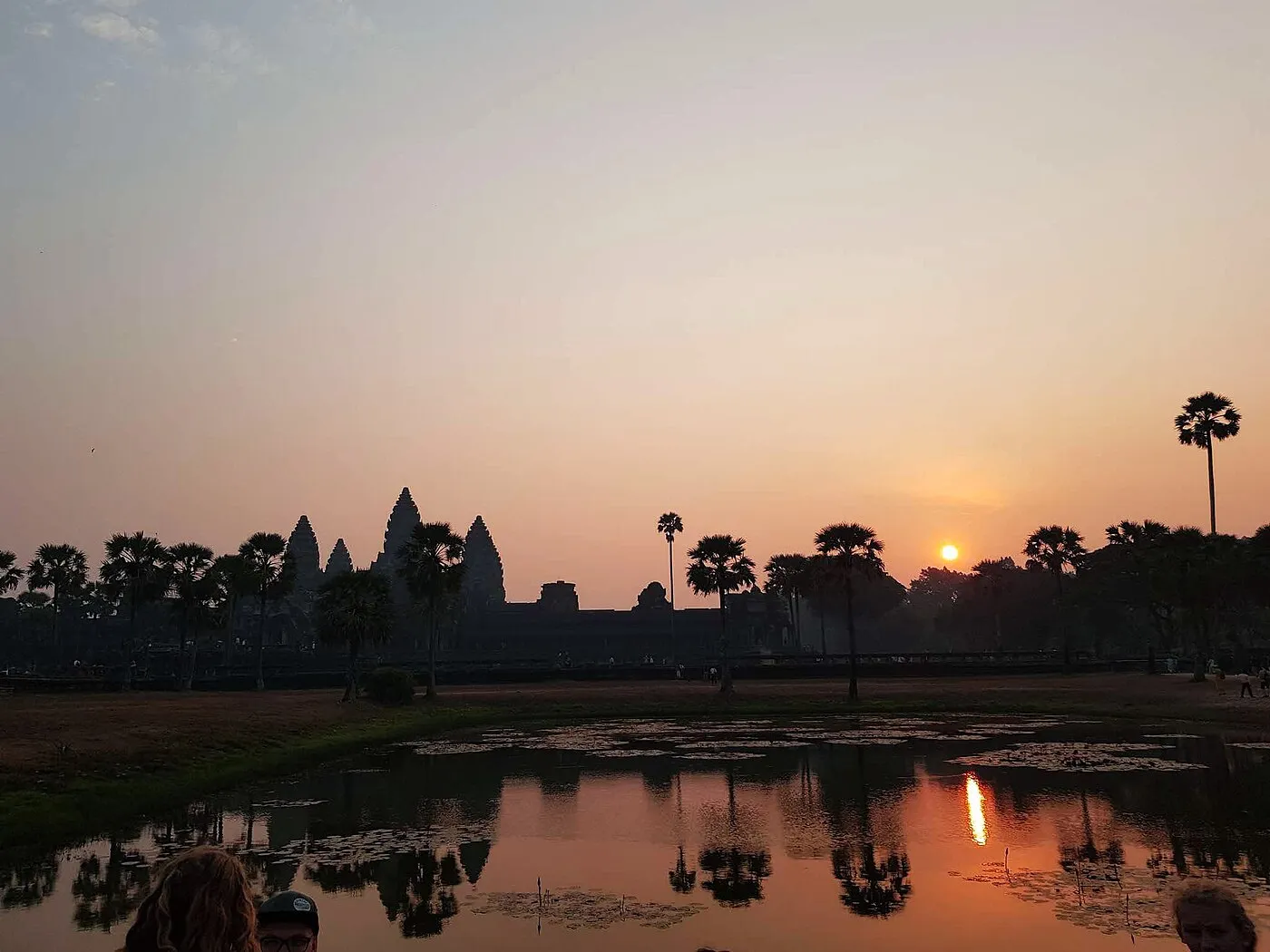
- Angkor Wat — sunrise over the world's largest religious monument
- Angkor Thom & Bayon — Jayavarman VII's enigmatic smiling towers explained by a guide who understands Khmer symbolism
- Ta Prohm — jungle roots reclaiming a 12th-century monastery
- Tonlé Sap Lake — floating villages on Southeast Asia's largest freshwater lake
- Royal Palace, Phnom Penh — the Silver Pagoda and Throne Hall of Cambodia's monarchy
Tips for Visitors
- Angkor pass — purchase your Angkor Archaeological Park pass the day before an early sunrise visit; passes are available at the main entrance and photographed for your ticket
- Dress code — shoulders and knees covered are mandatory at all Angkor temples; guards enforce this at the second enclosure entrance of Angkor Wat
- Currency — US dollars are accepted everywhere; Cambodian riel is used for small purchases and change below $1; carry both
- Heat — March through May is brutal; plan temple visits for before 9 AM and after 3 PM, with a midday break
- Tuk-tuks — the standard Angkor transport; negotiate a full-day rate ($15–20) at your hotel the evening before rather than at the park entrance
- Respectful photography — monks are active residents of some Angkor temples; ask before photographing any ceremony or individual
Frequently Asked Questions
What is the best time of year to visit Cambodia?
November through February is Cambodia's dry season and the most comfortable window for visiting — temperatures sit between 25 and 32°C with low humidity, and Angkor Wat's reflecting pools and moat are at their most photogenic in the sharp dry-season light. March and April build to intense heat peaking above 38°C before the southwest monsoon arrives in May. The wet season from May through October brings dramatic afternoon storms, lush jungle greenery around the temples, and dramatically fewer tourists — an experienced guide can navigate the season's rhythms and identify which temples drain quickly after rain and which become genuinely impassable.
How much does a licensed tour guide cost in Cambodia?
Cambodia offers exceptional guide value relative to the depth of its historical heritage. A licensed Angkor Archaeological Park guide for the full Angkor temple circuit costs $35–60 per day, covering Angkor Wat, the Bayon, Ta Prohm, and the outer temples. Group tours of the Angkor complex run $15–30 per person for a half-day circuit. Specialist guides with academic backgrounds in Khmer history and archaeology charge $60–100 per day and transform the temples from impressive ruins into a legible civilization. Phnom Penh city guides for the Royal Palace district and historical sites cost $30–50 for a half-day private tour.
Is Cambodia safe for independent travellers?
Cambodia is generally safe for tourists in the main destinations of Siem Reap and Phnom Penh, with petty theft the primary concern in crowded areas. The more significant challenge is extracting genuine depth from Cambodia's history — the country's trauma during the Khmer Rouge period (1975–1979) and the complex transition decades that followed are not easily conveyed through signage or English-language information boards at historical sites. A guide who lived through or whose family lived through this period provides context that no guidebook can replicate. Outside major cities, a guide with transport is essential for reaching remote temple complexes and floating villages on Tonlé Sap Lake.