
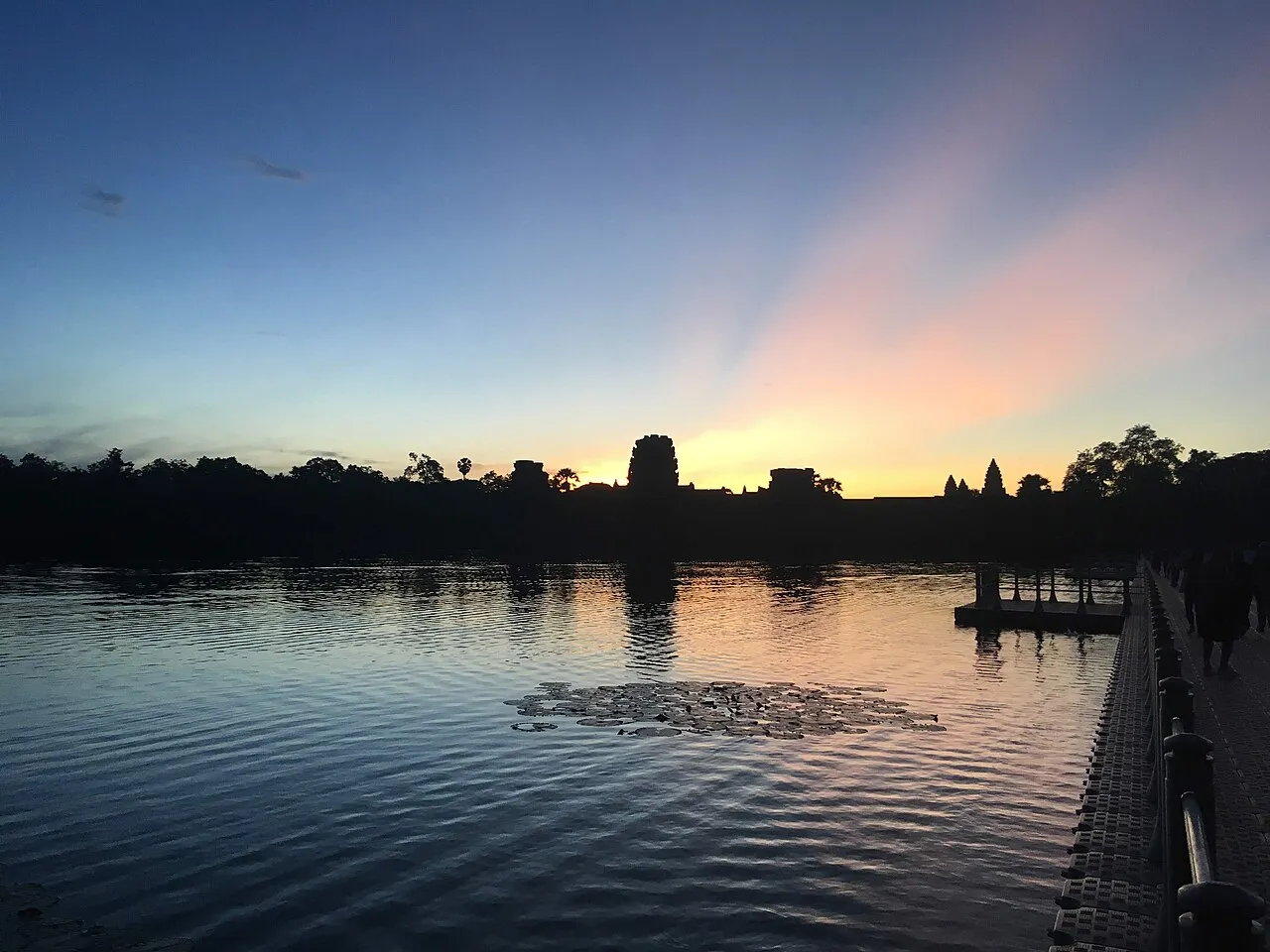
Tips for Visitors
Equinox timing: Visit in late March or late September for the solar alignment events — book accommodation 3+ months ahead. Central tower: Open when not under conservation; climbing requires long sleeves and trousers and is physically demanding. Afternoon option: The west-facing towers illuminate in golden afternoon light between 3–5 PM — an underrated second visit after a morning break. Dress code: Shoulders and knees covered at all times; guards will turn you away at the second enclosure entrance. Avoid midday: 11 AM–2 PM in the hot season (March–May) reaches 38°C — plan around this window or commit to shade and water.
When to Visit
Park opens for sunrise: 5 AM. Standard hours: 5 AM – 6 PM daily. Best sunrise position: Left-side reflecting pool — arrive by 5:15 AM for front-row access. Bas-relief gallery: Best lighting for photographing carvings between 8–10 AM (east-facing panels) and 2–4 PM (west-facing panels).
Admission and Costs
Angkor Archaeological Park pass (mandatory): $37 (1 day) / $62 (3 days) / $72 (7 days). Licensed guide (all of Angkor): $35–60 for a full day. Sunrise tuk-tuk from Siem Reap: $15–20 return.
The Case for a Guide
Angkor Wat is the most guide-dependent major site in Southeast Asia — its iconographic depth is entirely inaccessible without someone who has studied Khmer history and Hindu mythology.
- Bas-relief narrative reading: The eight gallery scenes are a complete narrative programme encoding Khmer imperial ideology, Hindu cosmology, and royal self-glorification — a guide reads the panels as a unified text, identifying specific battles, kings, deities, and narrative sequences that render the 1,200 metres of carved stone comprehensible
- Astronomical alignment: Angkor Wat's orientation, the specific angle of the causeway, and the solar alignment on equinoxes were deliberate architectural choices encoding a Khmer astronomical calendar — a guide explains what temple visitors in the 12th century would have experienced at key ritual moments
- Construction logistics: How 5 million tonnes of sandstone were quarried at Phnom Kulen 40 km away and transported to the site by canal — the engineering reasoning, labour organisation, and timeline — is one of the most extraordinary infrastructure stories of the pre-industrial world
- Living versus dead religion: Angkor Wat is simultaneously an active Buddhist monastery (visible in the monks resident in the northeast corner) and a Hindu archaeological monument — a guide navigates this religious palimpsest and explains when and how the temple transitioned from Vishnu worship to Theravada Buddhism
Frequently Asked Questions
How early should I arrive for Angkor Wat sunrise?
Angkor Wat faces west — which means it is the sun that rises behind and over the temple's five central towers when viewed from the main causeway and reflecting pool. To witness this from the optimal front pond position, arrive at the park entrance by 5 AM (the gate opens at 5 AM for sunrise visitors). The main reflecting pool on the left side of the causeway fills with visitors very quickly — from 5:30 AM it is crowded. A guide with transport will have you in position before the rush. True astronomical sunrise alignment occurs precisely on the spring equinox (around March 20–21), when the sun rises exactly behind the central tower.
What is on the bas-relief gallery and how long is it?
The bas-relief gallery on Angkor Wat's third enclosure wall extends for 1,200 metres — the longest continuous carved narrative in the world. It depicts eight distinct scenes from Hindu mythology and Khmer imperial history: the Battle of Kurukshetra, the army of Suryavarman II, the Heavens and Hells of Hindu cosmology, the Churning of the Sea of Milk, the Battle of Lanka, and others. A single circuit of the gallery at reading pace takes 60–90 minutes. Without a guide, most visitors see carved stone; with one, the scenes become legible stories.
How much time does Angkor Wat require?
Budget a minimum of 3 hours for a serious visit: 45 minutes for the exterior approach, moat, and first and second enclosures; 60 minutes for the bas-relief gallery circuit; 45 minutes for the central sanctuary towers. A thorough guided visit with time for the gallery commentary and the upper sanctuary (when open) takes 4–5 hours. If combining with Angkor Thom and Bayon in the same day, start Angkor Wat at sunrise and Bayon at mid-morning.