
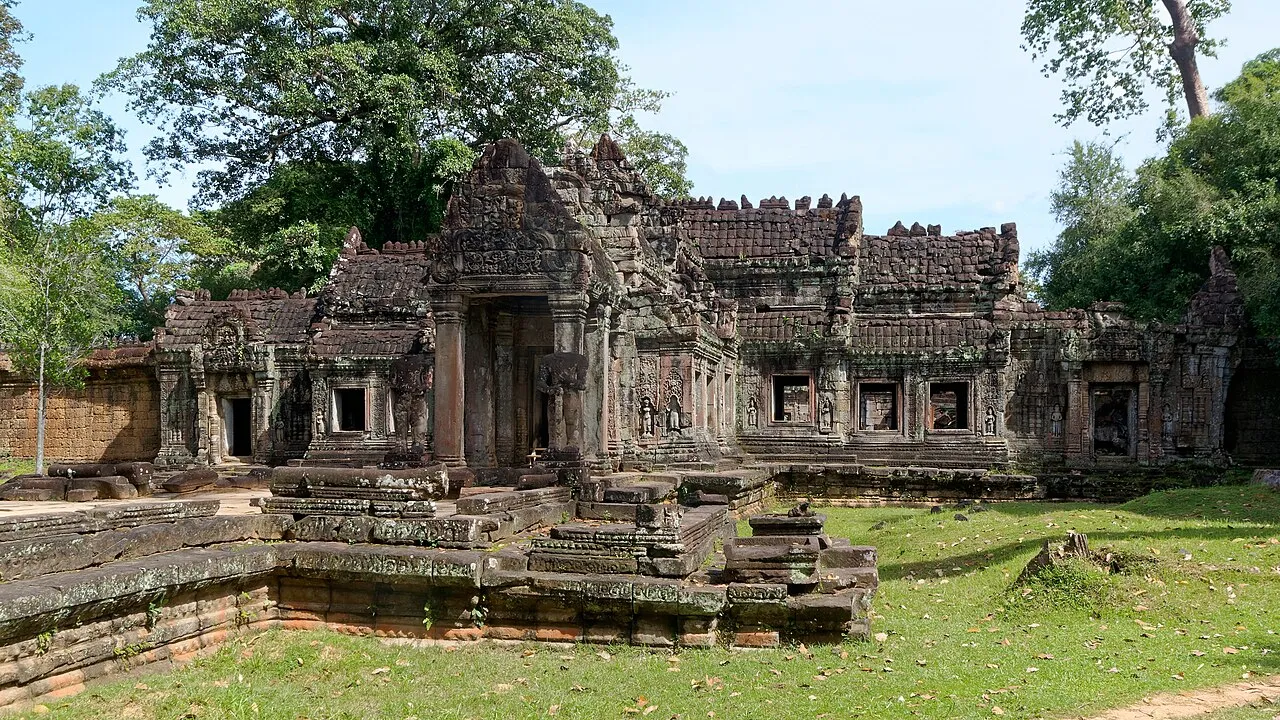
Tips for Visitors
East entrance: Enter from the east for the intended processional experience across the guardian causeway; most tuk-tuks drop visitors at the west entrance — ask your guide or driver to take you to the east gate first. Overgrown areas: Some of the most dramatic partly-collapsed corridors are in the northern arm of the complex, rarely walked on standard visit routes. Combine with Neak Pean: The small circular island temple Neak Pean is a 5-minute tuk-tuk ride from Preah Khan and rarely visited — a guide can incorporate it into the same morning for minimal extra time. Wear closed shoes: The complex has many uneven stone fragments and some areas require stepping over collapsed blocks.
When to Visit
Open: 7:30 AM – 5:30 PM daily. Best time: 8–10 AM before the modest tour-group activity peaks. Dry season: October–April for the firmest paths through the complex; monsoon season makes some lower areas waterlogged. Full circuit: Allow 90–120 minutes for a thorough guided exploration.
Admission and Costs
Included in Angkor Archaeological Park pass: $37 (1 day) / $62 (3 days). No separate entry fee.
The Case for a Guide
Preah Khan's labyrinthine layout and comparative lack of English signage makes it particularly guide-dependent — visitors without orientation can miss its finest features entirely.
- Directional navigation: The cruciform corridor system means visitors can arrive at the east gate, walk straight through to the west gate, and see only 20% of the complex; a guide maps a complete circuit through all four cardinal corridors and the second enclosure to capture the full experience
- Round column building: The two-storey structure with circular columns is a genuine architectural mystery — a guide presents the competing scholarly interpretations (library, dance platform, treasury) and explains what makes it uniquely anomalous in the Angkor architectural vocabulary
- Foundation stele data: The inscription listing Preah Khan's 97,840 residents and 515 stone images is a statistical record of medieval institutional life unparalleled in Southeast Asian history; a guide contextualises these numbers against comparable medieval European institutions
- Carving quality in the outer enclosure: The outer gopura's pediment carvings are among the finest in Angkor for their retention of original surface detail and composition clarity — a guide identifies the mythological scenes depicted and explains why outer enclosure carvings were typically executed at a higher standard than inner enclosure work
Frequently Asked Questions
What is Preah Khan and who built it?
Preah Khan (Sacred Sword) was built by King Jayavarman VII in approximately 1191 CE as a Buddhist monastery and teaching complex dedicated to his father — a deliberate companion to Ta Prohm, which he built to honour his mother. At its operational peak, the complex served as a city within a city, housing over 1,000 teachers, more than 97,000 servants and administrative staff, and a population of resident monks, students, and support workers sustained by 13,500 villages according to its foundation stele inscription.
How is Preah Khan different from the other major Angkor temples?
Preah Khan differs from Angkor Wat and Bayon in its scale and navigational complexity — the complex is enormous (900 × 700 metres) and its corridors extend in all four cardinal directions through a series of concentric enclosures, creating a labyrinthine experience quite different from the compact verticality of Angkor Wat or the face-tower focus of Bayon. It is also less restored than those flagship sites, meaning more areas retain their overgrown, partially collapsed character. A unique two-storey colonnade (the only round column structure in the Angkor complex) stands in the second enclosure as a structural anomaly still unexplained by scholars.
Is Preah Khan crowded?
Preah Khan receives significantly fewer visitors than Angkor Wat, Bayon, and Ta Prohm — it is frequently described as the best-value visit in the entire Angkor complex precisely because its scale, carved detail, and atmosphere rival the flagship sites with a fraction of the foot traffic. Mornings before 10 AM are particularly quiet. A guide who knows the complex's directional layout is useful here — the cruciform corridors and multiple enclosures make getting disoriented easy without guidance.