
Historical Significance
This is not a site that rewards rushing, and it is where a licensed guide earns their fee most clearly. Much of what makes the memorial meaningful is invisible without context. Guides explain why the names on the bronze parapets follow a system of meaningful adjacencies rather than alphabetical order — victims are grouped with the colleagues they worked beside, the passengers on their flight, or the first responders from their firehouse, and family members were consulted on more than 1,200 placement requests so that friends rest side by side. They tell the story of the Survivor Tree, the scorched Callery pear recovered from the rubble in October 2001, nursed back to health in a Bronx nursery, and replanted on the plaza in 2010, where its seedlings are now sent to communities recovering from tragedy worldwide. Below ground, guides slow visitors down at exhibits that are easy to walk past: the Vesey Street survivors' staircase preserved behind glass, the recovered fire trucks, and above all the In Memoriam gallery, where individual photographs and recorded remembrances of every victim turn an unfathomable number back into 2,983 distinct lives. Guides also situate the day within its longer history, connecting it to the earlier 1993 truck bombing that first targeted the same complex, and place the site inside a walkable arc of Lower Manhattan that rewards an unhurried half-day rather than a quick photo stop.
Architecture
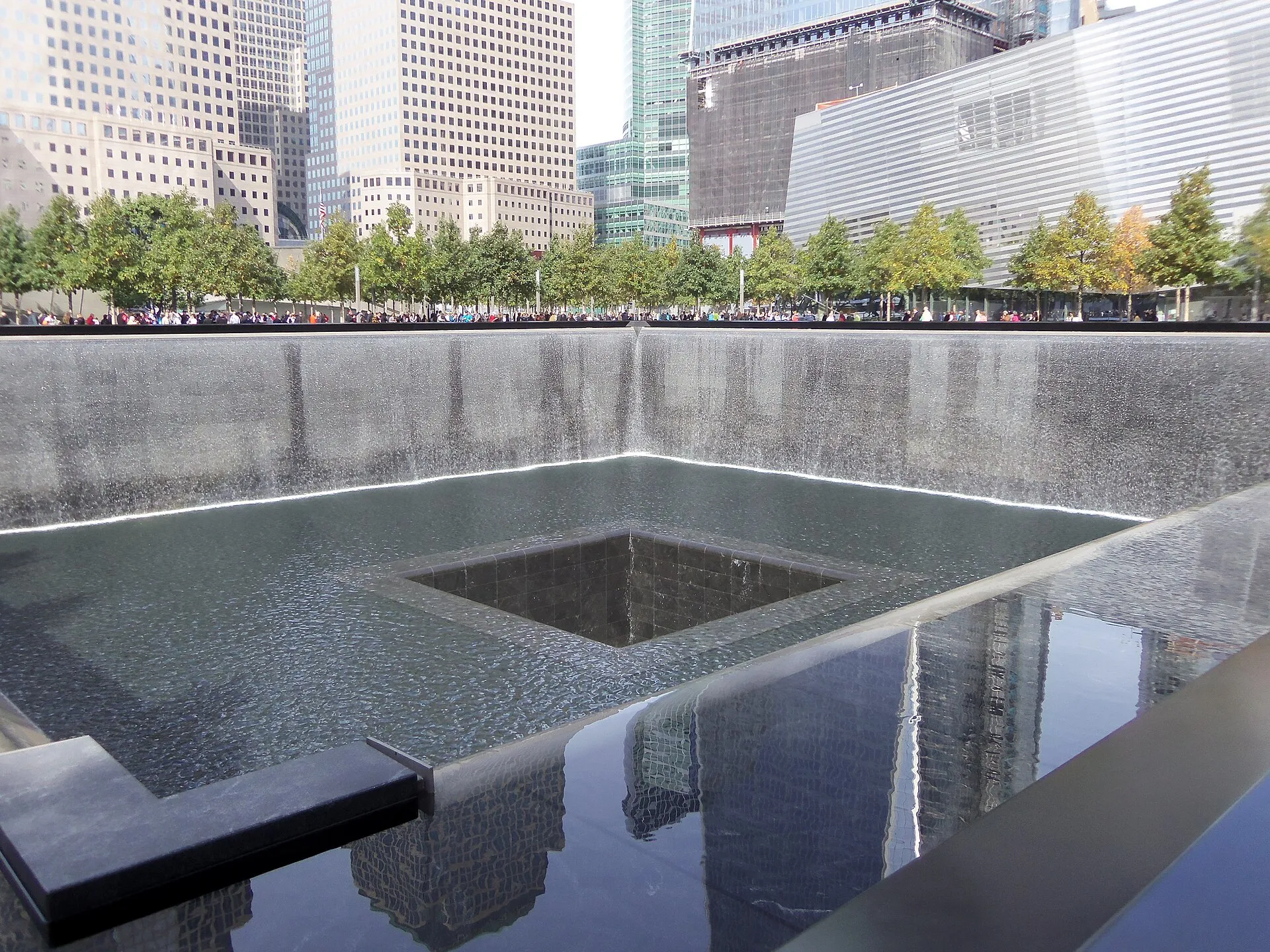
Michael Arad and Peter Walker's winning design, titled Reflecting Absence, was chosen from more than 5,200 entries in a 2003 international competition. Its central gesture is subtraction: two square voids, each roughly 176 feet across, sit precisely within the footprints of the fallen North and South Towers. Water sheets down all four walls of each pool in the largest man-made waterfalls in North America, dropping thirty feet before vanishing into a smaller central square whose bottom is never visible from the plaza. The names of every victim are cut clean through the bronze parapets ringing the pools, so daylight passes through the letters and staff can illuminate individual names on their birthdays. Around the pools, a plaza planted with more than 400 swamp white oaks — chosen to turn a russet gold each autumn — softens the hard geometry, with the lone Callery pear known as the Survivor Tree marking the northeast corner. The above-ground museum pavilion, designed by the Norwegian firm Snøhetta, is an angular glass atrium framing two of the original steel tridents from the towers' facade; from there the exhibitions designed by Davis Brody Bond descend seventy feet to bedrock, where Foundation Hall preserves the exposed slurry wall that held back the Hudson River and the Last Column, a 36-foot beam covered in tributes and ceremonially removed in May 2002. Santiago Calatrava's soaring white Oculus transit hub stands directly to the east, completing an architectural narrative that moves from absence to renewal alongside the One World Observatory overhead.
When to Visit
The outdoor memorial plaza is open daily 9:00 AM–8:00 PM with free admission — no reservation required. The museum operates Wednesday–Monday, 9:00 AM–7:00 PM (last entry 5:30 PM); it closes on Tuesdays except during peak holiday weeks. The quietest hours are weekday mornings from 9:00 to 11:00 AM, before school groups and tour buses arrive in force. Free Tuesday evenings (5:00 PM to closing) release a limited number of timed-entry tickets that disappear within minutes of the online booking window opening. The anniversary week around September 11 draws significantly larger crowds and special ceremonies — the plaza hosts the annual name-reading ceremony and is often restricted to victims' families for part of the day, so plan extra time and book museum entry well in advance. Allow a minimum of two hours for the museum alone; budget three to four hours if you plan to spend reflective time at both pools.
Admission and Costs
Memorial plaza: Free to visit, no reservation needed. Museum adult admission: $26. Seniors (65+) and veterans: $20. Youth (7-17): $15. Children 6 and under: Free. Guided museum tour (private): $250-400 for groups of up to 6, typically 2 hours with a licensed NYC guide. Walking tour including the memorial plaza plus Lower Manhattan: $35-55 per person for 2.5-3 hours. Bundling the museum with the adjacent One World Observatory on a combined ticket usually saves roughly $10 over buying each separately.
Tips for Visitors
Treat the plaza as a place of mourning. There is no formal dress code, but visitors keep their voices low and avoid smiling selfies at the pool parapets — running your fingers over the inscribed names is welcomed, climbing or sitting on them is not. Expect airport-style security at the museum entrance, where bags are screened and oversized luggage is not permitted, so travel light on your visit day. Keep tissues handy: even visitors with no personal connection to the events are often moved to tears, and the museum stocks tissue stations throughout the exhibitions for that reason. For food, Brookfield Place is a five-minute walk west with an upscale food hall and Hudson River views, while Eataly Downtown sits a block north inside 4 World Trade Center. Getting here is easy: take the E train to its World Trade Center terminus, or the 1, R, or W to Cortlandt Street, all within a two-minute walk. Build the memorial into a full Lower Manhattan day — the Brooklyn Bridge walkway is a fifteen-minute stroll east along Fulton Street, and the Statue of Liberty ferries leave from Battery Park about fifteen minutes south — using the itinerary ideas in our NYC first-timers guide.
Frequently Asked Questions
Is there a best season to visit the 9/11 Memorial and Museum?
April through June and September through October provide the most pleasant weather for spending time at the outdoor reflecting pools, with spring blooms and fall colors adding natural beauty to the solemn plaza. The museum is climate-controlled and deeply moving in any season. The anniversary week around September 11th draws large crowds and special ceremonies that add emotional weight but require extra planning.
What is the most atmospheric time to visit the National September 11 Memorial pools?
Reflecting pools at dusk: As daylight fades the illuminated waterfalls create a profoundly moving atmosphere unlike any other time of day.
How much is the entrance fee for National September 11 Memorial & Museum?
Memorial plaza: Free to visit, no reservation needed. Museum adult admission: $26. Seniors (65+) and veterans: $20. Youth (7-17): $15. Children 6 and under: Free.
What practical tips should visitors know before visiting the 9/11 Memorial & Museum?
Dress respectfully and allow at least two hours for the museum. The collection is emotionally absorbing, so pace yourself and take breaks in the plaza above whenever you need to.