
Taj Mahal timeline
-
Death of Mumtaz Mahal
Shah Jahan's favourite wife died at Burhanpur giving birth to their fourteenth child; the emperor resolved to build her an unrivalled tomb.
-
Construction begins
Work started on a riverside plot beside the Yamuna in Agra, with the mausoleum platform and foundations laid first.
-
Mausoleum completed
The central marble tomb and dome were essentially finished after about eleven years; the surrounding complex took roughly a decade more.
-
Whole complex finished
Gateway, mosque, guest house, and Charbagh gardens were done after some twenty-two years and the labour of about 20,000 artisans.
-
Shah Jahan deposed
Aurangzeb seized the throne and confined his father in the nearby Agra Fort, from which the emperor could still see the Taj across the river.
-
Shah Jahan buried beside Mumtaz
His cenotaph was placed next to hers off the central axis — the only asymmetry in an otherwise perfectly mirrored building.
-
Damage during the Rebellion
British soldiers prised semi-precious stones from the walls in the aftermath of the 1857 uprising, before later restoration reversed much of the loss.
-
Curzon-era restoration
Viceroy Lord Curzon oversaw a major repair of the gardens and inlay and gifted the great hanging lamp in the chamber.
-
UNESCO World Heritage listing
UNESCO inscribed the Taj Mahal as "the jewel of Muslim art in India" and a universally admired masterpiece.
Architecture
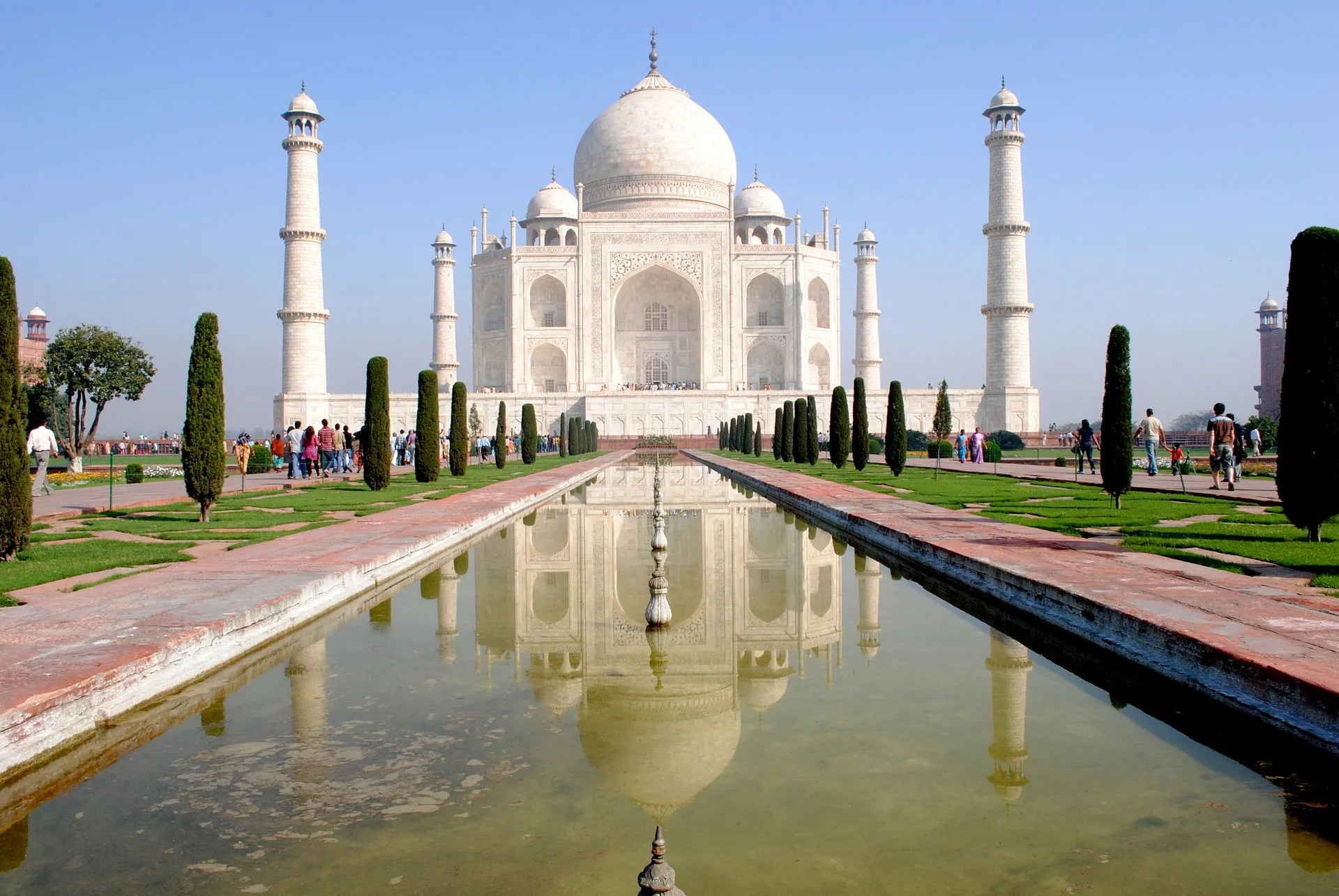
The Taj is a study in geometry and illusion, and reading its plan is half the pleasure. The whole ensemble is laid out on a strict grid: a monumental Great Gate (Darwaza-i-Rauza), a 300-metre square Charbagh garden quartered by raised walkways and a central reflecting canal, and — unusually — the tomb placed not at the centre but at the northern end, on a 7-metre marble plinth above the Yamuna, so the river becomes its backdrop. The mausoleum is flanked by two identical red-sandstone buildings: a working mosque to the west and a mirror-image jawab ("answer") to the east, built purely for balance.
- Dome and dimensions: The bulbous central dome rises about 35 metres, and the finial pushes the total height to roughly 73 metres (240 ft) — taller than it looks because it stands above the plinth. Four free-standing minarets, each about 40 metres, frame the tomb.
- The intentional lean: Those minarets tilt imperceptibly outward — an earthquake-proof design so they would fall away from the dome rather than onto it.
- The stone road: The white Makrana marble was hauled ~400 km from Rajasthan; the 28 varieties of inlaid stone — lapis lazuli from Afghanistan, jade from China, turquoise from Tibet, carnelian from Arabia — travelled trade routes spanning half the known world.
- Calligraphy that "corrects" perspective: The black-marble Quranic script framing the entrance arch is scaled progressively larger as it ascends, so every letter appears uniform from ground level; the calligrapher Amanat Khan is one of the very few artisans permitted to sign the building.
The marble itself performs: pinkish at dawn, brilliant white at noon, golden at sunset, and a translucent blue under moonlight — deliberate effects credited to the master builders, chief among them Ustad Ahmad Lahauri, whose names a guide can recite.
Historical Significance
The Taj is the head shrine of Mughal funerary architecture and the emotional climax of the dynasty's building program that began with Akbar at Fatehpur Sikri and the Agra Fort. Its pietra dura — 28 types of gemstone set into marble in floral patterns — was refined by artisans drawn from as far as Samarkand and Baghdad, and complete Quranic surahs run along the arched portals. Every element mirrors exactly across the central axis, with one telling exception: Shah Jahan's cenotaph, added beside his wife's after his death, breaks the symmetry his architects had so carefully maintained — the building's only flaw, and its most human detail.
The monument's later history is nearly as dramatic as its making. After Aurangzeb deposed his father in 1658, Shah Jahan spent his final years confined in the Musamman Burj, the octagonal marble tower of Agra Fort, where he could see the Taj across the river until his death in 1666. During the upheaval of 1857 soldiers prised gemstones from the walls; the gardens and inlay were later restored under Viceroy Lord Curzon around 1908, who also hung the great brass lamp in the central chamber. Today, as a UNESCO World Heritage Site, the Taj draws millions of visitors a year and remains, for most, the single image that defines India.
When to Visit
Open Saturday–Thursday, 6:00 AM – 6:30 PM, and closed every Friday for congregational prayers at the on-site mosque. Night visits run on the full-moon night and the two nights either side (8:30 PM – 12:30 AM), capped at 400 visitors in eight batches of 50 and booked a day ahead through the Archaeological Survey of India. The single best slot is sunrise (6:00–7:00 AM): crowds are thinnest, the light is soft, and you catch the famous pink-to-white color shift as the sun clears the horizon. Allow 2–3 hours to move unhurried from the Great Gate through the gardens to the plinth. Avoid weekends, Indian public holidays, and the midday summer glare, when both the crowds and the heat off the marble peak.
Admission and Costs
Foreigners: ₹1,100 ($13.20), which bundles a bottle of water and disposable shoe covers; a separate ₹200 surcharge is charged to step up onto the main mausoleum platform. Indian nationals: ₹50 (plus the same ₹200 for the platform). Children under 15 enter free. Night viewing costs ₹750 for foreigners and ₹510 for Indians, with advance booking required. An ASI-approved guide runs ₹1,000–1,500 for a two-hour tour — the single best value add for decoding what you are seeing. Buy tickets online through the official ticketing portal to skip the counter queue, and keep the QR code on your phone. A combined ticket bought the same day for Agra Fort trims the cost of visiting both.
The Case for a Guide
The Taj Mahal is the world's most photographed building, yet the overwhelming majority of visitors leave without understanding a single one of the deliberate optical illusions, theological messages, and engineering decisions that Mughal architects embedded into every surface.
- 28 semi-precious stone types by origin: A guide identifies each inlaid stone — lapis lazuli from Afghanistan, jade from China, turquoise from Tibet, carnelian from Arabia — and explains the trade network that brought them to Agra, making the floral patterns readable as a map of Mughal imperial reach.
- The intentionally leaning minarets: The four minarets lean imperceptibly outward — an earthquake engineering feature ensuring they would fall away from the dome rather than onto it. Self-guided visitors stand next to this without knowing it exists.
- Calligraphy scaling optical illusion: The Quranic inscriptions on the entrance arch are scaled progressively larger as they ascend so that every letter appears the same size when read from ground level — a guide points this out and demonstrates the effect.
- Moonlight visit access: Full-moon night visits (limited to 400 people) require advance booking through the ASI; guides explain the access logistics and what the translucent blue marble glow actually looks like at 10 PM versus midday.
- Shah Jahan's imprisonment story: After his son Aurangzeb seized power in 1658, Shah Jahan spent his final eight years imprisoned in Agra Fort with a window view of the Taj — guides connect this to the Musamman Burj tower you can visit across the river, transforming the monument from a love story into a tragedy.
Tips for Visitors
Enter from the East Gate: queues are usually shorter than the West Gate, and you approach through gardens for the classic reveal. Only small bags are allowed; free lockers sit at the gates, and food, tripods, and most electronics are restricted. Shoe covers are included with the foreigner ticket, or you can go barefoot on the marble platform. Petrol and diesel vehicles are banned within 500 metres, so cover the last stretch by electric golf cart, battery e-rickshaw, or on foot from the ticket plaza.
For the best photographs, aim for these spots:
- The central marble bench on the main axis (the "Diana bench") — the postcard shot with the tomb reflected in the canal, best just after gates open.
- Under the Great Gate arch, which frames the Taj like a picture and hides the crowds beyond.
- The mosque side (west), where the red sandstone foreground makes the white marble pop in late-afternoon light.
- Mehtab Bagh across the Yamuna — cross the river for a free sunset view of the Taj reflected in the water, without entering the complex or paying admission.
Book night visits early: only 400 spots per night, arranged through the ASI or your hotel. And visit the Agra Fort after the Taj — its Musamman Burj tower, where Shah Jahan gazed at the monument he built, gives the whole story its heartbreaking coda (see the costs section for the same-day combined ticket).
Frequently Asked Questions
Which season offers the best experience at the Taj Mahal?
February is arguably the single best month, with cool mornings perfect for the iconic sunrise visit and clear skies that show the marble at its most luminous white. October through December and January are also excellent, with pleasant temperatures and the chance to see the Taj under a full moon. Summer months from May through August bring extreme heat, heavy monsoon rains, and hazy skies that obscure the marble's famous color-shifting properties.
When can visitors tour Taj Mahal?
Open: Saturday–Thursday, 6:00 AM – 6:30 PM. Closed: Every Friday (mosque prayers). Night visits: Available on full moon nights and two days either side (8:30 PM – 12:30 AM, limited to 400 visitors).
How much is the entrance fee for Taj Mahal?
Foreigners: ₹1,100 ($13.20) — includes water and shoe covers. Indian nationals: ₹50. Children under 15: Free. Night viewing: ₹750 foreigners, ₹510 Indians (advance booking required). ASI-approved guide: ₹1,000–1,500 for a 2-hour tour
What should visitors know before visiting Taj Mahal?
Enter from the East Gate: Shorter queues than the West Gate, and you approach through gardens for the classic reveal. Bag restrictions: Only small bags allowed. Lockers available at gates (free). Electronics, food, and tripods are restricted.
How do you get to the Taj Mahal, and how close can vehicles go?
Petrol and diesel vehicles are banned within 500 metres of the monument to protect the marble from pollution, so you finish the approach on foot, by battery e-rickshaw, by electric golf cart, or by cycle rickshaw from the ticket plazas. Most visitors reach Agra by the Gatimaan or Shatabdi Express from Delhi (under two hours), then take an auto-rickshaw or hotel car to the East Gate, roughly 6 km from Agra Cantonment station.
Is the Taj Mahal accessible for wheelchair users and visitors with limited mobility?
Yes, largely. Wheelchairs are available free at the gates, and a ramp leads up onto the main marble plinth so the mausoleum's exterior and the classic garden views are reachable without stairs. The narrow, dim central chamber and the crypt-level cenotaphs are harder to access, and shoe covers (or bare feet) are still required on the platform. Battery vehicles bridge the 500-metre car-free zone for those who cannot walk it.