
Architecture
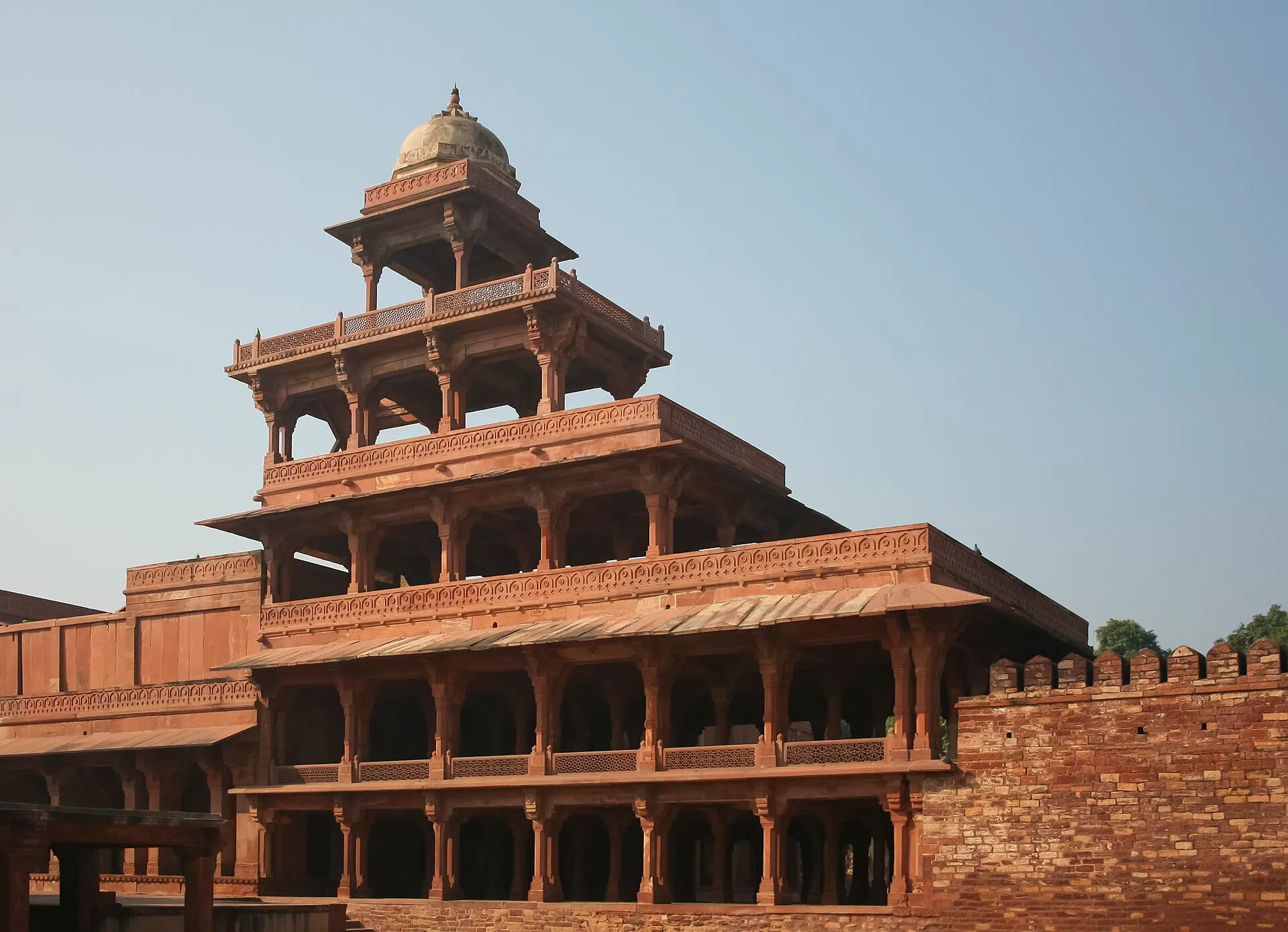
Fatehpur Sikri is built almost entirely from locally quarried red sandstone, cut and assembled with trabeate (post-and-beam) joinery rather than mortar, a technique borrowed from Hindu and Jain temple construction. The result is a distinctive Mughal architecture that fuses Islamic form with indigenous Indian craftsmanship. The Buland Darwaza, a 54-meter Victory Gate, remains one of the tallest gateways in the world, its scale amplified by a soaring half-dome and inlaid marble calligraphy. The five-tiered Panch Mahal rises like an open pavilion on 176 carved columns, each in a different style drawn from Hindu and Jain temples, with no two identical. The Diwan-i-Khas centers on a single ornately bracketed central pillar that supports a circular throne platform linked by four diagonal walkways. The Diwan-i-Am, Jodha Bai's Palace, and the Anup Talao pool showcase intricate jali screens, chhatri kiosks, and deep-cut relief carving. A guide points out how Akbar's masons blended Hindu brackets, Islamic arches, and Buddhist chhatris into a single coherent language, and how the warm red stone -- offset by the white marble of Salim Chishti's tomb -- gives the whole complex its unmistakable glow at sunrise and sunset.
Historical Significance
In 1571, Mughal Emperor Akbar began building an entirely new imperial capital on a rocky ridge 37 kilometers from Agra. The site was chosen to honor the Sufi saint Salim Chishti, who had correctly predicted the birth of Akbar's long-awaited heir, the future Emperor Jahangir. Over roughly 15 years Akbar raised palaces, audience halls, a mint, a bazaar, and the great Jama Masjid, making Fatehpur Sikri the political and cultural heart of the empire. It was here that Akbar convened the Ibadat Khana debates among Hindu, Muslim, Jain, Christian, and Zoroastrian thinkers and formulated his doctrine of sulh-i-kul ("universal peace"), a landmark expression of religious tolerance. Around 1585 the court abruptly departed -- likely because the ridge could not supply enough water -- and the city was largely abandoned within a generation, leaving it frozen as Akbar built it. Today the complex is a UNESCO World Heritage Site and one of the best-preserved examples of sixteenth-century Mughal urban planning. A guide explains how each building reflected Akbar's statecraft, from the single-pillar throne symbolizing the emperor at the center of four debating faiths to the layout that separated public governance from private royal life.
When to Visit
Palace complex: daily, 6:00 AM - 6:00 PM. Jama Masjid: open during prayer times and to visitors throughout the day. Best time: early morning for cooler temperatures and fewer tour groups. Avoid midday in summer -- the exposed stone complex offers minimal shade.
Admission and Costs
Foreigners: ₹600 ($7.20) for the palace complex. Indian nationals: ₹40. Jama Masjid: free. ASI guide: ₹500-1,000. Getting there from Agra: ₹500-800 by auto-rickshaw, ₹1,500-2,000 by taxi (round trip).
Tips for Visitors
Combine with Agra: Make Fatehpur Sikri a half-day trip from Agra, either before or after visiting the Taj Mahal and Agra Fort. Wear sun protection: The complex is largely open with little shade. Carry water, sunscreen, and a hat. Persistent touts: Unofficial guides aggressively offer services at the entrance. Arrange a proper ASI guide in advance or through your hotel. Shoes required off: Remove shoes at the Tomb of Salim Chishti. The marble floor is hot in summer and cold in winter. Allow 2-3 hours: The complex is large and rewards slow exploration, especially with a guide who can explain each building's function.
Frequently Asked Questions
When is the best season to tour Fatehpur Sikri?
October through March provides the most comfortable conditions for exploring this largely open and shadeless sandstone complex. November and December are particularly rewarding, with crisp mornings, golden afternoon light on the red stone, and the fewest tour groups. Avoid May through September when temperatures soar above 40 degrees C and monsoon rains make the exposed site difficult to enjoy.
What are the opening hours for Fatehpur Sikri?
Palace complex: Daily, 6:00 AM – 6:00 PM. Jama Masjid: Open during prayer times and to visitors throughout the day. Best time: Early morning for cooler temperatures and fewer tour groups.
What is the entrance fee for Fatehpur Sikri?
Foreigners: ₹600 ($7.20) for the palace complex. Indian nationals: ₹40. Jama Masjid: Free. ASI guide: ₹500–1,000. Getting there from Agra: ₹500–800 by auto-rickshaw, ₹1,500–2,000 by taxi (round trip)
What should visitors know before exploring Fatehpur Sikri?
Combine with Agra: Make Fatehpur Sikri a half-day trip from Agra, either before or after visiting the Taj Mahal. Wear sun protection: The complex is largely open with little shade. Carry water, sunscreen, and a hat.