
Palace of Fine Arts timeline
-
Built for the Panama-Pacific Exposition
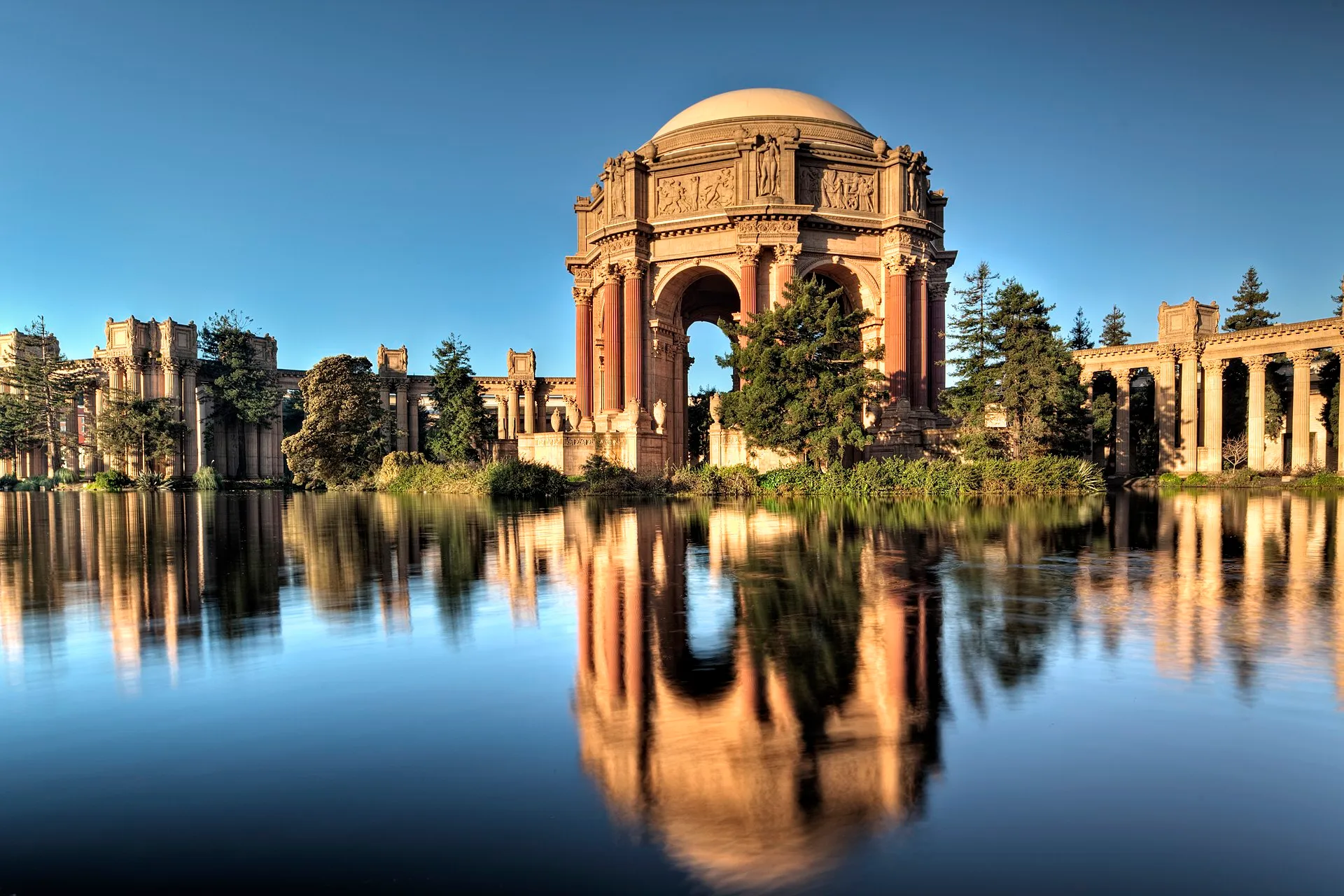
Bernard Maybeck raised the rotunda and curved colonnade in staff -- plaster over burlap and a wooden frame -- as the fair's fine-arts gallery, deliberately styled as a beautiful Roman ruin.
-
Spared the wrecking crews
Every other Exposition palace was torn down once the fair closed, but public affection kept Maybeck's structure standing on its original site while it found new uses -- from a motor-pool depot to indoor tennis courts.
- 1964-1974
Rebuilt in reinforced concrete
With the staff crumbling beyond repair, the original was demolished and recast ornament-by-ornament in poured concrete, a decade-long effort seeded by a $2 million gift from philanthropist Walter S. Johnson.
- 1969-2013
Home of the Exploratorium
Frank Oppenheimer opened his hands-on science museum in the domed exhibition hall behind the rotunda, where it drew visitors for 44 years before relocating to Pier 15 on the Embarcadero.
-
Listed on the National Register
The Palace was added to the National Register of Historic Places as the sole survivor of the 1915 Exposition still on its original ground.
-
Seismic retrofit and lagoon restoration
A Maybeck Foundation campaign strengthened the colonnade and rotunda against earthquakes and re-lined the leaking lagoon, securing Maybeck's vision for another generation.
Architecture
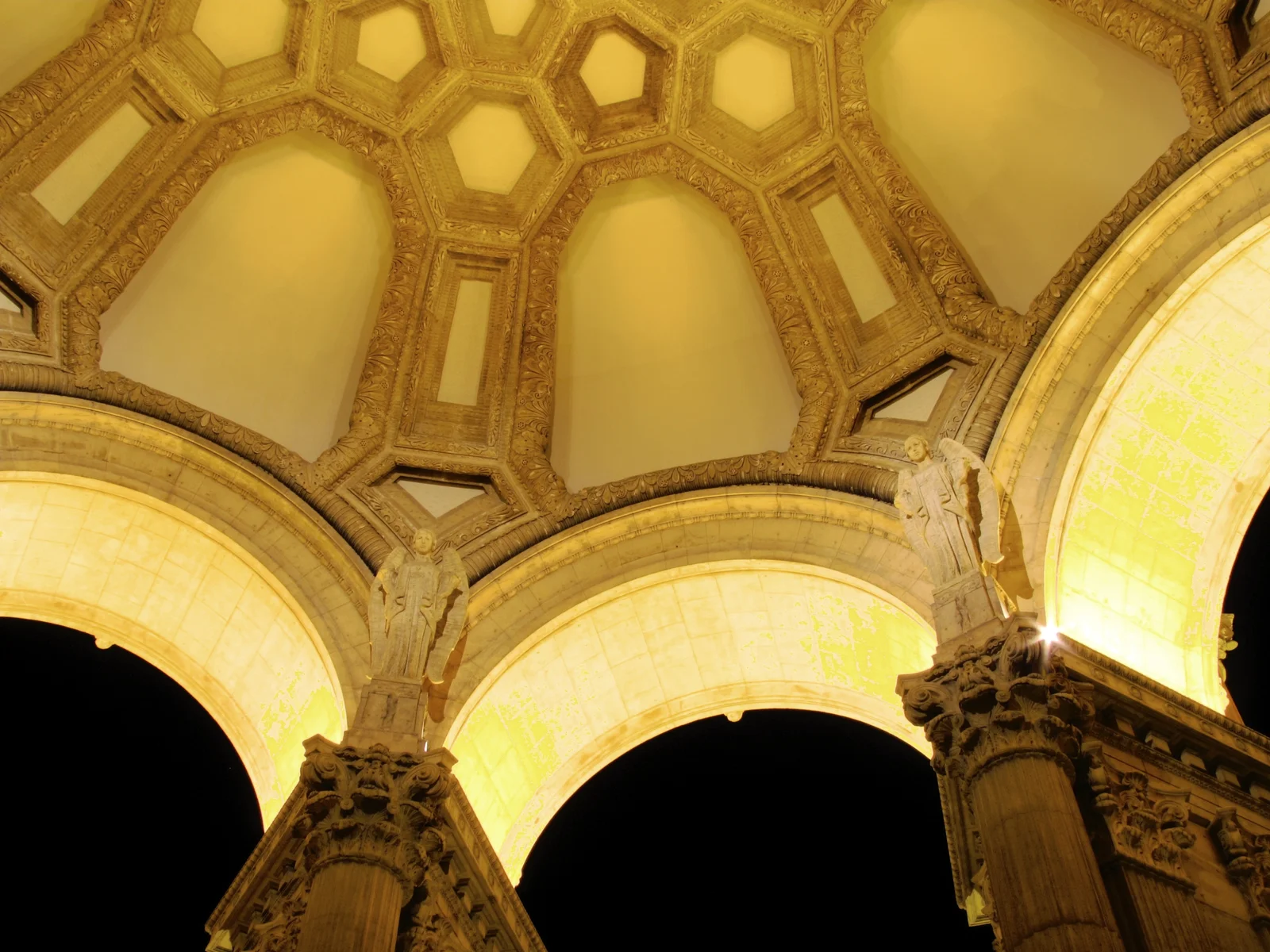
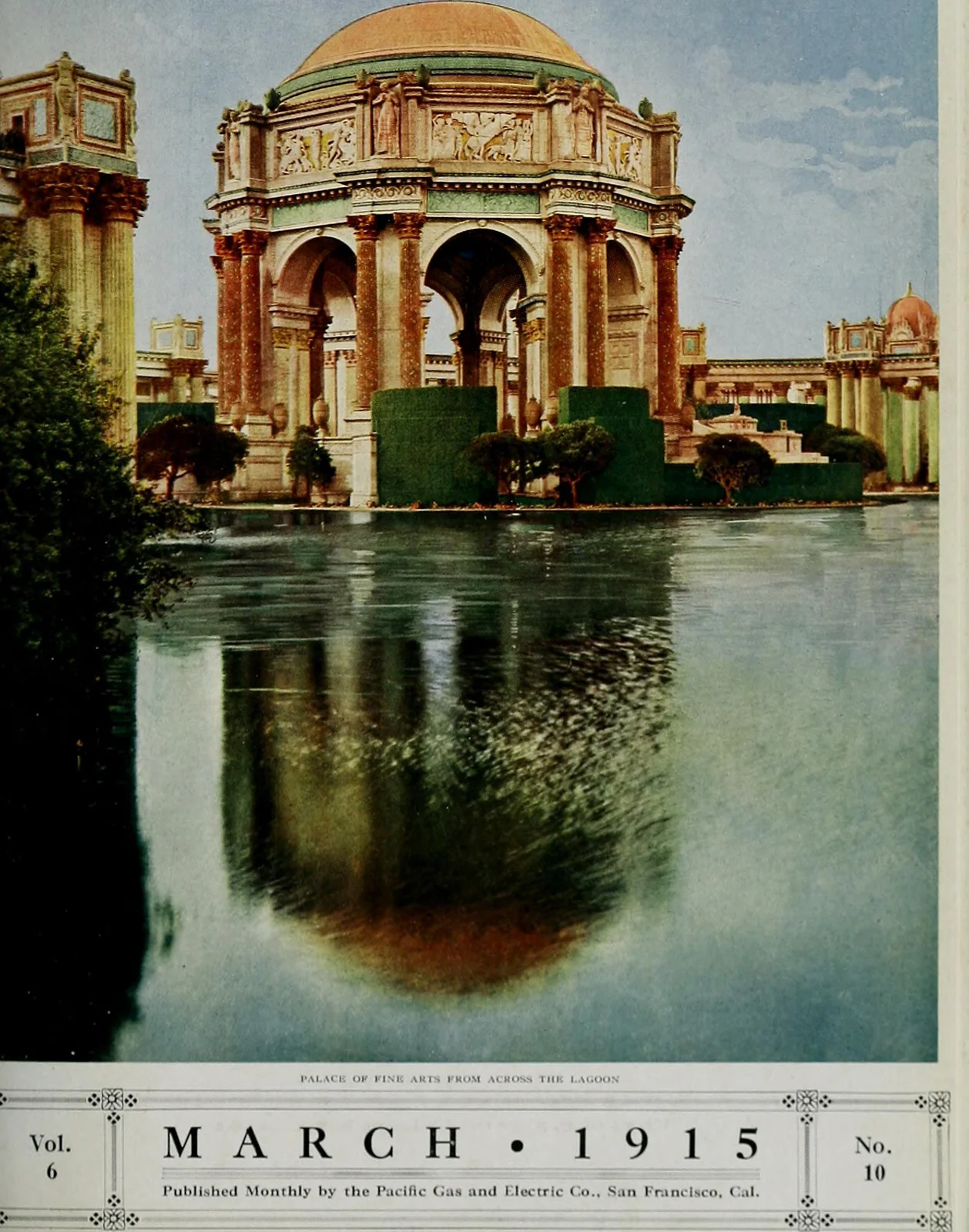
The rotunda rises 162 feet above the lagoon, its coffered dome open to the sky in a deliberate evocation of Roman grandeur. For the fair the muralist Robert Reid painted a series of allegorical panels for the rotunda ceiling on the theme of the birth and flowering of art, but they were perishable like everything else Maybeck built here and were never recreated in the 1964-1974 concrete rebuild -- which is why the coffered dome you stand beneath today is bare rather than painted, the absent murals quietly reinforcing the ruin Maybeck was reaching for. The curving lagoon in front of it is no accident of landscaping: Maybeck set the water there as a mirror, doubling the rotunda's apparent height and softening its mass so the structure reads as a half-remembered ruin glimpsed across a reflecting pool. Maybeck's colonnade curves outward from the rotunda in a semicircular sweep, each column topped with weeping figures and urns that reinforce the theme of noble decay. Maybeck carried that idea to its logical end: he imagined the grounds thickly planted with cypress and the building itself left to weather, so visitors would come upon the rotunda through the trees like a genuine relic and its slow crumbling would only sharpen the melancholy -- the public's refusal to let it fall is the gentle irony beneath every later rescue campaign. The original 1915 structure was built of staff (a mixture of plaster and burlap over a wooden frame), never intended to survive beyond the Exposition. When reconstruction began in 1964, engineers faced the challenge of replicating Maybeck's ornamental details in cast concrete -- a process that took a decade. Rather than copy from photographs alone, crews took molds directly from the decaying original ornament before it was demolished, so the friezes, urns and weeping figures could be recast faithfully. Guides point out subtle differences between the original design and the reconstruction, and explain how Maybeck's Beaux-Arts training at the Ecole des Beaux-Arts in Paris shaped his unique approach to blending classical forms with romantic atmosphere.
Historical Significance
The 1915 Panama-Pacific International Exposition transformed San Francisco from a city defined by catastrophe into one celebrating rebirth. Staged ostensibly to mark the 1914 opening of the Panama Canal -- a shortcut that put West Coast ports days closer to the Atlantic -- the fair was equally a chance for San Francisco to show the world it had rebuilt. It ran from February 20 to December 4, 1915, and just nine years after the 1906 earthquake and fire destroyed 80% of the city, this world's fair drew 19 million visitors and proved the city had risen from the ashes. Its glittering centrepiece was the 435-foot Tower of Jewels, hung with more than 100,000 cut-glass "Novagems" imported from Austria that swayed in the bay breeze and scattered the beams of the fair's nightly searchlights into colour -- a spectacle that, like nearly everything around it, was dismantled once the gates closed. Every other Exposition building was demolished afterward, but civic attachment saved Maybeck's Palace, which makes its lone survival across the old fairgrounds all the more striking. Its survival through decades of gentle decay, a spirited public campaign, and eventual reconstruction mirrors the city's own story of resilience. That story is written into the ground itself: the fair rose on roughly 635 acres of bayfront that engineers reclaimed with fill, and the residential Marina District later grew over the same made land -- soil that liquefied and buckled so severely in the 1989 Loma Prieta earthquake that a 2009 Maybeck Foundation campaign seismically retrofit the colonnade and rotunda to brace them for the next one. The surrounding Presidio, a former military post turned national park, adds another layer of San Francisco history accessible on foot from the Palace grounds.
A second, quieter layer of national history clings to the Palace from its Exploratorium decades. The museum's founder, physicist Frank Oppenheimer, was the younger brother of J. Robert Oppenheimer, scientific director of the Manhattan Project, and had himself worked on the wartime bomb effort before he was forced out of academic physics during the 1950s McCarthy-era Red Scare and spent years ranching in Colorado. When he returned to teaching he poured that hard experience into a radically open, hands-on museum, and in 1969 he installed it in the empty exhibition hall behind Maybeck's rotunda. For 44 years the same domed shell that began as a monument to fine art housed one of the country's most imitated experiments in science education, until the museum outgrew the space and moved to Pier 15 in 2013 -- so the Palace connects San Francisco's 1915 rebirth to a distinctly Cold War chapter of American science.
Palace of Fine Arts in Pictures
When to Visit
The grounds never close. The lagoon, colonnade, and open-air rotunda are free public parkland around the clock, 7 days a week, so you can arrive at dawn for mist rising off the water or after dark when the dome is softly lit. The only indoor space -- the exhibition hall behind the rotunda, now the Palace of Fine Arts Theatre -- keeps limited hours of roughly Tuesday-Sunday, 10:00 AM - 5:00 PM, and opens mainly for scheduled performances and private events rather than casual drop-ins. For photographers, the reflection is sharpest in the still air of early morning and warmest in the golden hour before sunset, and weekday mornings are the least crowded time year-round. Season matters more than most visitors expect, because the Marina sits squarely in the path of the fog that pours through the Golden Gate on summer afternoons: from June through August the rotunda often spends the day under a flat grey ceiling that flattens the dome's silhouette and dulls the lagoon's mirror. San Francisco's microclimate flips in early autumn, when the fog retreats and September and October bring the city's warmest, clearest skies -- the two months when the water most reliably doubles a crisp blue backdrop, and the reason those months top this page's visit ratings; our San Francisco trip planner walks through how that fog-free autumn window lines up with the rest of the city, from an Alcatraz crossing to a fog-timed Golden Gate Bridge walk. Winter days are quiet and often bright between Pacific storm fronts, though the low sun sets early and leaves the paths puddled after rain, while spring is a dependable middle ground with thinner crowds than the summer tourist peak. Even on a foggy day the visit rarely disappoints: overcast skies give the plaster a moody, romantic cast that suits Maybeck's ruin, and because the grounds never close you can simply return on a clearer morning at no cost.
After sunset the rotunda and colonnade are floodlit from below, and because there is no gate the Palace becomes one of the few major San Francisco landmarks you can photograph at night for free. The crowds and wedding parties are long gone by then, so the lagoon usually lies glass-still -- ideal for long-exposure shots that double the lit dome in the water. The Marina around the grounds is a residential, well-lit neighbourhood, and the free Lyon Street lot empties out in the evening, making a late visit far easier for parking than a weekend morning. An evening here feels safe within the ordinary caution any city park asks for after dark -- the floodlit walkways stay bright and a steady trickle of joggers, dog-walkers, and photographers keeps the place from ever feeling deserted -- so stick to the paved lit loop rather than the dark lawns and unlit lagoon edges, and leave nothing visible in your parked car, since the Lyon Street lot, like every San Francisco lot, sees the occasional smash-and-grab. Bring a jacket and, ideally, a tripod: the bay air turns cold once the sun drops, and the low light rewards a steady camera.
Admission and Costs
Admission to the grounds, rotunda, and lagoon is completely free, with no tickets or reservations required -- the reason locals treat the Palace as an everyday park rather than a monument. You pay only when you step indoors for a ticketed show at the Palace of Fine Arts Theatre, where prices vary by performance, or when you book a guide: a group Marina and Presidio walking tour that includes the Palace runs about $30-50 per person, while a private 2-hour architectural tour of the district costs roughly $150-250. Parking in the adjacent Lyon Street lot is free as well, with the accessible spaces grouped near the theater entrance, though it is a modest lot that fills on weekend mornings when the wedding parties arrive. It turns over quickly, so timing beats luck: a weekday visit or a weekend arrival before about 9 AM usually finds a space, while a weekend late-morning arrival often means circling. Note that this free lot is the exception: the residential Marina streets around it fall under the city's neighbourhood permit-parking (RPP) zones, which cap non-resident stays at two hours on weekdays, so if the lot is full you either move quickly, feed a nearby meter, or skip the car entirely and arrive on the MUNI 30 Stockton bus or by bike along the flat, car-free Bay Trail. There is no walk-up box office for casual visitors either -- because the only paid attraction is a show at the Theatre, tickets are sold per-event through the promoter online rather than at a booth on the grounds, so there is nothing to queue for and nothing to buy unless you have a specific performance in mind.
The Case for a Guide
The grounds are free and self-guiding, so a guide's value here is interpretive rather than access: an architecture-focused Marina and Presidio walking tour turns a pretty photo stop into a lesson in Beaux-Arts symbolism, and reveals how much of what you see is a 1960s replica rather than 1915 original.
- Maybeck's weeping maidens: Sculptor Ulric Ellerhusen crowned the colonnade with figures who bow their heads into planter boxes that were meant to hold living greenery tended from behind, so the women appear to mourn the vegetation -- Maybeck's literal expression of "the mortality of grandeur." A guide points them out; most visitors never look up.
- What is real and what is concrete: Almost nothing you touch is from 1915. A guide explains how the original staff (plaster over burlap and wood) crumbled for decades until the 1964-1974 rebuild recast every ornament in reinforced concrete, and points out the few surviving original fragments.
- Why the "Fine Arts" hall holds no art: The name is a leftover from 1915, when the domed hall behind the rotunda was the Exposition's picture gallery, hung with thousands of paintings and sculptures. That collection scattered when the fair closed, the hall passed through decades of other uses, and it has been the Palace of Fine Arts Theatre since the Exploratorium science museum left for Pier 15 in 2013 -- a guide traces how a temporary art gallery ended up a concrete monument to itself.
- The Panama-Pacific Exposition footprint: The Palace is the sole survivor of a temporary fair city that stretched across today's Marina District; a guide maps where the vanished courts, towers and Joy Zone once stood on land dredged from the bay.
- The campaign that saved it: A guide tells how philanthropist Walter S. Johnson and a citizens' movement funded the reconstruction after decades of neglect, connecting the Palace to San Francisco's habit of rescuing its landmarks.
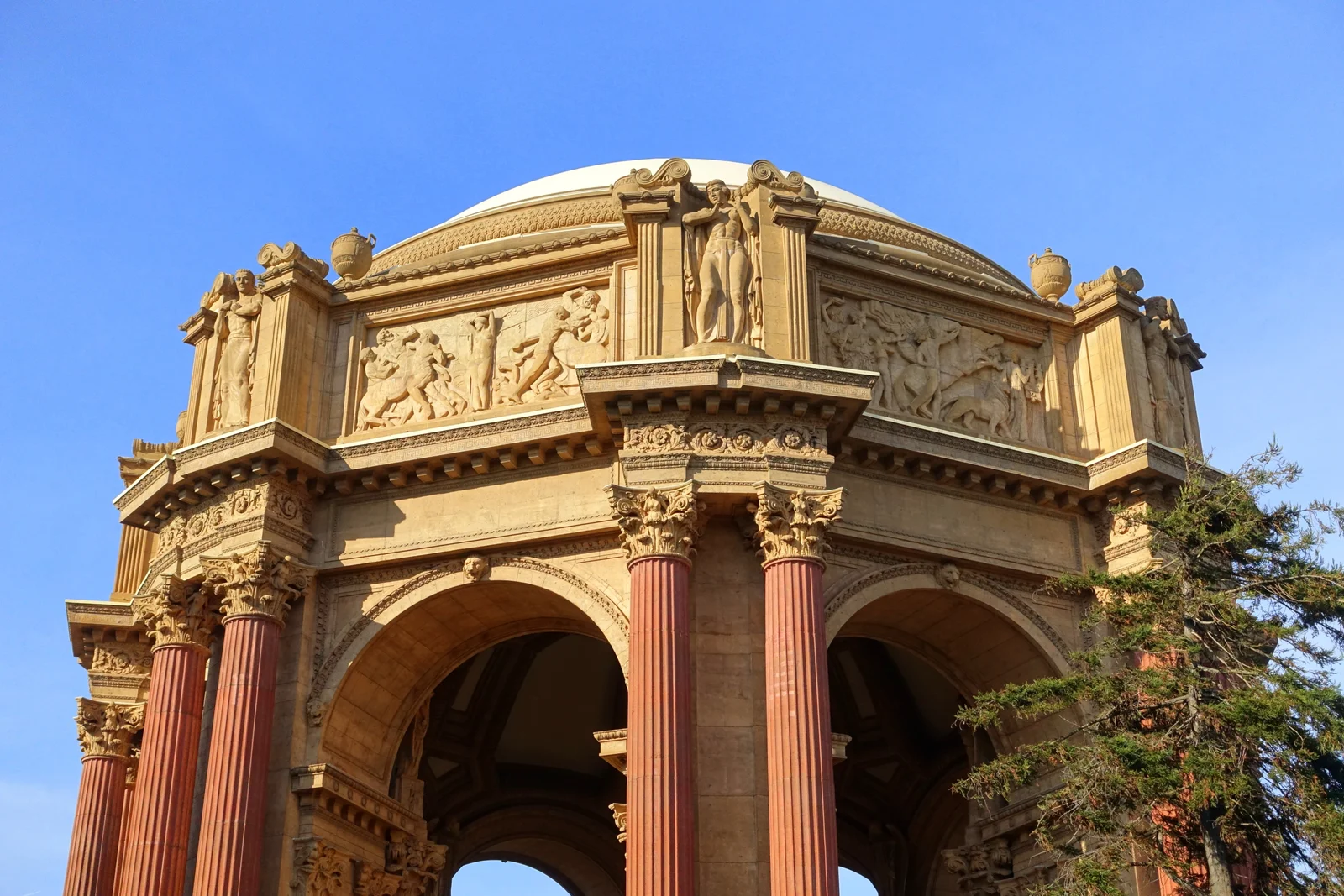
- The frieze most visitors walk beneath unaware: Wrapping the rotunda's attic, sculptor Bruno Louis Zimm modelled three panel groups he called The Struggle for the Beautiful -- classical figures acting out art's contest with the forces of materialism, the same melancholy allegory Maybeck built into the whole structure. They ride so high above the paths that from the ground they read as abstract pattern, so a guide who names the theme turns a weathered band of relief into the building's quiet argument about why beauty is worth saving.
Tips for Visitors
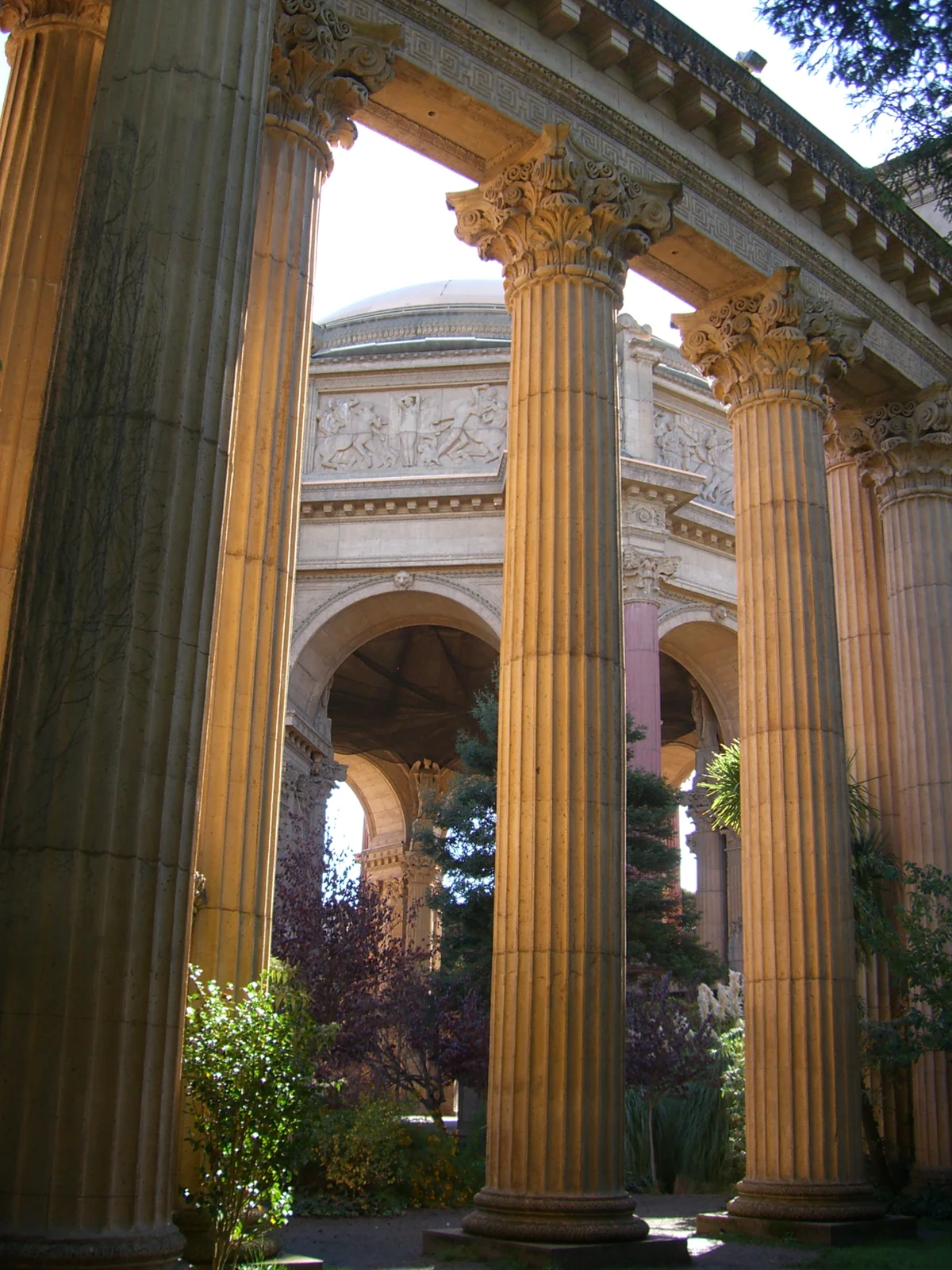
Plan for a compact visit: most people need only 30 to 45 minutes to circle the lagoon, stand beneath the open-air rotunda, and follow the full curve of the colonnade, since the grounds are small and there is no indoor museum to slow you down. Stretch it to an hour or more if you are chasing the reflection at golden hour, waiting out a wedding party for a clear frame under the dome, or lingering on the quieter western bank to watch the swans. Because the Palace is free and never closes, it rewards being treated as one leg of a longer waterfront outing rather than a standalone stop -- string it together with the walk to the Golden Gate Bridge, the harbour path to the Wave Organ, or a picnic on the Marina Green, and it anchors an easy half-day on foot. The Palace sits at 3601 Lyon Street, on the seam between the Marina District and the Presidio. Without a car, the MUNI 30 Stockton bus stops two blocks away at Broderick and Beach, the 28 and 43 lines serve the neighboring Presidio, and the free PresidiGo shuttle reaches the park as well. Photographers should aim for the eastern bank of the lagoon, where the rotunda's reflection lands best in early-morning or late-afternoon light; arriving before 9 AM on a weekday also beats the wedding and quinceañera parties that claim the colonnade on weekend mornings. Beyond that classic reflection shot, three other vantage points reward a slower visit: step in among the Corinthian columns and frame along the curving walkway so the piers recede into a tunnel of light and shadow; cross the low footbridge on the lagoon's western side, which lifts you just above the water for a centred, symmetrical rotunda-over-lagoon composition with the resident swans in the foreground; and stand at the centre of the rotunda and point the lens straight up into the open coffered dome, whose octagonal panels ring a disc of bare sky rather than a painted ceiling. A longer lens picks out the sculpted weeping maidens bowing along the colonnade attic and Bruno Louis Zimm's high-relief frieze overhead, ornament most visitors never notice from the paths below. Leave the drone at home: aerial photography over the grounds needs a San Francisco Recreation and Parks permit, and the adjacent Presidio bans drones altogether, so the reflection has to be caught from the bank rather than the air. Walk right up into the rotunda -- its interior is open and can be explored up close -- and if you have the time, follow the waterfront path west through Crissy Field to reach the Golden Gate Bridge in about a 30-minute walk. Dress in layers, because the Marina is exposed to bay winds even on sunny days. Check the Theatre's schedule before you go if you hope to catch one of its rotating exhibitions or performances, and note that the paved loop is dog-friendly and stroller-accessible, with public restrooms beside the theater entrance. If you drive, remember the free lot fills on weekend mornings -- walking from the Marina District or riding the 30 bus is often easier. For a distinctive detour, follow the harbour path about 15 minutes east to the Wave Organ, a wave-activated acoustic sculpture built in 1986 on the yacht-harbour jetty by the same Exploratorium that once occupied the Palace; its submerged pipes murmur loudest around high tide, so time a visit with the tide chart. For a very different kind of detour, walk about 10 minutes west into the Presidio to the Letterman Digital Arts Center, the Lucasfilm campus whose landscaped public courtyard is anchored by the Yoda Fountain -- a bronze Jedi Master perched above a jet of water -- a quietly popular stop that surprises visitors who wander in from the neighbouring lawns and one most Palace guides never mention. The grounds have no cafe, so pack a picnic for the lawns or drop three blocks south to the bakeries and cafes of Chestnut Street before or after your walk.
Frequently Asked Questions
When can visitors tour Palace of Fine Arts?
There is no gate and no closing time. The lagoon, colonnade, and open-air rotunda are public parkland you can wander at any hour, day or night, without a ticket. The only indoor space -- the exhibition hall behind the rotunda, now the Palace of Fine Arts Theatre -- opens only for scheduled performances and private events, roughly Tuesday to Sunday between 10 AM and 5 PM, so check the venue's calendar before counting on getting inside. For the grounds themselves, weekday mornings are the calmest window; by mid-morning on weekends the colonnade fills with wedding and quinceañera parties waiting their turn beneath the dome.
Can you go inside the Palace of Fine Arts?
You can walk right up into the open-air rotunda and follow the full curve of the colonnade at any hour -- those grand outdoor spaces are the whole point of a visit, and they are always accessible without a ticket. What you cannot casually tour is the domed hall behind the rotunda: despite the name, there is no art gallery inside today. That hall was the Exposition's picture gallery in 1915 and later housed the Exploratorium science museum until it moved to Pier 15 in 2013, but it is now the 1,000-seat Palace of Fine Arts Theatre, a private event and performance venue that unlocks its doors only for ticketed shows and booked functions. Plan your time around the architecture and the lagoon rather than expecting a museum to browse indoors.
How much is the entrance fee for Palace of Fine Arts?
Nothing to walk the grounds. Standing under the rotunda and circling the lagoon costs you nothing and needs no reservation, which is a large part of why locals treat the Palace as an everyday park rather than a ticketed monument. You pay only if you go indoors for a performance at the Palace of Fine Arts Theatre, where prices depend entirely on the event, or if you join a guided Marina and Presidio walking tour that folds the Palace into a wider route, typically $30-50 per person. The adjacent lot on Lyon Street is free too, though it fills fast on weekend mornings, and casual snapshots and hobby photography never cost a cent.
Can I hold a wedding or professional photo shoot at the Palace of Fine Arts?
Yes, but it takes paperwork rather than just turning up. Because the rotunda and lagoon are city parkland, any staged wedding ceremony, engagement session, or professional or commercial photo or video shoot needs a permit booked in advance through the San Francisco Recreation and Parks Department -- the office that manages the grounds, not the Theatre that runs the indoor hall. Each reservation is pinned to a specific date, time window, and headcount, and the fee climbs with the size of your group and whether the shoot is commercial. The domed rotunda is one of the most requested ceremony backdrops in San Francisco, so prime weekend-morning slots are claimed months ahead, and more than one couple has arrived on a quiet weekday only to find another permitted party already set up beneath the dome. Only casual, hand-held photography stays free and permit-free; the rules kick in the moment you bring staging, a large party, or a paid crew. Drones fall under the same permit regime and then some: the Recreation and Parks Department requires advance authorisation to launch, land, or fly one from the grounds, and the neighbouring Presidio is federal land where the managing Presidio Trust bans drone flights outright, so the sweeping aerial rotunda-over-lagoon shot you may be picturing is effectively off the table -- plan on a ground-level lens instead.
How do I get to the Palace of Fine Arts without a car?
From downtown, take MUNI bus 30 (Stockton) and get off at Broderick and Beach, two blocks from the grounds; the 28 and 43 lines serve the neighboring Presidio, and the free PresidiGo shuttle also reaches the park. Rideshares drop off directly on Lyon Street. There is no BART or MUNI Metro station within walking distance, so buses or rideshare are the practical transit options. Cycling is one of the easiest arrivals of all: the flat, car-free Bay Trail runs right past the grounds, linking the Palace to Crissy Field, Fort Mason, and Fisherman's Wharf on a paved waterfront path, and Bay Wheels bikeshare docks in the surrounding Marina put a one-way ride within reach even if you did not bring your own bike. If you do drive, the on-site lot off Lyon Street is free but fills quickly on weekend mornings when wedding and quinceañera parties arrive.
Is the Palace of Fine Arts the original 1915 building or a replica?
Almost nothing you touch dates from 1915. Bernard Maybeck built the original rotunda and colonnade in staff -- plaster over burlap on a wooden frame -- as a temporary structure that was never meant to outlive the Panama-Pacific International Exposition. It was so admired that San Francisco kept it standing, but the perishable material crumbled for decades until the whole thing was demolished and recast in reinforced concrete between 1964 and 1974. Crews took molds directly from the decaying original ornament before knocking it down, so the friezes, urns, and weeping figures are faithful reproductions rather than free reinterpretations. What survives from 1915 is the design, the footprint, and a handful of salvaged fragments; the structure you photograph today is a durable mid-century rebuild of Maybeck's vision, which is exactly why it is still standing when every other fair building is gone. Directors from Hitchcock's Vertigo (1958) to The Rock (1996) have used that dreamlike rotunda as a backdrop, so many visitors recognise it before they ever learn its history.
Are there swans on the Palace of Fine Arts lagoon?
Yes -- swans are the lagoon's signature residents, and because they stay put year-round rather than migrate through, you have a good chance of finding a pair on almost any visit. For the best odds, follow the paved loop around to the quieter western and northern banks, away from the rotunda steps where wedding parties and photographers cluster on the eastern reflection bank. Treat them as the wild birds they are: a nesting swan will hiss and lunge if you crowd it, so keep your distance, resist the urge to hand-feed one, and pack a zoom lens rather than edging closer for a phone shot. Keep dogs leashed on the loop, too, so a curious dog cannot send the whole flock scattering across the water. Late winter into early spring is the liveliest stretch, when you may catch fluffy grey cygnets trailing their parents in a line behind them.
Is the Palace of Fine Arts accessible for wheelchairs and strollers?
Yes. The paved paths circling the lagoon and the area beneath the rotunda are level and stroller- and wheelchair-friendly, and the grounds are dog-friendly on a leash. Accessible parking and public restrooms sit beside the theater entrance. The lawns and lagoon edges are uneven in places, so wheeled visitors should keep to the paved loop, which still passes every major photo vantage point.
Where can I eat near the Palace of Fine Arts?
The grounds themselves have no cafe or concession stand, so plan ahead: the lawns beside the lagoon are made for a picnic, and the Marina Green waterfront a few minutes north is a classic spot to eat outdoors facing the bay. For something bought on the spot, Chestnut Street -- the Marina District's main commercial strip -- runs three blocks south of the Palace and is lined with bakeries, coffee bars, and restaurants. Walk west into the Presidio instead and the Tunnel Tops park draws a rotating line-up of food trucks above Crissy Field.
What else is worth seeing near the Palace of Fine Arts?
The Palace sits on the edge of the Marina District beside the Presidio, so it pairs naturally with a waterfront half-day. Walk west along the Crissy Field shoreline, with Alcatraz and the bay off to the north, and in roughly 30 minutes you reach Fort Point directly beneath the Golden Gate Bridge. Head the other way and the path runs past the Marina Green toward Fisherman's Wharf and the barking sea lions at Pier 39. The surrounding Presidio adds forested trails and the Tunnel Tops overlook park, while the crooked switchbacks of Lombard Street are a short hop east through the neighbourhood. Push on past the wharf and you can board a cable car at the Powell-Hyde turnaround to grind up and over Russian Hill toward Chinatown and the downtown core, turning the flat waterfront stroll into a full cross-city day.