
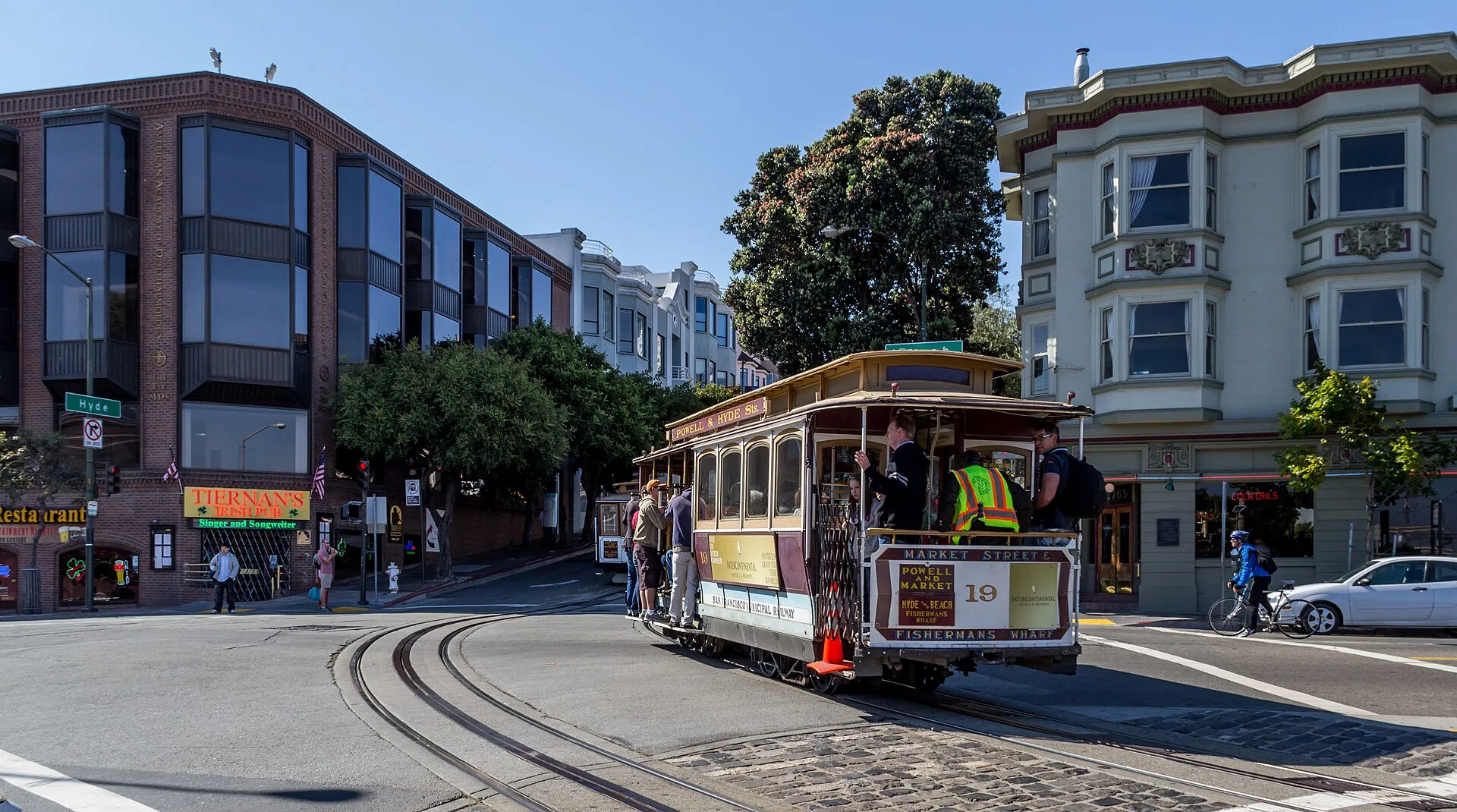
Observation Points
Powell-Hyde descent to Aquatic Park: The steepest and most dramatic downhill stretch, with bay views appearing suddenly as you crest Russian Hill. California Street line: The quieter, more elegant route crossing Nob Hill past the Fairmont and Mark Hopkins hotels with sweeping views of the Financial District.
Cable Car Museum: Free museum at Washington and Mason streets where you can see the massive winding wheels that drive all the cables underground. Powell Street turntable: Watch operators manually spin the 15,000-pound car on a wooden turntable at the Market Street terminus. Riding on the running board: Stand on the outside step and lean out while gripping the pole -- the quintessential San Francisco experience.
Engineering Facts
Andrew Hallidie launched the first cable car down Clay Street in 1873, solving the problem of horse-drawn streetcars struggling on San Francisco's steep hills. Each car weighs approximately 15,000 pounds and grips a continuously moving underground steel cable running at 9.5 miles per hour. The gripman operates a lever that latches onto and releases the cable through a slot in the street.
Three lines survive from the original 23 that once spanned 112 miles of track. The entire system is powered from the Cable Car Museum at Washington and Mason streets, where massive winding wheels drive all the cables. In 1947, a citizen campaign led by Friedel Klussmann saved the system from demolition, and a $60 million restoration in the 1980s rebuilt the infrastructure from the ground up. Riding on the running board -- standing on the outside step and leaning out while gripping the pole -- remains the quintessential San Francisco experience.
When to Visit
Daily service: Approximately 7:00 AM - 11:00 PM (varies by line and season). Frequency: Cars arrive every 5-10 minutes during peak hours. Shortest waits: Weekday mornings before 9:00 AM or after 7:00 PM. Longest waits: Weekend afternoons at Powell and Market turntable, often 45-90 minutes. Pro tip: Board at intermediate stops rather than the turntable to skip the line entirely
Admission and Costs
Single ride: $8 per person (exact change or Clipper card required; operators cannot make change). All-day Muni Passport: $24, covering unlimited cable car rides plus all Muni buses and Metro lines — good value if you plan to ride more than three times. Cable Car Museum: Free admission at Washington and Mason Streets. Guided city tour including cable car rides: $45-75 per person for a 2-3 hour walking and riding tour. Private guide: $200-350 for a customised half-day covering all three lines and key San Francisco neighbourhoods.
The Case for a Guide
That hour-long queue at the Powell Street turntable evaporates when you know the system's secrets. Guides walk you a few blocks to an intermediate stop where cars arrive half-empty, and time your boarding so you snag a spot on the running board with the city dropping away beneath your feet.
- Beating the queue: Guides know every intermediate boarding point on all three lines, eliminating the 45-90 minute wait at the Powell and Market turntable that defeats most first-time visitors.
- The gripman's technique: Guides explain how the lever latches onto a steel cable moving perpetually at 9.5 miles per hour beneath the street, what the gripman feels when gripping on a steep hill, and what happens in the rare instances when that grip fails.
- Choosing the right line: Powell-Hyde delivers the most dramatic bay views on the descent toward Aquatic Park; California Street crosses Nob Hill past gilded-age hotels with far shorter waits; guides match the route to your interests and available time.
- The 1947 citizen campaign: Friedel Klussmann led a grassroots movement that saved the entire system from demolition; guides tell this story on the ride, connecting it to the $60 million restoration in the 1980s that rebuilt the infrastructure from the ground up.
- Onward connections: At the end of the line, guides continue to Lombard Street, the Cable Car Museum, or the waterfront at Fisherman's Wharf, building the cable car ride into a coherent neighbourhood itinerary.
Tips for Visitors
Board mid-route: Walk a few blocks from the Powell turntable to avoid the massive queue and board at an intermediate stop. Have exact change or Clipper card: Operators cannot make change for bills larger than. Hold on tightly: The cars lurch when they grip and release the cable, especially on hills. Best photos: Stand at the back platform facing uphill for the classic shot of the car climbing toward the sky. Dress in layers: The ride is breezy and can be chilly, especially hanging off the running board near the waterfront. Try all three lines: Each offers different views and neighborhoods, and the California line is almost never crowded
Frequently Asked Questions
Is there a best season for riding San Francisco's cable cars?
September through November brings San Francisco's warmest and clearest weather, making open-air cable car rides through the hills most enjoyable. The famous summer fog from June through August can make rides chilly and damp, so bring layers even in July. Spring and fall offer shorter queue times at the Powell Street turntable compared to peak summer months when tourist volumes push wait times past an hour.
What are the daily service hours for San Francisco's cable cars?
Daily service: Approximately 7:00 AM - 11:00 PM (varies by line and season). Frequency: Cars arrive every 5-10 minutes during peak hours. Shortest waits: Weekday mornings before 9:00 AM or after 7:00 PM.
How can visitors skip the Powell Street cable car turntable queue?
That hour-long queue at the Powell Street turntable evaporates when you know the system's secrets.
What practical tips help when riding Cable Cars?
Board mid-route: Walk a few blocks from the Powell turntable to avoid the massive queue and board at an intermediate stop. Have exact change or Clipper card: Operators cannot make change for bills larger than.