
Walking Route
Local Life
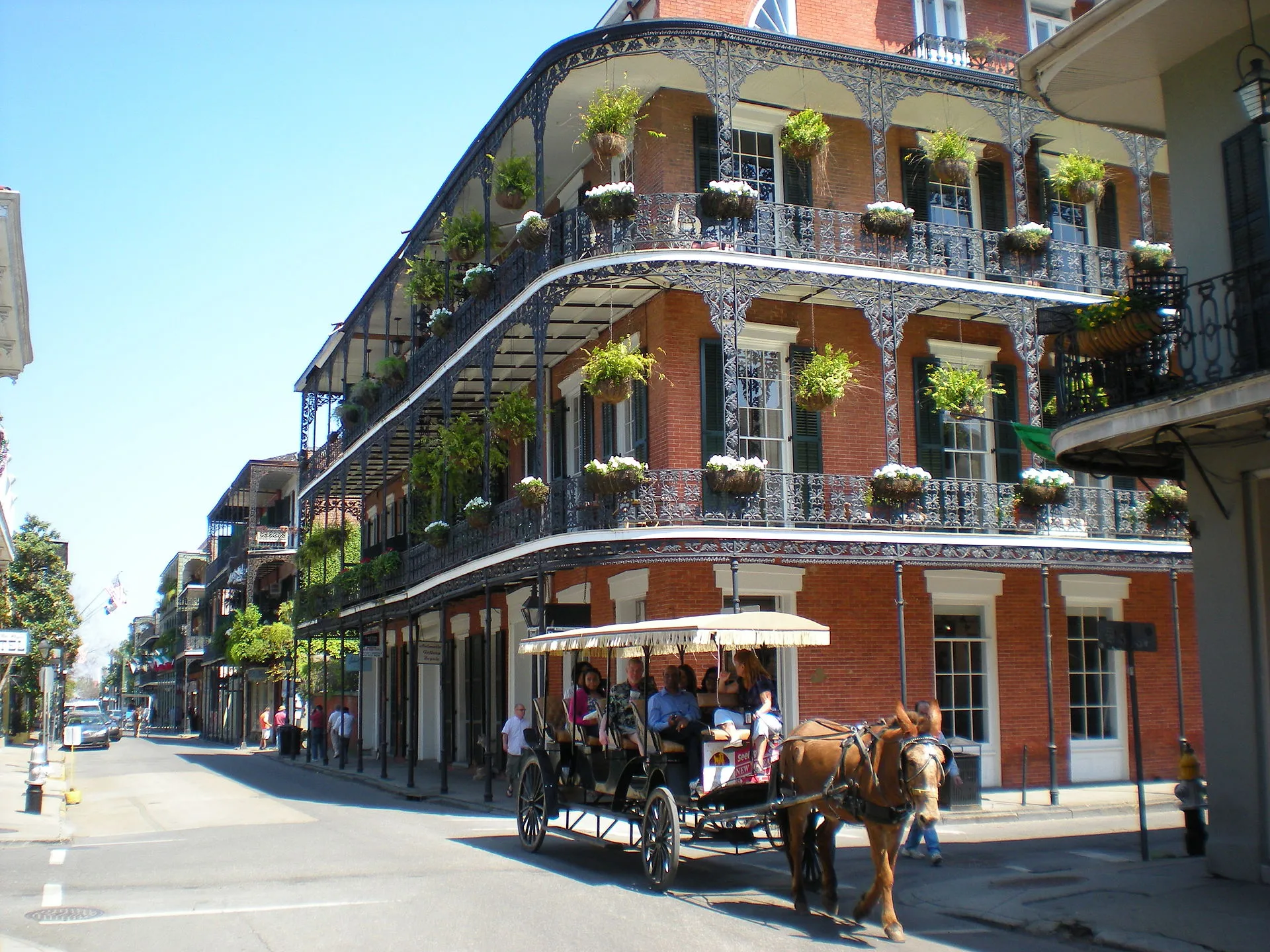
The French Quarter, known locally as the Vieux Carré (Old Square), is both the oldest neighborhood in New Orleans and the spiritual center of a city that has always defined itself through its streets. French engineer Adrien de Pauger laid it out in 1721 as a perfect grid along the Mississippi River, and these 78 blocks have since survived fires, floods, yellow fever epidemics, and Hurricane Katrina, absorbing each catastrophe and emerging with yet another layer of character etched into their facades. Despite the name, most of the architecture is Spanish Colonial rather than French — the result of two devastating fires in 1788 and 1794 that leveled the original French structures during the period of Spanish governance, after which the rebuilt town gained the brick, tiled roofs, and iron galleries seen today.
At the heart of the Quarter sits Jackson Square, where the triple spires of St. Louis Cathedral rise above fortune tellers, street musicians, and artists displaying their work along the iron fence. The square served as the Place d'Armes during French rule, a military parade ground under Spanish control, and the site where the Louisiana Purchase was formally enacted at the Cabildo in 1803, transferring the territory to the United States. It remains the most visited open space in the city, framed by the Pontalba Buildings — among the oldest continuously occupied apartment buildings in America — and flanked by the Cabildo and Presbytère museums that chronicle Louisiana's tangled colonial past.
Walking just a few blocks in any direction reveals hidden courtyards shaded by banana trees, wrought-iron galleries dripping with ferns, and the murmur of jazz drifting from clubs like Preservation Hall that have kept their doors open for generations. That everyday texture — a working neighborhood layered over a colonial one — is what protection under the Vieux Carré Commission, established in 1937, was designed to keep alive.
Walking Routes
The Quarter is small enough to cross in fifteen minutes, but a good walk lingers. These are the landmarks most guided routes string together, roughly in the order a loop from Jackson Square takes them:
- Royal Street galleries — antique dealers, fine-art galleries, and jazz musicians line this elegant street that runs parallel to Bourbon Street but feels like a different century. Its balconies are the Quarter's most photographed, best caught in soft morning light.
- St. Louis Cathedral — the white triple-spired landmark at Jackson Square has anchored the Quarter since 1727 and is the oldest cathedral in continuous use in the country.
- Café du Monde — open 24 hours (except Christmas Day), this 1862 coffee stand serves beignets dusted in powdered sugar that have become synonymous with the city itself.
- The Cabildo — the former seat of Spanish colonial government, now part of the Louisiana State Museum, including the room where the Louisiana Purchase transfer was signed.
- Preservation Hall — this unadorned venue on St. Peter Street has presented traditional New Orleans jazz nightly since 1961, with no drinks and no food, just the music.
- Old Ursuline Convent — the oldest surviving building in the Mississippi River Valley, dating to 1752, and one of the few remaining examples of French Colonial architecture.
- Napoleon House — a 200-year-old bar on Chartres Street originally intended as a refuge for the exiled French emperor, now serving Pimm's Cups and muffulettas in crumbling splendor.
For the best photographs, shoot the balconies of Royal and Chartres streets before 10 AM, the cathedral's floodlit facade at dusk, and the courtyards glimpsed through carriageway gates whenever an owner leaves them open.
French Quarter timeline
-
New Orleans founded
Jean-Baptiste Le Moyne de Bienville plants a French settlement on a crescent bend of the Mississippi, the seed from which the Vieux Carré would grow.
-
Adrien de Pauger lays out the grid
The royal engineer surveys the 78-block gridiron still walked today, centered on the Place d'Armes — the parade ground now known as Jackson Square.
-
The Good Friday fire
A candle in a Chartres Street home ignites a blaze that destroys more than 850 buildings on 21 March, erasing most of the original French timber town.
-
Second great fire and Spanish rebuilding
A second fire levels roughly 200 buildings; under Spanish rule the Quarter is rebuilt in brick, tiled roofs, courtyards, and the iron galleries that define it.
-
Louisiana Purchase transfer
The formal handover of Louisiana to the United States is enacted at the Cabildo on Jackson Square on 20 December, doubling the size of the young nation.
-
The Pontalba Buildings completed
Baroness Micaela Almonester de Pontalba raises the red-brick rows flanking the square — among the oldest continuously occupied apartment buildings in America.
-
Andrew Jackson takes the square
Clark Mills's equestrian statue of Andrew Jackson is unveiled at the center of the redesigned garden, and the Place d'Armes is renamed Jackson Square.
-
The Vieux Carré Commission
A 1936 amendment to the Louisiana Constitution creates the commission that begins regulating the Quarter's facades in 1937, one of the earliest US preservation districts.
-
National Historic Landmark district
The Vieux Carré is designated a National Historic Landmark, recognizing the most intact colonial-era street plan and building stock in the country.
-
Katrina spares the high ground
Built on the Mississippi's natural levee, the Quarter escapes the catastrophic flooding that inundated lower neighborhoods after Hurricane Katrina.
When to Visit
District access: Public streets are open 24 hours a day, 365 days a year, free to walk at any time. The Quarter runs on a rhythm most day-trippers miss, so time your visit to the hour, not just the day:
- Early morning (8–10 AM): The best window for architecture and photography, when low light rakes across the pastel facades and the streets belong to locals heading to coffee.
- Jackson Square artists: Painters and tarot readers set up daily from around 9 AM to dusk, weather permitting, with the widest variety on weekends.
- Midday on weekends (11 AM–3 PM): The blocks nearest Bourbon Street grow congested; a guide slips onto quieter parallel routes along Royal and Chartres streets.
- Night tours (7–9 PM): Ghost, vampire, and voodoo walks depart after dark and explore the Quarter under gaslight, revealing an entirely different atmosphere from the daytime neighborhood.
Because the streets never close, the neighborhood is as much an early-morning coffee walk as a late-night one — the same 78 blocks feel like two different places twelve hours apart.
Admission and Costs
Walking the Quarter is completely free — no tickets or admission are required for the neighborhood itself. The costs come from the guides, tastings, and museums layered on top:
- Guided history walk: $25–40 per person for 2-hour group tours covering architecture, colonial history, and literary landmarks.
- Private Quarter tour: $200–350 for up to 6 people, 2–3 hours, with a route personalized to your interests.
- Food tour: $65–95 per person including tastings at 4–5 stops, from beignets to muffulettas.
- Ghost and vampire tour: $25–35 per person, 90 minutes to 2 hours through allegedly haunted locations.
- Cabildo and Presbytère museums: $9 each, or a $15 combo ticket for both Louisiana State Museum buildings flanking St. Louis Cathedral.
Getting here costs almost nothing: the Riverfront and Canal Street streetcar lines both reach the Quarter's edge for $1.25, the same fare that carries you to the Garden District on the St. Charles line.
The Case for a Guide
The French Quarter rewards curiosity, but its most interesting layers — the ironwork origins, the living voodoo tradition, the working-class second line — are buried beneath tourist-facing surfaces that a knowledgeable guide cuts straight through.
- Spanish ironwork balconies, not French: The ornate lacy balconies are the Quarter's signature image, yet a guide explains they are almost entirely Spanish Colonial in origin — built after two catastrophic fires in 1788 and 1794 destroyed the French-built city, when the Spanish reconstruction funded a new architectural language.
- Voodoo as practiced vs. sold: The tourist shops sell gris-gris bags and plastic dolls, but a guide distinguishes these commercial artifacts from the actual Haitian-rooted spiritual tradition still practiced by New Orleans communities — and explains why Marie Laveau, the 19th-century Voodoo Queen, was also a devout Catholic who worshipped at St. Louis Cathedral.
- Second-line parade tradition: A guide explains that second-line parades are organized by Social Aid and Pleasure Clubs as mutual aid societies dating to before the Civil War, and knows which neighborhoods and Sundays see genuine community processions rather than tourist-staged performances.
- Below-sea-level infrastructure: New Orleans sits in a bowl; a guide traces how the city's Sewerage & Water Board pumping stations move billions of gallons of stormwater, why the lowest neighborhoods flood first, and why the Quarter's perch on the Mississippi's natural levee spared it the worst of Katrina.
- Prohibition-era speakeasy locations: Several bars still operating in the Quarter functioned as speakeasies during Prohibition; a guide points out the hidden entrances, explains the specific strategies owners used to evade raids, and identifies which establishments maintain their 1920s-era layouts.
Tips for Visitors
- Wear comfortable shoes: The Quarter's sidewalks are famously uneven, with buckled flagstones and centuries-old brickwork that punish anything but sturdy, flat footwear.
- Start with the morning coffee ritual: Begin your day at Café du Monde or a neighborhood roaster before the tour groups arrive, then walk the quiet blocks between Esplanade and Ursulines avenues.
- Stay alert in the crowds: The Quarter is generally safe, but the busy blocks near Bourbon Street attract opportunistic pickpockets. Keep valuables in front pockets, especially during Mardi Gras.
- Hydrate constantly: The subtropical climate means even pleasant-looking days carry punishing humidity. Every corner store sells cold water, and guides build drink stops into their routes.
- Respect private residences: Many Quarter buildings are occupied homes. Do not climb balconies, peer through windows, or enter courtyards without permission, no matter how photogenic they appear.
- Chain it to the wider city: The St. Charles streetcar links the Quarter to the mansions and oak-lined streets of the Garden District for $1.25, and the National WWII Museum sits a short ride away in the Warehouse District — easy ways to see more of New Orleans in a single day.
Frequently Asked Questions
What months are best for visiting the French Quarter?
February through May is the prime window, capturing Mardi Gras season, the French Quarter Festival in April, and Jazz Fest in late April through early May, all before the suffocating summer humidity descends. October through November brings a second sweet spot with comfortable temperatures, thinner crowds, and the atmospheric buildup to the holiday season. July and August are the toughest months, with drenching afternoon thunderstorms and heat indices that can top 110 degrees.
What time of day is best for exploring French Quarter?
District access: Public streets open 24 hours a day, 365 days a year, free to walk at any time. Best for architecture tours: Early morning between 8 and 10 AM, when light catches the pastel facades and the streets belong to locals heading to coffee.
How much should visitors budget for French Quarter?
Walking the Quarter: Completely free, no tickets or admission required for the neighborhood itself. Guided history walk: $25-40 per person for 2-hour group tours covering architecture, colonial history, and literary landmarks.
Is a walking tour of French Quarter worth it?
Guides unstack French, Spanish, and Creole layers within these 78 blocks, unlock access to private courtyards most visitors never see, and separate literary fact from legend at locations tied to Tennessee Williams and Faulkner.
How do you get to and around the French Quarter?
Louis Armstrong International Airport sits about 11 miles west, roughly 30 minutes by taxi or ride-share. Once you arrive, leave the car behind: the Quarter is compact, flat, and best walked, and much of it is pedestrian-only. The Riverfront streetcar skirts its Mississippi edge and the Canal Street lines stop along its downtown border, both for $1.25. That same fare puts you on the St. Charles streetcar to the Garden District, making it easy to pair both neighborhoods in one day.