
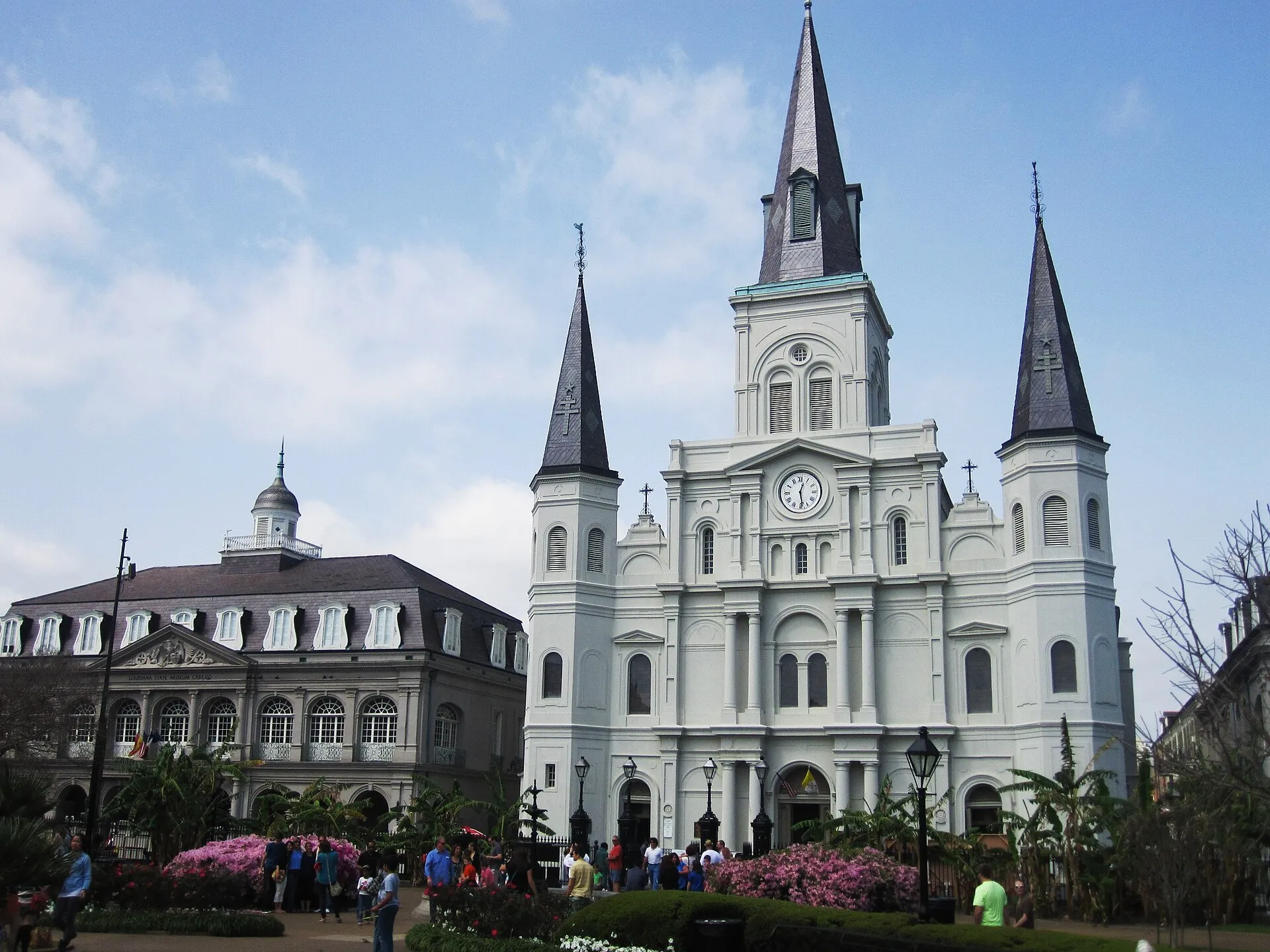
Visitor Etiquette
The cathedral is an active Catholic parish, and visitor behavior should respect ongoing worship. During Mass — daily at 7:30 AM and noon, Saturday vigil at 4:00 PM, Sunday at 9:00 AM and 11:00 AM — the nave is reserved for worshippers; tourists are asked to wait or move to the side aisles. Shoulders and knees must be covered for entry; hats should be removed inside. Still photography without flash is generally permitted during visiting hours when no services are underway — tripods and video equipment require prior permission from the parish office. Keep voices low inside the nave, especially when worshippers are present. The cathedral's entrance on Jackson Square can feel hectic; once inside, the acoustic warmth and candlelit interior create a distinct atmosphere that warrants quiet attention rather than a rushed walk-through.
Spiritual Significance
St. Louis Cathedral has been the spiritual center of New Orleans since the city's founding in 1718, making it the oldest Catholic cathedral in continuous use in the United States. Three successive churches have stood on this ground — the first a wooden chapel contemporary with the city's founding, the second destroyed in the catastrophic fire of 1788 — and the cumulative weight of nearly three centuries of Catholic worship gives the space an unmistakable gravity. The cathedral's patron, St. Louis IX, the French crusader-king who died of plague on his second campaign, embodies the French Catholic identity that first shaped colonial Louisiana. Erasmus Humbrecht's 1872 ceiling murals depict his life above the nave — including his death in Tunis — watched over by worshippers who have included French colonists, Spanish administrators, American settlers, Creole families, and formerly enslaved parishioners. In no other American city did Catholicism develop so complex and layered a relationship with West African and Caribbean spiritual traditions. The city's unique practice of honoring both the Catholic saints and their Voodoo correspondences, brought from Haiti and Dahomey by enslaved people who found in the saints an acceptable public face for older beliefs, produced a spiritual landscape that guides and theologians still interpret differently. Marie Laveau, the celebrated Voodoo Queen of New Orleans and a devout Catholic who attended Mass here, embodies this fusion: she was baptized and married in this cathedral and worshipped here throughout her life, never perceiving a contradiction between her two spiritual practices.
St. Louis Cathedral timeline
-
New Orleans founded, first church raised
A modest wooden chapel goes up beside the young French colonial settlement on the site that would become Jackson Square, giving the parish its founding date.
-
Adrien de Pauger's brick church
Colonial engineer Adrien de Pauger, who laid out the French Quarter street grid, designs a sturdier brick-and-timber church to replace the storm-damaged chapel; it serves the growing town for six decades.
-
Good Friday fire destroys the church
The Great New Orleans Fire of 21 March 1788 sweeps through the Quarter and consumes the second church along with roughly 850 surrounding buildings.
-
Almonester rebuilds; the church becomes a cathedral
Spanish philanthropist Don Andrés Almonester y Roxas funds a new church, dedicated in December 1794 to serve the recently created Diocese of Louisiana and the Floridas.
-
Central bell-and-clock tower added
A central tower topped by a clock and bell is raised at the middle of the facade, beginning the vertical silhouette that would come to define the building.
-
Present triple-spired cathedral completed
Architect J.N.B. de Pouilly enlarges and largely rebuilds the church into the Franco-Spanish landmark seen today, after part of the older structure collapsed during construction.
-
Humbrecht paints the ceiling murals
Erasmus Humbrecht completes the nave murals depicting the life of St. Louis IX, including the crusader-king's death outside Tunis.
-
Elevated to a minor basilica
Pope Paul VI grants the church minor basilica status, an honor reserved for churches of special historical or spiritual significance.
-
Pope John Paul II prays at the cathedral
John Paul II visits the cathedral during his 1987 trip to New Orleans, addressing crowds gathered across Jackson Square.
-
The cathedral endures Hurricane Katrina
The storm inflicts only comparatively minor damage — a torn section of roof and cracked plaster — and the cathedral is back in use within months; in St. Anthony's Garden a toppled oak snaps the thumb and forefinger from the marble Sacred Heart statue yet leaves the figure otherwise intact.
When to Visit
Self-guided visits: Monday through Saturday 8:30 AM to 4:00 PM, Sunday 9:00 AM to 2:00 PM (hours may vary during services and special events). Mass schedule: Daily masses at 7:30 AM and noon, with additional Saturday vigil at 4:00 PM and Sunday masses at 9:00 AM and 11:00 AM. Best for quiet visits: Weekday mornings between 9 and 11 AM, after the early mass but before the midday tourist rush. The light through the stained glass is especially striking during this window. Exterior photography: The front facade photographs best in the golden hour before sunset, when the white stucco glows against the darkening sky behind Jackson Square. Guided tours available: Docent-led tours run intermittently throughout the day and are free, though donations are warmly encouraged to support preservation
Admission and Costs
Admission: Free — the cathedral is an active parish welcoming all visitors without charge. Suggested donation: $1-5 per visitor helps fund ongoing restoration of the 19th-century interior. Free docent-led tours run intermittently throughout the day (donations encouraged). Guided French Quarter tours including the cathedral: $25-40 per person for a 2-hour group walk through the Vieux Carré. Private religious history tour: $150-250 for up to 6 people, often combined with St. Augustine Church in Tremé and Our Lady of Guadalupe Chapel. Cabildo museum next door: $9 per adult for the Louisiana State Museum housed in the former Spanish colonial government building — essential historical context for the cathedral visit.
The Case for a Guide
Three churches have stood on this ground since 1718, each destroyed and replaced by something grander, and their progression mirrors the entire colonial history of Louisiana. Guides make this architectural timeline vivid rather than abstract, pointing to specific elements that reveal the French, Spanish, and American hands that shaped a single sacred space. Above the nave, Humbrecht's 1872 ceiling murals depict the life of St. Louis IX, yet most visitors never look up long enough to study them — a guide directs attention there and explains the crusader king's significance to Louisiana's French identity. The hand-painted Stations of the Cross, the subtle differences between French Gothic aspirations and Spanish colonial proportions, the ornate main altar — these details reward expert explanation that transforms passive viewing into active understanding. Behind the cathedral, St. Anthony's Garden — one of the French Quarter's quietest corners — hides in plain sight, and many visitors pass within yards of its Royal Street gate without discovering it exists; guides ensure you find it and explain its history as a 19th-century dueling ground. The cathedral cannot be fully understood without the context of Jackson Square — the Cabildo and Presbytere flanking it, the Pontalba Buildings framing the plaza, the equestrian statue of Andrew Jackson at its center — and guides weave these elements into a coherent narrative that also addresses the city's unique spiritual landscape, where Catholic saints have long coexisted with West African and Caribbean traditions.
Tips for Visitors
The ceiling murals: Look up to see Erasmus Humbrecht's 1872 paintings depicting the life of St. Louis IX, the French king who inspired the cathedral's name and who died on crusade in 1270. The main altar: An ornate masterpiece of carved wood and gold leaf that has served as the focal point of worship since the mid-19th century. Stained glass windows: Donated by various New Orleans families over the decades, each window tells a different story from scripture and Louisiana Catholic history. St. Anthony's Garden: Enter from Royal Street to find this walled formal garden with a statue of the Sacred Heart, a peaceful retreat from Jackson Square's bustle. In the 1800s, this garden was a favored site for settling affairs of honor by duel. Pirate's Alley: The narrow lane running along the cathedral's left side connects Jackson Square to Royal Street. William Faulkner lived in an apartment at its far end while writing his first novel, Soldiers' Pay. The cathedral bells: Listen for the bells that have rung over the Quarter for nearly two centuries, marking time in a neighborhood that otherwise seems to exist outside of it. Jackson Square at night: Return after sunset to see the cathedral dramatically floodlit, its white spires glowing against the dark sky while street musicians play below. Make a day of it: The cathedral sits at the quiet heart of the French Quarter, just a few blocks from the neon and brass bands of Bourbon Street; pair a morning here with an afternoon among the mansions of the Garden District or the exhibits of the National WWII Museum for a fuller picture of the city
Frequently Asked Questions
What time of year is most rewarding for visiting St. Louis Cathedral?
February through April and October through December offer the most comfortable conditions for combining a cathedral visit with time in Jackson Square, avoiding the worst of New Orleans' summer heat while catching the city's liveliest festival calendar. The cathedral's interior provides cool refuge year-round, and the stained glass is most luminous during weekday morning visits when the sun angles through the eastern windows.
When is St. Louis Cathedral open for visitors?
Self-guided visits: Monday through Saturday 8:30 AM to 4:00 PM, Sunday 9:00 AM to 2:00 PM (hours may vary during services and special events).
What is the entrance fee at St. Louis Cathedral?
Admission is free. The cathedral is an active parish and welcomes visitors without charge. A suggested donation of $1-5 per visitor helps fund ongoing restoration. Guided French Quarter tours including the cathedral run $25-40 per person.
What guided tour options are available at St. Louis Cathedral?
Docent-led tours run intermittently throughout the day and are free, though donations are encouraged. Private religious history tours cost $150-250 for up to 6 people. The adjacent Cabildo museum is $9 per adult for the Louisiana State Museum in the former Spanish colonial government building.
How do you get to St. Louis Cathedral?
The cathedral fronts Jackson Square in the heart of the French Quarter, an easy walk from most Quarter hotels. From outside the neighborhood, the Riverfront and Canal Street streetcar lines both stop within a few blocks, and the free Algiers Ferry from the West Bank lands a short walk away at the foot of Canal Street. There is no dedicated parking; use a nearby garage on Decatur or Iberville Street and continue on foot, since much of the surrounding Quarter is pedestrian-only.
How much time should you plan for a visit to St. Louis Cathedral?
Allow about 20-30 minutes for the interior itself — long enough to study the ceiling murals, the main altar, and the stained-glass windows without rushing. Add another half-hour to hour if you plan to sit quietly during a service, walk through St. Anthony's Garden behind the building, or linger in Jackson Square to take in the Cabildo, the Presbytere, and the Pontalba Buildings that frame the plaza.