

Overview
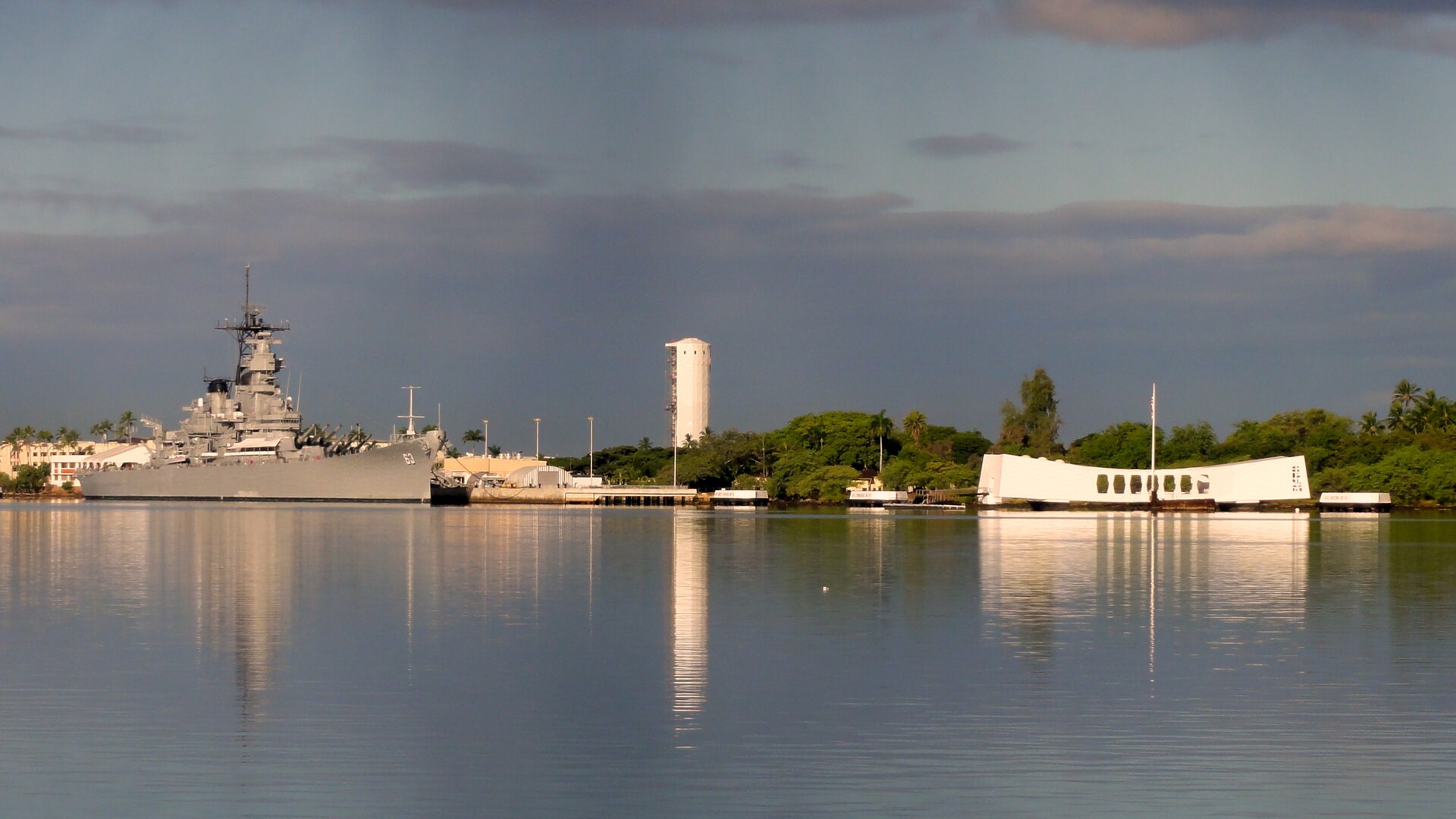
Pearl Harbor National Memorial occupies the western shore of Oahu's sheltered natural harbour, the site where 353 Imperial Japanese aircraft attacked the United States Pacific Fleet at 7:55 AM on December 7, 1941, killing 2,403 Americans and propelling the nation into World War II. The centrepiece is the USS Arizona Memorial, a white concrete structure designed by Austrian-born architect Alfred Preis that straddles the sunken hull of the battleship USS Arizona without touching it. The Arizona sank in nine minutes after a 1,760-pound armour-piercing bomb detonated its forward ammunition magazine, killing 1,177 of its 1,512 crewmen.
Their remains lie within the rusting hull beneath the memorial, and oil from the ship's bunkers still seeps to the surface more than eight decades later, forming iridescent slicks that visitors call the "tears of the Arizona." The broader Pearl Harbor Historic Sites complex extends beyond the Arizona memorial to include the Battleship Missouri, where Japan formally surrendered on September 2, 1945, ending the war that began in this very harbour; the USS Bowfin submarine; and the Pacific Aviation Museum on Ford Island. Together these sites create a bookend narrative: the Arizona represents the war's catastrophic beginning, the Missouri its conclusive end.
Historical Significance
Understanding why Japan targeted this specific harbour transforms a memorial visit into a strategic education. Guides explain how Oahu's geography concentrated the Pacific Fleet into a confined anchorage, how American intelligence failures allowed the attack force to approach undetected despite warning signs, and how the devastating success of December 7, 1941, forever changed naval warfare doctrine. Without this framework, the sunken battleships remain tragedies; with it, they become lessons in the catastrophic consequences of unpreparedness.
Statistics flatten the human dimension that guides restore through individual stories. They recount Doris Miller, a mess attendant with no gunnery training who manned an anti-aircraft gun and earned the Navy Cross for his actions. They describe the bandsmen of the USS Nevada who continued playing the national anthem even as bombs fell around them. They share the fate of twin brothers entombed together within the Arizona's hull. These personal narratives give faces and names to the 2,403 Americans who died that morning. Architectural symbolism suffuses the memorial in ways that demand interpretation. The 21 open windows along each side represent a 21-gun salute. The roofline sags in the centre and rises at both ends, reflecting initial defeat followed by eventual victory. The shrine room's marble wall lists every Arizona casualty without distinguishing rank or race, a democratic levelling that was intentional. Guides also draw the narrative arc from the Arizona to the Missouri, explaining how military planners deliberately staged the Japanese surrender ceremony on the Missouri's deck overlooking the sunken battleship, bringing the war full circle in the same waters where it began for America. Visiting Pearl Harbor is the most profoundly moving experience available in Honolulu, an essential counterweight to the beaches of Waikiki that places the islands' strategic importance and human cost into inescapable clarity.
Architecture
USS Arizona Memorial: Stand above the sunken battleship and look down through the clear water at the rusting hull, the turret barbettes, and the oil that still rises from below after more than 80 years. Shrine room: The memorial's rear wall lists the names of all 1,177 Arizona crewmen killed; gold stars mark those whose remains were later recovered, while the unmarked names belong to those still within the ship.
Battleship Missouri: Walk the teak deck where General MacArthur accepted Japan's unconditional surrender on September 2, 1945; the brass plaque marks the exact spot where the surrender documents were signed. USS Bowfin: Descend into the cramped interior of a World War II fleet submarine that visitors can explore from bow to stern, experiencing the claustrophobic reality of undersea warfare firsthand. Documentary film: The 23-minute National Park Service film provides essential context with archival footage and survivor testimonies that set the emotional tone for the memorial visit. Attack map and timeline: The visitor centre's outdoor exhibits include a detailed timeline of the 90-minute attack with maps showing each wave of Japanese aircraft and the positions of every ship in Battleship Row.
When to Visit
Visitor centre: Open daily 7 AM to 5 PM; closed on Thanksgiving, Christmas, and New Year's Day. Arizona memorial programmes: Timed-entry programmes run from 7:30 AM to 3 PM, departing every 15 minutes; each includes a 23-minute documentary film and a boat ride to the memorial. Battleship Missouri: Open daily 8 AM to 4 PM, with shuttle service from the visitor centre.
Best time to visit: Arrive when the visitor centre opens at 7 AM to secure early timed-entry tickets; by mid-morning, same-day tickets are often gone, especially from December through March. Avoid December 7: The annual commemoration ceremony closes public access to the memorial; visit the day before or after for a still-solemn but accessible experience.
Admission and Costs
Understanding why Japan targeted this specific harbour transforms a memorial visit into a strategic education. Guides explain how Oahu's geography concentrated the Pacific Fleet into a confined anchorage, how American intelligence failures allowed the attack force to approach undetected despite warning signs, and how the devastating success of December 7, 1941, forever changed naval warfare doctrine. Without this framework, the sunken battleships remain tragedies; with it, they become lessons in the catastrophic consequences of unpreparedness. Statistics flatten the human dimension that guides restore through individual stories. They recount Doris Miller, a mess attendant with no gunnery training who manned an anti-aircraft gun and earned the Navy Cross for his actions. They describe the bandsmen of the USS Nevada who continued playing the national anthem even as bombs fell around them. They share the fate of twin brothers entombed together within the Arizona's hull. These personal narratives give faces and names to the 2,403 Americans who died that morning. Architectural symbolism suffuses the memorial in ways that demand interpretation. The 21 open windows along each side represent a 21-gun salute. The roofline sags in the centre and rises at both ends, reflecting initial defeat followed by eventual victory. The shrine room's marble wall lists every Arizona casualty without distinguishing rank or race, a democratic levelling that was intentional. Guides also draw the narrative arc from the Arizona to the Missouri, explaining how military planners deliberately staged the Japanese surrender ceremony on the Missouri's deck overlooking the sunken battleship, bringing the war full circle in the same waters where it began for America.
USS Arizona Memorial: Completely free, including the film, boat ride, and memorial visit; timed-entry tickets can be reserved online at recreation.gov ($1 booking fee) or obtained free at the visitor centre on a first-come basis. Battleship Missouri: $35 adults, $18 children ages 4-12; guided tours available at additional cost. USS Bowfin submarine: $18 adults, $12 children ages 4-12; children under 4 not permitted aboard. Pacific Aviation Museum: $26 adults, $15 children ages 4-12. Passport to Pearl Harbor (all sites): $89 adults, $45 children for access to all four major attractions.
Tips for Visitors
Reserve tickets early: Online reservations open 60 days in advance and sell out for peak dates; book as soon as they become available, especially for visits between November and March. No bags allowed: Backpacks, purses, camera bags, and diaper bags are prohibited beyond the visitor centre; free secured storage is provided, but the line can add 15-20 minutes.
Dress respectfully: Pearl Harbor is an active military base and a war memorial; swimwear, bare feet, and overly casual attire are inappropriate. Allow a full day: The Arizona memorial programme takes about 75 minutes; adding the Missouri, Bowfin, and Aviation Museum fills a full day. Getting there: Pearl Harbor is about 30 minutes west of Waikiki by car; several tour companies offer round-trip shuttle service from Waikiki hotels. Combine thoughtfully: Pearl Harbor demands emotional energy; consider pairing it with a quiet afternoon rather than rushing to Diamond Head or other high-energy attractions on the same day.