
Observation Spots
Formation
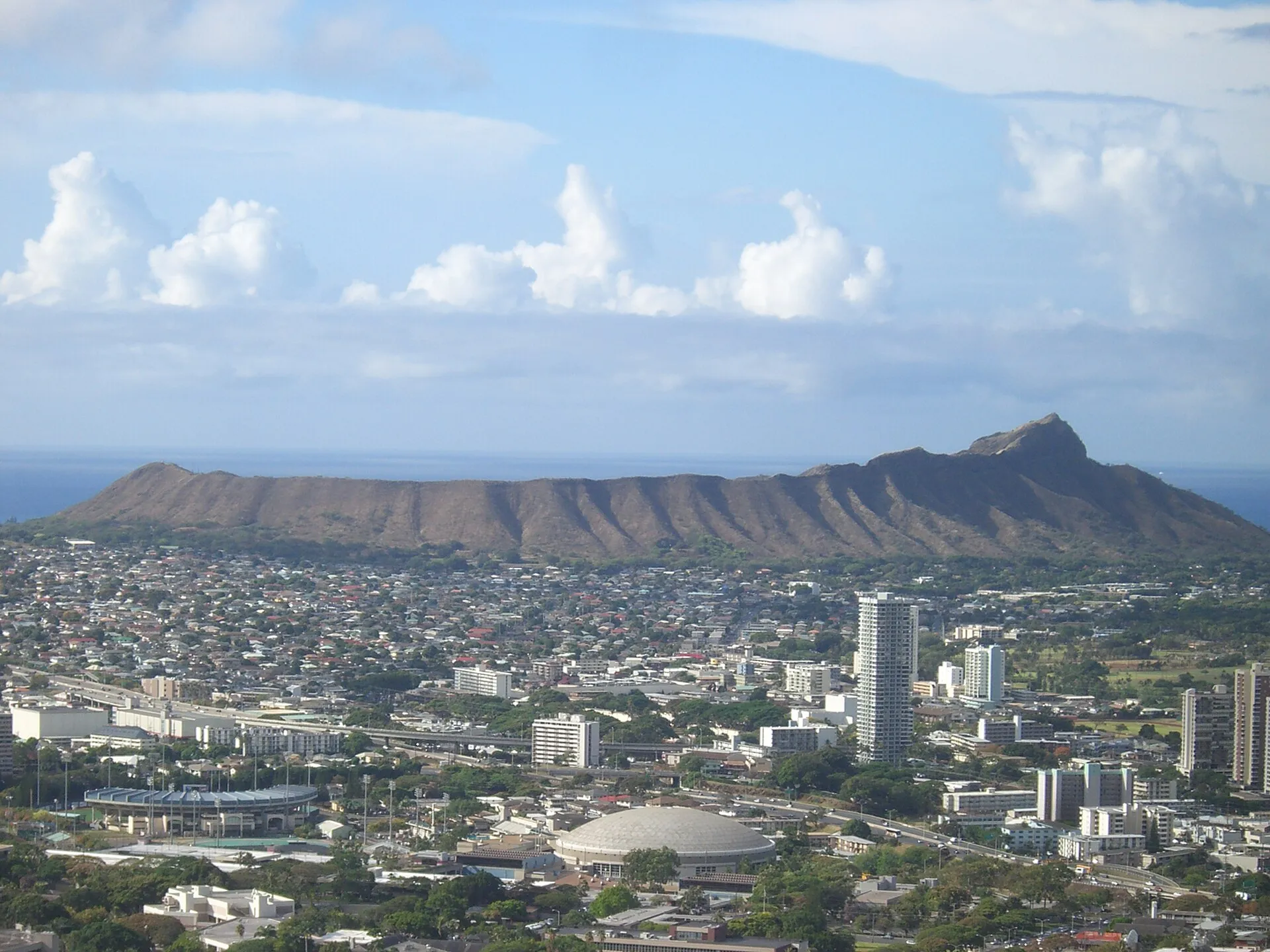
Diamond Head belongs to the Honolulu Volcanics, a late-stage series of eruptions that punched through the southeastern flank of Oahu long after the island's main shield volcano had died. It is a tuff cone: not a mountain built by slow lava flows, but a rampart of compacted volcanic ash thrown up in a single, violent, phreatomagmatic burst. When rising magma met shallow groundwater and seawater about 300,000 years ago, the explosive contact flash-boiled the water into steam, shattering the magma into fine ash that rained down and welded into the tan-coloured rock known as palagonite tuff.
Two features of that eruption still shape what hikers see today:
- An asymmetric rim. The prevailing northeast trade winds blew the ash cloud toward the southwest, piling the crater wall higher on that side. That is why the 560-foot trail climbs steadily toward a summit on the seaward rim rather than around a level ring.
- A single, final eruption. Because the cone was built by one short-lived event and the vent never reopened, geologists classify Diamond Head as extinct rather than dormant — there is no magma chamber left to feed a future eruption.
A trained guide can point out the difference between this light, layered tuff and the darker basalt lava flows visible elsewhere on Oahu, and read the fossil eruption written into the crater walls the way others read a book.
Wildlife
Diamond Head's sun-baked interior is a study in adaptation to a dry, exposed environment, and the sparse vegetation rewards informed observation. Naturalist guides identify the gnarled kiawe (mesquite) trees that shade the crater floor, the low ilima shrubs whose delicate orange blossoms are the official flower of Oahu, and the native pili grass that once thatched Hawaiian houses. Introduced koa haole and lantana have colonised the disturbed ground along the switchbacks, a living record of the island's altered ecology.
The animal life is modest but present: zebra doves and common mynahs forage around the trailhead, red-crested cardinals flash through the scrub, and white-tailed tropicbirds (koa'e kea) sometimes wheel along the seaward cliffs below the summit. Small geckos and the occasional introduced mongoose dart between the rocks. Guides who have memorised exactly when the morning light strikes the crater rim, the coastline, and the towers of Waikiki help photographers capture images worth keeping rather than settling for the flat midday glare that washes out the exposed upper trail.
Trails
The route is short but packed with distinct viewpoints, each worth pausing for:
- Crater interior: From the trailhead, the dry, bowl-shaped basin reveals the full scale of the eruption that formed this landmark 300,000 years ago.
- Lighthouse lookout: About halfway up, a side platform offers a clean view of the Diamond Head Lighthouse and the surfers riding the reef break below the cliffs.
- Military tunnel and stairs: The dark 225-foot tunnel through the crater wall and the 99-step spiral staircase inside the observation post are the most dramatic moments of the climb.
- Fire Control Station: The flat-roofed concrete bunker at the very top was built in 1911 to coordinate artillery fire across Oahu's south shore and now serves as the primary viewing platform.
- Summit panorama: The 360-degree view takes in Waikiki, Koko Head, the Waianae Range, and the Pacific stretching to the horizon; look southeast to the jagged profile of Koko Head crater and the deep blue cove of Hanauma Bay beyond.
- Sunrise vantage: Reach the platform before dawn to watch the sun rise over the Pacific while Waikiki's towers catch the first golden light below you.
Diamond Head timeline
- c. 300,000 BP
A single blast builds the cone
A brief phreatomagmatic eruption on Oahu's southeast flank piled volcanic ash into the palagonite-tuff rampart hikers still climb today.
-
Western sailors coin "Diamond Head"
British crews mistook calcite crystals glinting in the tuff for diamonds; Hawaiians had long known the ridge as Le'ahi, the brow of the tuna.
-
The federal government buys the crater
The U.S. acquired Le'ahi for a few thousand dollars to anchor Oahu's coastal defence, later organising the land as the Fort Ruger reservation.
-
The Army cuts the summit trail and tunnel
Engineers bored the passage through the crater wall and switchbacked a path to the rim to reach the new artillery-direction posts.
-
The Fire Control Station crowns the rim
The flat-roofed concrete bunker that now shelters the summit viewpoint was built to direct coastal-battery fire across the south shore.
-
Named a National Natural Landmark
Federal designation recognised the crater as one of the country's clearest examples of a coastal tuff cone, cementing its protected status.
When to Visit
Park hours run daily from 6 AM to 6 PM, with last entry at 4 PM so hikers can descend before the gate closes. Since 2022, all out-of-state visitors must hold a timed-entry reservation booked online through Hawaii's state parks reservation portal; walk-ups are not guaranteed, and the earliest morning slots routinely sell out days ahead. Arriving at the gate by 6 AM puts you on the summit for the coolest air, the sharpest light, and the emptiest platform of the day.
Aim for early morning before 8 AM or late afternoon after 3 PM; midday sun on the fully exposed trail makes the climb noticeably harder. The stretch to avoid is weekend mid-morning, roughly 9 AM to noon, when the switchbacks bottleneck and the summit becomes standing-room only.
Admission and Costs
- Entry fee: $5 per person for non-residents, paid at the entrance; free for Hawaii residents with valid ID.
- Parking: $10 per vehicle inside the crater, but the lot holds only about 150 spaces that fill well before opening.
- TheBus Route 23: $3 each way from Waikiki to the trailhead — the most affordable option when the parking lot is full.
- Guided sunrise hike: $30-50 per person, typically including transport from Waikiki and naturalist narration.
- Private geology and history tour: $150-250 for a 3-hour guided hike for up to four people with in-depth geological and military-history commentary.
The Case for a Guide
Most visitors treat Diamond Head as a quick cardio workout with a good view at the end. A knowledgeable guide turns the same 1.6-mile trail into a layered lesson in island geology, Hawaiian language, and Pacific military history — context you simply cannot read off the paved path.
- A volcano you can decode: Guides explain how a single days-long eruption built this tuff cone, distinguish its pale ash from Oahu's darker lava, and make the case for why it is extinct rather than merely sleeping.
- The meaning behind the name: They share the traditional name Le'ahi and the crater's role for Polynesian navigators, who used its unmistakable profile to orient voyages across open ocean.
- Hidden military architecture: The tunnel, the rim bunkers, and the observation posts were built between 1908 and 1943 as part of Oahu's coastal defence network; guides connect this hilltop to the wider Pacific story that reached its climax at Pearl Harbor, a few miles to the west.
- Light, framed: Guides who know exactly when the sun hits the rim, the reef, and the Waikiki skyline steer photographers to the right spot at the right minute.
- Logistics handled: From securing scarce timed-entry reservations to timing the climb around the heat and the crowds, a guide removes the friction that catches unprepared visitors.
Tips for Visitors
- Reserve early: Timed-entry reservations are mandatory for non-residents and book out days ahead for morning and sunrise slots.
- Carry water: The trail is fully exposed with no shade or water stations; a litre per person is the minimum on hot days.
- Wear real shoes: The path is paved but steep and uneven, and the staircase and tunnel demand sure footing — sandals and flip-flops are a bad idea.
- Pack a light: The tunnel through the crater wall is about 225 feet long and dark; a phone torch works, but a small headlamp is better.
- Sun protection is essential: There is zero shade on the upper trail and summit, and the tropical sun burns fast even on overcast mornings.
- Budget 1.5-2 hours for the round trip including time at the top, and pair a sunrise climb with a morning at Waikiki Beach — the trailhead is a short walk or bus ride away — for a near-perfect half-day.
Frequently Asked Questions
What are the opening hours at Diamond Head?
Park hours: Open daily from 6 AM to 6 PM; last entry at 4 PM to ensure hikers can descend before closing.
How much does it cost to access Diamond Head?
Entry fee: $5 per person for non-residents; free for Hawaii residents with valid ID. Parking: $10 per vehicle inside the crater; limited to about 150 spaces that fill early.
Do visitors need to book in advance for Diamond Head?
Reserve in advance: Timed entry reservations are mandatory and often book up days ahead for morning slots; plan early, especially for sunrise.
How difficult is the Diamond Head hike?
The trail is a moderate 1.6-mile round trip with about 560 feet of elevation gain, taking most people 1.5 to 2 hours. It is paved but steep and uneven in places, with a dark 225-foot tunnel and a 99-step staircase, so sure footing and a basic level of fitness are needed; there is no shade or water on the route.
How do you get to Diamond Head without a car?
TheBus Route 23 runs from Waikiki to the Diamond Head trailhead for about $3 each way, and the crater is roughly a 20-minute walk from the eastern end of Waikiki Beach. Many operators also run guided sunrise hikes with hotel pickup, which avoid the parking lot that fills before dawn.