
Trails
The signature route is the stone stairway of 418 steps that climbs from the Byparken in the town centre to the Fjellstua terrace, gaining roughly 130 metres over a series of switchbacks shaded by trees. It is a steady, unrelenting ascent rather than a technical one, with flat landings at intervals that double as rest stops and minor viewpoints in their own right. Handrails run along much of the route, and the surface is solid stone throughout.
Beyond the main terrace, walking paths continue along the ridge of Aksla and connect toward the hospital hill and quieter forest trails, giving keen walkers the option of a longer loop away from the crowds at the summit. Those who drive up can still sample the walk by descending the steps into town and arranging to collect the car later, which is the way to enjoy the panorama and the stairway without the full climb.
Formation
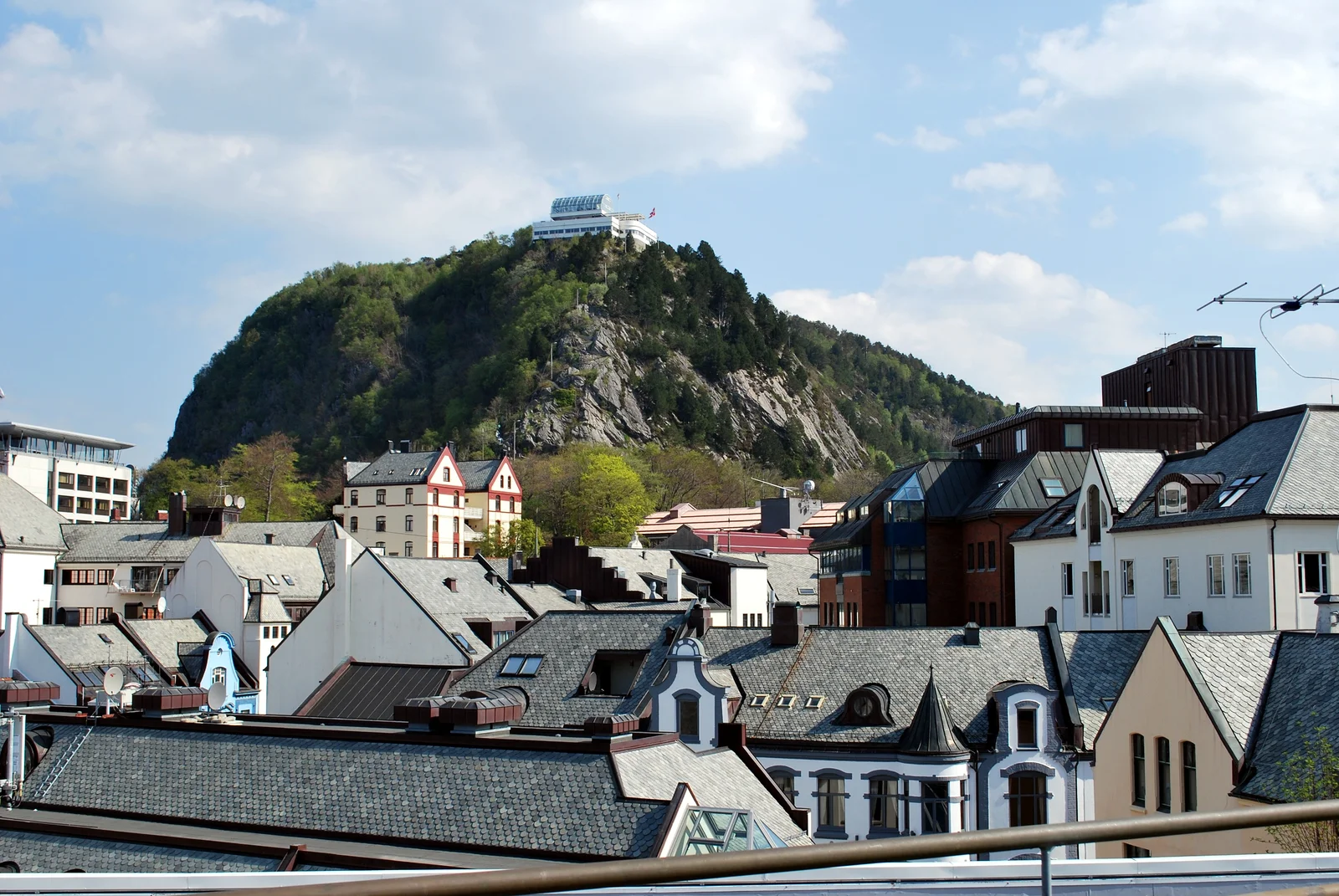
Mount Aksla is part of the rugged bedrock of the Sunnmøre coast, a landscape of hard Precambrian gneiss shaped over millennia by glaciers that carved the deep fjords and rounded the low islands now visible from the top. The hill's steep seaward face is why the viewpoint sits so dramatically above the town, with the rooftops of Ålesund seeming to begin at the foot of the slope.
The wider panorama takes in a classic western-Norwegian scene born of ice: drowned valleys forming sheltered channels, skerries and islands offshore, and the sharp alpine profile of the Sunnmøre Alps inland, whose peaks were sculpted by the same glacial forces on a grander scale. From Fjellstua the contrast between the smooth, sea-worn islands and the jagged interior summits lays out the region's glacial geology in a single sweep.
When to Visit
The viewpoint itself never closes, which makes it as good for a midsummer midnight visit under the low northern light as for a midday orientation stop. The clearest air often comes early in the morning or in the hours before sunset, when the town glows and the islands stand out crisply against the sea; midday haze can flatten the distant peaks. Allow around an hour for the round trip on foot, plus whatever time you linger over the panorama.
Late spring through early autumn offers the most reliable weather and the greenest park, while winter brings a real risk of ice on the stone steps, when the road is the safer option. Whatever the season, check the local forecast before setting out, because low cloud can hide the Sunnmøre Alps entirely and turn a spectacular view into a grey wall within minutes.
Admission and Costs
There is no admission fee to climb Mount Aksla or to stand at the Fjellstua terrace, and the stairway from the Byparken is open to all without charge. The only unavoidable cost for walkers is your own effort; the reward is a free panorama that rivals any paid attraction in the region.
Drivers who take the Aksla road pay a small parking fee near the summit, typically a few dozen kroner, and the hilltop café charges normal Norwegian café prices, so a coffee and a slice of cake runs to around NOK 120 ($11) for two. Guided walking tours that fold the climb into a wider tour of the town cost more but bundle the ascent with commentary on the streets below.
The Case for a Guide
A local guide turns the Aksla panorama from a pretty picture into a readable map of the region. Standing at the rail, a knowledgeable guide can point out which islands are which, trace the line of the shipping channel that made Ålesund a fishing and export port, and explain how the 1904 fire and the unified rebuild produced the townscape spread out below. That context is far harder to piece together on your own, and it makes the streets you explore afterwards immediately more meaningful.
Tips for Visitors
Wear proper shoes with grip. The stone steps become slippery in Ålesund's frequent rain, and the descent is harder on the knees than the climb is on the lungs. Carrying a light windproof layer is wise even on warm days, as the exposed terrace catches the sea breeze.
For photography, come at golden hour when the low sun rakes across the Jugendstil facades, and consider walking up but taking a taxi down if your legs are tired. Combining the viewpoint with a stroll around the harbour and a visit to the Atlantic Sea Park to the west makes for a well-balanced day that pairs the town's best view with its best family attraction.
Frequently Asked Questions
How many steps lead up to the Fjellstua viewpoint?
The classic route counts 418 stone steps, starting in the Byparken city park in the town centre and rising steadily up the flank of Mount Aksla to the Fjellstua terrace. Most reasonably fit walkers manage the climb in fifteen to twenty-five minutes, pausing at the landings along the way. Anyone who would rather not tackle the stairs can reach the same platform by car or taxi via Aksla road.
Do you have to pay to go up Mount Aksla?
Climbing the steps and standing at the Fjellstua viewpoint are free at any hour, since the platform is open public ground rather than a ticketed attraction. There is a modest charge only if you drive up and use the paid parking near the top, and of course for anything you order at the café. Sunrise and late-evening visits cost nothing and are often the quietest.
What can you see from the top of Aksla?
The terrace looks straight down over Ålesund's Jugendstil rooftops and the narrow Brosundet channel, then out across a scatter of low islands to the open Atlantic. On a clear day the jagged Sunnmøre Alps fill the eastern skyline, and the peak of Godøy and the entrance toward the Geirangerfjord region are visible in the distance. It is the single best orientation point before exploring the town below.
Is the Aksla climb suitable for children and older visitors?
The stairway is well built with frequent flat landings, so families with school-age children generally cope well if they take it slowly. Visitors who find long flights of steps difficult can avoid them entirely by taking the road to the upper car park, from where the terrace is only a short, gentle walk. Sturdy shoes help in wet weather, as the stone can be slick after rain.