
Trails
A single well-chosen loop turns the Inis Mór day trip into a full day without any rushing. From Kilronan pier, collect a hire bike (roughly €15 for the day) and ride the low coast road northwest, then climb the 3-kilometre track to Dún Aonghasa — a steady 100-metre ascent that most people manage comfortably on a bike, walking the steepest final stretch. From the fort, continue to the Seven Churches (Na Seacht dTeampaill) monastic ruins on the northwest coast, and detour to the Worm Hole (Poll na bPéist), the uncannily rectangular tidal pool cut into the limestone below the cliffs that hosts the Red Bull cliff-diving championship. Kilmurvey Beach, a sheltered white-sand cove near the base of the Dún Aonghasa walk, is the island's best swimming spot and a natural lunch stop. The full circuit runs roughly 14–18 kilometres depending on detours; allow five to six hours at an unhurried pace, and always leave a clear hour's buffer before your return ferry.
Not everyone wants to cycle. Pony-and-trap drivers and minibus tours wait at Kilronan pier and cover the same headline sights — Dún Aonghasa, the Seven Churches, the seal colony — for those who prefer to ride, and both are excellent for families or anyone who finds the hills daunting. On Inis Oírr, the smaller island's loop is short and flat enough to walk in an afternoon, taking in O'Brien's Castle, the Plassey wreck, and Tobar Éinne (St Enda's holy well) without any need for a bike.
Wildlife
The Aran limestone is an extension of the Burren, and its wildflowers bloom from the grykes (the fissures in the pavement) from late April into June, when Arctic, Alpine, and Mediterranean species improbably flower side by side. Offshore and along the low rocky shores, a colony of grey and common seals hauls out near the Kilmurvey and Port Chorrúch shallows, easily spotted on a calm day. The cliffs and stone walls hold breeding fulmars, shags, and the red-billed chough — a scarce crow that is something of a west-of-Ireland speciality — while the ferry crossing itself often turns up common dolphins, and, in late summer, the occasional basking shark or minke whale feeding in Galway Bay.
When to Visit
Ferries from Rossaveal Pier (45 km west of Galway city) to Inis Mór take 45 minutes; shuttle buses from Galway city to Rossaveal run to connect with ferry departures. The ferry company Aran Island Ferries operates the main service; Doolin Ferry provides an alternative from County Clare. Crossings run daily from April through October, with reduced winter services. First departure is typically around 9 AM; last return by 7 PM in summer. Aer Arann Islands operates ten-minute flights from Connemara Regional Airport for approximately €50–70 return — the aerial view of the limestone pavements is extraordinary. Dún Aonghasa is open daily 9:30 AM–6 PM (April–October); hours reduce November–March. Allow 1.5–2 hours for the Dún Aonghasa walk and site.
Admission and Costs
Rossaveal ferry return: €25–30 per adult (including shuttle bus from Galway). Day trip packages (shuttle bus + ferry + bike hire + Dún Aonghasa entry) typically cost €45–60 from Galway city. Dún Aonghasa entry: €5 adults, €2 students, under 12 free. Bike hire on Inis Mór: €15–20 per day from multiple operators near Kilronan pier. Island guide for a half-day Inis Mór tour: €80–150 depending on group size. A guided day trip from Galway with island guide included runs approximately €80–110 per person all-inclusive.
The Case for a Guide
An island guide transforms the Aran experience from a landscape walk into a cultural and archaeological encounter:
- Dún Aonghasa archaeological reading — The chevaux-de-frise field, the sequence of three concentric walls, and the cliff-edge choice of site all require interpretation: a guide explains the theories around whether the fort was defensive, ceremonial, or a statement of power visible from the sea
- Irish language in practice — An Irish-speaking island guide can demonstrate the living language in context, explaining how island place names (all in Irish) encode landscape, history, and sometimes folklore in ways that English translations flatten completely
- Wildflower identification — The Aran limestone supports over 600 plant species in a remarkably small area; a botanically knowledgeable guide can identify the Spring Gentian, Mountain Avens, Bloody Cranesbill, and Burren orchids that grow from the pavement cracks in April and May
- Stone wall agriculture — The 1,600 kilometres of stone walls on Inis Mór (more than on most mainland counties) divide the island into tiny fields built up with seaweed and sand over centuries to create soil on bare rock; a guide explains this lazy bed cultivation system and what it reveals about island resilience
- Monastic tradition — The Seven Churches site and the Teampall Bheanáin (the smallest Romanesque church in Ireland, barely larger than a room) become comprehensible within the context of early Irish Christianity's drive toward Atlantic isolation that a guide can provide
Tips for Visitors
Book the ferry in advance — July and August sailings can sell out days ahead. Rent a bike on arrival — The island's 14 kilometres of road are most enjoyable by bicycle; the uphill section to Dún Aonghasa is manageable. Start with Dún Aonghasa — The cliff-edge fort is the highlight; complete it before lunch while energy is high. Bring a packed lunch or eat at Kilronan — The island has a few pubs and cafés but limited options; a picnic at the cliff edge is hard to improve on. Sunscreen and waterproofs — The limestone reflects sun intensely; Atlantic squalls arrive with no warning. Allow a full day on Inis Mór — Day-trippers who take the 9 AM ferry and return on the 5:30 PM boat can cover Dún Aonghasa, the Seven Churches, and the Worm Hole without rushing.
Frequently Asked Questions
Which Aran Island should I visit?
Inis Mór (the largest island, population around 800) is the most visited and has the most to offer in a single day: Dún Aonghasa, the most dramatic Bronze Age cliff fort in Europe; the Seven Churches early monastic site; the Worm Hole (a naturally rectangular tidal pool used for wild swimming championships); and a landscape of stone-walled fields, thatched cottages, and limestone pavement that has remained essentially unchanged for centuries. Bikes are the ideal way to explore — rentable from multiple shops near the pier for around €15 per day. Inis Meáin (middle island, population around 160) is the least visited and most authentically Gaeltacht in character — a single road, a handful of B&Bs, and the sensation of arriving somewhere time has genuinely not reached. Inis Oírr (smallest island, population around 260) is the closest to the Galway mainland and receives visitors from the Doolin ferry in Clare as well as from Rossaveal; its 16th-century O'Brien's Castle and the half-submerged wreck of the MV Plassey on the beach are its most visited sites.
What is Dún Aonghasa and how old is it?
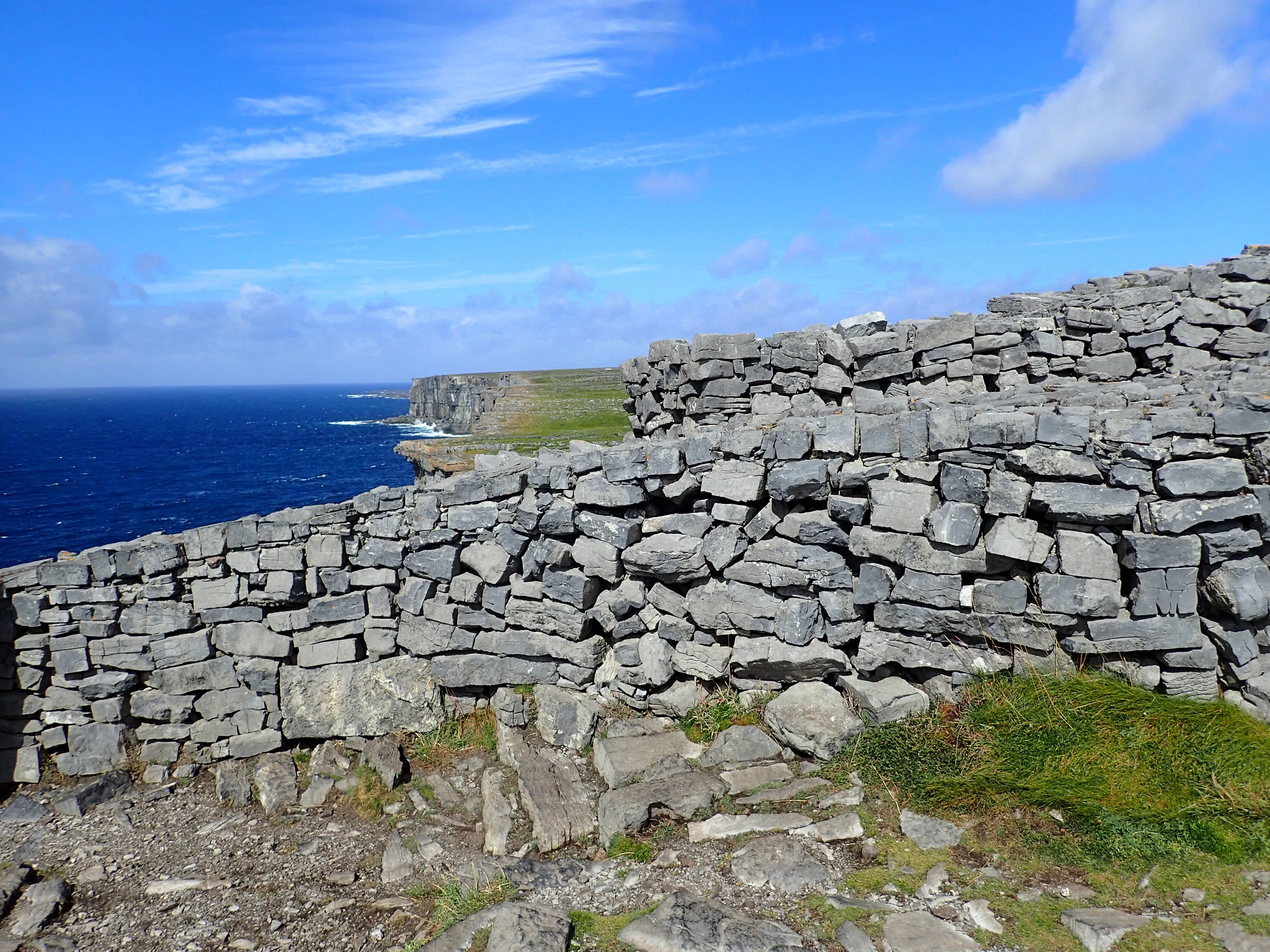
Dún Aonghasa (Irish: Dún Aonghasa) is a Bronze Age cliff fort on the southwestern edge of Inis Mór whose semicircular walls — built in three concentric rings from the unmortared limestone of the island — end abruptly at a sheer 100-metre drop into the Atlantic. Dating in its current form to approximately 1100 BCE (though the site shows evidence of earlier activity going back to 1500 BCE), it is one of the most impressive prehistoric monuments in Europe, and also one of the most vertiginous: there are no railings at the cliff edge, and the view straight down into the Atlantic swell is unobstructed. The chevaux-de-frise — a field of sharp-edged limestone slabs set upright in the ground between the outer walls to slow attacking forces — is an extraordinary defensive feature that survives in almost complete condition. Archaeologists remain uncertain whether the fort was defensive, ceremonial, or both.
Is it possible to visit the Aran Islands without speaking Irish?
Entirely — English is spoken throughout, and islanders are warm and hospitable to visitors. But the islands are one of the strongest Irish-speaking communities (Gaeltacht) in Ireland, with Irish (Gaeilge) as the daily language of conversation among islanders, in schools, in shops, and between neighbours. Roadsigns are in Irish only; the pub conversations around you will often be in Irish; and the cultural atmosphere — built on oral tradition, sean-nós (old style unaccompanied singing), and island crafts including the distinctive Aran sweater (whose intricate cable patterns were once unique to each family) — is Gaelic in a way that the mainland rarely achieves. A local island guide who speaks both Irish and English adds a dimension to the visit that ferry-and-bike independent travel alone cannot replicate.
How do I do a day trip to the Aran Islands from Galway?
The standard Galway day trip runs to Inis Mór, the largest island. A shuttle bus from Galway city centre connects with the Aran Island Ferries sailing from Rossaveal pier, 45 km west of the city; the crossing takes about 45 minutes, the first boat leaves around 9 AM, and the last return is by early evening in summer. All-in day-trip packages bundling the shuttle, return ferry, and often bike hire and Dún Aonghasa entry cost roughly €45–60 from Galway. Take the morning ferry, hire a bike at Kilronan pier, ride the 7 km up to Dún Aonghasa first, and you can still fit the Seven Churches and the Worm Hole before the afternoon boat back — a full day without ever feeling rushed.
Is an Aran Islands day trip worth it, or should you skip it?
For most visitors to Galway it is emphatically worth it: Dún Aonghasa on the cliff edge, a genuine Gaeltacht where Irish is still the daily language, and the slow rhythm of cycling stone-walled lanes are experiences the mainland cannot match, and a day here comfortably rivals the more crowded Cliffs of Moher. Reconsider or adjust if you are prone to seasickness (the Atlantic crossing can be genuinely rough in wind), if bad weather has closed in (Dún Aonghasa's unrailed 100-metre cliff loses much of its point in dense cloud), or if you have only half a day — in any of those cases the shorter, gentler hop to Inis Oírr is the better call. What you should not expect is a beach resort: this is a wild, spare limestone island, and that austerity is precisely the appeal.
Should I choose Inis Mór or Inis Oírr for a day trip?
Inis Mór is the right choice for a first visit and a full day: it holds the headline sights — Dún Aonghasa, the Seven Churches, and the Worm Hole — but at 14 km long it genuinely needs a bike or a minibus tour to cover, and the ride up to the fort involves a steady climb. Inis Oírr, the smallest island, suits a shorter or more relaxed trip: it is compact enough to explore on foot in a few hours, sits closest to the mainland (and is reachable in about 15 minutes on the Doolin ferry from County Clare as well as from Rossaveal), and rewards visitors with O'Brien's Castle, the rusting wreck of the MV Plassey on its beach, and a gentler, less-visited feel. Inis Meáin, the middle island, is for travellers deliberately seeking solitude rather than sights.