
.jpg)
Overview
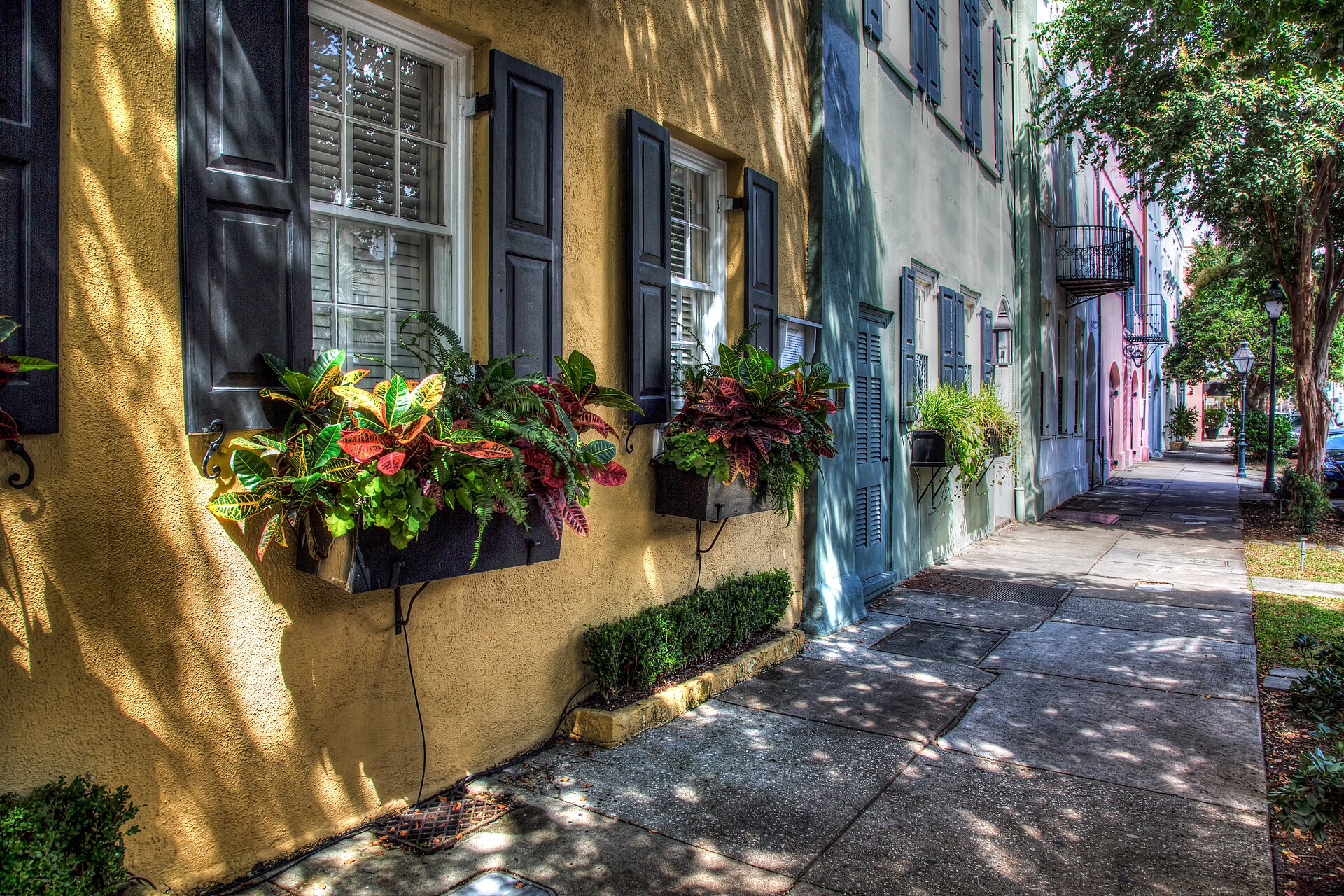
Rainbow Row is a series of thirteen colourful Georgian rowhouses lining East Bay Street between Tradd Street and Elliott Street in Charleston's Historic District. Built between roughly 1740 and 1845, these homes represent the longest cluster of Georgian-style rowhouses in the United States, and their candy-coloured facades -- pink, blue, yellow, peach, lavender, mint -- have become the single most iconic image of the city. The houses were originally constructed as merchant shops with living quarters above, their ground floors opening directly onto the wharves that once lined the waterfront before the city extended its land eastward through fill.
By the early 20th century, the row had fallen into disrepair, and it was the vision of preservationist Dorothy Porcher Legge who purchased and restored them beginning in 1931, painting the first house a soft Caribbean pink that inspired the rainbow palette that followed. The pastel colour scheme has a practical origin that guides explain on walking tours: Caribbean influence. Charleston's merchant class traded extensively with Barbados and other West Indian islands, and the bright hues served to help illiterate sailors identify which shop they were looking for on a busy wharf. Whether this folk explanation is fully historical or partly romantic, the tradition stuck. Today each homeowner maintains the pastel tradition, though the specific shades shift over the years as houses are repainted. The row sits just steps from The Battery promenade and a short walk from the Charleston City Market, making it a natural anchor point for any walking tour of the historic peninsula.
Historical Significance
Without context, Rainbow Row is a beautiful photo opportunity and nothing more -- thirteen pretty houses in a line. With a guide, each house becomes a chapter in Charleston's commercial history, from the colonial merchants who built ground-floor counting houses to the enslaved workers who loaded cargo on the wharves that once lapped at these foundations. Guides point out architectural details invisible to the casual observer: the earthquake bolts added after the devastating 1886 earthquake, the single house design where the narrow end faces the street and the piazza runs along the long side to catch the prevailing harbour breeze, and the subtle differences in window proportions and fanlights that distinguish Georgian from later Federal renovations.
Dorothy Legge's restoration of Rainbow Row in the 1930s was a pivotal moment in American preservation history. At a time when most cities were demolishing their colonial buildings for modern development, Charleston chose to protect them -- and Rainbow Row became the poster child for that movement. Guides who understand this context explain how one woman's purchase of a single dilapidated townhouse catalysed a preservation ethic that eventually protected over 2,800 buildings in the Historic District and inspired similar movements in cities like Savannah, New Orleans, and Boston.
Architecture
99 East Bay (the pink house): Dorothy Legge's first restoration in 1931, painted Caribbean pink, which sparked the entire Rainbow Row colour tradition. Georgian architectural details: Look for the symmetrical facades, double-hung sash windows, and fanlights above doorways that define the Georgian style of the 1740s-1780s.
Original wharf level: The ground-floor storefronts once opened directly onto the waterfront before land reclamation pushed the harbour edge eastward by several blocks. Earthquake bolts: Star-shaped and circular iron plates visible on many facades are not decorative -- they anchor iron rods running through the buildings, added after the 1886 earthquake that destroyed much of the city. Window box gardens: Homeowners maintain elaborate seasonal plantings in their window boxes, and the combination of pastel walls and cascading flowers creates compositions that vary with every visit.
When to Visit
Best light for photos: Early morning between 7 and 9 AM, when the eastern sun hits the facades directly and casts a warm glow on the pastel colours with minimal shadows. Fewest crowds: Weekday mornings before 10 AM or late afternoon after 4 PM. Tour groups typically pass through between 10 AM and 2 PM.
Spring blooms: March through May brings window boxes overflowing with flowers, adding another layer of colour to the already vivid streetscape. After rain: The wet cobblestones reflect the pastel hues, creating mirror-image compositions that photographers prize.
Admission and Costs
Viewing and photographing: Completely free. Rainbow Row is a public street and the houses are visible from the sidewalk at all times. Group walking tour including Rainbow Row: $25-40 per person, typically part of a 2-hour Historic District tour that also covers The Battery and Church Street.
Private architecture tour: $200-375 for up to 6 people, with deep focus on the Georgian, Federal, and antebellum styles that define the surrounding blocks. Photography-focused tour: $150-250 for private sessions with guides who know optimal angles, lighting conditions, and lesser-photographed details.
Tips for Visitors
Private residences: All thirteen houses are occupied private homes. Do not enter gates, climb stairs, or peer through windows -- photograph from the sidewalk and street. Cross the street for full perspective: The best overall views of the row come from the east side of East Bay Street, where you can capture several houses in a single frame.
Combine with The Battery: The Battery is a 5-minute walk south along East Bay Street, making them a natural pair on any walking tour. Parking nearby: Street metered parking on East Bay is extremely limited. Walk from the Visitor Centre or use a rideshare. Respect the neighbours: Keep voices low, especially early morning and evening. These are not museum exhibits but family homes whose residents live with constant foot traffic outside their windows.