
Walking Route
Photo Spots
The mansions along South Battery and East Battery are private residences that visitors cannot enter. Without a guide, they are magnificent facades that reveal nothing of the families, fortunes, and catastrophes behind them. With a guide, each becomes a narrative: the family that survived the 1886 earthquake only to see a third-floor ballroom crack apart, the mansion that served as a Confederate headquarters, or the widow who kept her home for decades by selling portions of the garden. The one house whose interior you can actually see is the Edmondston-Alston House at 21 East Battery, whose second-floor piazza frames the exact harbour view over which the Fort Sumter bombardment unfolded.
The best vantages, in the order a seawall walk reaches them:
- High Battery at sunrise -- the raised east-facing seawall near Water Street catches the first light on the harbour; arrive before 7 AM for warm tones and empty paths.
- The point -- where East Battery bends into Murray Boulevard, the widest panorama takes in Fort Sumter, Fort Moultrie, and Castle Pinckney in a single frame.
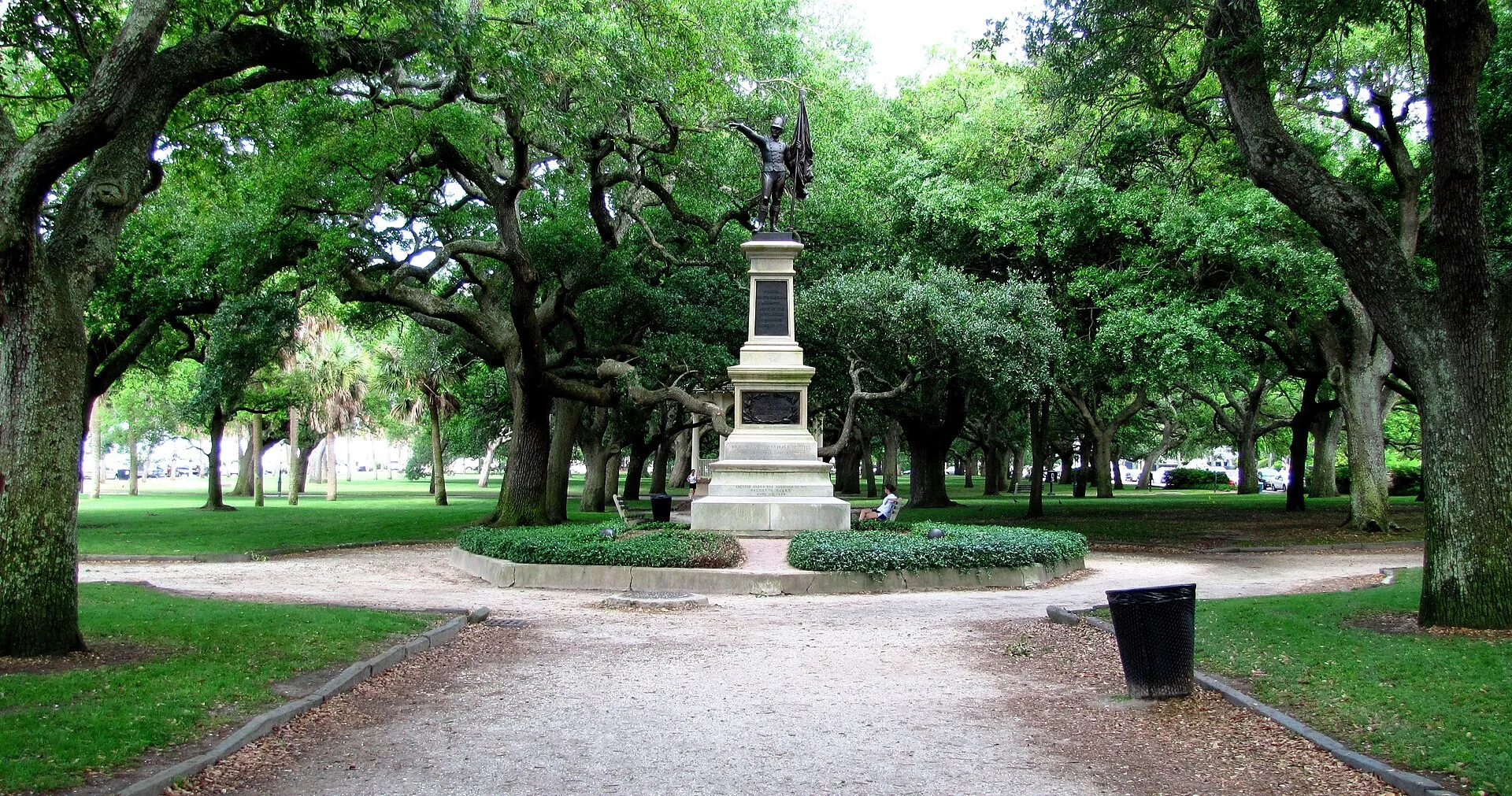
- White Point Garden bandstand -- the Victorian cast-iron bandstand under the live oaks makes a shaded, quintessentially Charleston composition.
- Murray Boulevard at sunset -- the quieter west-side seawall looks over the Ashley River marshes toward James Island as the light drops.
The military history embedded in White Point Garden adds another layer. Guides explain the strategic significance of the harbour position, the types of artillery on display, and the link between the cannon here and the bombardment of Fort Sumter directly across the water. Pirate history also surfaces -- the garden was the execution ground for Stede Bonnet and his crew in 1718, and guides who know the colonial court records can reconstruct the trial and hanging that took place on this very soil. These overlapping narratives -- colonial, military, architectural, social -- are invisible without interpretation but extraordinarily vivid with it.
Landmarks Along
- Edmondston-Alston House -- The lone Battery mansion open for tours, an 1825 merchant's house at 21 East Battery whose piazza commands the harbour and the Fort Sumter view.
- Antebellum mansions -- The homes along South Battery and East Battery represent the pinnacle of pre-Civil War Southern architecture, with Greek Revival, Italianate, and Colonial Revival styles all within a few blocks.
- Civil War artillery -- Original cannon and mortar from the Confederate defences remain on display in White Point Garden, positioned to face the harbour they once guarded.
- Harbour panorama -- Fort Sumter, Fort Moultrie, Castle Pinckney, and the barrier islands are all visible from the seawall, with cargo ships passing through the channel.
- White Point Garden -- Ancient live oaks, palmetto palms, and a Victorian bandstand create a shaded retreat at the peninsula's tip, the city's original public promenade since 1837.
- Pirate history -- The site where Stede Bonnet, the "Gentleman Pirate," and 29 of his crew were publicly hanged in 1718 after their capture near the harbour entrance.
The Battery timeline
- 1670s
Oyster Point at the peninsula's tip
When Charles Towne took root, the marshy southern point was called White Point for the sun-bleached oyster shells that whitened its shore.
-
The Gentleman Pirate hanged at White Point
Stede Bonnet and some 29 of his crew were tried in Charleston and publicly hanged at the point after their capture near the harbour, a warning to every pirate working the Carolina coast.
- Early 1800s
Gun batteries fortify the seawall
Coastal artillery mounted along the raised seawall to guard the harbour entrance gave the promenade the name it still carries today - the Battery.
-
White Point Garden opens as a public park
The city laid out the point as a landscaped public promenade and planted the live oaks that now shade its walks and benches.
- 1850s
East Battery lined with grand mansions
Rice and cotton fortunes raised the three- and four-storey antebellum houses, their double piazzas turned to catch the harbour breeze, that define East and South Battery.
-
Charleston watches Fort Sumter shelled
On 12 April 1861 residents crowded the Battery to watch Confederate guns open fire on Fort Sumter across the harbour, the opening engagement of the Civil War.
-
The great earthquake strikes
The magnitude-7 earthquake cracked chimneys and walls along the Battery; the iron earthquake bolts bracing many facades date from the repairs that followed.
-
Hurricane Hugo floods the seawall
Hugo's storm surge poured over the Battery seawall and into the streets behind it, one of the worst floods in the district's modern history.
When to Visit
Access: the seawall, White Point Garden, and the surrounding sidewalks are public and open 24 hours, free to visit any time. Best for walking: early morning for soft light on the mansions and empty paths, or late afternoon into sunset for harbour views. Guided-tour hours: most walking and carriage tours pass through between 10 AM and 2 PM, so plan your visit outside that window for a quieter experience.
Seasonally, April and October are the standout months on our ratings -- comfortable temperatures, clear light, and the mansions at their most photogenic. Note the practical rhythms of a Lowcountry visit:
- Spring and autumn offer the most comfortable walking weather and the best photographic light.
- Summer afternoons bring sudden thunderstorms off the harbour; the shadeless seawall gets genuinely hot, so walk early and carry water.
- Hurricane season peaks from August into October -- the same storms that occasionally send surge over the seawall, as Hurricane Hugo did in 1989 -- so watch the forecast if you travel in early autumn.
Admission and Costs
Walking the promenade and White Point Garden is completely free at all times, with nothing to book and no admission gate. The costs are all optional -- interpretation, access, and comfort.
- Group walking tour including The Battery -- $25-40 per person, typically a 2-hour route that also covers Rainbow Row and the Historic District.
- Private mansion and architecture tour -- $200-375 for up to six people, with detailed analysis of the Battery-facing homes.
- Horse-drawn carriage tour passing The Battery -- $35-55 per person, roughly an hour; the exact route depends on a random zone lottery, so The Battery is not guaranteed on every ride.
- Edmondston-Alston House museum, 21 East Battery -- about $15 for adults, the one Battery mansion you can tour inside.
Tip walking guides $5-10 per person, or 15-20% on a private tour. Most other headline peninsula sights -- Rainbow Row, the Charleston City Market -- are also free to see; the ticketed exceptions are the Fort Sumter ferry and the gardens at Magnolia Plantation up the Ashley River.
The Case for a Guide
A guide is what turns a pleasant seawall stroll into a reading of Charleston itself. The Battery has no ticket booth, no signage, and no interior to enter beyond a single house museum, so everything that makes the point significant -- four centuries of harbour history, the stories behind each mansion, the strategy behind the guns -- is invisible without someone to narrate it. Charleston sets an unusually high bar for that narration: licensed city guides must pass a rigorous written examination covering some 300 years of local history and architecture before they can work, so a credentialed guide arrives with genuine depth rather than a memorised script.
- They decode the architecture -- separating Greek Revival from Italianate and Colonial Revival work, and pointing out the single-house piazzas, ironwork, and earthquake bolts you would otherwise walk straight past.
- They read the harbour -- placing Fort Sumter, Fort Moultrie, and Castle Pinckney in the story of secession, bombardment, and blockade.
- They separate history from folklore -- putting the Stede Bonnet hangings, the Civil War batteries, and the antebellum fortunes in their true chronological order.
- They sequence the peninsula -- chaining The Battery naturally into Rainbow Row, the Charleston City Market, and the Fort Sumter ferry so the city's story builds rather than blurs.
Tips for Visitors
- Start at Rainbow Row: walk south along East Bay Street, which becomes East Battery, for a continuous architectural tour covering about half a mile of Charleston's finest streetscape before you reach the point.
- Sunrise photographers: the east-facing seawall catches the first light directly on the harbour and fort. Arrive before 7 AM for golden tones and empty paths.
- Respect the residences: the Battery mansions are occupied homes. Admire and photograph from the sidewalk, but do not enter gardens or approach porches -- the Edmondston-Alston House is the only one you can legitimately go inside.
- Parking: metered street parking along Murray Boulevard (the west side of the peninsula) is slightly easier to find than East Battery; a 10-minute walk brings you to the point.
- Combine with the fort: the Fort Sumter ferry departs from Liberty Square, a 15-minute walk north along the waterfront, making a natural full-morning itinerary.
- Bench breaks: White Point Garden has plenty of benches beneath the live oaks -- pack a water bottle and take your time absorbing the view.
- Footwear: the surrounding brick and tabby sidewalks are historic and uneven, so flat, sturdy shoes matter more here than in most cities.
Frequently Asked Questions
When are The Battery and White Point Garden open to visitors?
The seawall, White Point Garden, and the surrounding sidewalks are public and open at all hours, free to visit any time. For the best walk, come at early morning for soft light on the mansions and empty paths, or late afternoon for harbour sunset views. Guided walking tours mostly pass through between 10 AM and 2 PM, so visit outside that window if you want the promenade to yourself.
Is The Battery free to visit?
Walking the promenade and White Point Garden is completely free at all times. A group walking tour that includes The Battery runs about $25-40 per person, typically as part of a 2-hour route that also covers Rainbow Row and the Historic District. The only ticketed thing at the point itself is the Edmondston-Alston House museum at 21 East Battery, roughly $15 for adults.
Can you go inside any of the Battery mansions?
Almost all of the houses along East Battery and South Battery are private, occupied residences you can only admire from the sidewalk. The one exception is the Edmondston-Alston House at 21 East Battery, an 1825 merchant's mansion run as a house museum, whose piazza offers the same harbour view from which Confederate officers watched the shelling of Fort Sumter in 1861.
What is the best route for walking The Battery?
Start at Rainbow Row and walk south along East Bay Street, which becomes East Battery, for a continuous architectural tour covering about half a mile of Charleston's finest streetscape. Follow the raised seawall to the point at White Point Garden, then loop back along Murray Boulevard on the Ashley River side for quieter water views and, in the evening, the sunset.
How do I get to The Battery and where can I park?
The Battery sits at the southern tip of the peninsula, an easy 10-15 minute walk south from Rainbow Row, the City Market, or the Meeting Street visitor garage. Metered street parking along Murray Boulevard on the west side is usually easier to find than East Battery. The free DASH trolley serves the wider Historic District, but the closest stops leave a short walk down to the point.