
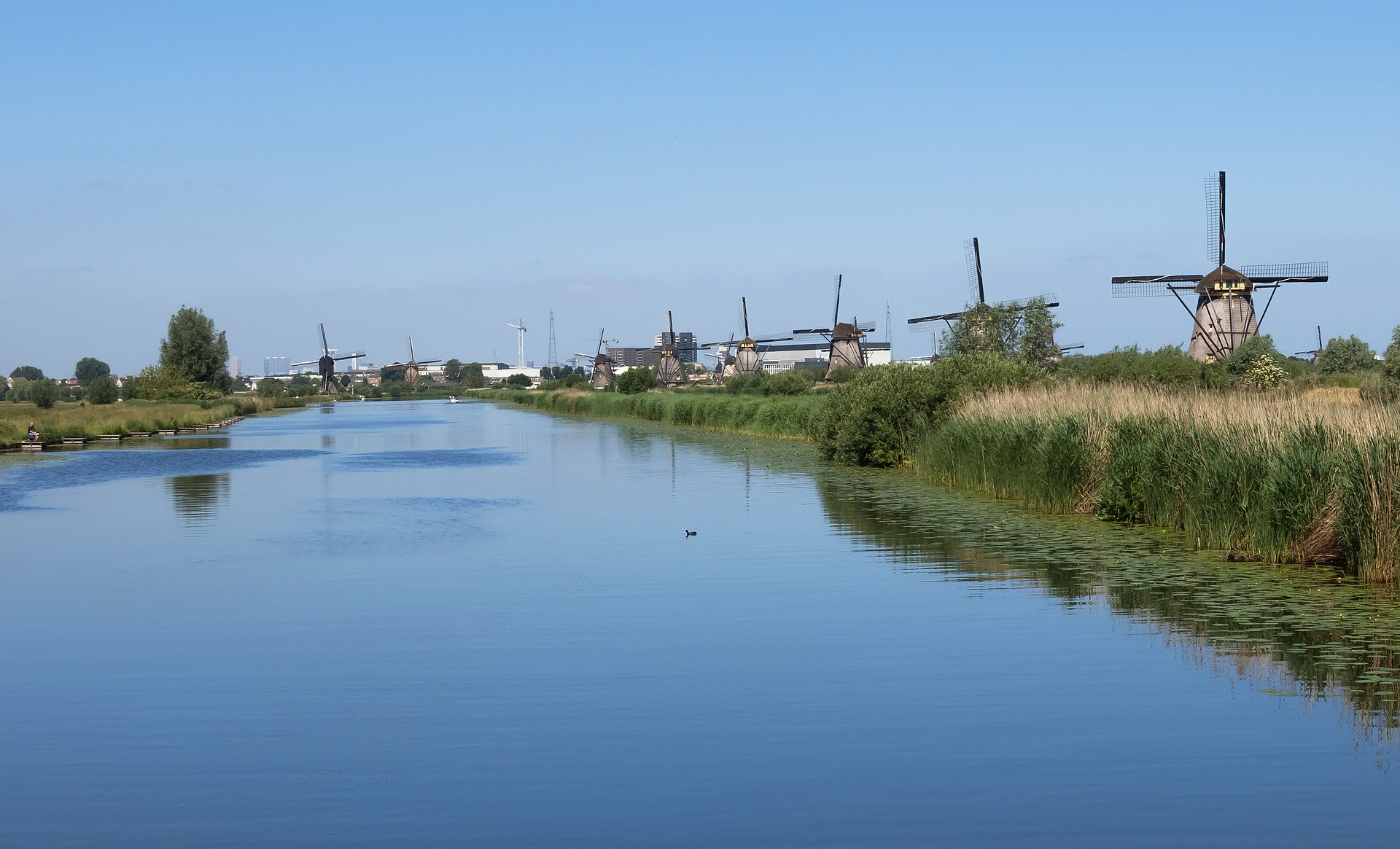

What makes Netherlands a must-visit destination?
The Netherlands defies its modest geography with outsized cultural influence. A country roughly the size of Maryland has produced Rembrandt, Vermeer, Van Gogh, and Mondrian, pioneered global trade through the Dutch East India Company, and engineered one of the world's most sophisticated water management systems — roughly a third of the country lies below sea level, protected by dikes, pumping stations, and the Delta Works barrier that UNESCO considers a modern wonder. Amsterdam draws most visitors with its 165 canals, world-class museums, and liberal atmosphere, but the country rewards deeper exploration: Rotterdam rebuilt itself after wartime destruction into Europe's most adventurous architectural laboratory, The Hague houses both the Dutch royal family and the International Court of Justice, Utrecht preserves medieval canal cellars converted into waterside terraces, and Delft continues producing the blue-and-white pottery that once competed with Chinese porcelain for global supremacy.
Dutch people speak English with near-native fluency — the highest proficiency of any non-native country — which can mislead visitors into thinking a guide is unnecessary. But a knowledgeable local transforms the experience: they explain why Dutch houses lean forward (to hoist furniture through windows too narrow for staircases), how the polder model of consensus politics shaped everything from business to urban planning, why Vermeer's light effects remain technically unreproducible, and how a nation of 17 million people became the world's second-largest agricultural exporter. The Netherlands packs centuries of history, artistic achievement, and engineering ingenuity into a landscape so flat you can see church spires from the next town over.
Where should you go in Netherlands?
Amsterdam & Utrecht
Amsterdam's concentric canals frame a city where the Rijksmuseum, the Van Gogh Museum, and the Anne Frank House each tell a different chapter of Dutch resilience and creativity. Utrecht hides its best feature below street level, where medieval canal wharves have been converted into waterside cafes beneath the shadow of the leaning Dom Tower, and the city's De Stijl heritage surfaces in Rietveld's iconic architecture.
Rotterdam & The Hague
Rotterdam wears its postwar reinvention proudly — Piet Blom's Cube Houses tilt at improbable angles, the cathedral-like Markthal shelters a food market beneath a painted ceiling, and the Erasmus Bridge slices across the Maas in a single asymmetric sweep. The Hague carries the weight of governance and justice: Vermeer's Girl with a Pearl Earring hangs in the Mauritshuis steps from the Binnenhof parliament complex, while the Peace Palace arbitrates disputes between nations.
Delft
Delft rounds out the picture with the quiet canals that Vermeer painted and workshops where artisans still hand-glaze the blue-and-white pottery that made the town famous across the globe.
Amsterdam
Golden Age canals, world-class museums, and a freewheeling spirit shaped by four centuries of tolerance
🏺Delft
Vermeer's city — canals, ceramics, and a Golden Age streetscape that inspired the world's most luminous paintings
🏗️Rotterdam
Europe's architectural laboratory — a city that rebuilt itself from wartime rubble into a showcase of radical design
👑The Hague
The Netherlands' seat of power — royal residences, international courts, Vermeer's masterpieces, and a North Sea
🏰Utrecht
Medieval canal cellars, the tallest church tower in the Netherlands, and a university city with more character than the
What do visitors need to know about Netherlands?
Finding a Guide
- Dutch city guide guilds — professional associations whose members hold certified qualifications; Amsterdam's guide guild is among Europe's oldest, with members undergoing rigorous art history, architecture, and city history training
- Rijksmuseum and Van Gogh Museum — offer expert-led group tours and private guide bookings; independent art historians provide specialized tours connecting multiple museums across a single day
- Guided cycling tours — the Netherlands has more bicycles than people; tours explore Amsterdam's neighborhoods, countryside windmill routes, tulip fields in season, and inter-city paths connecting Delft to The Hague in under an hour
- Private boat tours — in Amsterdam, skip the large tourist boats for smaller electric vessels where a guide-captain explains canal house gables, bridge mechanics, and the floating flower market from water level
Typical Costs
| Tour Type | Price Range |
|---|---|
| Free walking tour (tip expected) | €0 (€10–15 tip) |
| Group tour | €20–50 per person |
| Private half-day guide | €175–300 |
| Private full-day guide | €350–550 |
| Cycling tour | €30–55 per person |
| Specialist guide (half-day) | €200–400 |
Must-See Experiences
- Rijksmuseum, Amsterdam — Rembrandt's Night Watch anchors a collection spanning 800 years of Dutch art, displayed in a building that architect Pierre Cuypers designed as a cathedral to culture
- Mauritshuis, The Hague — Vermeer's Girl with a Pearl Earring and Rembrandt's The Anatomy Lesson of Dr. Nicolaes Tulp hang in an intimate 17th-century townhouse overlooking the Hofvijver pond
- Cube Houses, Rotterdam — Piet Blom's tilted cubes perch on concrete stilts like a geometric forest; one is open to visitors, revealing how people actually live at 45-degree angles
- Dom Tower, Utrecht — the tallest church tower in the Netherlands stands separated from its cathedral after a tornado destroyed the nave in 1674; climb 465 steps for views across four provinces
- Royal Delft — the last remaining Delftware factory from the 17th century, where artisans still hand-paint every tile and plate using techniques unchanged for 370 years
- Keukenhof Gardens — seven million bulbs bloom across 79 acres each spring (mid-March to mid-May) in the world's largest flower exhibition; book guides for tulip history and horticultural insight
Tips for Visitors
- Cycling etiquette — bike lanes are sacred; never walk in them, stand in them, or photograph from them; cyclists will not swerve; in Amsterdam alone, roughly 15,000 bikes are fished out of canals annually, so lock yours securely to fixed objects
- Tipping — service is included in Dutch restaurant bills; rounding up or leaving 5–10% for attentive service is appreciated but not obligatory; tipping guides €5–10 per person is standard for group tours
- Weather strategy — "there's no bad weather, only bad clothing" is a Dutch proverb for good reason; expect rain at any time between September and May; summer temperatures average 20–22°C (68–72°F), with occasional heat waves pushing above 30°C
- OV-chipkaart — buy an anonymous transit card for trains, trams, buses, and metros across the entire country; load credit and tap in/out
- Museum reservations — the Rijksmuseum, Van Gogh Museum, and Anne Frank House require advance timed-entry tickets; the Anne Frank House sells out weeks ahead
- Compact country — no Dutch city is more than three hours from any other by train; day trips from Amsterdam to Rotterdam (40 minutes), The Hague (50 minutes), Utrecht (25 minutes), or Delft (55 minutes) are effortless
- Coffeeshop vs. cafe — a "coffeeshop" sells cannabis (tolerated, regulated); a "cafe" or "koffiehuis" serves coffee; if you want espresso, don't walk into a coffeeshop by mistake
- Currency — the Netherlands uses the euro (EUR/€); card payment is universal and many Dutch businesses prefer it over cash; some operate cashless entirely
When is the best time to visit Netherlands?
Frequently Asked Questions
What is the best time of year to visit the Netherlands?
Late April through early May brings Keukenhof's tulip season and King's Day celebrations, making it the most iconic time to visit. Summer (June-August) offers the warmest weather at 20-22°C and long daylight hours, ideal for cycling and canal-side terraces. Autumn and winter are cooler and wetter but reward visitors with fewer crowds, lower prices, and atmospheric events like Sinterklaas in December. Rain is possible year-round, so pack layers and a waterproof jacket regardless of season.
How much does a private tour guide cost in the Netherlands?
Amsterdam offers free walking tours where tipping €10-15 is customary for a two-hour route through the canal ring. Private half-day guides range from €175 to €300 and cover multiple museums or neighborhoods. Full-day rates run €350-550, with specialist art or architecture guides closer to €400. Cycling tours average €30-55 per person and are a quintessentially Dutch way to see the countryside.
Do I need to speak the local language to travel in the Netherlands?
Dutch people speak English with near-native fluency — the highest proficiency of any non-native country — which can mislead visitors into thinking a guide is unnecessary. But a knowledgeable local explains why Dutch houses lean forward, how the polder model shaped the nation's consensus culture, and why Vermeer's light effects remain technically unreproducible. The depth a guide adds goes far beyond translation.