
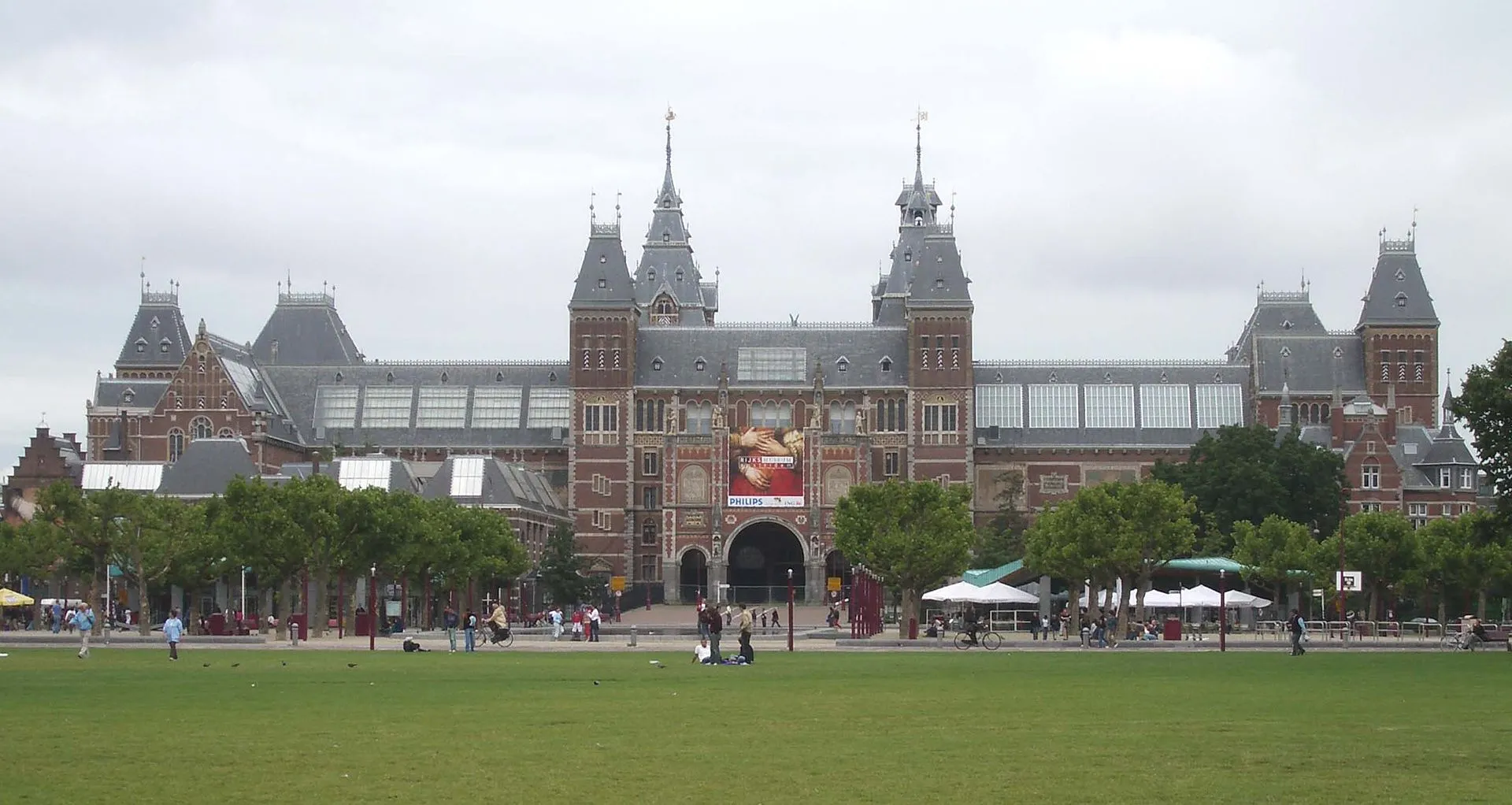
Collection Highlights
The Night Watch (Rembrandt, 1642)
Rembrandt's largest and most ambitious canvas dominates the far wall of the Gallery of Honour, breaking with the static group portrait to catch a militia company mid-movement. Since 2019 it has been the focus of Operation Night Watch, whose imaging and AI analysis keep revealing lost detail — a guide can point out what has been uncovered.
The Milkmaid (Vermeer, c. 1660)
Vermeer's mastery of light — sunlight on crusty bread, the rough plaster wall, milk falling in a thin stream — achieves something photographic two centuries before photography. One of only four Vermeers the Rijksmuseum holds from the 36 known worldwide, and small enough that patient viewers are rewarded up close.
The Gallery of Honour
The restored nave-like corridor that organises the whole visit, lined with the masterpieces of the Golden Age — Hals, Steen, Vermeer, and De Hooch — and drawing the eye toward the Night Watch at its end. Arriving here first, before the crowds, is the single best-timed move in the museum.
The Cuypers Library
The largest art-history research library in the Netherlands occupies a soaring reading room ringed by wrought-iron balconies and spiral staircases. One of Europe's most photogenic library spaces, it sits just off the Gallery of Honour, yet most visitors walk past without ever finding it.
Period Rooms and dolls' houses
Reconstructed Dutch interiors trace domestic life from the 17th to the 19th centuries — canal-house parlours with painted ceilings, a working pharmacy, and cabinet dolls' houses so lavishly furnished they once cost as much as a real house, offering a tangible sense of how Golden Age wealth was lived day to day.
Maritime Special Collections
Rigged ship models, navigational instruments, and richly decorated sterns trace the Dutch East India Company's transformation of global trade — and the colonial exploitation that financed Amsterdam's prosperity. The Special Collections floor also gathers arms, glass, and magic lanterns among its curiosities.
The Asian Pavilion
A free-standing pavilion set apart from the main building holds Buddhist and Hindu sculpture, Chinese and Japanese art rarely seen outside Asia, including a serene dancing Shiva and temple guardians — a quiet counterpoint to the Dutch galleries and usually far less crowded.
The gardens and cycle passage
The free sculpture gardens frame the building with fountains, hedges, and architectural fragments rescued from demolished Dutch buildings, plus a cafe away from the crowds. Beneath them runs the public passageway where cyclists still ride straight through the museum, a legacy of a citizen's legal right of way.
Collections Highlights
The Rijksmuseum's centre of gravity is the Dutch Golden Age: the 17th-century rooms concentrate the greatest surviving body of Dutch painting anywhere, from Frans Hals's laughing portraits and Jan Steen's morally loaded household chaos to the luminous domestic worlds of Vermeer and Pieter de Hooch. Around that core the collection fans out in every direction. The applied-arts galleries trace Delftware, silver, and furniture that turned imported ideas — Chinese porcelain, Japanese lacquer — into a distinctly Dutch material culture built on global trade. The Special Collections floor gathers the museum's stranger treasures: intricately rigged ship models, ornate weapons, magic lanterns, and dolls' houses that cost as much as real canal homes. The period rooms reconstruct Dutch interiors from the 17th to the 19th centuries, while upper floors carry the story into the twentieth with design, De Stijl, and photography. Reading the collection this way — as one continuous argument about a small nation's outsized reach — is exactly what a guide supplies that the free app cannot.
Guided Tours
A guide trained in Dutch art history transforms the Rijksmuseum from an overwhelming 80-gallery maze into a coherent narrative. The standard 2-hour private tour covers the Gallery of Honour highlights — Night Watch, The Milkmaid, The Merry Drinker — while weaving in the social and economic context of the Dutch Golden Age that produced them. Specialist tours focus on Rembrandt's technique (his use of impasto and chiaroscuro), Vermeer's optical innovations (the camera obscura theory), or the colonial trade history embedded in the maritime and Delftware collections. Combine a Rijksmuseum visit with the Van Gogh Museum across Museumplein for a full day of Dutch art history, or pair with the Royal Palace on Dam Square for Golden Age architecture and governance context.
When to Visit
Open daily 9:00-17:00, every day of the year including public holidays. For the calmest experience, arrive right at 9:00 and walk straight to the Gallery of Honour before the tour groups arrive, or come after 15:00, when morning coach groups begin to leave. The busiest window is 11:00-14:00, especially at weekends and during Dutch school holidays; Monday and Tuesday mornings and Friday afternoons are usually the quietest. Allow 2 hours for the highlights and 4 hours for a thorough visit. The museum stands on Museumplein, a few minutes' walk from the Van Gogh Museum: trams 2 and 12 stop directly outside at the Rijksmuseum stop, with lines 2, 5, and 12 running from Amsterdam Centraal toward the museum quarter. The galleries are step-free and wheelchair-accessible throughout, with lifts to every floor and wheelchairs and folding stools available to borrow free of charge.
Admission and Costs
General admission €22.50 (about US$24) for adults; free for under-18s. A guided group tour adds a €5 supplement on top of admission (45 minutes, gallery highlights); a private guide runs €150-250 (about US$160-270) for 2 hours, booked independently with museum entry paid separately. The multimedia tour on the free Rijksmuseum app is included with admission and has replaced the old handset audio guide. Frequent museum-goers should weigh the Museumkaart, an annual pass (€65, about US$70) that covers unlimited entry to the Rijksmuseum and 400+ other Dutch museums; the I amsterdam City Card also bundles admission with public transport and a canal cruise.
The Case for a Guide
The Rijksmuseum's 80 galleries reward a slower, more informed visit — a guide trained in Dutch art history transforms the walk from masterpiece to masterpiece into a coherent account of why a small maritime nation produced the most astonishing burst of painting in European history.
- Night Watch militia's refusal to pay: The militia company that commissioned the painting apparently refused to accept it on delivery, possibly because Rembrandt depicted them in dynamic action rather than the conventional posed group portrait they expected; guides explain the social contract between painter and patron in 17th-century Amsterdam and trace the painting's troubled early history before it became a national icon.
- Vermeer's light technique unpacked: Of the 36 known Vermeer paintings, the Rijksmuseum holds four; guides explain the camera obscura theory, identify the specific window angle used in The Milkmaid, and describe how Vermeer ground his own lapis lazuli pigment — one reason he produced so few works and died in debt.
- The 80-year construction and renovation history: Cuypers designed the building in 1885 but it closed entirely in 2003 and spent a decade and €375 million being renovated; guides explain the restoration's most difficult challenge — how to return natural light to galleries while routing cyclists through the ground-floor passage as per a citizen's legal right.
- Dutch Golden Age trading empire context: The maritime and Delftware collections document an empire built on the VOC's spice monopoly; guides explain that the wealth funding Rembrandt's commissions and Vermeer's patrons flowed directly from forced labour on Indonesian nutmeg plantations, giving the Golden Age paintings a moral complexity invisible without historical framing.
- Hidden symbols in genre paintings: Jan Steen's chaotic domestic scenes contain deliberate moral messages — overturned shoes, burning candles, playing children — that 17th-century Dutch audiences read immediately; guides decode this symbolic vocabulary, turning apparently lighthearted tavern scenes into cautionary stories about virtue, sin, and social order.
Tips for Visitors
- Book a timed-entry ticket online before you go: the museum regularly reaches capacity, and walk-ups risk long queues or being turned away.
- Use the garden (Atrium) entrance: the second entrance on the garden side is usually quieter than the main passage during peak hours.
- Download the free Rijksmuseum app: it provides multimedia tours, floor maps, and lets you bookmark works to find later — it has replaced the old audio guide.
- Check your coat and bags: the cloakroom is free and mandatory for large bags and umbrellas, with lockers for smaller items — arrive prepared to check belongings.
- Photography is allowed without flash or tripod; the Night Watch wall is perpetually crowded, so patience yields better photos than elbowing to the front.
- Take a break in the gardens: free to enter and dotted with sculpture and architectural fragments, they hide a quiet cafe well away from the crowds.
- Pair it wisely: combine the museum with the Van Gogh Museum across Museumplein — possible in one day but tiring, so many visitors split it across two mornings — or add the nearby Royal Palace or a wander into the Jordaan.
Frequently Asked Questions
What are the opening hours of the Rijksmuseum?
The Rijksmuseum is open daily 9:00-17:00, every day of the year including public holidays. For the calmest visit, arrive at opening (9:00) and head straight to the Gallery of Honour, or come after 15:00 when morning tour groups begin to leave.
What does admission to the Rijksmuseum cost?
General admission is €22.50 (about US$24) for adults and free for under-18s. A guided group tour adds a €5 supplement (45 minutes, gallery highlights); a private guide runs €150-250 (about US$160-270) for two hours, with museum entry booked separately.
How should visitors book Rijksmuseum tickets?
Advance timed-entry tickets are essential: buy them online before you go, because the museum frequently reaches capacity and walk-ups risk long waits or being turned away. The garden-side Atrium entrance is usually quieter than the main passage at peak times.
How much time do you need at the Rijksmuseum, and what should you prioritise?
Allow at least two hours for the highlights and up to four for a thorough visit. If time is short, walk the Gallery of Honour first — Rembrandt's Night Watch and Vermeer's Milkmaid — then choose one further wing: the maritime Special Collections, the period rooms, or the Asian Pavilion.
Is the Rijksmuseum wheelchair accessible?
Yes. The galleries are step-free throughout, with lifts serving every floor and the Gallery of Honour, and wheelchairs and folding stools can be borrowed free of charge. Accessible toilets and a barrier-free garden entrance make the whole route navigable for visitors with reduced mobility.
How do you get to the Rijksmuseum?
The museum stands on Museumplein, a few minutes' walk from the Van Gogh Museum. Trams 2 and 12 stop directly outside at the Rijksmuseum stop, with lines 2, 5, and 12 running from Amsterdam Centraal toward the museum quarter; the flat, well-signposted route also makes it an easy cycle or walk from the canal ring.
Can you visit the Rijksmuseum and Van Gogh Museum on the same day?
You can — the two face each other across Museumplein, only a few minutes apart. Doing both in one day is feasible but intense, so many visitors take one in the morning and the other after a lunch break, or split them across two mornings to keep fresh eyes for the art.