
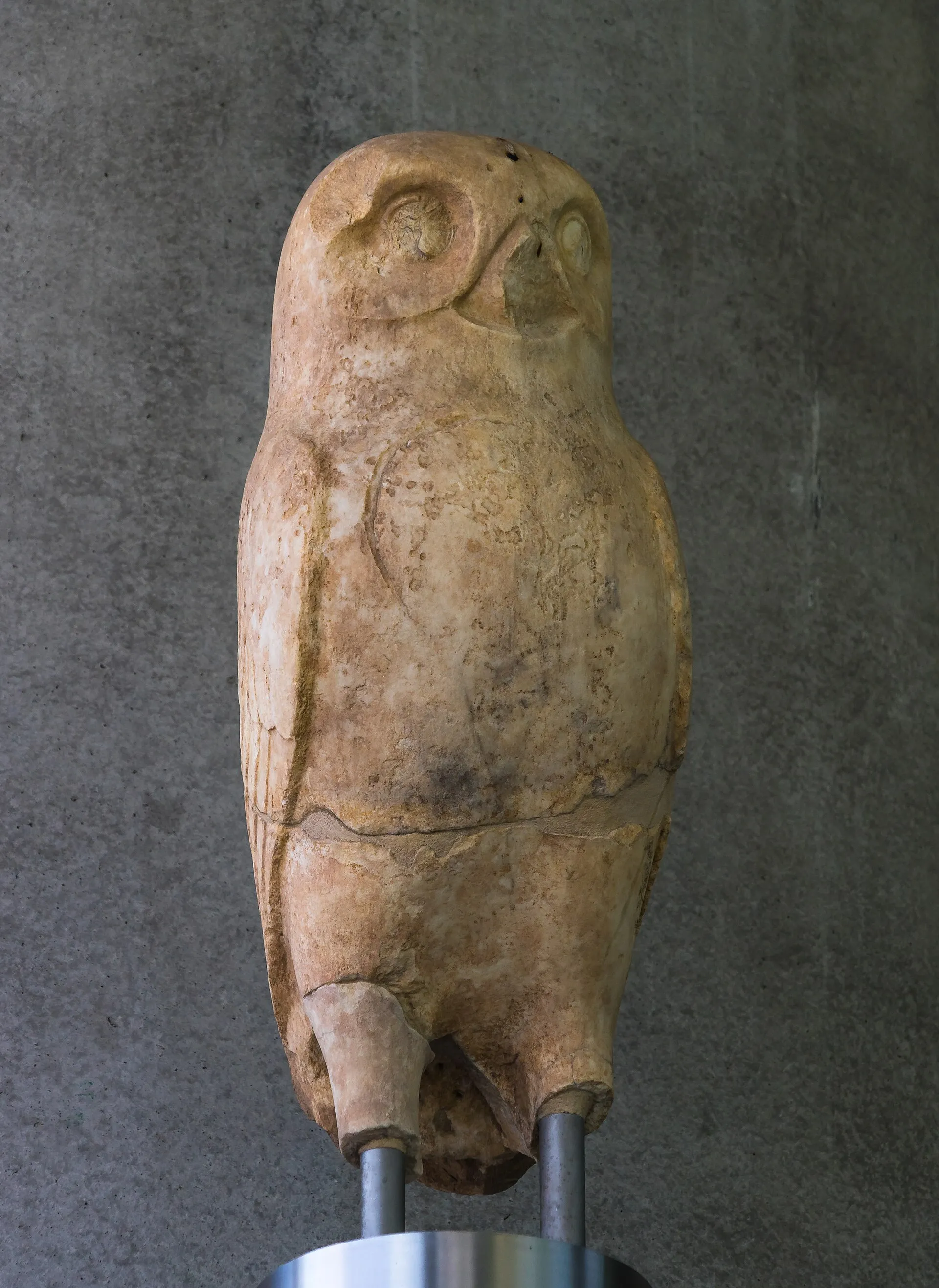
Collection Highlights
The Parthenon Frieze
The 160-metre marble relief of the Panathenaic procession wraps the top-floor gallery at eye level, displayed in the exact orientation of the temple visible through the glass walls. Surviving original blocks stand beside pale plaster casts of the pieces now held in London and other museums.
The Caryatids
Five of the six original maiden columns from the Erechtheion porch stand on a dedicated balcony, cleaned by laser to reveal their draped robes and braided hair. The sixth was removed by Lord Elgin and remains in the British Museum, a gap the display leaves pointedly visible.
The Moschophoros (Calf-Bearer)
Carved around 570 BC, this Archaic statue of a bearded man carrying a calf to sacrifice is among the earliest large-scale marble figures from the Acropolis, remarkable for its warm, almost smiling expression and its near-complete preservation.
The Kritios Boy
Sculpted about 480 BC, this youth marks the moment Greek art broke from rigid Archaic poses into naturalism, his weight shifted onto one leg in the earliest known contrapposto stance. He was recovered from the Persian destruction debris on the Acropolis.
The Peplos Kore
One of the most beloved Archaic Kore statues, carved around 530 BC and named for the woollen peplos she wears. Traces of pigment show she was once vividly painted, a reminder that classical marble was never the blank white it appears today.
The Rampin Horseman
A rare Archaic equestrian statue from about 550 BC, its rider's head a cast of the original now in the Louvre. The finely carved beard and victor's wreath show the Archaic sculptor's love of pattern and precise detail.
The Pediment Sculptures
Fragments from the Parthenon and earlier temples depict gods and giants locked in the Gigantomachy and other mythic battles that once filled the triangular gable ends, displayed so you can read the compositions across the top-floor gallery.
The Excavation Beneath the Glass
The museum is built on stilts over an excavated Athenian neighbourhood inhabited from Classical to Byzantine times. Opened to visitors in 2019, the ruins of houses, workshops, streets, and baths are visible through glass floors and along a walkway below the entrance.
Collections Highlights
The visit unfolds as a climb through time. The gently sloping ground-floor Gallery of the Slopes of the Acropolis gathers finds from the sanctuaries and homes that ringed the rock -- votive offerings, marriage vessels, and everyday objects -- beneath a transparent floor that reveals the excavation below. The first-floor Archaic Gallery is the collection's beating heart: a forest of Kore statues in their original painted finery, the Moschophoros (Calf-Bearer) of about 570 BC, the Peplos Kore of around 530 BC, the transitional Kritios Boy of roughly 480 BC, and the Rampin Horseman -- many of them recovered from the Perserschutt rubble the Athenians buried after the Persian sack of 480 BC, the same layer excavated on the Acropolis itself. A dedicated balcony holds the five original Caryatids from the Erechtheion porch, lit and spaced so you can circle them (the sixth was removed by Lord Elgin and remains in the British Museum). The top-floor Parthenon Gallery is the climax: a glass-walled hall built on a rectangular concrete core the exact size and orientation of the Parthenon framed in its windows, so the 160-metre frieze of the Panathenaic procession wraps the room at eye level, combining surviving originals with pale plaster casts of the blocks held abroad. Pediment figures of gods and giants and rows of carved metopes complete the ensemble.
Guided Tours
A guide turns a room of marble into a living argument. Expert context on the Parthenon Marbles dispute -- exactly which blocks are in Athens, which are in the British Museum, and why the empty cast slabs in the Parthenon Gallery are deliberately left pale -- gives the top floor a charge no audio guide can match. Guides read the Panathenaic procession frieze as one continuous narrative, decode the mythology behind the pediment sculptures, and explain the conservation science that keeps 2,500-year-old painted marble stable in climate-controlled cases. Most importantly, a guide connects the collection back to the Acropolis above, so the Caryatids on their balcony and the casts standing in the Erechtheion porch outside finally read as two halves of one monument. With around 4,000 objects on display, a good guide edits ruthlessly, steering your limited attention to the pieces that reward it.
Acropolis Museum timeline
-
Design competition won
Bernard Tschumi and Greek architect Michael Photiadis won the international competition to design the new museum.
-
Antiquities transferred
Sculptures were craned down from the cramped old museum on the Acropolis rock to the new building below.
- June 2009
Museum opens
The Acropolis Museum opened to the public after decades of proposals and false starts.
-
Excavation opens
The ancient Athenian neighbourhood beneath the glass floors opened to visitors for the museum's tenth anniversary.
When to Visit
Hours: Monday 9 AM-5 PM | Tuesday-Sunday 9 AM-8 PM, with Fridays running late to 10 PM; the museum extends its opening across the summer season (roughly April-October), so always confirm the current schedule on the official hours page before you go. Best time: weekday mornings (9-11 AM) or Friday evenings, when the low sun rakes across the Parthenon Gallery and the crowds thin. Least crowded: Tuesday-Thursday mornings in winter. Perfect pairing: climb the Acropolis at first light (8 AM), then descend to the museum around 11 AM with the monuments fresh in mind. Closed: January 1, Greek Orthodox Easter Sunday, May 1, and December 25-26.
Admission and Costs
General admission: €15 (~$16) in the summer season (April-October) and €10 (~$11) in winter (November-March). A reduced €10 ticket covers non-EU students and seniors over 65, while under-18s and EU citizens under 25 enter free with ID; admission is also free on national holidays such as March 25 and October 28 (check the museum's ticket page for the current list). An audio guide is €5 in several languages. Guided group tours run €35-50 per person for a two-hour visit led by an art historian, and a private guide costs €180-280 for up to six people (tickets not included). For a first visit the standout value is a combined Acropolis and Museum tour at €55-80 per person over 4-5 hours, which links the monuments above to the sculptures below in a single narrative.
The Case for a Guide
The Acropolis Museum looks self-explanatory and is anything but: half the Parthenon frieze is a cast of sculptures held in London, the Caryatids on the balcony are the originals while the ones outside on the Acropolis are copies, and the painted Archaic Korai upend the myth of pure white classical marble. A guide surfaces the arguments hiding in plain sight.
- The Parthenon Marbles dispute in full: which blocks are in Athens, which Lord Elgin removed in 1801, and why the museum leaves the missing slabs as pale casts rather than filling the gaps -- a deliberate statement about the reunification case.
- Reading the Panathenaic frieze: the 160-metre relief is a single processional narrative, and a guide walks you along it in order, from the horsemen assembling to the gods receiving the city's tribute.
- The Caryatids' story: why five maidens stand on the balcony and a sixth is absent, and how conservators used laser cleaning to lift centuries of grime without touching the marble surface.
- Colour on classical sculpture: guides describe the vivid blues, reds, and golds that once covered the Korai and the pediments, correcting the neoclassical fiction of blank white stone.
- From museum to monument: a guide ties every gallery back to the Acropolis above and the old town of Plaka below, so the whole hillside reads as one connected site.
Tips for Visitors
Visit the museum after the Acropolis so the sculptures land with the site fresh in memory. Book online to skip the ticket queue, though it is rarely as long as on the rock above. Photography is allowed for personal use with no flash and no tripods, except in the first-floor Archaic Gallery where it is restricted -- watch for the signs. The building is fully wheelchair accessible, with lifts to every floor and free wheelchairs at the cloakroom, which also handles bags and backpacks. Allow 2-3 hours and do not rush the Parthenon Gallery. The second-floor restaurant has a terrace facing the Acropolis and opens late on Fridays for dinner with a view, while the ground-floor shop sells well-made casts and books. Free WiFi runs throughout. The nearest metro is Akropoli (Line 2), a two-minute walk from the entrance, which also connects to the lanes of Plaka.
Frequently Asked Questions
What are the opening hours for the Acropolis Museum?
Hours: Monday 9 AM-5 PM | Tuesday-Sunday 9 AM-8 PM (until 10 PM Fridays) | Extended summer hours April-October. Best time: Weekday mornings (9-11 AM) or Friday evenings for fewer crowds. Least crowded: Tuesday-Thursday mornings in winter. Always confirm the current seasonal schedule on the official museum website before visiting.
What does admission to Acropolis Museum cost?
General admission: €15 ($16, April-October) | €10 ($11, November-March). Reduced ticket: €10 for non-EU students and seniors 65+. Free entry: under-18s and EU citizens under 25 with ID, plus March 25 and October 28. Audio guide: €5 (available in multiple languages).
What can visitors see at Acropolis Museum with a guide?
Parthenon Gallery - Top floor recreates the temple frieze at its exact orientation. Caryatids - Five original maiden columns from the Erechtheion (a sixth is in the British Museum). Moschophoros - Archaic statue of a man carrying a calf, carved around 570 BC with stunning preservation.
How do I get to the Acropolis Museum?
The museum sits at the foot of the Acropolis, a two-minute walk from Akropoli station on metro Line 2 - take the station's southern exit and it stands directly across the street. Syntagma (Lines 2 and 3) and Monastiraki (Lines 1 and 3) are each a 10-15 minute walk through Plaka. From Athens International Airport, ride Line 3 to Syntagma and change to Line 2 for one stop to Akropoli.
How much time should I plan for the Acropolis Museum?
Allow two to three hours to do the collection justice. About 45 minutes covers the Gallery of the Slopes and the Archaic Gallery with its Kore statues and the Calf-Bearer, and you will want a full hour upstairs in the Parthenon Gallery walking the 160-metre frieze. Add time for the glass-floor excavation, the restaurant terrace with its Acropolis view, and the shop. Pair it with the Acropolis itself for a comfortable full day.