
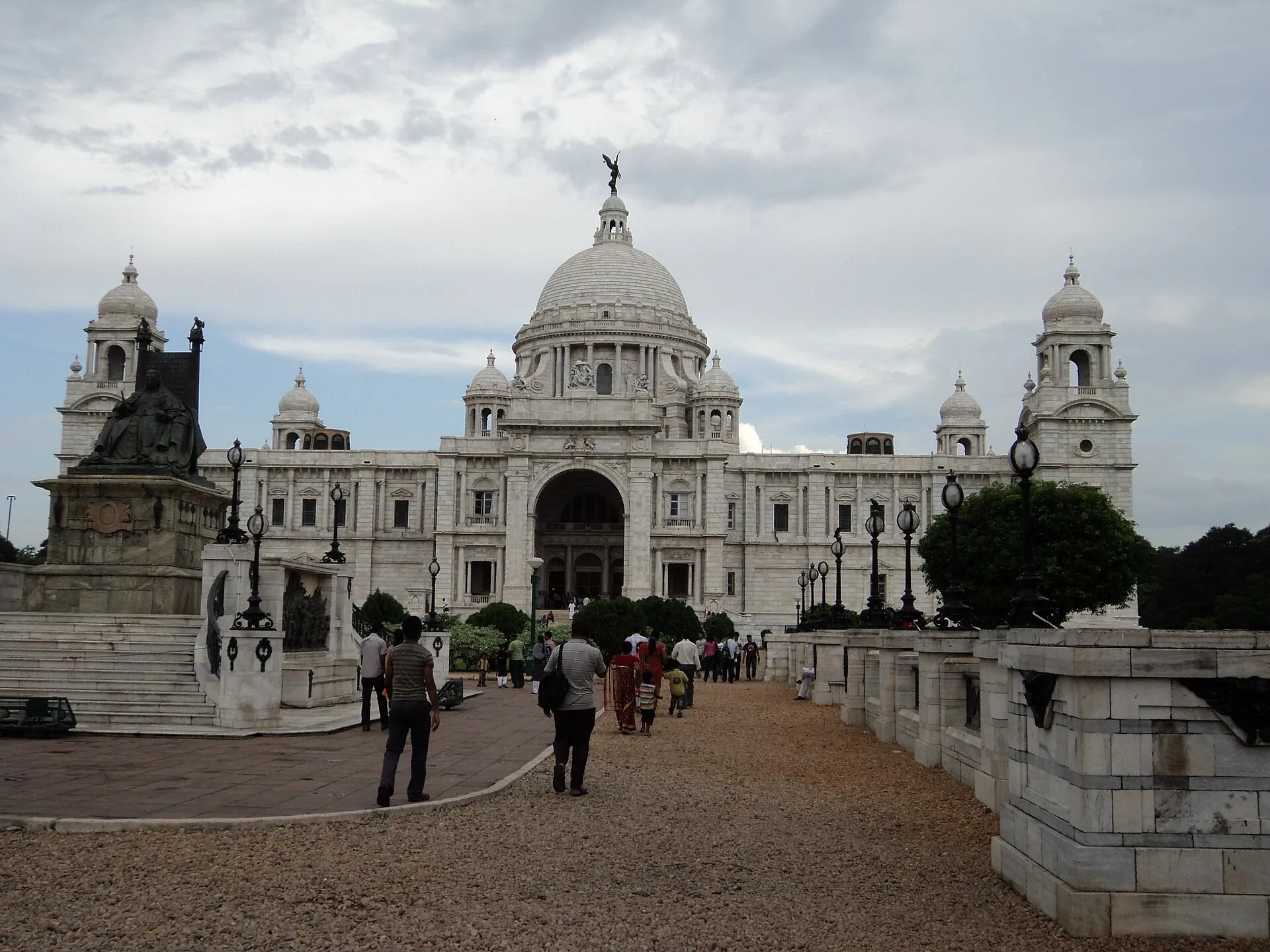
Guided Tours
Understanding the Victoria Memorial means holding two ideas at once, and this is where a good guide earns their fee. The memorial began as a monument of empire: the museum's own history records that Lord Curzon promoted the scheme in a speech at Calcutta Town Hall on 6 February 1901, envisioning a marble monument to Queen Victoria that would also serve as a national gallery for the British Empire in India.
On the other hand, everything the empire it commemorated tried to project has been quietly inverted: the marble was cut by Indian hands, the crores were subscribed by Indian donors, and the galleries now teach the history of India to Indians. The design itself embodies the tension. Sir William Emerson blended Renaissance proportion with Mughal domes and chhatris, while his on-site deputy Vincent Esch supervised nearly two decades of construction using the same Makrana marble as the Taj Mahal; the result looks, deliberately, both European and Indian. A guide reads that architectural bilingualism for you, points out where the Bengal Renaissance — the intellectual awakening that produced Tagore, Vivekananda, and Ram Mohan Roy — surfaces in the collection, and connects those movements to Kolkata's standing as India's cultural capital. Guides also do the practical work: at a museum of 25 galleries and 28,000 objects, they steer you to the paintings and rooms that actually repay attention and skip the rest, so a half-day feels revelatory rather than exhausting.
Collections Highlights
The building is arranged around a lofty Central Hall beneath the dome, from which the galleries radiate; a guide or the official floor plan helps you tackle them in a sensible loop rather than doubling back. The rooms worth budgeting time for:
- The Royal Gallery hangs portraits and coronation scenes of Victoria's reign, and holds one of the museum's showpieces — a vast oil canvas by the Russian painter Vasily Vereshchagin depicting the state procession of the Prince of Wales into Jaipur in 1876, among the largest paintings on public display in India.
- The Calcutta Gallery, added in 1992, is the emotional heart of the museum: maps, paintings, and photographs follow the city from a cluster of Hooghly-side villages to the second city of the British Empire, and on toward the independence era.
- The Daniell collection gathers the finest single holding of aquatints and oils by Thomas and William Daniell, the uncle-and-nephew artists whose late-18th-century views shaped how Europe imagined India, alongside works by Johann Zoffany.
- The Arms and Armour Gallery ranges from Mughal swords and daggers to firearms and relics associated with the 1857 uprising.
- The Portrait and Sculpture galleries and the National Leaders Gallery carry busts, paintings, and manuscripts of the figures — British and Indian — who shaped Bengal's modern history.
Crowning the whole ensemble, the bronze Angel of Victory stands 16 feet tall on the central dome; mounted on ball bearings, it was designed to pivot in a strong wind like a weathervane and is visible clear across the Maidan.
Victoria Memorial timeline
-
Curzon proposes the memorial
After Queen Victoria's death, Viceroy Lord Curzon called for a grand marble hall and museum in Calcutta, to be paid for entirely by public subscription rather than the treasury.
-
Foundation stone laid
The Prince of Wales, the future King George V, laid the foundation stone on 4 January 1906, and construction in Makrana marble began under architect Sir William Emerson.
-
Opened to the public
After fifteen years of work the completed memorial was inaugurated, crowned by the bronze Angel of Victory above its central dome.
-
Calcutta Gallery opens
A dedicated gallery tracing the city's growth from riverside villages to imperial capital was added, reframing the building as a museum of India's own history.
- Today
A national museum of history
Administered by a Board of Trustees under the Ministry of Culture, it is among India's most visited museums and Kolkata's defining landmark.
When to Visit
The site keeps three separate schedules, and knowing them shapes your visit:
- Museum galleries: Tuesday–Sunday, 10:00 AM – 5:00 PM (last entry around 4:30 PM), closed Mondays and national holidays. Best explored in the morning, when light floods the halls and crowds are thinner.
- Gardens: open daily 5:30 AM – 6:00 PM, hours before the museum, drawing joggers and families to the lawns and lily ponds at dawn.
- Sound-and-light show: an evening son et lumière on museum-open days, narrated in alternating English and Bengali/Hindi slots; the start time shifts with sunset across the seasons, so confirm it at the counter.
Weekday mornings (Tuesday–Thursday) are quietest; weekends and holidays fill the gardens. Aim to see the museum by day and linger for sunset, when the illuminated marble against the darkening Maidan is the memorial at its most photogenic.
Admission and Costs
Admission is set by the Victoria Memorial Hall administration and is charged separately for the galleries, the gardens, and the evening show, so you pay only for what you actually visit. Current rates:
- Museum, foreign visitors: ₹500 (about $6) — a single ticket covering all 25 galleries.
- Museum, Indian nationals: ₹30, one of the best-value museum tickets in the country.
- Gardens only: ₹20, enough to walk the 64 acres, photograph the exterior, and reach the Queen Victoria statue without entering the galleries.
- Sound-and-light show: a separate, low-priced evening ticket, sold for the specific show slot rather than bundled with daytime entry.
- Licensed guide: ₹500–1,000 for a roughly 1.5-hour museum tour; agreeing the scope and price before you start avoids misunderstandings.
Children below a set age generally enter free — ask at the window. Because photography is prohibited inside the galleries, there is no interior camera fee; the gardens and exterior carry none either. Tickets are sold at the north and south gate counters (and, increasingly, online), so buying gardens-only access first and upgrading later is easy. Compared with a full-day private Kolkata tour — roughly ₹4,000–8,000 ($48–96) with a car — the memorial is an inexpensive centrepiece for a colonial-heritage day.
Tips for Visitors
Allow 2–3 hours: the galleries are extensive, and a guide helps you prioritise the rooms that reward a close look. Photography is restricted inside the museum, so save your camera for the gardens and the exterior — the reflecting north tank, the tree-framed approaches, and the marble at sunset are the classic shots. Even without buying a museum ticket, the illuminated hall at dusk is worth the trip. For a full colonial-heritage day, pair it with St. Paul's Cathedral and the Indian Museum, both a short walk across the Maidan, and with the Maidan itself, Kolkata's great central green.
On access and comfort: the ground-floor galleries and gardens are the most step-free parts of the complex, and staff can advise on the least stair-heavy route; carry water in the warmer months, as the grounds offer little shade at midday. The nearest Metro stops are Maidan and Rabindra Sadan, making arrival easy without a taxi. Combine the memorial with the Howrah Bridge at dawn to the north and the riverside Dakshineswar Kali Temple upstream for a rounded Kolkata itinerary that moves from empire to engineering to devotion.
Frequently Asked Questions
When is the best time of year to visit Victoria Memorial?
November through February is ideal: cool, dry weather makes the museum comfortable and the gardens are at their greenest, with soft winter light for photographing the white marble at sunset. October and early March are still pleasant. April to June is hot and humid, and the June–September monsoon brings heavy afternoon downpours, though the freshly washed marble and dramatic skies can reward a well-timed break in the rain.
What are the opening hours for Victoria Memorial?
Museum galleries: Tuesday–Sunday, 10:00 AM – 5:00 PM (last entry around 4:30 PM). Closed Mondays and national holidays. Gardens: 5:30 AM – 6:00 PM daily, opening earlier than the museum for morning walkers. The evening sound-and-light show runs after dusk on museum-open days; confirm the current seasonal slot at the ticket counter.
What does admission to Victoria Memorial cost?
Museum (foreign visitors): ₹500 ($6). Museum (Indian nationals): ₹30. Gardens only: ₹20. The sound-and-light show carries a separate low-priced evening ticket. A licensed guide adds ₹500–1,000 for a roughly 1.5-hour museum tour. Children under a certain age typically enter free — check the counter.
What should visitors know before touring Victoria Memorial?
Allow 2–3 hours; the 25 galleries are extensive and a guide helps prioritise the most significant rooms. Photography is not permitted inside the museum galleries, but the gardens and exterior are freely photographable. Bags are screened at the gate, and large bags may need to be left at the cloakroom.
How do you get to Victoria Memorial in Kolkata?
The memorial sits on the Maidan in central Kolkata. The nearest Metro stations are Maidan and Rabindra Sadan, each a short walk from the gates, and Park Street station is close by. Yellow Ambassador taxis, app cabs, and buses all serve the area. Enter through the north gate (near the Queen Victoria statue) or the south gate off Ashutosh Mukherjee Road.