
India Gate timeline
-
Foundation stone laid
The Duke of Connaught laid the first stone of the All-India War Memorial at the eastern end of Kingsway.
-
Arch unveiled
Viceroy Lord Irwin inaugurated Lutyens' finished 42-meter arch, inscribed with 13,516 names of the fallen.
-
George V statue removed
The marble statue of King George V left the chhatri canopy behind the arch for Coronation Park.
-
Amar Jawan Jyoti lit
An eternal flame honoring India's post-independence fallen began burning beneath the arch.
-
National War Memorial opens
A 40-acre memorial listing 25,942 post-1947 soldiers opened 400 meters east of the arch.
-
Kartavya Path renaming
Rajpath was renamed Kartavya Path and reopened on 8 September after the Central Vista redevelopment — re-turfed lawns, red-granite walkways, pedestrian underpasses, and permanent food-and-toilet amenity blocks — while the Amar Jawan Jyoti flame was merged into the National War Memorial flame.
-
Netaji statue installed
A 28-foot black-granite statue of Netaji Subhas Chandra Bose, carved from a single monolithic granite block and weighing 65 tonnes, was unveiled on 8 September beneath the arch's rear canopy — empty since George V's statue left in 1968 — replacing a hologram shown there that January.
Architecture
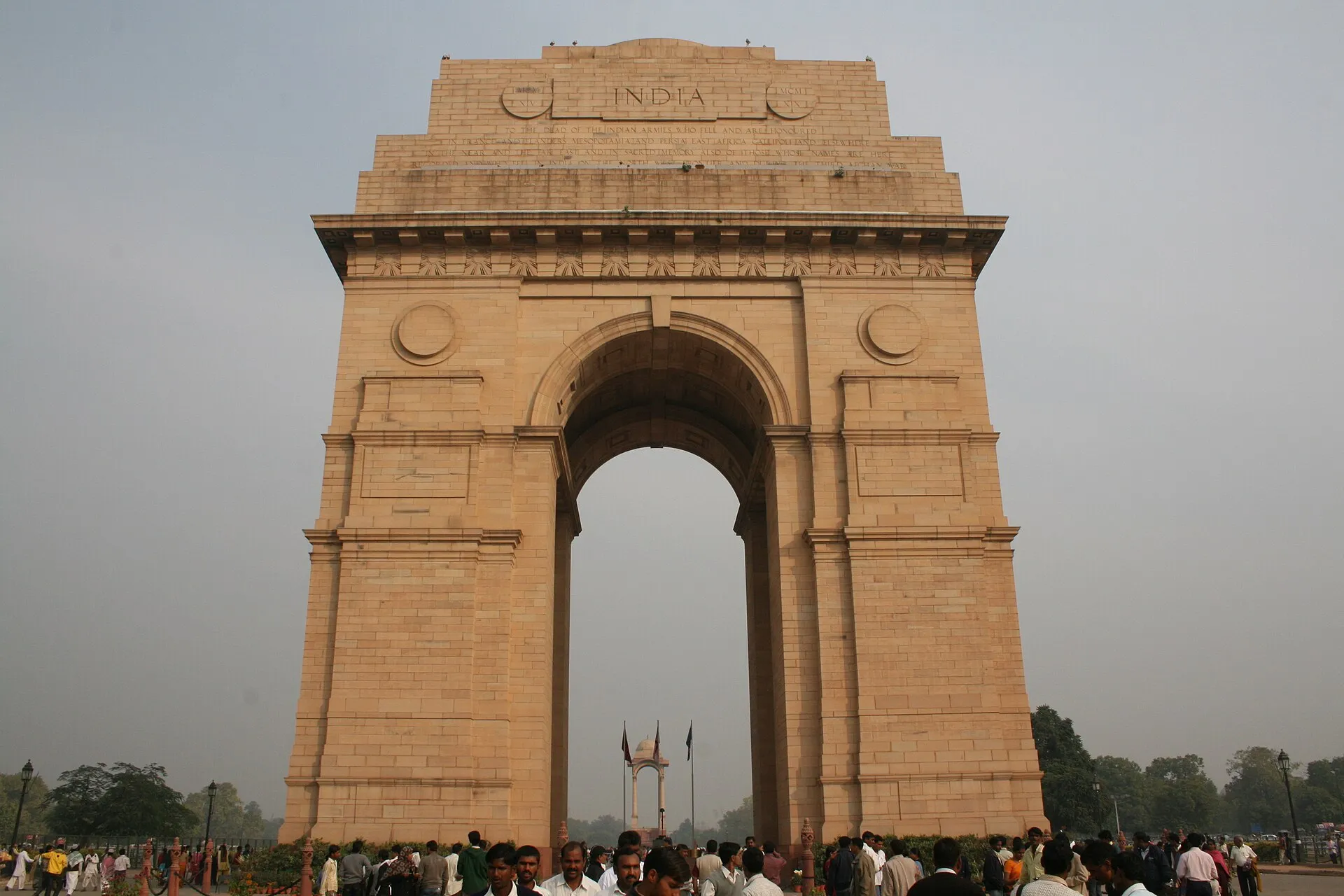
The arch rises 42 meters and carries 13,516 names, cut into red and buff Bharatpur sandstone and grouped by regiment and theater of war — reading them all takes hours and drives home the scale of a colonial-era sacrifice. The word INDIA is carved across each face, flanked by the Roman dates MCMXIV (1914) and MCMXIX (1919), above a dedication that names the far-flung fronts where the dead fell — France and Flanders, Mesopotamia, Persia, East Africa, Gallipoli, and the North-West Frontier of the Third Anglo-Afghan War. A shallow domed cupola crowns the arch, designed to be filled with burning oil on ceremonial anniversaries — a detail most visitors miss from the lawns below. Shallow ornamental ponds flank the monument along the C-Hexagon, mirroring the floodlit arch after dark. About 400 meters east of the arch stands the National War Memorial, opened in 2019 across roughly 40 acres, whose concentric granite walls list 25,942 soldiers killed in conflicts since independence and whose central obelisk shelters a relocated eternal flame. Kartavya Path runs about 2.5 kilometers from India Gate up Raisina Hill to Rashtrapati Bhavan (the presidential palace), forming one of the world's great ceremonial axes. A stone chhatri canopy just east of the arch sheltered a marble statue of King George V until 1968, when it was rehoused at Coronation Park; the canopy then stood empty for over half a century until a 28-foot (8.5 m) black-granite statue of Netaji Subhas Chandra Bose, weighing 65 tonnes and carved from a single monolithic granite block, was installed beneath it in 2022 — deliberately setting an Indian nationalist where an imperial monarch once stood, and one of the clearest markers of the precinct's decolonization. The lawns ringing it are Delhi's most popular gathering spot, where families picnic, children play cricket, and vendors sell chaat and kulfi into the night.
Historical Significance
India Gate stands at the eastern end of Kartavya Path — renamed in 2022 from Rajpath, and known under the British as Kingsway — the ceremonial boulevard that forms the spine of Lutyens' Delhi. Designed by Sir Edwin Lutyens, its foundation stone was laid by the Duke of Connaught in 1921, and the finished arch was unveiled by Viceroy Lord Irwin in 1931. Conceived as the All-India War Memorial, it commemorates the 74,187 Indian soldiers who died fighting for the British Empire in World War I and the Third Anglo-Afghan War. A guide turns India Gate from a photo backdrop into a meditation on colonialism, nationhood, and memory — explaining how an imperial monument became a symbol of Indian identity, how the eternal flame of the Amar Jawan Jyoti burned beneath the arch from 1972 until it was merged into the adjacent National War Memorial flame in 2022, how the Kartavya Path ("path of duty") renaming deliberately rewrote the colonial vocabulary of the avenue, and how, in 2022, a granite statue of Netaji Subhas Chandra Bose filled the rear canopy that a statue of King George V had vacated in 1968. At night the arch is dramatically floodlit and ringed by families, ice-cream sellers, and balloon vendors — Delhi at its most relaxed and communal, a short hop from the Qutub Minar and the other icons of the capital's past.
When to Visit
Open: 24 hours, 7 days a week (outdoor monument), with no ticket or timed entry. Best for photos: early morning (6-8 AM) for clear light and thin crowds before the heat and haze build. Best for atmosphere: after sunset, when the arch is floodlit and Delhi families spread across the lawns with ice cream and street snacks. The adjacent National War Memorial keeps set hours — roughly 9 AM - 6:30 PM, free entry — and stages a short changing-of-the-guard ceremony worth timing your walk around.
Admission and Costs
India Gate: free. National War Memorial: free. Kartavya Path area: free to walk along, with no paid parking directly beside the arch. A guided walking tour of Lutyens' Delhi runs ₹1,500-3,000 ($18-36) and typically bundles India Gate with Rashtrapati Bhavan and Parliament. Metro fares from central Delhi to the nearest station, Central Secretariat, are ₹20-40 ($0.25-0.50); an app cab from Connaught Place is usually ₹120-200 ($1.50-2.50).
The Case for a Guide
India Gate rewards context far more than it rewards a quick photo stop. A knowledgeable Delhi guide reads the arch as a document — which regiments are named, why the Third Anglo-Afghan War sits alongside World War I, and how the monument's meaning flipped from imperial tribute to national shrine after 1947. Expect help with the practical side too: timing the visit for the post-sunset illumination, navigating the security-controlled pedestrian zone, and stitching India Gate into a coherent Lutyens'-Delhi walk toward Rashtrapati Bhavan and the Secretariat buildings. Guides also decode the surrounding rituals — the changing of the guard at the National War Memorial, the meaning of the Amar Jawan Jyoti, and the Republic Day parade route that turns Kartavya Path into the country's grandest stage every January 26. For most visitors, an hour with a guide is the difference between seeing a large arch and understanding a century of Indian history.
Tips for Visitors
Republic Day on January 26 brings India's grand parade along Kartavya Path — the most spectacular event on Delhi's calendar, though public access is restricted and the whole precinct locks down for rehearsals in the days beforehand. Combine with Lutyens' Delhi: walk west along Kartavya Path toward Rashtrapati Bhavan for the full colonial-era architectural sweep. Evening ice cream from the vendors ringing the arch after dark is a quintessential Delhi ritual. Nearby: a Children's Park and the shallow ornamental ponds sit right beside the arch, while the Mughal-era Red Fort, Humayun's Tomb, and Qutub Minar — Delhi's UNESCO-listed icons — are each a 20-40 minute cab ride away, making India Gate a natural first stop. Security: bag checks at every entry point to the pedestrian zone, and no large bags or backpacks. Facilities: since the 2022 Kartavya Path redevelopment the avenue has permanent amenity blocks — a dozen-odd food kiosks, public toilets, drinking-water points, and ramped pedestrian underpasses — making the flat, step-free plaza one of central Delhi's more accessible monuments. Metro access: Central Secretariat (Yellow/Violet Line) is the nearest station, about a 15-minute walk; bring water and sun cover if you visit before evening. Extend the trip: India Gate is the usual first stop on India's Golden Triangle, an easy add-on before the Taj Mahal in Agra (roughly 3-4 hours by fast train or car) or the palaces and forts of Jaipur (about 5 hours), both classic follow-ons to a few days in Delhi. First-timers will find the arch slotted into a wider three-day itinerary in our Delhi first-timer's guide, which pairs it with Old Delhi and the capital's other landmarks.
Frequently Asked Questions
What is the best season for visiting India Gate?
November through February provides cool evenings ideal for strolling the Kartavya Path lawns and enjoying the illuminated monument after sunset, with January's Republic Day parade offering Delhi's grandest spectacle. March and October bookend the pleasant season with mild temperatures. The summer months from May through August are brutally hot and monsoon-drenched, making an outdoor visit uncomfortable despite the monument's 24-hour accessibility.
When can visitors tour India Gate?
Open: 24 hours, 7 days a week (outdoor monument). Best for photos: Early morning (6–8 AM) for clear views and soft light. Best for atmosphere: After sunset when the monument is illuminated and families gather. The adjacent National War Memorial keeps its own hours, roughly 9 AM to 6:30 PM.
How much is the entrance fee for India Gate?
India Gate: Free. National War Memorial: Free. Kartavya Path area: Free to walk along. Guided walking tour of Lutyens' Delhi: ₹1,500–3,000 ($18–36) covering India Gate, Rashtrapati Bhavan, and Parliament
How many names are inscribed on India Gate?
The arch is inscribed with 13,516 names — Indian and British soldiers and officers — out of the 74,187 troops of the British Indian Army it commemorates, all of whom died between 1914 and 1921 in World War I and the Third Anglo-Afghan War. The names are organized by regiment and theater of war across the arch's sandstone surface.
Who designed India Gate?
Sir Edwin Lutyens, the British architect who master-planned New Delhi, designed India Gate for the Imperial War Graves Commission. He drew on the classical triumphal-arch tradition — the monument is often compared to the Arch of Constantine in Rome and the Arc de Triomphe in Paris — but stripped the ornament back to plain Bharatpur sandstone, letting the 13,516 inscribed names carry the weight. The Duke of Connaught laid the foundation stone in 1921 and Viceroy Lord Irwin unveiled the finished 42-meter arch in 1931.
Can you go inside or climb India Gate?
No — India Gate is a solid ceremonial arch with no interior chambers, staircase, or viewing platform, so visitors admire it from the surrounding lawns and the pedestrian plaza rather than entering it. The space beneath the arch that once held the Amar Jawan Jyoti eternal flame is cordoned off; that flame was merged into the National War Memorial 400 meters east in 2022. For an elevated Lutyens'-Delhi view, walk west along Kartavya Path toward Rashtrapati Bhavan on Raisina Hill instead.
How much time do you need at India Gate?
Most visitors spend 30 to 45 minutes at the arch itself — long enough to walk the lawns, read the inscribed regiments, and photograph the monument. Pairing it with the adjacent National War Memorial and a stroll west along Kartavya Path stretches the visit to about 1.5 to 2 hours. Evening visitors tend to linger longer once the arch is floodlit and the lawns fill with families, ice-cream sellers, and chaat vendors.
How do you get to India Gate?
Metro is easiest: Central Secretariat (Yellow and Violet lines) is the nearest station, about a 15-minute (1.5 km) walk northwest, while Khan Market on the Violet Line sits a similar distance to the southeast. An auto-rickshaw or app cab from Connaught Place, 3 km north, runs roughly ₹120–200 ($1.50–2.50). The lawns and plaza immediately around the arch form a traffic-free pedestrian zone, so vehicles drop off along the C-Hexagon roads that ring it; roadside paid parking fills fast on weekend evenings, which is why most visitors arrive by Metro or cab rather than driving.
What happened to the Amar Jawan Jyoti flame at India Gate?
For 50 years an eternal flame called the Amar Jawan Jyoti burned beneath the arch, lit on 26 January 1972 to honor the soldiers killed in the 1971 India–Pakistan war. On 21 January 2022 that flame was merged with the one at the National War Memorial, 400 meters east, so India Gate itself no longer carries a burning flame. The black marble cenotaph — an inverted rifle topped by a soldier's helmet — remains in place beneath the arch but is cordoned off. Visitors who want to see a lit eternal flame and a changing-of-the-guard ceremony should walk east to the National War Memorial.
Are there food stalls and toilets at India Gate, and is it wheelchair accessible?
Yes on both counts. The Central Vista redevelopment reopened Kartavya Path on 8 September 2022 with permanent amenity blocks along the avenue — roughly a dozen vending kiosks selling packaged snacks, ice cream, tea, and regional street food, plus public toilets and drinking-water points — while informal ice-cream and chaat vendors still ring the arch after dark. The re-turfed lawns, red-granite walkways, and pedestrian plaza are flat and step-free, and the new underpasses across the C-Hexagon roads include ramps, so wheelchair users and strollers reach the arch without stairs; because the memorial is a solid arch with no interior, there is nothing to climb. The nearest step-free Metro access is Central Secretariat, about 1.5 km away, so many visitors with limited mobility arrive by cab to a drop-off on the surrounding C-Hexagon.