
Historical Significance
The Parliament building's construction was part of Hungary's Millennium celebrations of 1896, marking one thousand years since the Magyar tribes settled in the Carpathian Basin under Árpád. The timing was deliberate: building a parliament on a scale to rival Westminster was a statement of Hungarian national ambition within the Austro-Hungarian dual monarchy. The building was completed in 1904, shortly after the coronation of Emperor Franz Joseph as King of Hungary (1867) had formalised the constitutional compromise (Ausgleich) that gave Hungary equal status with Austria. The Crown of Saint Stephen — now displayed in the Grand Hall — is one of Europe's oldest continuously revered royal relics, allegedly given to King Stephen I of Hungary by Pope Sylvester II in the year 1000. Its custody has been a central political issue throughout Hungarian history; the crown was taken to the United States for safekeeping in 1945 and returned by the Carter administration in 1978.
When to Visit
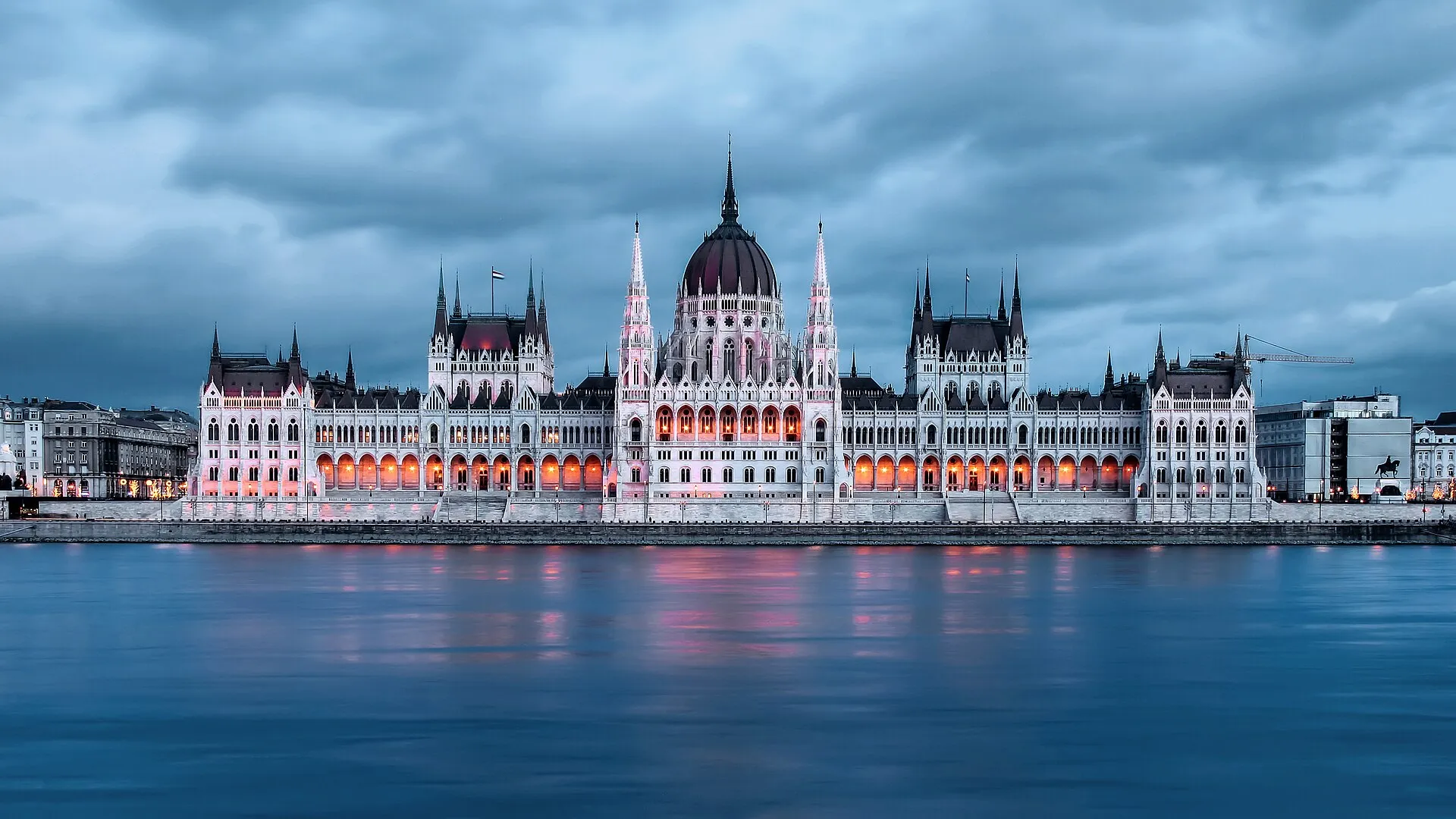
Tours depart daily when the Parliament is not in session, typically 8 AM–4 PM on weekdays and 8 AM–6 PM on weekends. English tours run approximately every 45 minutes; Spanish, German, French, and other language tours also available. Duration: 45 minutes. Book online in advance at parlament.hu, especially in summer when slots sell out by mid-morning. The building's exterior is spectacular at any hour; night illumination runs until around midnight year-round. The best exterior photography light is at dusk when the warm stone glows amber before the floodlights take over.
Admission and Costs
Non-EU citizens: 8,000 HUF (approximately €20). EU/EEA citizens: 4,000 HUF (approximately €10) with valid ID. Students under 24 from EU/EEA: free with valid student card and passport. Children under 6: free. Tickets can be purchased on site if available, but online booking is strongly recommended. Private guides who specialise in the Parliament and can provide extended context — beyond what the standard 45-minute tour covers — charge 15,000–25,000 HUF for pre- and post-tour context covering the building's political history and Hungary's constitutional development.
The Case for a Guide
The standard guided tour covers approximately 4% of the building's 691 rooms; a specialist guide who can provide context before and after the official tour significantly extends the visit's value:
- Architectural symbolism — Every detail of Steindl's design carries national symbolism; the 96-metre dome, the 96 towers, and the dimensions of the Grand Hall all encode the founding mythology of the Hungarian state
- Crown of Saint Stephen — Understanding the significance of this relic in Hungarian history, politics, and religious culture requires context beyond what the tour placard provides
- Parliamentary history — The building has hosted the legislature through the Austro-Hungarian period, two World Wars, the Arrow Cross terror, the Communist dictatorship, and the post-1989 transition; each period left traces
- The Danube panorama — From the building's perspective and from across the river, a guide can explain the wider UNESCO World Heritage riverfront and the relationship between Buda Castle, the Chain Bridge, and the Parliament as a unified architectural composition
Tips for Visitors
Book at least a week ahead in summer — tours fill up fast and on-the-day availability is not guaranteed. If your tour slot falls through, the exterior visit along the Pest bank promenade is still worthwhile. Bring photo ID (passport or national ID) — EU citizens must show proof of nationality to receive the reduced rate, and this is verified at the entrance. Photography inside is permitted on the standard tour route; a tripod would not be practical given the paced tour format. The building is best viewed from the Buda bank around sunset, from either the Fisherman's Bastion or from the embankment at the base of the hill. A boat cruise on the Danube passing the Parliament is another popular option and gives a perspective from the river level that no land-based viewpoint can replicate.
Frequently Asked Questions
How do you book a guided tour of the Hungarian Parliament?
Interior tours must be booked in advance through the official Parliament website (parlament.hu). English-language tours depart multiple times daily; EU/EEA citizens pay reduced entry and non-EU visitors pay a standard ticket price. Tours follow a fixed route through a limited portion of the building and cannot be taken independently. The Parliament is a working legislature — tours may be restricted or cancelled when the National Assembly is in session.
What can you see inside the Parliament Building?
The guided tour route covers the main entrance hall with its grand ceremonial staircase, the Upper House chamber, and the Grand Hall where the Crown of Saint Stephen and the Hungarian Royal Regalia are displayed under permanent guard. The Crown of Saint Stephen — Hungary's most sacred national relic — is the oldest and most significant item in the Hungarian state insignia and has been central to the country's coronation tradition since the eleventh century.
Is Parliament's best view from the Buda side or the Pest side?
The most famous view is from the Buda side — specifically from the Fisherman's Bastion at Buda Castle, which provides an elevated perspective across the Danube. At river level, a walk along the Pest bank promenade (Duna-korzó) from the Chain Bridge northward gives an extended view of the building's full 268-metre riverside facade. Night photographs are spectacular from either bank when the building is illuminated.