
Engineering Facts
The Chain Bridge's opening in November 1849 was a defining moment in the unification of Buda and Pest — it made the combined city imaginable as a single metropolitan entity and laid the groundwork for the formal merger in 1873. Its construction was financed in part by Count István Széchenyi's personal contribution and was the product of his broader campaign to modernise Hungary within the Habsburg empire. The opening coincided with the aftermath of the failed Hungarian Revolution of 1848–49 — Széchenyi himself, broken by the revolution's failure, was confined to a sanatorium and never saw the completed bridge. In 1945, the deliberate destruction of all nine Budapest bridges by retreating German forces was a symbolic act of erasure as well as a military measure; the restoration of the Chain Bridge in 1949 was consequently invested with enormous national meaning. Today, Budapest residents treat the bridge with a particular affection — it appears on the city's oldest continuously published theatre's logo, features in the folk memory of the 1956 uprising, and is the default postcard image of the city.
When to Visit
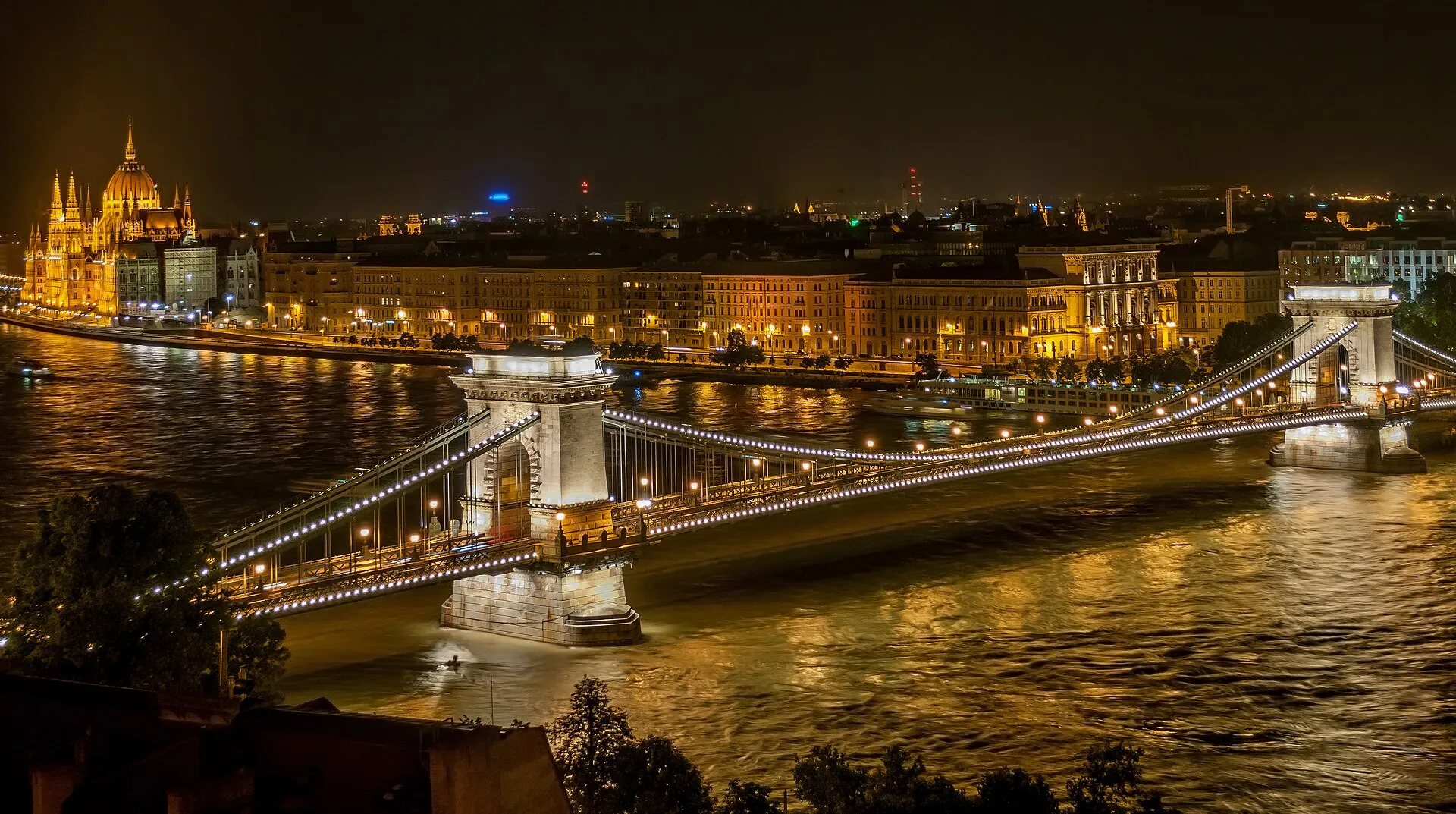
The Chain Bridge pedestrian walkways are open 24 hours, 7 days a week, free of charge. Vehicle traffic crosses during normal hours; the bridge is occasionally closed to vehicles for maintenance or events. The best times for photography are dawn (when the light catches the Parliament facade from the Buda side) and after dark (when the bridge and castle are illuminated — one of Europe's great urban night scenes). In summer, the bridge and the promenade on the Pest bank (Duna-korzó) are lively with street performers and walkers from morning until midnight. Cross from either end: the Buda end places you at Adam Clark Square, with the funicular up to Buda Castle immediately to your right.
Admission and Costs
Walking the Chain Bridge is entirely free. The funicular (Budavári Sikló) at the Buda end costs 1,400 HUF one way / 2,200 HUF return to Castle Hill. Guided city walking tours that include the bridge typically cost 4,000–8,000 HUF per person as part of a wider Budapest tour. The bridge is one of the most commonly featured landmarks in guided walks of the city; few tours omit it entirely. Private guides who focus specifically on the bridge and its historical significance typically charge 2,000–4,000 HUF extra for the bridge section of a broader walking tour.
The Case for a Guide
The Chain Bridge is both a visual landmark and an entry point into Budapest's complex political and social history:
- Széchenyi's vision — Understanding Count Széchenyi's role in nineteenth-century Hungarian modernisation gives the bridge its full significance as a political project as well as an engineering feat
- Unification of Buda and Pest — The bridge's physical connection prefigured and facilitated the political unification of 1873; a guide explains how the bridge changed commerce, commuting, and cultural life
- 1945 destruction — The wartime story of the bridge's destruction and the 1949 centenary reopening is one of Budapest's most resonant historical narratives
- UNESCO panorama — The bridge is the centrepiece of the World Heritage riverfront; a guide positions it within the wider architectural story of the embankment
Tips for Visitors
For the best photographs, stand at the Pest end of the bridge in the early morning facing Buda — the castle and the suspension towers are at their most dramatic with the morning light behind you. For the reverse view (looking toward Pest and Parliament), the terrace at Buda Castle's Fisherman's Bastion offers a superior vantage point. Cross the bridge on foot rather than by tram or car — the walkway is uncrowded outside summer weekends and the 15-minute crossing rewards the time. At night, the illumination system highlights the suspension chains and stone towers with warm light; the promenade on the Pest side (Duna-korzó) is a beautiful place to walk with the illuminated bridge as a backdrop.
Frequently Asked Questions
Can you walk across the Chain Bridge?
Yes — the Chain Bridge has dedicated pedestrian walkways on both sides of the roadway and is free to cross on foot at any time. The walk across takes about 10–15 minutes and offers exceptional views of both Buda Castle and the Parliament building. The bridge is also popular for photography at dawn and at night when it is illuminated. Cyclists may also use the bridge.
What is the history behind the Chain Bridge's name?
The bridge takes its formal name — Széchenyi Lánchíd — from Count István Széchenyi, the Hungarian reformer and statesman who championed its construction. Széchenyi was inspired to commission a permanent bridge after being stranded on the Buda bank for a week in 1820 when ice blocked the river's seasonal pontoon bridge, preventing him from attending his father's funeral. He personally financed much of the construction and lobbied the Habsburg authorities for permission over two decades.
Was the Chain Bridge destroyed and rebuilt?
Yes. The original Chain Bridge, opened in 1849, was blown up by retreating German forces in January 1945 during the Siege of Budapest — all nine of the city's bridges were destroyed within days. The reconstruction of the Chain Bridge was treated as a national priority; it reopened on 20 November 1949, exactly one hundred years after its original opening. The reconstruction maintained the suspension towers and overall form of the original while replacing the deck and ironwork.