
Collection Highlights
Sky Church
The soaring central hall named for Jimi Hendrix's dream of a place where music united everyone, Sky Church is dominated by one of the largest indoor LED screens in the world — a wall roughly 40 feet tall that plays high-definition concert films and original programming. Beneath it, the room doubles as MoPOP's live-performance and event space, and the acoustics were tuned to make even a quiet visit feel like a soundcheck.
Roots and Branches guitar tower
Rising through the museum's atrium is Trimpin's kinetic sculpture Roots and Branches, a swirling tornado of several hundred guitars and instruments wired to play themselves. Custom software strums, bows, and bangs the pieces in choreographed sequences, turning the building's core into an instrument you can watch perform on its own throughout the day.
Nirvana — Taking Punk to the Masses
Drawn largely from MoPOP's own permanent collection, this gallery traces Nirvana from Aberdeen garages to global fame with more than 200 artifacts — handwritten lyrics, Kurt Cobain's smashed guitars, flyers, and demo tapes. It roots the band firmly in the [Seattle](/united-states/seattle/) grunge scene that made the city a music capital in the early 1990s.
Sound Lab
An interactive studio where visitors of any skill level can pick up a guitar, sit at a drum kit, or step into a sound-isolation booth to record vocals and mix a track. On Stage, an adjoining space, lets you perform on a simulated concert stage complete with lights, fog, and a screaming virtual crowd — the most hands-on experience in the building.
Indie Game Revolution
A celebration of the independent video-game movement featuring a dozen playable titles and the stories of the small studios behind them. Rather than blockbuster franchises, the gallery spotlights experimental and artful games, letting visitors handle the controllers and see how a handful of developers reshaped an entire medium.
Infinite Worlds of Science Fiction
Built on the collection of the former Science Fiction Museum, this gallery gathers original props, costumes, and concept art spanning a century of speculative storytelling — from Star Trek phasers to Battlestar Galactica hardware — alongside artifacts that trace how imagined futures shaped real science.
Fantasy — Worlds of Myth and Magic
A journey through the imagery of fantasy fiction, film, and gaming, this gallery displays original manuscripts, illustrations, and screen-used props that chart the genre from ancient myth to modern blockbusters, with immersive set pieces that let visitors step inside dragon-guarded caverns and enchanted forests.
Scared to Death — The Thrill of Horror Film
MoPOP's dedicated horror gallery collects screen-used props, costumes, and creatures from a century of scary cinema, staged in a deliberately unsettling walk-through environment. It examines why audiences seek out fear and how horror craft evolved from silent-era shadows to modern practical effects.
Guided Tours
Seattle's music scene erupted onto the world stage in the late 1980s, when bands playing small clubs and garages launched a movement that redefined rock. Guides who know this history connect the museum's artifacts to the broader grunge revolution, placing handwritten lyrics and stage-worn clothing in the context of the creative ferment that transformed local sounds into global phenomena. Without that narrative thread the displays stay impressive but disconnected from the city that produced them.
"Sky Church" — Jimi Hendrix's name for a place where music would bring people together regardless of background — gives the museum's central hall both its title and its mission.
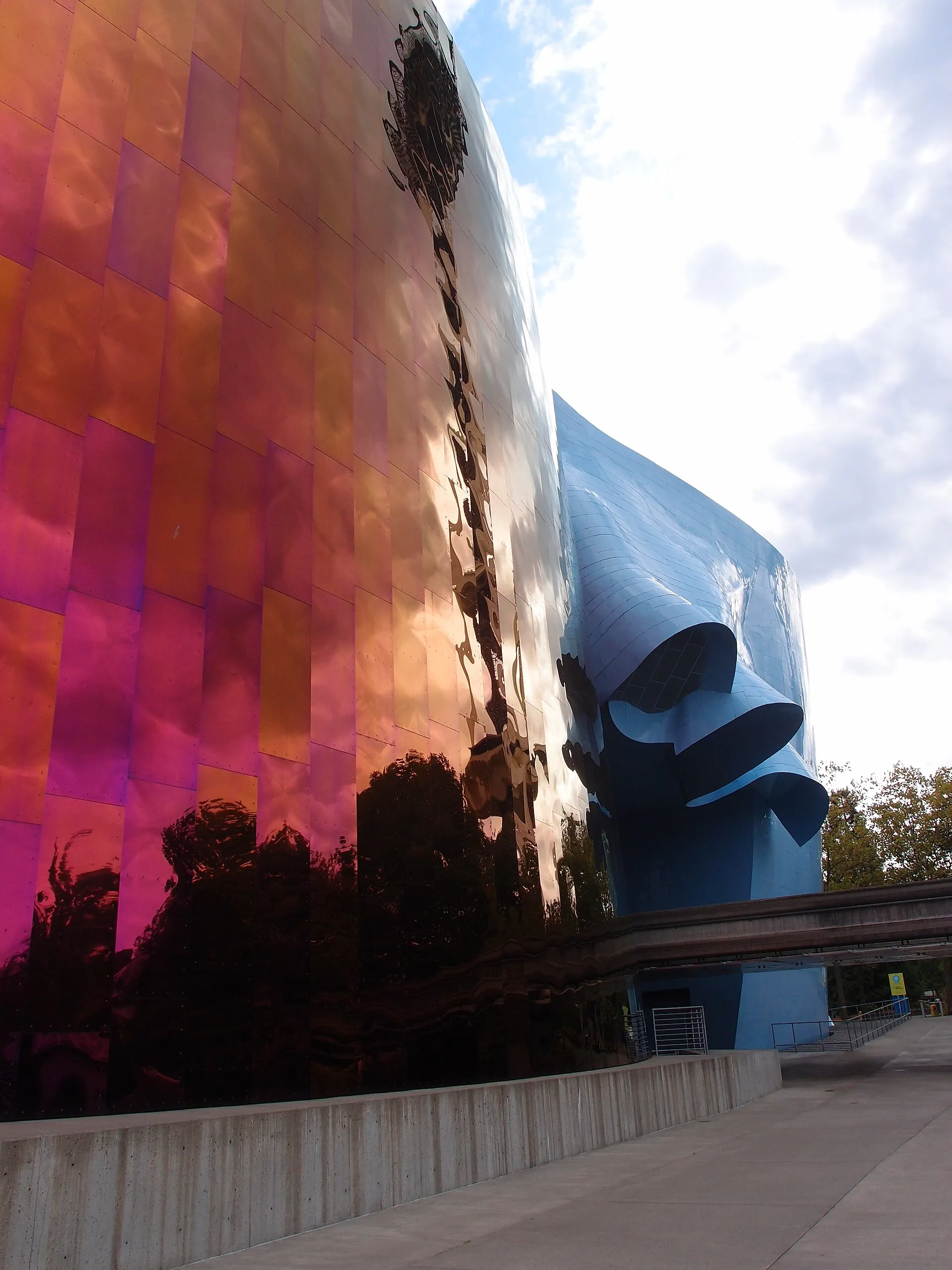
The building itself deserves interpretation. Frank Gehry cut apart real guitars to model the shimmering exterior, then clad it in 21,000 individually shaped stainless steel and aluminum shingles that shift with weather and light. Guides explain the engineering challenges behind this sculptural form and why it has become as photographed as any exhibit inside. They also help visitors prioritise among three floors of rotating shows, tailoring routes to individual interests. For hands-on experience, guides coach visitors through the Sound Lab, where even non-musicians can record vocals, mix tracks, and learn riffs with step-by-step guidance that makes the stations accessible rather than intimidating.
After exploring MoPOP, natural itineraries extend to the neighboring Chihuly Garden and Glass and the Space Needle, completing a Seattle Center day that blends music, art, and iconic views — with downtown's Pike Place Market a short monorail ride south for lunch and Kerry Park up Queen Anne Hill for the classic skyline photo.
Collections Highlights
- Allow 2–3 hours: the interactive exhibits, especially the Sound Lab, absorb significant time if you want to try everything.
- Bag check: large backpacks and luggage must be checked at the front desk; small bags and camera bags are fine inside.
- Monorail access: the Seattle Monorail runs from Westlake Center directly to the Seattle Center station adjacent to MoPOP in about two minutes.
- Photography: photos are welcome in most galleries, but flash and tripods are restricted in certain exhibition spaces.
- Nearby food: the Seattle Center Armory food court is a short walk away, offering quick, affordable dining.
- Combine with neighbors: the Space Needle and Chihuly Garden and Glass are each less than a five-minute walk from MoPOP's entrance.
When to Visit
- Regular hours: daily 10:00 AM – 5:00 PM, with select Thursdays extended to 8:00 PM during summer; hours shift around major holidays, so confirm before a late visit.
- Best for immersive visits: arrive at opening on a weekday to reach the Sound Lab and other hands-on stations before turns back up.
- Busiest windows: Saturday and Sunday afternoons between 1:00 and 4:00 PM draw the heaviest crowds, as do rainy days when indoor attractions fill across the city.
- Special exhibitions: check the rotating gallery schedule — blockbuster shows pull extra visitors during their opening and closing weeks.
- Holiday hours: the museum closes on select holidays; confirm the calendar if you are visiting over Thanksgiving or Christmas week.
Admission and Costs
- Adult admission: $33 general entry (timed tickets recommended in peak season).
- Youth (5–17): $22; children under 5 enter free.
- Seattle CityPASS: bundles MoPOP with the Space Needle, Chihuly Garden and Glass, and other major sights at a meaningful discount if you are visiting several attractions.
- Guided museum tours: $45–70 per person (typically 1.5–2 hours, a curated route through the permanent and rotating galleries).
- Private music-history guide: $225–375 for groups up to 6, focused on Seattle's grunge roots and wider music heritage.
The Case for a Guide
MoPOP rewards a guide more than most museums, because its galleries assume you already know the cultural stories behind the objects. A specialist supplies that context and turns three floors of memorabilia into a coherent narrative about how Seattle shaped modern pop culture.
- Grounding grunge in its geography: guides connect Nirvana's smashed guitars and handwritten lyrics to the rain-soaked clubs where Pearl Jam, Soundgarden, and Alice in Chains emerged, explaining how a local sound became a global movement.
- Reading the building: the shimmering exterior is itself an exhibit; guides explain how Frank Gehry modelled it on dismembered guitars and how engineers shaped and hung its 21,000 metal shingles.
- Prioritising three floors: with constantly rotating shows, guides tailor a route to your interests — horror film, indie games, science fiction props, or rock memorabilia — so you spend time on what matters to you.
- Coaching the hands-on stations: guides make the Sound Lab and On Stage approachable, walking non-musicians through recording vocals, mixing a track, or learning a riff step by step.
- Building the wider itinerary: guides extend the visit across Seattle Center to the Space Needle and Chihuly Garden and Glass, or south to Pike Place Market and Pioneer Square for a full Seattle day.
Tips for Visitors
- Guitar Gallery: over 200 rare guitars, including instruments played by Hendrix, Cobain, and Eddie Van Halen, alongside Trimpin's three-storey self-playing sculpture Roots and Branches in the atrium.
- Sound Lab and On Stage: record vocals, mix a track, learn a riff, or perform on a simulated concert stage with lights and a virtual crowd — the most hands-on part of the museum.
- Nirvana exhibit: handwritten lyrics, stage-worn clothing, and personal artifacts from the band that put Seattle on the world music map.
- Infinite Worlds of Science Fiction: original props from Star Trek, Battlestar Galactica, and Doctor Who alongside concept art spanning a century of speculative storytelling.
- Indie Game Revolution: playable independent video games and developer stories highlighting the creative side of gaming culture.
- Scared to Death: a walk-through horror-film gallery of screen-used props and creatures that examines why we seek out fear.
- Building exterior: walk around the outside to watch Gehry's metallic skin shift between silver, gold, purple, and blue depending on the weather and time of day.
Frequently Asked Questions
What are the opening hours at Museum of Pop Culture?
Regular hours: Daily 10:00 AM - 5:00 PM (open until 8:00 PM on select Thursdays during summer). Best for immersive visits: Arrive at opening on weekdays to explore interactive exhibits without waiting for turns.
What does admission to Museum of Pop Culture cost?
Adult admission: $33 general entry. Youth (5-17): $22; children under 5 enter free. Seattle CityPASS: Includes MoPOP alongside other major attractions at a bundled discount.
What are the Guitar Gallery highlights at Museum of Pop Culture?
Guitar Gallery: Over 200 rare guitars, including instruments played by Hendrix, Cobain, and Eddie Van Halen, displayed in a soaring vertical tower. In the central atrium, Trimpin's sculpture Roots and Branches assembles several hundred instruments into a self-playing tower three storeys tall.
Why is the building shaped like a smashed guitar?
Frank Gehry bought several electric guitars, sliced them apart, and used the fragments as a physical model, cladding the finished structure in roughly 21,000 stainless steel and aluminum shingles that shift colour with the light. The design nods to Seattle's own Jimi Hendrix, who was known for smashing guitars on stage.
How long should I spend at MoPOP, and how do I get there?
Allow 2-3 hours to do the interactive galleries and Sound Lab justice; dedicated music or sci-fi fans easily stay longer. The Seattle Monorail runs from Westlake Center downtown to the Seattle Center station beside the museum in about two minutes, and MoPOP sits a five-minute walk from both the Space Needle and Chihuly Garden and Glass.
Was the museum always called MoPOP?
No. It opened in 2000 as the Experience Music Project (EMP), later became the EMP Museum after absorbing the Science Fiction Museum and Hall of Fame, and was renamed the Museum of Pop Culture in 2016 to reflect its broader focus on music, film, gaming, and fantasy.