
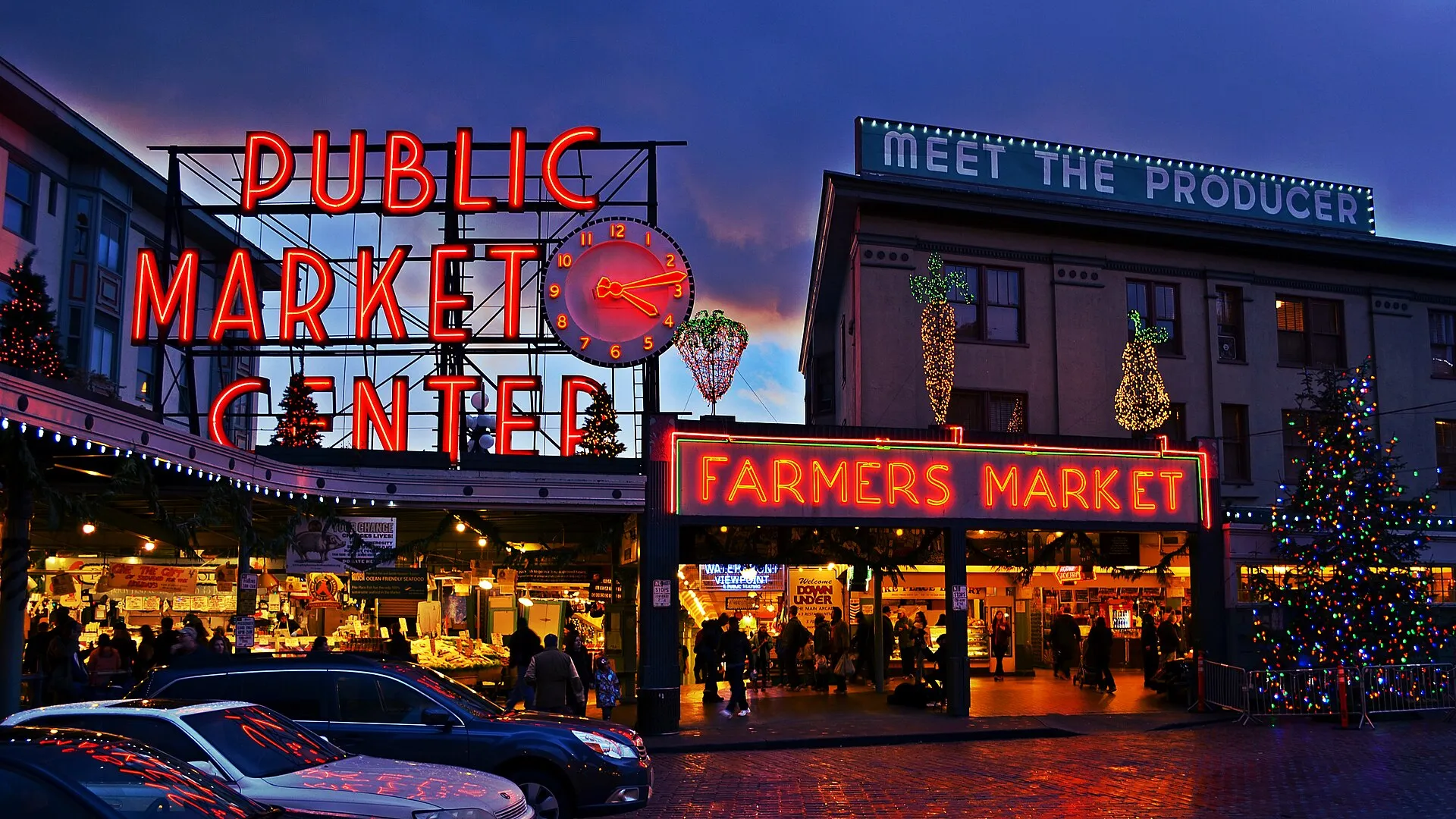
What To Buy
Come with a tote bag and an appetite. The market rewards grazing, but a few stalls are worth planning around:
- Pike Place Fish Market salmon toss — fishmongers hurl whole fish from the ice bed to the wrapping counter; buy a fillet, or just watch (they often invite a volunteer to try a catch).
- Beecher's Handmade Cheese — watch curds turned through the creamery's street-facing glass, then sample the Flagship cheddar or a cup of its celebrated mac and cheese.
- Flower stalls — seasonal bouquets, many arranged by Hmong-American farming families, sell for a few dollars along the cobbled entrance; cash keeps the line moving.
- Daily Dozen Doughnut Company — mini doughnuts fried to order in the Economy Building, best eaten warm from the paper bag.
- The original Starbucks — the oldest surviving Starbucks has traded at 1912 Pike Place since 1977 (the chain's very first 1971 storefront, a few blocks away on Western Avenue, has closed) and still carries the original brown siren logo.
- Rachel the Piggy Bank — the 550-pound bronze pig under the clock is really a donation box; coins dropped in her snout fund the market's food bank, clinic, and senior services.
What to skip: the mass-produced souvenir T-shirts and magnets near the entrance are marked up and sold all over the city. Save your money for produce, cheese, flowers, and the craft tables where the maker is standing behind the goods — meet the producer is still the surest test of whether something is worth buying here.
Food Stalls
Beyond the grab-and-go counters, the market is a full meal in itself. Longtime favourites cluster on a few levels:
- Pike Place Chowder in Post Alley — routinely ranked among the country's best clam chowders; expect a line at lunch.
- Piroshky Piroshky — a Russian bakery turning out braided salmon pâté and beef-and-cheese pastries from a tiny open kitchen.
- Le Panier and Three Girls Bakery — a French patisserie and a counter that is one of the market's oldest tenants, both good for a sandwich eaten on the spot.
- The DownUnder levels — descend the staircases below the main arcade to find magic shops, comic and vintage-poster dealers, a Turkish-delight stand, and family diners that have fed regulars for decades.
Eat early or mid-afternoon to dodge the noon crush, and carry cash for the smaller stalls. A late-morning graze — chowder, a piroshky, a few cheese samples, and a warm bag of doughnuts — costs far less than a sit-down lunch and lets you taste widely, which is exactly how the market is meant to be worked.
When to Visit
Main arcade: daily 9:00 AM – 6:00 PM; most restaurants open earlier and close later, and individual shop hours vary. Plan around these rhythms:
- 10:00–11:00 AM — the sweet spot for food tours: stalls are fully stocked and the lunch crush hasn't hit.
- Fish tosses run more or less continuously from opening at Pike Place Fish Market, but the clearest views are in the quieter morning.
- Farm tables sell year-round, though the fullest seasonal selection runs June through October; berries peak in July and August, which is why the month ratings above crest in summer.
- Quietest — weekday mornings in January and February offer the most relaxed browsing.
Two set-pieces sit just off the main deck: the MarketFront plaza (opened June 2017) adds Elliott Bay viewpoints and more farm stalls on the north end, while the Gum Wall in Post Alley — a brick passage layered in decades of chewed gum since the early 1990s — is open at all hours.
Admission and Costs
- Market entry — free; walking and browsing cost nothing.
- Guided food tour — $55–85 per person for 2–3 hours, with tastings at six to eight stops.
- Historical walking tour — $30–45 per person for 1.5–2 hours on architecture and market lore.
- Private guide — $175–300 for groups up to eight, with a customized route and flexible pace.
- Tastings budget — plan $15–30 for bites beyond what a tour includes; a self-guided graze of chowder, a pastry, and doughnuts runs roughly $20–30.
Prices are typical 2026 ranges and vary by operator and season; most tours are cheaper on weekday mornings.
The Case for a Guide
Most visitors see only the top arcade, watch the fish fly, and leave without discovering the labyrinth below. A good local guide earns its cost for three reasons:
- Navigation — guides know which staircases connect the DownUnder levels, which vendors trade only on certain days, and which doors open onto hidden courtyards, so you cover ground self-guided visitors miss entirely.
- Access — years of relationships turn transactions into conversations: a fishmonger explaining the morning's catch, a cheesemaker passing a sample from the aging room, a flower vendor describing the pre-dawn logistics that fill the stalls by opening time.
- Curation — with hundreds of stalls competing for attention, a guide steers your tastings toward the standouts and threads in the social history — the 1971 fight to save the market, the farm families still selling here — that turns a food crawl into the story of the city.
Food and history walking tours run daily; see the costs above for typical prices, and pair the market with nearby Pioneer Square or the Museum of Pop Culture at Seattle Center to build a full day.
Tips for Visitors
- Getting there — skip the parking hunt and take Link light rail to Westlake Station, a five-minute downhill walk; the market's own garage on Western Avenue fills fast on weekends. A pedestrian bridge from the MarketFront also drops down to the waterfront.
- Accessibility — the market is built into a hillside, but elevators link the main arcade to the DownUnder levels and the Western Avenue garage; the cobbles and older floors are uneven, so wear shoes with good grip.
- Beat the crowds — Saturday noon–3:00 PM is the peak; a weekday or early-morning visit is far calmer.
- Shipping seafood — several fishmongers pack catch on ice for airline carry-on or overnight shipping nationwide.
- Photography — the flying fish and flower stalls are the classic shots, but ask produce and craft vendors before photographing their tables up close.
- Connecting walks — a waterfront promenade links the market to the Seattle Great Wheel and the aquarium at Pier 57, while a 15-minute stroll south reaches Pioneer Square.
Frequently Asked Questions
What are the hours and best time to arrive at Pike Place Market?
The main market runs daily 9:00 AM - 6:00 PM, though many restaurants open earlier and individual shop hours vary. For food tours, arrive between 10:00 and 11:00 AM, before the lunch crowds surge. Fishmongers at Pike Place Fish Market toss salmon throughout the day, but mornings offer the closest, least crowded views.
What prices should visitors expect at Pike Place Market?
Walking through and browsing the market is completely free. A guided food tour runs $55-85 per person (2-3 hours, with tastings at six to eight stops), and a historical walking tour $30-45 per person (1.5-2 hours). Private guides cost $175-300 for groups up to eight; budget another $15-30 for tastings on your own.
What are the must-try stalls at Pike Place Market?
Pike Place Fish Market for the salmon toss, the original Starbucks at 1912 Pike Place, Beecher's Handmade Cheese with its glass-window creamery, Daily Dozen for fresh mini doughnuts, Pike Place Chowder for award-winning clam chowder, and the flower stalls lining the cobblestone entrance.
How much time should you spend at Pike Place Market?
Allow at least two hours to take in the main arcade, the fish toss, and the flower and produce stalls. Add a third hour to explore the labyrinthine DownUnder levels, sit down for a meal, or join a guided food tour, which typically runs two to three hours.
Is Pike Place Market good for families with children?
Yes. Children love the flying fish at Pike Place Fish Market, dropping coins into Rachel the bronze piggy bank under the clock, and the mini doughnuts at Daily Dozen. Entry is free, elevators connect the levels for strollers, and the Gum Wall in Post Alley is a memorable (if sticky) photo stop.