

Overview
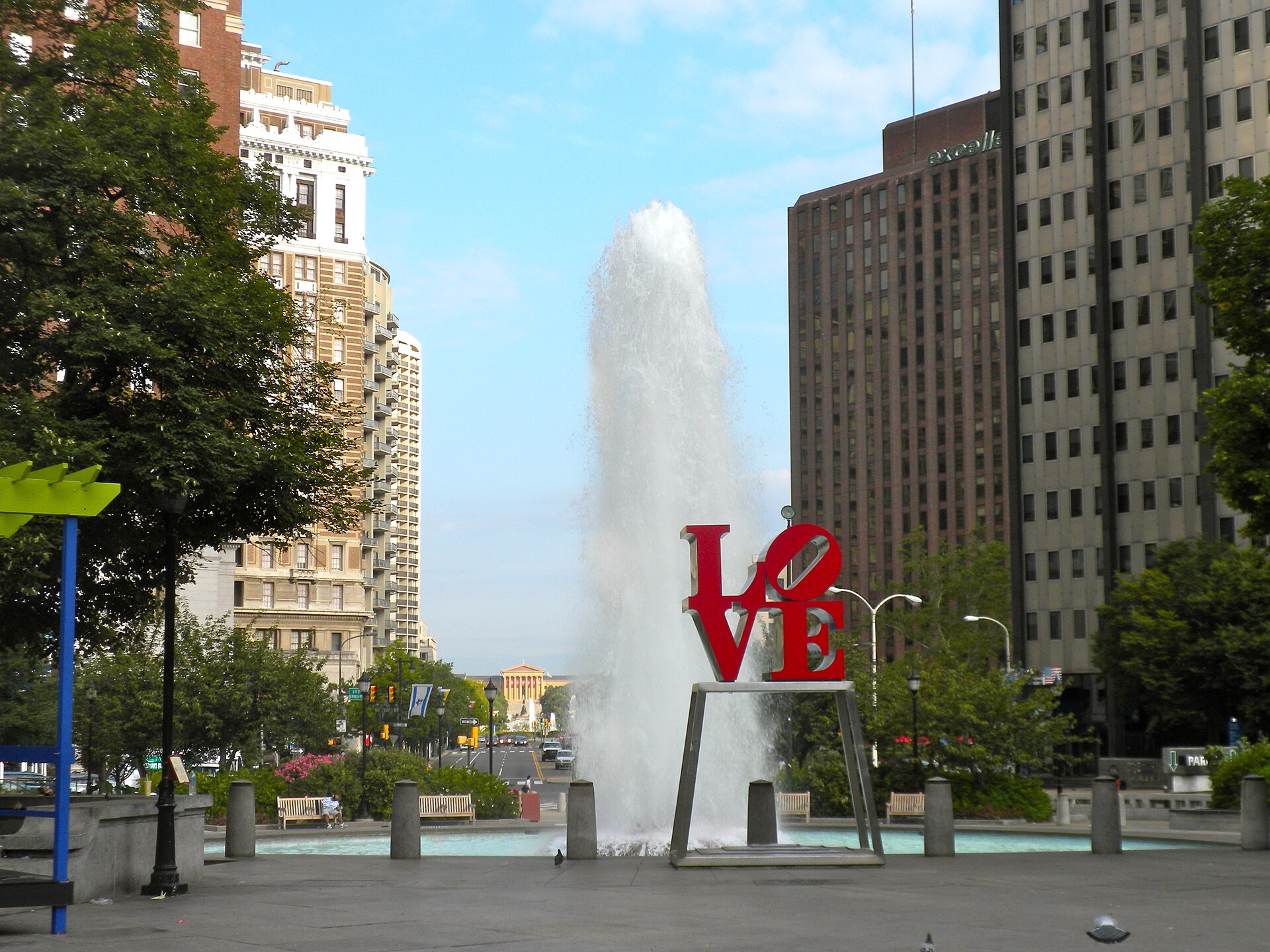
Officially named John F. Kennedy Plaza, this compact urban park at 15th Street and the Benjamin Franklin Parkway has been known as LOVE Park since Robert Indiana's iconic LOVE sculpture was installed here in 1976 as part of the nation's bicentennial celebration. The sculpture, with its distinctive tilted "O," was originally meant to be temporary. But Philadelphia claimed it as its own, and after a brief period when the artwork was removed, public outcry ensured its permanent return. Today the park serves as the gateway to the Benjamin Franklin Parkway and offers a direct sightline from City Hall to the Philadelphia Museum of Art. The park underwent a complete $16.5 million renovation completed in 2018 that transformed it from a beloved but aging plaza into a modern gathering space with a new fountain, granite seating walls, improved green space, and enhanced accessibility. The LOVE sculpture now sits on a raised platform with the Philadelphia skyline as its backdrop. What makes the park meaningful beyond the photo opportunity is its role as the literal and symbolic center of the city. It is where Philadelphia celebrates, protests, gathers for lunch on sunny days, and hosts its annual Christmas Village during the holidays. The sculpture has also become a global icon, inspiring replica LOVE artworks in cities from Tokyo to Taipei.
Seasonal Highlights
The Benjamin Franklin Parkway stretching northwest from LOVE Park was explicitly modeled after the Champs-Elysees, and understanding that intentional parallel transforms a pleasant boulevard into a statement of civic ambition. Guides explain how Philadelphia slashed a diagonal through its orderly street grid to create this grand European-style avenue in the early twentieth century, anchored at one end by the ornate Second Empire City Hall and at the other by the Greek Revival Museum of Art. The flags of every nation line the route, and the museums, libraries, and cultural institutions along the Parkway were deliberately placed to create a cultural corridor rivaling any in Europe. LOVE Park itself is just one stop on a Parkway rich with public art that rewards guided exploration. The Swann Fountain's three bronze figures represent the region's major rivers. The Calder mobile suspended in the Free Library's atrium represents the work of Alexander Calder, who was born in Philadelphia. The Rodin Museum, the largest collection of the sculptor's work outside Paris, features a formal garden with The Thinker presiding at its entrance. Guides weave these disparate works into a coherent tour of artistic ambition that spans from pop art to neoclassical to modern abstract, all within walking distance. Before its $16.5 million renovation, LOVE Park was one of the most famous skateboarding spots on Earth, its granite ledges and open plazas appearing in countless videos and hosting international competitions. Skaters staged protests when the redesigned park made skating impossible, and guides familiar with that subculture explain why the original LOVE Park mattered to a global community. City Hall rises directly opposite, the tallest masonry building in the world, with William Penn standing atop its 548-foot tower. For decades, a "gentleman's agreement" prevented any building from rising above his hat, a restriction broken in 1987 that some Philadelphians blamed for sports championship droughts. Reading Terminal Market waits ten minutes' walk east for lunch.
Activities
Quick visit works: LOVE Park is compact enough to visit in 15-20 minutes for photos, or spend an hour with a coffee and people-watching on the granite benches. Starting point for the Parkway: Use LOVE Park as the launchpad for a walk up the Benjamin Franklin Parkway, passing the Free Library, the Rodin Museum, and ending at the Museum of Art Rocky Steps. Closest transit: City Hall and 15th Street stations (Broad Street and Market-Frankford lines) are directly adjacent to the park. Wi-Fi available: Free public Wi-Fi covers the park area, useful for sharing photos immediately. Combine with Reading Terminal: Reading Terminal Market is a 10-minute walk east. Grab lunch at the market and eat it on the park benches facing City Hall. Safety: The park is well-patrolled and active throughout the day. As with any urban park, exercise normal awareness after dark. Proposals happen here: The LOVE sculpture is one of Philadelphia's most popular proposal spots. If you are planning one, early morning offers privacy and beautiful light
When to Visit
The LOVE sculpture: Robert Indiana's 1976 pop art icon with its distinctive tilted "O." Position yourself on the south side for the cleanest photo with the Parkway stretching behind. The fountain: The redesigned park features a modern fountain with choreographed water jets that children play in during summer months. City Hall sightline: Turn your back to the Parkway and face east for a dramatic view of Philadelphia's Second Empire-style City Hall, topped by the 37-foot bronze statue of William Penn. Benjamin Franklin Parkway vista: Look northwest from the sculpture for the tree-lined boulevard stretching to the Museum of Art, with flags of every nation lining the route. Christmas Village: From late November through December, wooden chalets fill the park with handcrafted ornaments, bratwurst, mulled wine, and a Bavarian-style holiday atmosphere. Skateboarding legacy: Though the redesigned park discourages skating, plaques and local memory preserve LOVE Park's reputation as one of the most influential skate spots in history
Admission and Costs
Entry: Completely free, always. No tickets, no reservations, no time restrictions. Food trucks: $8-15 for lunch from the rotating food trucks that line the park's perimeter on weekdays. Christmas Village: Free entry to the holiday market, with individual vendor prices for food, drinks, and crafts. Center City walking tour: $25-45 per person for 2-3 hour tours that use LOVE Park as a starting or ending point. Parkway cultural tour: $35-60 per person for guided walks along the Benjamin Franklin Parkway from LOVE Park to the Museum of Art
Tips for Visitors
Access: Open 24 hours a day, seven days a week. It is a public park with no gates or admission. Best for photos: Early morning before 9:00 AM, when the sculpture is unobstructed by crowds and soft light creates ideal conditions. Golden hour: Late afternoon in spring and fall, when warm light catches the red sculpture against the Parkway's tree-lined vista. Lunchtime energy: Weekdays from noon to 1:30 PM, the park fills with office workers and food truck customers, giving it a vibrant city pulse. Holiday season: Late November through December, the Christmas Village at LOVE Park transforms the space with wooden chalets, mulled wine, and European-style holiday shopping