
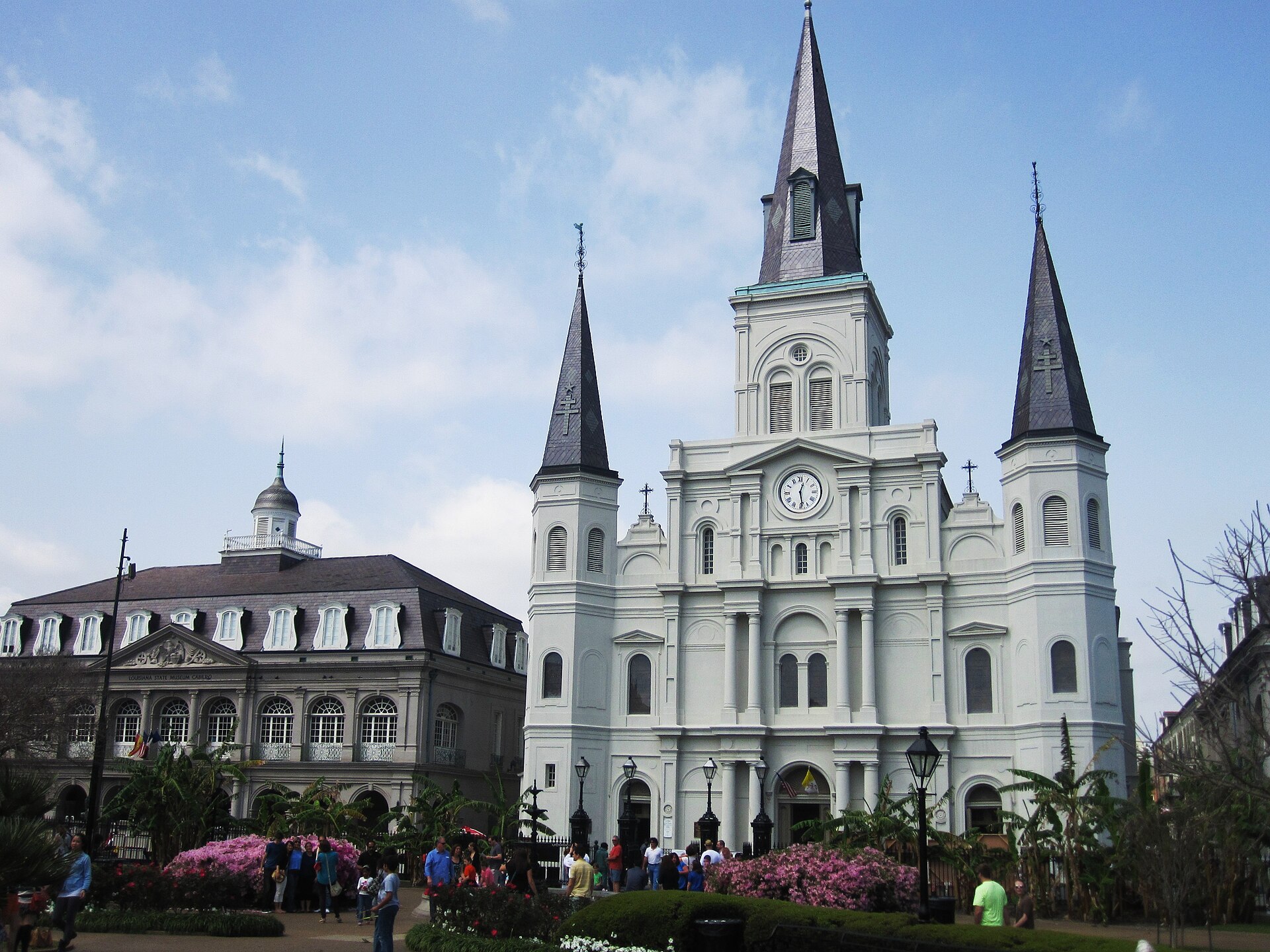

Overview
The Cathedral-Basilica of St. Louis, King of France, holds a distinction that no other house of worship in the United States can claim: it has served as an active parish church longer than any cathedral in the nation, with worship on this site dating to 1727. The white triple-spired facade that dominates Jackson Square is actually the third church built here. The first, a modest wooden chapel, rose in 1718 alongside the founding of New Orleans itself. A hurricane destroyed it in 1722. The second, a brick structure, burned in the great fire of 1788 that consumed most of the French Quarter. The current building, designed by architect J.N.B. de Pouilly, was completed in 1850 in the Franco-Spanish style that reflects the tangled colonial history of the city it overlooks. Standing before the cathedral's main altar, visitors can trace the political shifts that swept through Louisiana: French fleurs-de-lis carved into the original woodwork, Spanish colonial influence in the building's proportions, and American additions from the various restorations that followed statehood. Pope Paul VI elevated the church to Minor Basilica status in 1964, an honor reserved for churches of special historical or spiritual significance. Behind the cathedral lies St. Anthony's Garden, a quiet formal garden with an imposing statue of the Sacred Heart of Jesus, accessible through a gate on Royal Street. The garden offers one of the few genuinely peaceful spots in the French Quarter, hidden from the fortune tellers and street performers working just around the corner in Jackson Square.
Visitor Etiquette
Admission: Free. The cathedral is an active parish and welcomes visitors without charge. Donations: Appreciated but not required. Suggested donation of $1-5 per visitor helps fund ongoing restoration of the 19th-century interior. Guided French Quarter tours including the cathedral: $25-40 per person as part of a 2-hour group walk through the Vieux Carre. Private religious history tour: $150-250 for up to 6 people, covering the cathedral, St. Augustine Church in Treme, and Our Lady of Guadalupe Chapel. Cabildo museum next door: $9 per adult for the Louisiana State Museum housed in the former Spanish colonial government building, which provides essential context for the cathedral's history
Spiritual Significance
Combine with Jackson Square: The cathedral sits at the center of the French Quarter's most concentrated area of attractions. The Cabildo, Presbytere, and Pontalba Buildings are all within steps. Dress appropriately: This is an active church. Shoulders and knees should be covered, and hats removed upon entry. Tour groups in beach attire are politely redirected. Photography etiquette: Still photography without flash is generally permitted during visiting hours when no services are underway. Tripods and video equipment require prior permission from the parish office. Nearby refreshment: Cafe Du Monde sits just across the square, making it natural to pair a cathedral visit with beignets and chicory coffee at one of the oldest coffee stands in the country. Rain plan: The cathedral makes an excellent retreat during New Orleans' frequent afternoon thundershowers. The acoustics inside during a rainstorm are something visitors rarely forget. Cemetery connections: If the cathedral's history fascinates you, ask your guide about St. Louis Cemetery No. 1, located a few blocks away, which contains the above-ground tombs of many prominent parishioners and the reputed grave of Voodoo Queen Marie Laveau
When to Visit
Self-guided visits: Monday through Saturday 8:30 AM to 4:00 PM, Sunday 9:00 AM to 2:00 PM (hours may vary during services and special events). Mass schedule: Daily masses at 7:30 AM and noon, with additional Saturday vigil at 4:00 PM and Sunday masses at 9:00 AM and 11:00 AM. Best for quiet visits: Weekday mornings between 9 and 11 AM, after the early mass but before the midday tourist rush. The light through the stained glass is especially striking during this window. Exterior photography: The front facade photographs best in the golden hour before sunset, when the white stucco glows against the darkening sky behind Jackson Square. Guided tours available: Docent-led tours run intermittently throughout the day and are free, though donations are warmly encouraged to support preservation
Admission and Costs
Three churches have stood on this ground since 1718, each destroyed and replaced by something grander, and their progression mirrors the entire colonial history of Louisiana. The first wooden chapel rose alongside the founding of the city itself, fell to a hurricane, and was replaced by a brick structure that burned in the devastating fire of 1788. The current building carries the marks of both French ambition and Spanish reconstruction, yet distinguishing these layers requires expertise that casual visitors cannot bring to bear. Guides make this architectural timeline vivid rather than abstract, pointing to specific elements that reveal the hands of different colonial powers shaping a single sacred space. Above the nave, Erasmus Humbrecht's 1872 ceiling murals depict the life of St. Louis IX, the French crusader king who gave this cathedral its name, yet most visitors never look up long enough to study them. The hand-painted Stations of the Cross, the subtle differences between French Gothic aspirations and Spanish colonial proportions, the ornate main altar that has served as the focal point of Creole worship for nearly two centuries - these details reward the kind of expert explanation that transforms passive viewing into active understanding. Behind the cathedral, St. Anthony's Garden offers one of the French Quarter's few genuinely peaceful retreats, though many visitors pass within yards of its entrance without discovering it exists. Guides ensure you find this walled garden and explain its surprising history as a favored dueling ground in the 19th century, where affairs of honor were settled with pistols among the statuary. The cathedral cannot be fully understood without the context of Jackson Square itself. The Cabildo and Presbytere flanking it, the Pontalba Buildings framing the plaza, the equestrian statue of Andrew Jackson at its center - together these structures tell a story of power, faith, and commerce in colonial New Orleans that no single building conveys alone. Guides weave these elements into a coherent narrative while also addressing the city's unique spiritual landscape, where Catholic saints have long coexisted with West African and Caribbean traditions. The blending of Voodoo and Catholicism in New Orleans produced something found nowhere else in the country, and sensitive guides explain these intersections with the nuance they deserve rather than reducing them to sensationalized tourism.
Tips for Visitors
The ceiling murals: Look up to see Erasmus Humbrecht's 1872 paintings depicting the life of St. Louis IX, the French king who inspired the cathedral's name and who died on crusade in 1270. The main altar: An ornate masterpiece of carved wood and gold leaf that has served as the focal point of worship since the mid-19th century. Stained glass windows: Donated by various New Orleans families over the decades, each window tells a different story from scripture and Louisiana Catholic history. St. Anthony's Garden: Enter from Royal Street to find this walled formal garden with a statue of the Sacred Heart, a peaceful retreat from Jackson Square's bustle. In the 1800s, this garden was a favored site for settling affairs of honor by duel. Pirate's Alley: The narrow lane running along the cathedral's left side connects Jackson Square to Royal Street. William Faulkner lived in an apartment at its far end while writing his first novel, Soldiers' Pay. The cathedral bells: Listen for the bells that have rung over the Quarter for nearly two centuries, marking time in a neighborhood that otherwise seems to exist outside of it. Jackson Square at night: Return after sunset to see the cathedral dramatically floodlit, its white spires glowing against the dark sky while street musicians play below