

Overview
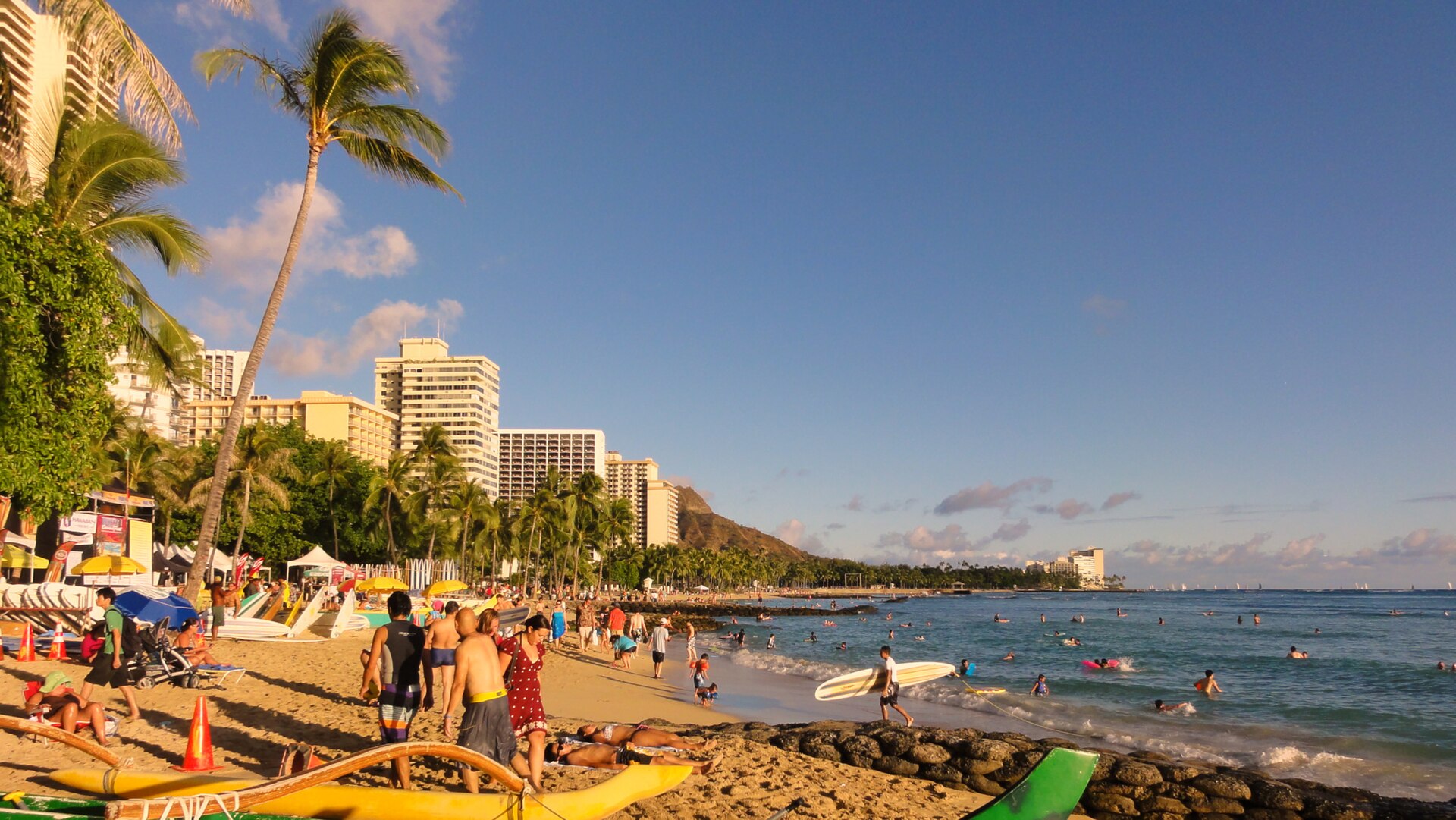
Waikiki Beach stretches roughly two miles along the southern shore of Honolulu, from the Hilton Hawaiian Village lagoon on the west to the base of Diamond Head crater on the east. What Hawaiian royalty once reserved as their personal surfing grounds has become the most visited beach in the Pacific, drawing an estimated 72,000 visitors on any given day. The beach is actually a series of distinct sections, each with its own character: the gentle waters of Kuhio Beach, protected by a submerged concrete wall that creates a calm swimming lagoon ideal for children; the surf breaks off Queen's Beach and Canoes, where beginners take their first stand-up rides on longboards; and the quieter stretch of Sans Souci near the Natatorium, where Robert Louis Stevenson once watched the sunset from the lanai of a beachfront cottage. The backdrop to it all is the unmistakable profile of Diamond Head, a 300,000-year-old volcanic tuff cone that catches the morning light in shades of rust and gold.
Waikiki's significance to surfing history cannot be overstated. Duke Kahanamoku, born in 1890 in a modest house just blocks from the shore, became the father of modern surfing by demonstrating the sport to audiences in California, Australia, and Europe during his career as an Olympic swimming champion. A bronze statue of Duke stands on Kuhio Beach with arms outstretched, leis perpetually draped around his neck by admirers. Before Duke, surfing was a dying Hawaiian tradition suppressed by missionaries who considered it frivolous; after Duke, it became a global phenomenon. Today the beach hosts outrigger canoe rides that replicate the traditional Hawaiian watercraft, stand-up paddleboard lessons, catamaran sunset cruises that depart directly from the sand, and surf schools that put first-timers on their feet within an hour on the same gentle waves that Hawaiian chiefs rode centuries ago. The beach is backed by Kalakaua Avenue, a palm-lined boulevard of luxury hotels, open-air restaurants, and surf shops that functions as Honolulu's social spine.
Local Life
Long before hotels lined this shore, Waikiki held sacred significance for Hawaiian royalty who reserved its waves for their own surfing and its waters for ceremonial bathing. Guides explain the ahupua'a land division system that organised traditional Hawaiian society, describe how wetland taro farms were drained and filled to create the resort strip visible today, and connect the modern beach to the spiritual practices that once defined this place. Understanding this history transforms Waikiki from a pleasant beach into a layered cultural landscape.
Duke Kahanamoku's bronze statue draws endless photographs, but his story deserves more than a quick snapshot. Guides trace the Duke's journey from a modest Honolulu family to Olympic swimming glory, and explain how he used that platform to demonstrate surfing to audiences in California, Australia, and Europe who had never seen anyone ride a wave. Before Duke, surfing was a dying Hawaiian tradition suppressed by missionaries; after Duke, it became a global phenomenon. His legacy lives in every surfer who paddles out anywhere in the world.
Waikiki's waters present hidden complexities that guides help visitors navigate safely. Currents, reef formations, and wave patterns vary dramatically between sections of the beach, and what feels like calm water can shift quickly. Guides identify the safest swimming areas for families, explain rip current behaviour, and steer experienced swimmers toward the outer breaks while keeping beginners in protected shallows. They also reveal quieter alternatives like Sans Souci Beach near Diamond Head, the tide pools of Kapiolani Park, and the local favourite Ala Moana Beach Park just west of Waikiki's tourist density.
Walking Routes
Duke Kahanamoku statue: The bronze Duke stands on Kuhio Beach with arms outstretched, perpetually draped in fresh leis; the most photographed spot on Waikiki and the perfect starting point for understanding the beach's history. Kuhio Beach torch-lighting: Every evening at 6:30 PM, a conch shell sounds and tiki torches are lit along the beach wall, followed by a free hula and Hawaiian music performance as the sun sets.
Canoes surf break: Take a surfing lesson or an outrigger canoe ride at the gentle break off the Royal Hawaiian Hotel, where beginners have been catching their first waves for over a century. Sea turtles at Kaimana Beach: Green sea turtles (honu) frequently surface and rest on the sand near the eastern end of Waikiki; maintain a respectful 10-foot distance as required by law. Full moon over Diamond Head: On nights near the full moon, the crater glows silver against the sky while moonlight reflects off the calm water; locals call this one of Oahu's most magical sights. Sunset catamaran cruise: Board one of the beach catamarans for a 90-minute sail as the sun drops behind the Waianae Mountains, casting the Waikiki skyline in warm silhouette.
When to Visit
Beach access: Open 24 hours a day, every day; lifeguards on duty from approximately 9 AM to 5:30 PM at major sections. Sunrise sessions: Waikiki faces south, so direct sunrise views are partial, but the early morning light on Diamond Head between 6 and 7 AM is spectacular and the beach is blissfully uncrowded.
Sunset: Waikiki sunsets are legendary, with the sky turning amber and violet behind the yacht harbour; the Kuhio Beach torch-lighting ceremony with hula performance occurs nightly at 6:30 PM. Best for swimming: Mornings before the trade winds pick up around 11 AM; the water is calmest and clearest in summer (May through September). Best for surfing: South swells from May through September bring consistent waves to the outer breaks; beginners can find rideable waves year-round in the shallower inside sections.
Admission and Costs
Beach access: Completely free; all beaches in Hawaii are public by law, even those fronting private hotels. Surfboard rental: $15-25 per hour for a longboard from the concessions on the beach; $60-80 for a full day. Surf lesson (group): $40-60 per person for a 90-minute group lesson including board and rash guard.
Outrigger canoe ride: $25-35 per person for a 30-minute ride that catches several waves; a quintessential Waikiki experience. Catamaran sunset sail: $35-50 per person for a 90-minute cruise departing directly from the beach, often with open bar.
Tips for Visitors
Reef-safe sunscreen: Hawaii law prohibits sunscreens containing oxybenzone and octinoxate; buy reef-safe brands before arriving or at any ABC Store along Kalakaua Avenue. Public beach access: Look for marked public access paths between hotels; Kuhio Beach Park has free public restrooms, showers, and changing facilities.
Getting there: TheBus routes 2 and 8 run along Kuhio Avenue through Waikiki from downtown Honolulu; parking is scarce and expensive. Combine with Diamond Head: The crater trailhead is a 20-minute walk or short bus ride from the eastern end of Waikiki; hike in the morning and beach in the afternoon for a perfect day. Valuables: Do not leave electronics or wallets unattended on the sand; use a waterproof pouch or leave valuables in your hotel safe. Snorkelling nearby: For clearer water and more marine life, take a short drive to Hanauma Bay, Oahu's premier snorkelling destination inside a volcanic crater.