
Formation
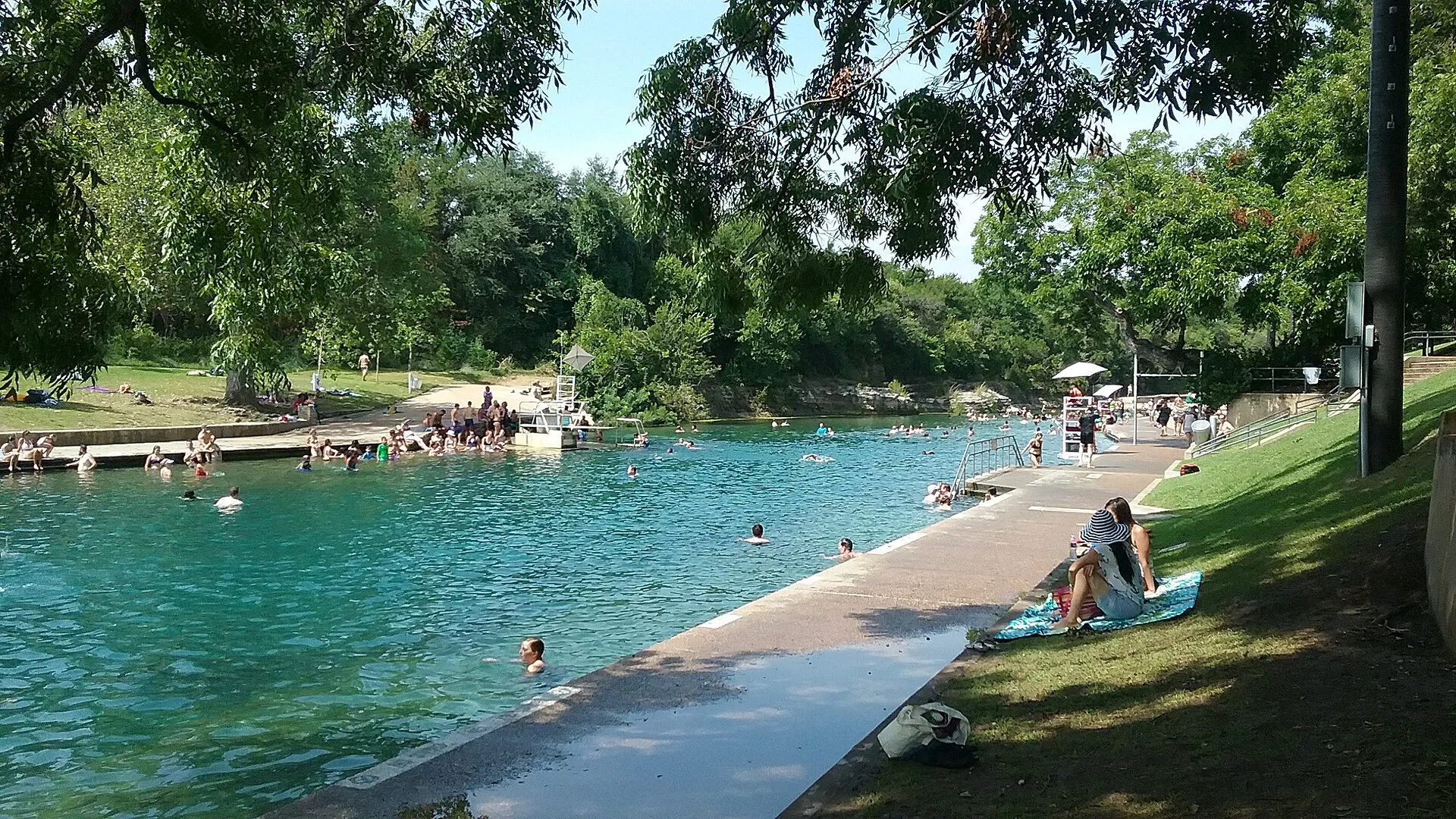
Barton Springs is the fourth-largest spring in Texas, and its cold, clear flow is the visible outlet of a vast hidden plumbing system. The water rises along the Balcones Fault Zone, the band of fractures where the Texas Hill Country drops away toward the coastal plain, and it drains the Barton Springs segment of the Edwards Aquifer — a honeycomb of Cretaceous limestone laid down beneath a shallow sea more than 100 million years ago. Rain that falls across the creeks southwest of the city sinks into the porous rock of the recharge zone and travels underground for weeks or years before surfacing here, which is exactly why the pool holds its 68-to-70-degree temperature no matter the weather above ground.
The pool is fed by four distinct spring outlets. Main Spring, historically called Parthenia, is the largest and wells up through a fault fissure in the pool floor near the diving board; Eliza Spring and Old Mill Spring — the latter also known as Sunken Garden and once named Zenobia — rise just outside the pool walls; and Upper Barton Spring flows only after heavy rains upstream. Together they discharge that roughly 27-million-gallon daily average, a rate that swells and shrinks with drought and rainfall across the aquifer.
Because the source is groundwater rather than sun-warmed surface water, the pool feels frigid in the August heat and comparatively mild in January — a natural air-conditioner that has shaped how Austin has always used it. The springs were mapped by Spanish explorers in the 1700s, dammed to power a grist mill in the 19th century, and finally shaped into today's swimming pool with concrete retaining walls in the early 20th century. Grasping this geology is the difference between seeing a swimming hole and seeing the beating heart of Central Texas hydrology.
Wildlife
The pool is the entire known world for two creatures that live nowhere else. The Barton Springs salamander (Eurycea sosorum), a gilled amphibian barely two inches long, was listed as endangered in 1997; the even more elusive Austin blind salamander (Eurycea waterlooensis), which lives deep in the aquifer and only occasionally surfaces, joined the endangered list in 2013. Both breathe through feathery external gills and depend on the same clean, cool, constant flow that makes the pool so pleasant to swim in — which is precisely why water quality here is monitored so closely and why the Save Our Springs fight of the 1990s mattered so much.
Above the waterline, the springs anchor a broader Zilker Park ecosystem. Great blue herons and green kingfishers hunt the outflow channels, turtles bask on the limestone shelves, and the bald cypress and pecan trees along the bank shelter migrating songbirds each spring and autumn. The salamanders' rocky habitat at the upper end connects downstream, by way of Barton Creek, to the 13-mile Barton Creek Greenbelt and ultimately to Lady Bird Lake — a continuous ribbon of water and wildlife threading through the middle of the city.
Trails
🌅 Early-morning swim: Arrive at 5 AM to float in an empty pool as mist rises off the water and the city still sleeps. 🌳 Pecan-tree hillside: The sloped south lawn is one of Austin's finest picnic spots, shaded by some of the oldest trees in the city. 🦎 Salamander outflows: Near the spring vents at the upper end, clear water reveals the rocky habitat of the endangered Barton Springs salamander. 🌟 Sunset from the diving board: The west-facing pool catches golden light, and a leap from the board into the glowing water is a quintessential Austin moment. 🚶 Barton Creek Greenbelt: Reachable directly from the pool area, the greenbelt runs 13 miles with hiking trails, rock climbing, and additional swimming holes. 🌿 Zilker Botanical Garden: A short walk uphill, the garden hides a prehistoric section with dinosaur tracks pressed into the limestone. 🏠 Splash exhibit: The Beverly S. Sheffield Education Center at the pool entrance tells the springs' ecological story through interactive displays.
When to Visit
Regular hours: open daily 5 AM to 10 PM, with lifeguards on duty from 8 AM to 8 PM. The pool closes for cleaning every Thursday from 9 AM to 7 PM, when staff lower the water level and scrub algae from the limestone. Admission is waived entirely during the free-swim windows before 8 AM and after 8 PM.
For the calmest and most photogenic visit, time your swim deliberately:
- Sunrise laps — Arrive before 8 AM, when the water is glassy, the crowds are thin, and low light filters through the pecan canopy.
- Weekday afternoons — Any day but Thursday from October through April gives you room to spread out on the hillside.
- Avoid summer weekends — From May through September the lawn packs tight and the parking lots overflow by late morning.
Admission and Costs
Adult admission is $9 for non-residents and $5 for Austin residents with valid ID. Children under 12 pay $4 non-resident or $3 resident, and entry is free during the pre-8 AM and post-8 PM windows. The City of Austin also sells an annual pass — $75 for residents or $135 for non-residents — covering unlimited visits all year.
Naturalist-led ecology walks covering the springs, salamander habitat, and aquifer system run $15-30 per person. Zilker Park parking is free on weekdays and $5 on weekends and holidays; the neighbouring soccer-field lot is often the easier place to leave a car on busy days.
The Case for a Guide
A dip in Barton Springs is simple enough to enjoy alone, but a knowledgeable guide turns three acres of cold water into a lesson in geology, ecology, and civic history that most visitors never glimpse.
- Reading the aquifer: Guides explain how the Edwards Aquifer and the Balcones Fault Zone deliver the pool's constant 68-degree flow, and why the recharge zone became the flashpoint for Austin's most consequential environmental battles.
- Finding the salamander: The endangered Barton Springs salamander is invisible to nearly every swimmer; guides know the rocky outflows near the upper end where a patient observer might spot one, and can recount the conservation campaigns that protect it.
- Layered human history: From the Tonkawa and Comanche who camped here, to "Uncle Billy" Barton naming the springs for his daughters, to the 1990s Save Our Springs movement, guides connect the water to the people who fought over it.
- Photography and timing: Guides have scouted the golden-hour angles off the diving board, the misty pre-dawn light, and the clearest windows for underwater visibility around the spring vents.
- A full Zilker day: A guided swim links naturally to the Zilker Botanical Garden, the 13-mile Barton Creek Greenbelt, and the trail circling Lady Bird Lake, turning a quick dip into a full day outdoors.
Tips for Visitors
Bring water shoes: the pool bottom is natural rock and can be slippery, especially near the algae-covered limestone at the shallow south end. The water is genuinely cold — at 68 degrees the initial plunge shocks most swimmers, so wade in gradually from the shallow end if you prefer a gentler adjustment. For accessibility, the City of Austin maintains an accessible ramp into the shallow end on the south side and offers an aquatic wheelchair on request; call the pool office ahead if you need it.
Combine with South Congress Avenue: SoCo is a 10-minute drive south and makes an ideal post-swim destination for food trucks and browsing. Pack for the day, as many locals spend entire afternoons alternating between swimming and lounging on the hillside with books and coolers. Remember there are no lifeguards during the free-swim hours before 8 AM and after 8 PM, so early and late swims are at your own risk, though the pool is well lit in the evening. Check algae conditions before you go — the City posts regular water-quality updates, and occasional high-algae days may cut visibility even though the water stays safe. On peak days, park at the Zilker Park soccer-field lot and walk 10 minutes rather than battling the small lot nearest the pool.
Frequently Asked Questions
What are the opening hours at Barton Springs Pool?
Regular hours: Open daily 5 AM to 10 PM, with lifeguards on duty from 8 AM to 8 PM. Free swim periods: Before 8 AM and after 8 PM daily, no admission fee during these windows. The pool closes for cleaning every Thursday from 9 AM to 7 PM.
How much does it cost to access Barton Springs Pool?
Adult admission: $9 for non-residents, $5 for Austin residents with valid ID. Children (under 12): $4 non-resident, $3 resident. Free hours: No charge before 8 AM or after 8 PM daily. An annual pass costs $75 for residents or $135 for non-residents.
What should visitors bring when visiting Barton Springs Pool?
Bring water shoes: The pool bottom is natural rock and can be slippery, especially near the algae-covered limestone at the shallow end. Pack a towel, sunscreen, and a picnic for the shaded hillside lawn above the pool.
Can you swim at Barton Springs Pool in winter?
Yes. Because the springs hold a constant 68 to 70 degrees regardless of season, the pool is open and swimmable year-round. On cold mornings the water often feels warmer than the air, and steam rising off the surface is a common winter sight.
Is Barton Springs Pool wheelchair accessible?
The City of Austin provides an accessible ramp into the shallow south end and an aquatic wheelchair on request. Because the bathhouse approach and grassy areas involve slopes and natural rock, visitors with mobility needs should contact the pool office in advance.
Why is Barton Springs Pool important for the endangered salamander?
The pool is the only known home of the Barton Springs salamander (Eurycea sosorum), listed as endangered in 1997, as well as the Austin blind salamander. Both depend on the clean, constant spring flow, which is why the City monitors water quality and periodically closes the pool to clean it.