
Collection Highlights
Mana Whenua & Te Ao Māori
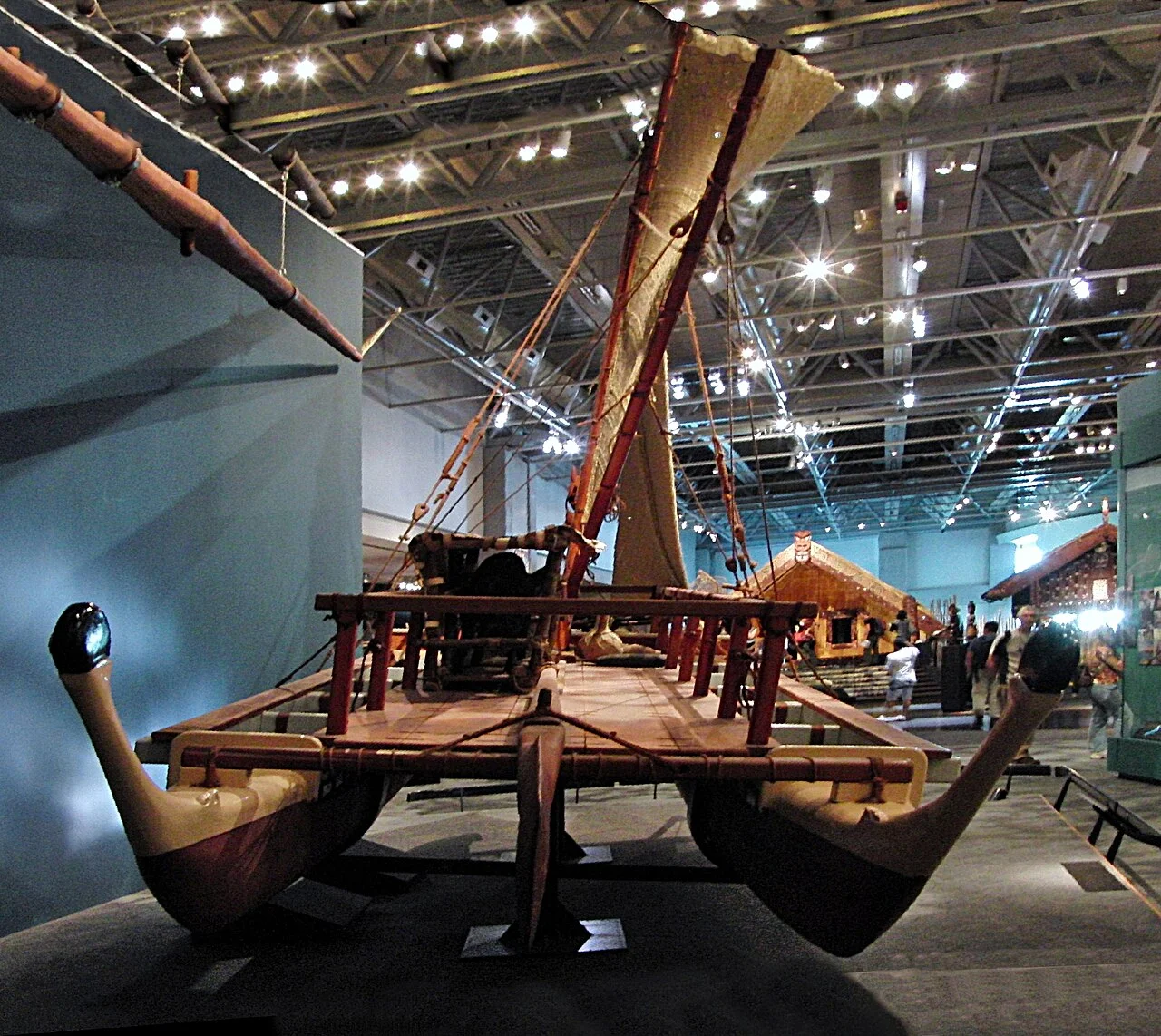
The heart of the museum's bicultural mission: the Māori galleries hold taonga of immense significance, chief among them Te Hau ki Tūranga, one of the oldest surviving carved meeting houses in New Zealand, carved in the 1840s. Intricate poupou (ancestral posts), cloaks, weapons, and contemporary iwi-commissioned works trace Māori identity from ancestral migration to twenty-first-century politics, curated under the museum's guiding principle of mana taonga — that source communities retain authority over how their treasures are shown.
Te Marae Rongomaraeroa
Te Papa's own marae is unlike any other in the country: a marae for all peoples, its brilliantly coloured wharenui, Te Hono ki Hawaiki, was designed by artist Cliff Whiting and completed for the 1998 opening using contemporary materials and a deliberately non-traditional palette. It stands on Level 4 as a working ceremonial space and a statement that Te Papa belongs to tangata whenua and tangata Tiriti alike.
Te Taiao | Nature
The natural-environment galleries showcase New Zealand's extraordinary and often lost biodiversity: the world's most complete collection of moa skeletons, the tuatara (sole survivor of an order older than the dinosaurs), preserved huia specimens of a bird extinct since 1907, and the star draw — the only intact colossal squid on public display anywhere in the world, at 4.2 metres and 495 kilograms.
Awesome Forces & the Earthquake House
New Zealand sits on the boundary of the Pacific and Australian tectonic plates, and this gallery makes that vivid. The earthquake house simulates the shaking of a magnitude-5 and a magnitude-7.5 quake from the safety of a recreated suburban living room, while surrounding displays explain the volcanoes, faults, and tsunami risk that shape life on the Shaky Isles. It is consistently one of the museum's most visited interactive exhibits.
Gallipoli: The Scale of Our War
Created with Wellington's Wētā Workshop and opened in 2015, this powerful exhibition tells the story of the 1915 Gallipoli campaign through eight New Zealanders rendered as hyper-real figures at 2.4 times human scale. Every pore, tear, and bead of sweat is modelled, placing the visitor eye-to-eye with the ordinary soldiers, nurses, and officers of a defining episode in the nation's history.
Toi Art
Te Papa is a national art gallery as well as a museum, and Toi Art — opened across two floors in 2018 — is where that role comes alive. Rotating exhibitions draw on the national art collection to show historic and contemporary New Zealand and Pacific art alongside international loans, from colonial-era painting to bold new Māori and Pasifika practice.
Bush City & the Outdoor Galleries
Not every gallery is indoors. Bush City is an outdoor living exhibit wrapped around the museum's seaward side, with a native-bush walk, a lagoon, a swing bridge, a recreated cave, and glow-worms — a compact, free introduction to the ecosystems of Aotearoa and a favourite decompression stop for families between the indoor floors.
Guided Tours
A little navigation planning turns a sprawling museum into a manageable half-day. The permanent galleries climb from levels 2 to 5: the busy Te Taiao | Nature zone (the colossal squid, the moa, and the earthquake house) sits low in the building; Te Ao Māori and the marae occupy an upper floor alongside the harbour-view windows; Toi Art carries the national art collection higher still; and Bush City wraps the seaward side outdoors. Ticketed special exhibitions — often blockbuster international touring shows — occupy their own gallery and are usually the only part of the building that charges admission.
Te Papa runs free introductory tours most days, departing from the information desk near the main entrance. The flagship Introducing Te Papa highlights walk lasts about an hour and threads together the colossal squid, the Māori galleries, and the natural-history halls with a museum host; times are posted on arrival and at the desk. Māori-hosted tours and te reo Māori experiences run to their own schedule and are the richest way to encounter the taonga.
A private local guide adds what a free highlights tour cannot: pacing tuned to your interests, uninterrupted time in front of the pieces that matter to you, and the cultural and historical context that turns objects into stories. Independent Wellington guides typically fold Te Papa into a wider walking morning that also takes in the waterfront and Cuba Street, or pair it with the Wellington Cable Car and the Botanic Garden. For self-guided visitors, the museum's own maps and the front-desk hosts are genuinely helpful — do not be shy about asking which galleries are quietest at the hour you arrive.
When to Visit
Open daily 10 AM to 6 PM (closed Christmas Day, 25 December), so the museum trades 364 days a year. Late-night opening extends the hours on selected evenings during summer and major exhibitions — check the day's schedule on arrival. Entry to all permanent galleries is free and needs no booking. The museum is least crowded on weekday mornings and busiest on Saturday afternoons and during school-holiday periods (January, April, July, and September–October). Free guided tours depart several times daily from the information desk; the posted schedule is the reliable source. Special-exhibition hours may differ from the main museum, so confirm before timing your visit around a ticketed show.
Te Papa is comprehensively accessible: the building is fully step-free with lifts to every gallery level, manual wheelchairs and mobility scooters can be borrowed from the ground-floor information desk (booking ahead is wise on busy days), and accessible parking sits close to the entrance. A cloakroom takes large bags and backpacks, which are not permitted in some galleries; prams and pushchairs are welcome throughout, and baby-change and feeding facilities are provided. Quieter, sensory-friendly conditions are easiest to find on weekday mornings soon after opening.
Admission and Costs
Permanent galleries: Free — open to everyone without booking, and the museum's defining feature. Ticketed special exhibitions: NZ$10–25 ($6–15) per person; children are often free or discounted, and these Level 6 touring shows are usually the only paid part of the building. Guided tours (permanent galleries): Free — a small tip of NZ$5–10 ($3–6) is appreciated for an extended tour. Museum café: standard Wellington café prices — coffee NZ$5–7 ($3–4), breakfast NZ$15–22 ($9–13), lunch NZ$18–30 ($11–18). Museum shop: quality New Zealand art books, Māori-inspired jewellery and textiles, and natural-history titles. Parking: there is no visitor car park at the museum; the paid waterfront and Frank Kitts Park parking nearby run roughly NZ$4–6 ($2.50–4) an hour, so most visitors walk in from the central city.
The Case for a Guide
- Taonga protocol — a knowledgeable guide explains which objects have restricted viewing rights (tapu) and why, and how the museum's principle of mana taonga navigates the tension between public access and cultural authority over sensitive collection items
- Wharenui (meeting house) interpretation — the carved panels and poupou (interior posts) of the meeting houses encode genealogical narratives that reward decoding; each carving tells a specific ancestor's story a guide can unlock
- Moa extinction evidence — the moa skeletons and surrounding displays present the most compelling evidence of human-caused megafauna extinction in New Zealand; a guide contextualises this within global patterns of Holocene extinction
- Contemporary Māori art — several permanent galleries feature contemporary iwi-commissioned works addressing modern cultural, political, and environmental issues; a guide frames these within te Tiriti o Waitangi (the Treaty of Waitangi) and present-day New Zealand politics
- Reading the building — the base-isolated structure, the weathering-steel geometry, and the deliberate meeting of land and sea are part of the story; a guide connects the architecture to Wellington's earthquake geography and the museum's bicultural brief
Tips for Visitors
Start on the upper floors and work downward — the higher levels hold the less-crowded art galleries and the magnificent harbour views from the upper windows, while the busy natural-history zone on Level 2 is best hit right at opening or in the late afternoon. The earthquake house always draws a queue; ride it immediately at opening or after 2 PM once the morning crowds thin. Leave your backpack in the ground-floor cloakroom before you start, since large bags are not allowed in some galleries. The museum's waterfront position makes it the natural anchor of a Wellington harbour walk south toward the waterfront restaurants and the Wellington Cable Car base, and Te Papa is a 15-minute stroll from Cuba Street — combining the two covers Wellington's cultural and community identity in complementary dimensions. For a full day, add the panorama from the Mount Victoria Lookout before dinner. Families should budget extra time for Bush City outdoors, and everyone should save a few minutes for the Level 4 windows, the best free harbour view inside the Wellington CBD.
Frequently Asked Questions
Is Te Papa Museum free to enter?
General entry to Te Papa Tongarewa is free, including permanent galleries covering Maori culture and history (Te Ao Maori), the natural environment (Te Taiao), New Zealand history, and Pacific cultures. Some ticketed special exhibitions charge NZ$10–25 ($6–15). The museum's free entry policy has been in place since opening in 1998 and reflects a government commitment to universal access to the national collections. Te Papa is open 364 days a year (closed Christmas Day).
How long should I spend at Te Papa?
Allow a minimum of 2 hours for a focused visit covering the Maori galleries and one or two other permanent floors. A thorough visit of 3 to 4 hours covers the major permanent collections, the colossal squid, the earthquake house experience, and a current special exhibition. With a guided tour, 2 hours is typically enough for the highlights with meaningful context added to what you see. The museum's waterfront café makes it easy to extend into a half-day Wellington waterfront itinerary.
What is the colossal squid at Te Papa?
Te Papa holds the world's only complete specimen of a colossal squid (Mesonychoteuthis hamiltoni), the largest known invertebrate on Earth. The specimen, caught accidentally in the Ross Sea by a New Zealand fishing vessel in 2007, is displayed in a specially designed preservation case at 4.2 metres long and weighing 495 kg. The colossal squid is equipped with unique swivelling hooks rather than suckers and has the largest known eyes of any living animal, estimated at 27 cm in diameter — bigger than a dinner plate.
Where is Te Papa and how do I get there?
Te Papa sits on Cable Street on Wellington's waterfront, a flat 10-minute walk from Wellington Railway Station and the Interislander ferry terminal, and about 12 minutes on foot from the Wellington Cable Car base on Lambton Quay. Cuba Street is a 15-minute stroll inland. Frequent Metlink buses stop on nearby Courtenay Place and Cable Street, and the museum is fully step-free from the waterfront promenade. There is no visitor car park at the museum; use the paid waterfront and Frank Kitts Park parking nearby, or arrive on foot as part of a central-city walk.
Is Te Papa good for kids and families?
Yes — Te Papa is one of New Zealand's best free family days out. The interactive Te Taiao | Nature zone lets children stand inside the earthquake house, walk through a recreated southern-hemisphere cave, and handle science exhibits, while the outdoor Bush City offers a lagoon, a bush walk, and a glow-worm cave to explore. A dedicated discovery space for younger children (nappy-change and feeding facilities nearby) rotates hands-on activities, and prams are welcome throughout the step-free galleries. Entry is free, so families can dip in and out across a wider Wellington itinerary without a ticket commitment.
Can you take photos inside Te Papa?
Photography for personal use is permitted in most permanent galleries, including the colossal squid, the natural-history halls, and the harbour-view windows on the upper floors — flash and tripods are generally discouraged in crowded spaces. Some taonga Maori and certain touring special exhibitions restrict or prohibit photography for cultural or copyright reasons; look for the posted signage at each gallery entrance, and when in doubt ask a host. Filming the earthquake house in action and the wide waterfront panoramas from Level 4 are among the most popular shots visitors take home.