
Walking Route
Landmarks Along
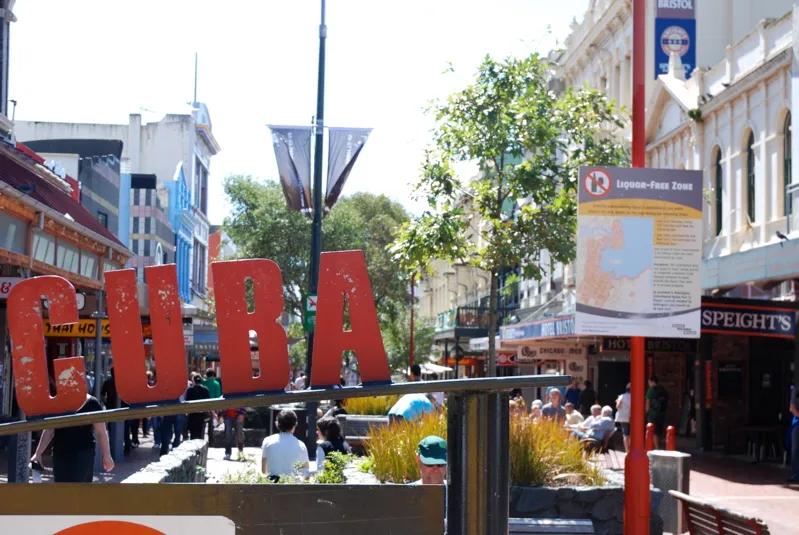
Walking Cuba Street from its northern Cuba Mall entrance at Manners Street up to the Webb Street end, you pass a run of landmarks that together tell the story of the strip. The unmissable one is the Bucket Fountain, the 1969 kinetic water sculpture by the architects Burren and Keen that sits midway along the pedestrian mall and serves as the street's meeting point and unofficial logo. A few steps away, the Havana Bar occupies a converted villa with courtyard seating, while the narrow Left Bank arcade off the mall is packed with murals, tattoo studios, and hole-in-the-wall traders.
Higher up, the heritage precinct comes into its own: the Cuba Street heritage area preserves Victorian, Edwardian, and Art Deco facades largely intact above the shopfronts, a rare surviving streetscape in central Wellington. Long-running institutions punctuate the upper strip — Fidel's Café with its Cuban-revolution theme, the all-hours Midnight Espresso, and Slow Boat Records, one of New Zealand's longest-surviving independent record shops. From the northern end it is a five-minute walk to the Wellington Cable Car and about fifteen to Te Papa on the waterfront.
Photo Spots
Cuba Street rewards a camera, and a handful of vantage points capture its character best. The Left Bank arcade off the pedestrian mall holds the densest concentration of murals and street art on the strip and is the single best spot for close, graphic photography — its narrow walls and changing paste-ups reward repeat visits. For the street's signature image, shoot the Bucket Fountain from the Havana Bar's outdoor seating across the way, where you can frame the tipping metal buckets against passers-by without stepping into splash range.
The upper strip near Ghuznee and Vivian streets is where the heritage facades photograph best: the two-way traffic block preserves the densest run of Victorian, Edwardian, and Art Deco shopfronts, and the softest, most even light falls on them in the mid-afternoon lull between 2 and 5 PM. For crowd and atmosphere shots, the Cuba Mall entrance at Manners Street is the widest, most performative block, busy with buskers and food carts — and for one spectacular day, CubaDupa in late March fills the whole traffic-free street with stages and parades. Vertical framing works well throughout, catching the ornate upper storeys that most passers-by never look up to see.
When to Visit
Cuba Street operates daily from approximately 7 AM until midnight or later at the bar end of the strip. Cafés begin opening from 7 AM for breakfast trade. The pedestrian mall section is closed to through traffic and accessible at all hours. The Saturday morning market at the top of the Cuba Mall runs from approximately 8 AM to 1 PM. Live music venues (the Bodega, San Fran, and Meow) begin programming from 8 PM most nights; check their individual websites for current listings. The street is at its quietest between 2 and 5 PM on weekdays — a good time for the cafés if you prefer to linger without queuing, and the softest light for photographing the heritage facades. On Friday and Saturday evenings the Wellington Night Market takes over part of the strip — the lower Cuba Mall end near the Bucket Fountain on Fridays, the upper block on Saturdays — with food stalls trading from roughly 5 PM until late. For the street at its most alive, plan around CubaDupa in late March, when Cuba Street closes to traffic for two days of free stages and parades.
Admission and Costs
Cuba Street itself is free to walk. Coffee: NZ$5–7 ($3–4) for a flat white or long black at any of the independent cafés. Lunch: NZ$15–25 ($9–15) for a substantial meal at most cafés and food trucks. Vinyl records: from about NZ$10 ($6) for secondhand to NZ$40–80 ($24–48) for new specialist releases. Music venues: typically NZ$10–25 ($6–15) door charge for live acts. Vintage clothing: NZ$20–150 ($12–90) depending on item and condition. A guided food-and-culture walk of Cuba Street with a Wellington local costs approximately NZ$30–60 ($18–36) per person and typically includes a bakery stop, a café tasting, and a tour of the most architecturally interesting buildings. CubaDupa and the Bucket Fountain are always free.
The Case for a Guide
- Business histories — the independent operators of Cuba Street have deep histories a local guide can relay: which café shaped the Wellington flat-white style, which record shop has served the city's musicians for decades, which bar hosted the early sessions of bands that went international
- Architectural layering — Cuba Street's buildings span Victorian commercial facades, Edwardian and Art Deco shopfronts, 1960s concrete modernism, and contemporary interventions; a guide traces these layers and explains which buildings sit within the registered heritage precinct and why
- Cultural identity — Cuba Street is inseparable from Wellington's identity as a progressive, arts-led city; a guide contextualises the street's political history (Treaty settlements, LGBTQ+ rights marches, housing protests) and its current role in New Zealand cultural life
- Coffee culture entry point — Wellington is New Zealand's acknowledged capital of specialty coffee; a guide introduces the specific roasters, extraction methods, and milk-texturing standards that local baristas regard as non-negotiable
- Music and festival memory — from the small live-music rooms to the annual CubaDupa street festival, a guide can map the venues, plaques, and stories behind Wellington's outsized live-music reputation
Tips for Visitors
Worth it for anyone who values independent cafés, vinyl, vintage fashion, and street art over polished chain retail — Cuba Street is the most characterful strip in Wellington and rewards an unhurried browse rather than a quick tick-off. Skip it only if you are short on time and chasing big-ticket sights, because the appeal is atmosphere and independent shopfronts rather than a single must-see monument. Eat breakfast or lunch on Cuba Street rather than at your hotel — the independent café options are genuinely excellent and far more interesting than any hotel buffet. The Bucket Fountain is best observed from the Havana Bar's outdoor seating across the street, where you can watch its irregular water patterns over a coffee without getting splashed, while the Left Bank arcade off the mall holds the street's densest concentration of murals for photography. For vinyl, Slow Boat Records in the upper strip carries an extraordinary collection across every genre. If you are in Wellington on a Friday evening, Cuba Street is where the city's creative workforce congregates — the bars and live-music venues fill from 7 PM, and the energy makes it the best single street experience in the whole of New Zealand. Combine it with Te Papa or the Wellington Cable Car earlier in the day for a complete Wellington itinerary.
Frequently Asked Questions
Why is Cuba Street so famous in Wellington?
Cuba Street has been Wellington's counterculture main street since the 1970s, when artists, musicians, and independent traders who couldn't afford the main shopping precinct colonised the then-run-down strip and created an alternative commercial culture that has persisted and flourished for fifty years. The combination of independently owned small businesses — no chains or franchise operators — a partially pedestrianised design that encourages lingering, and the city's disproportionately large arts, film, and café-industry population makes Cuba Street a genuine community hub as much as a visitor attraction. Much of the strip is a registered heritage precinct, its Victorian, Edwardian, and Art Deco facades largely intact above the shopfronts.
What is the Cuba Street bucket fountain?
The Bucket Fountain is a 1969 kinetic water sculpture designed by the architects Burren and Keen for the opening of the pedestrianised Cuba Mall, consisting of a series of metal buckets that fill, tip, and slosh water in a perpetually shifting sequence that is both mesmerising and unpredictably splashy. It has been a Wellington landmark for over five decades and a meeting-point marker for generations of residents, serving as the symbol of Cuba Street's irreverent, slightly chaotic personality. The fountain sits midway along the Cuba Street pedestrian mall and is typically surrounded by people eating lunch, buskers, and the occasional toddler attempting to interact with the buckets.
What is the best time to visit Cuba Street?
Cuba Street operates all day every day, but its best periods are weekday lunch hours (12–2 PM) when the local workforce fills the cafés and food trucks, Friday afternoons from 4 PM onward when the music venues begin warming up and the street takes on its most social energy, and Saturday mornings when the organic market at the northern end of the strip is in full swing and the whole street feels leisurely and exploratory. For its single biggest day, come in late March for CubaDupa, the free street festival that closes Cuba Street to traffic and fills it with stages and parades.
What is the difference between Cuba Street and Cuba Mall?
They are the same place under two names. Cuba Mall is the pedestrianised lower section — closed to traffic since 1969 — that runs from Manners Street up to Ghuznee Street and holds the Bucket Fountain, the buskers, and the food carts. Cuba Street is the full strip of roughly 800 metres, which continues north-west of the mall as a two-way shared zone lined with heritage shopfronts, record shops, and long-running cafés. Locals use the two names interchangeably, but if someone in Wellington directs you to "the Cuba Mall" they mean the traffic-free block around the fountain. The whole strip sits in the Te Aro quarter of central Wellington.
Where is Cuba Street in Wellington, New Zealand, and how do I get there?
Cuba Street runs through Te Aro in central Wellington, on New Zealand's North Island, a flat five- to ten-minute walk inland from the waterfront and from Wellington Railway Station along the route locals call the Golden Mile. It is entirely walkable from most central hotels; Metlink buses stopping on nearby Manners Street and Courtenay Place put you a block away, and the base of the Wellington Cable Car on Lambton Quay is about a five-minute walk from the top of the mall. There is no need to drive — paid parking in Te Aro is limited and many surrounding streets are one-way — so most visitors arrive on foot as part of a wider Wellington city walk.
Are there guided tours of Cuba Street?
Yes. Small-group food-and-culture walks led by Wellington locals cover Cuba Street in about two to three hours for roughly NZ$30–60 ($18–36) per person, typically pairing a bakery or café tasting with the history of the independent traders and the heritage architecture above the shopfronts. A tour is worth it if you want the backstories — which café shaped the Wellington flat white, which record shop has served the city's musicians for decades — and the specialty-coffee context that a self-guided wander misses. Skip the paid tour if you have a spare afternoon and prefer to browse the vinyl shops, vintage racks, and cafés at your own pace, because the street is compact, free to walk, and easy to navigate solo. Many visitors fold a Cuba Street walk into the same day as the Wellington Cable Car and Te Papa.
Is there a night market on Cuba Street?
Yes — the Wellington Night Market sets up along Cuba Street on Friday and Saturday evenings, filling the strip with hot-food stalls cooking cuisines from across Asia, the Pacific, and the Middle East, generally from around 5 PM until late. The Friday market runs on the lower Cuba Mall end near the Bucket Fountain, and the Saturday market moves to the upper strip; both are free to wander and are one of the cheapest ways to eat well in the central city, with most dishes in the NZ$8–15 ($5–9) range. Combined with the bars and live-music rooms that fill from early evening, the weekend nights are when Cuba Street is at its liveliest.