

Overview
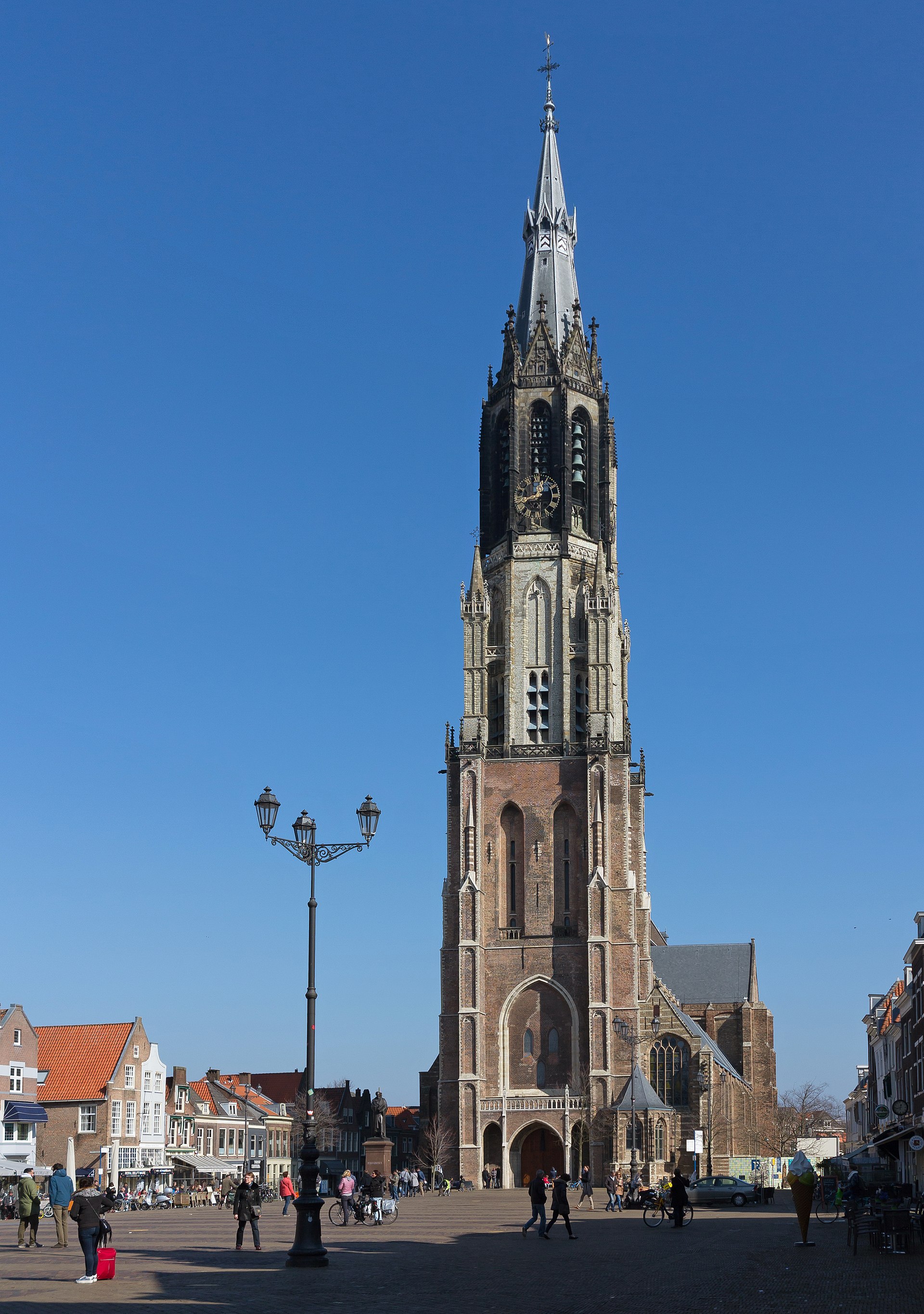
The Nieuwe Kerk (New Church) dominates Delft's Markt square with a 108.75-meter tower that took nearly a century to build (1381-1496) and remains the second tallest church tower in the Netherlands, after Utrecht's Dom Tower. "New" is relative — the church was "new" compared to the Oude Kerk across town, which dates to the 1200s. Inside, the building's primary significance is political rather than architectural: the elaborate marble and bronze tomb of William of Orange (William the Silent), designed by Hendrick de Keyser and completed in 1623, marks the resting place of the founder of the Dutch nation.
William led the revolt against Spanish rule and was assassinated in the nearby Prinsenhof in 1584. Beneath the tomb lies the Koninklijke Grafkelder (Royal Crypt), where members of the House of Orange-Nassau — the Dutch royal family — have been interred since William's death. The tower climb — 376 steps up a narrow spiral staircase — rewards the effort with views extending to The Hague, Rotterdam, and on exceptionally clear days, the North Sea coast. Along the climb, the guide (tower visits are accompanied) points out the bell chamber, the clock mechanism, and the structural engineering that has kept a 15th-century stone tower stable for over five centuries. Back at ground level, the church interior contains memorial plaques for Hugo Grotius (father of international law, buried here) and naval heroes of the Dutch Golden Age. The Nieuwe Kerk functions as the Netherlands' Westminster Abbey — the place where national identity, monarchy, and history converge in a single Gothic space.
Spiritual Significance
William of Orange's Tomb: Hendrick de Keyser's masterwork in marble and bronze — the prince lies in effigy surrounded by allegorical figures of Liberty, Justice, Religion, and Courage. His dog, who died shortly after his master, rests at his feet. Royal Crypt: Beneath the tomb, the Koninklijke Grafkelder contains the remains of Dutch monarchs from William the Silent to the present royal family — closed to the public but its existence gives the church its national significance. Tower Views: The 376-step climb yields panoramic views — the Markt square directly below, Delft's canal grid radiating outward, The Hague's skyline to the northwest, and Rotterdam's towers to the southeast. Hugo Grotius Memorial: A floor slab marks the burial place of Hugo Grotius (1583-1645), whose De Jure Belli ac Pacis established the foundations of international law — fitting that his memorial lies in Delft, near The Hague's Peace Palace. Stained Glass: The church's windows, including a notable window depicting William of Orange, fill the interior with colored light that shifts throughout the day.
Visitor Etiquette
The Nieuwe Kerk remains an active place of worship alongside its role as a national monument. Sunday services take priority over tourist visits — check service times before planning. During the tower climb, guides request silence at certain levels where the narrow staircase passes close to residential properties. Photography is permitted inside the church but visitors should avoid flash near the stained glass and the royal tomb. The Koninklijke Grafkelder is closed to the public out of respect for the royal family; the tomb above provides the visible memorial. Combine the Nieuwe Kerk with the nearby Vermeer Centrum and Royal Delft for a full day exploring Delft's artistic, political, and craft heritage.
When to Visit
Church: Monday-Saturday 9:00-18:00 (shorter hours in winter); check for Sunday service times. Tower climb: Available during church opening hours, weather permitting (tower closes in high winds). Best: Mid-morning for interior light through the stained glass; clear-sky afternoons for the best tower views. Allow: 45 minutes for the church interior; add 30-45 minutes for the tower climb.
Admission and Costs
Church admission: €5 adults. Church + tower climb: €9 adults. Combination ticket: Available with the Oude Kerk for reduced combined price. Guided tours: Group tours bookable through the church office; individual visits are self-guided with information panels.
Tips for Visitors
Weather for tower: The tower closes in high winds and thunderstorms. Check the weather before planning around the climb — the church interior is worthwhile regardless. Physical demands: The 376-step climb involves narrow spiral stairs with no elevator option. The passage narrows significantly near the top. Combination tickets: Buy the Oude Kerk + Nieuwe Kerk combination ticket if visiting both churches — it saves money and both merit visiting. Markt square context: Before entering, stand on the Markt and take in the tower's full height against the Renaissance City Hall on the square's opposite side — the juxtaposition captures Delft's civic character. Vermeer connection: After the church, visit the Vermeer Centrum around the corner to learn how the artist depicted Delft's churches and streetscapes in his paintings.