
Collection Highlights
The Book of Kells
The reason most people come — an illuminated gospel book of around 800 CE whose ornament has never been equalled. Shown two volumes at a time in a darkened case; look for the Chi Rho page (folio 34r), the full-page evangelist portraits, and the carpet pages of pure abstract interlace.
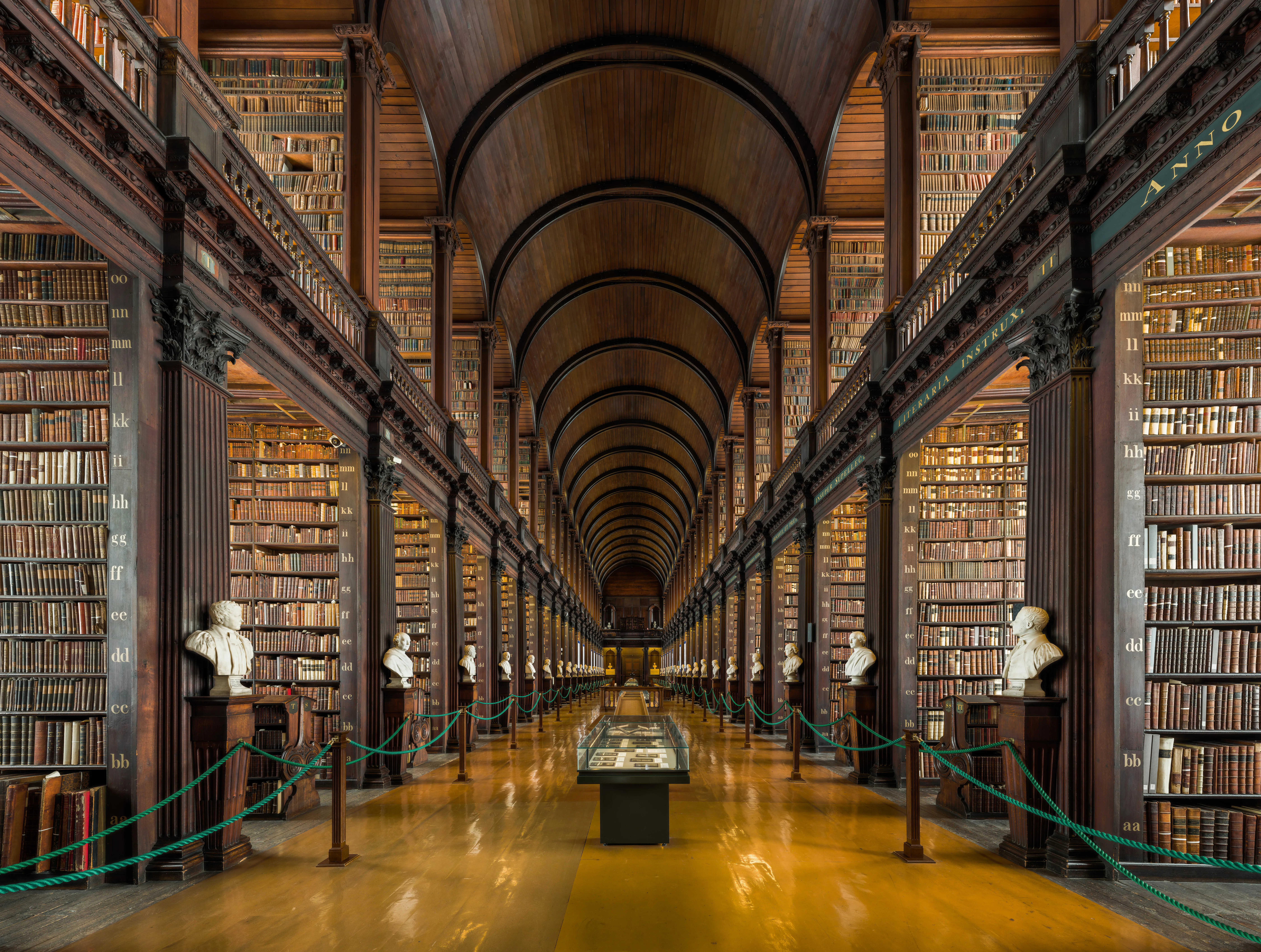
The Long Room
A 65-metre barrel-vaulted hall of dark oak lined with 200,000 of Trinity's oldest books — Ireland's most photographed interior and, by common consent, one of the most beautiful libraries on earth. Built 1712–1732, with its soaring ceiling added in 1860.
The Chi Rho page
Folio 34r, the most elaborately decorated page in the Western manuscript tradition, where the Greek monogram for Christ dissolves into a labyrinth of interlace concealing cats, mice, moths, and an otter catching a fish. Weeks of a single scribe's labour under a hair-fine stylus.
The Brian Boru harp
The 14th–15th-century willow-and-oak harp that became the emblem of the Irish state, appearing on every euro coin, the presidential seal, and the passport. One of only three medieval Gaelic harps to survive anywhere in the world.
The marble busts
More than forty busts of writers, philosophers, and scientists line the Long Room, from Homer and Aristotle to Newton. The masterpiece is Roubiliac's bust of Jonathan Swift, the Trinity graduate whose presence still dominates the room.
The Book of Durrow and Book of Armagh
Kells's older insular companions — Durrow (around 700 CE), the earliest fully decorated gospel book, and Armagh (807 CE), the only near-complete early Irish New Testament, carrying documents on Saint Patrick. Rotated into the exhibition alongside the star manuscript.
The 1916 Proclamation
An original printing of the Proclamation of the Irish Republic held in the Old Library — a direct thread from the scholarship of the Long Room to the revolution that founded the modern state and to the executions at Kilmainham Gaol.
The Trinity campus
Free to wander at any time: cobbled Parliament and Library Squares, the Campanile bell tower, the Museum Building's natural-history collections, and the modernist Berkeley Library — the university setting that gives the manuscripts their context.
Collections Highlights
Most visitors arrive for one manuscript and leave having discovered a whole treasury of early Irish and European book culture. These are the pieces worth slowing down for:
- The Book of Kells — The star exhibit, shown two volumes at a time in a darkened, climate-controlled case. Look for the Chi Rho monogram (folio 34r), the carpet pages of pure ornament, and the four evangelist symbols; palaeographers have distinguished at least four separate scribal-artistic hands across its folios.
- The Book of Durrow — Roughly a century older than Kells (around 700 CE), this is the earliest fully decorated insular gospel book and shows the tradition in a starker, more geometric stage before Kells brought it to riotous maturity.
- The Book of Armagh — Written in 807 CE, it is the only near-complete early Irish New Testament to survive and bundles in early documents on Saint Patrick, making it as much a national archive as a gospel book.
- The Long Room — Not a container for the treasures but a treasure itself: a 65-metre nave of dark oak lined with 200,000 of the library's oldest books, ladders, and busts. This is Ireland's most photographed interior.
- The Brian Boru harp — The oldest of only three surviving medieval Gaelic harps and the model for the emblem on every Irish coin and passport.
- The 1916 Proclamation — An original printing of the Proclamation of the Irish Republic, connecting the Long Room's quiet scholarship to the revolution that made the modern state and to the executions at Kilmainham Gaol.
The Book of Kells exhibition and the Long Room are the two "galleries" of the visit, but the interpretive room between them — with enlarged reproductions, video, and context on pigments and vellum — is where the manuscript becomes legible rather than merely dazzling. Do not rush it.
Guided Tours
Three broad ways to see the library, in ascending order of depth:
- Self-guided with the exhibition panels — The interpretive room is genuinely good, and independent visitors who read it carefully leave well informed. This is the cheapest route and fine if your time is tight.
- The official Trinity exhibition tour — Led by guides with specific medieval-manuscript training, this roughly 75-minute tour decodes the Chi Rho page, identifies the different scribal hands, and explains the Long Room's construction and its busts. It is the single biggest upgrade to the visit for the money.
- A private licensed city guide who includes Trinity — Dublin's Fáilte Ireland–approved guides often fold the Book of Kells into a wider walk that links Trinity to Dublin Castle and the medieval core, giving the manuscript its historical setting rather than treating it as an isolated marvel.
Whichever you choose, book the entry slot online in advance during summer; a tour ticket does not always guarantee timed admission, so check what your booking actually includes. Free tips-based walking tours of Dublin depart from the Trinity front gates and are an excellent orientation, but they cover the campus exterior only — the Book of Kells itself always requires a paid, timed ticket.
When to Visit
The Book of Kells exhibition and Long Room are open Monday–Saturday 8:30 AM–5:00 PM (extended to 5:30 PM in summer) and Sunday 9:30 AM–5:00 PM. The Library is closed on Christmas Day and St Stephen's Day. Book timed-entry tickets online at tcd.ie/visitors at least a day in advance in peak season — summer queues without a reservation can exceed 60 minutes. The best visiting window is the first 90 minutes after opening (8:30 AM on weekdays), when the exhibition halls are almost empty; the second-best is the last hour before closing, once the coach and cruise groups have moved on. Because the Old Library is undergoing phased redevelopment, opening arrangements and the exact route through the building can vary — always reconfirm times and any temporary closures on the official visitor page before you set out.
Admission and Costs
Adult admission: €18–23 (prices vary seasonally; check the Trinity website for current rates). Students with valid ID: €16. Under-18s: free. Guided tours of the exhibition (booked separately): approximately €8 per person additional. The Dublin Pass does not include the Book of Kells, which requires a separate ticket. Annual research visitors to the library enter through a separate scholars' entrance without paying the visitor exhibition fee. To stretch a heritage budget, pair the paid Book of Kells visit with the free National Museum of Ireland — Archaeology on Kildare Street and the free National Library, both a few minutes' walk away — a full morning of Ireland's finest early-medieval treasures for the price of a single ticket. Booking direct through Trinity rather than a reseller avoids third-party service fees.
The Case for a Guide
The Book of Kells exhibition includes good interpretive text panels, but a specialist guide transforms the encounter:
- Decoding the Chi Rho page — The most complex single page in Western manuscript history contains at least 13 distinct interlace patterns and numerous animal figures concealed in the knotwork; a guide traces them with practised knowledge while the self-guided visitor typically sees only the surface design
- Identifying the scribes — Palaeographers have identified at least four distinct scribal hands in the manuscript; a guide can point to page-turns where the handwriting changes and explain what this suggests about monastic collaborative working methods
- Long Room architectural history — The barrel-vaulted ceiling was not original; the upper gallery (with its classical wooden arcade) was added in the 1860 expansion. A guide explains why the shelves were raised and what was removed to make room
- Brian Boru's harp significance — The guide contextualises the harp within the history of the Celtic bardic tradition and explains the political choices that elevated this specific object to national symbol status in the 19th century
- Campus hidden history — The Berkeley Library, the Graduates Memorial Building, and the Printing House all reward the walk across campus that most visitors skip in their rush to exit after the Long Room
Tips for Visitors
Book online — Timed-entry is essential July–August; often available same-day in winter. Arrive at opening — The 8:30 AM window on weekdays is dramatically less crowded than mid-morning. Photography — Photography is permitted in the Long Room; the Book of Kells exhibition prohibits flash and tripods but allows handheld photography. Accessibility — The exhibition and Long Room are reached by stairs, but a lift provides step-free access to both floors; assistance dogs are welcome, and the exhibition offers seating at intervals. The campus is free to enter — Walk through the College Green front arch at any time; the squares, cricket pitch, and Campanile are accessible without buying a ticket. Combination visits — The nearby National Museum of Ireland — Archaeology on Kildare Street (free) and the National Library (free) complete a morning of Irish cultural heritage without additional cost, and Dublin Castle is a ten-minute walk west for the afternoon.
Frequently Asked Questions
What exactly is the Book of Kells?
The Book of Kells is an illuminated manuscript gospel book — containing the four Gospels of the New Testament in Latin — created by Celtic monks around 800 CE, most likely on the Scottish island of Iona before being brought to Kells Abbey in County Meath following a Viking raid. Its 340 vellum folios (680 pages), which required the skins of roughly 185 calves, are decorated with an intensity of ornamental interlace, zoomorphic figures, and symbolic imagery that has never been surpassed in the Western manuscript tradition. The colours — made from lapis lazuli ground in Afghanistan, orpiment (arsenic sulphide) from mines in the Middle East, and the local woad plant — retain their extraordinary vivacity after 1,200 years. The manuscript was donated to Trinity College by Henry Jones, Bishop of Meath, in 1661, and was inscribed on the UNESCO Memory of the World Register in 2011. It remains one of Ireland's most visited cultural treasures.
How long should I allow for a visit to Trinity College Library?
Allow a minimum of 60–90 minutes — 30–40 minutes for the Book of Kells exhibition (which includes scholarly context on manuscript production and Celtic art, not just the glass-encased pages) and 20–30 minutes to walk the Long Room at a considered pace. In peak summer (July and August), queues at the entrance can add 45 minutes to the wait unless you have booked timed-entry tickets online in advance. A guided tour of the exhibition, offered by specialist guides with medieval manuscript expertise, takes approximately 75 minutes and dramatically increases the experience. The broader Trinity College campus — cobbled squares, the Museum Building's natural history collections, and the Science Gallery — adds another hour if time permits, and pairs naturally with Dublin Castle a ten-minute walk to the west.
What is Brian Boru's harp and why is it Ireland's national symbol?
Displayed in the Long Room is the Brian Boru harp — a 14th- to 15th-century instrument (not, despite its name, the 10th-century High King's actual harp, though it is one of only three surviving medieval Gaelic harps) with a distinctive asymmetric soundbox carved from a single piece of willow and once strung with 29 brass strings. The image of this harp was adopted as Ireland's national symbol and appears on the Presidential Seal, Irish euro coins, and the passport cover; a left-facing version is the registered trademark of Guinness. The harp's positioning in the Long Room, surrounded by the 200,000+ books of the library's oldest collection and watched over by marble busts of scholars from Homer to Swift, makes it one of the most quietly powerful cultural encounters available in Ireland.
What else does the library hold besides the Book of Kells?
A great deal — the Book of Kells is only the most famous of Trinity's early manuscripts. The exhibition typically rotates in its companions from the same insular tradition: the Book of Durrow (around 700 CE, the earliest fully decorated insular gospel book) and the Book of Armagh (807 CE, which preserves the only near-complete New Testament to survive from early medieval Ireland alongside texts on Saint Patrick). The Long Room above holds an original 1916 printing of the Proclamation of the Irish Republic — one of the fewer than 50 surviving copies of the document read outside the GPO at the start of the Easter Rising, the same rebellion whose leaders were executed at Kilmainham Gaol. As a legal-deposit library since 1801, Trinity is entitled to a copy of every book published in Ireland and the United Kingdom, and its total holdings exceed six million volumes.
How do I get to Trinity College Library?
Trinity sits at the dead centre of Dublin, so nearly everything arrives at its gate. The Luas Green Line stops at Trinity and Dawson, both under three minutes' walk; the red line stops at Abbey Street across the Liffey. Dozens of Dublin Bus routes pass along Nassau Street and College Green, and the DART commuter rail reaches Pearse Station, a five-minute walk east. Coming from the airport, the Airlink 747 and the private Aircoach both stop within a few minutes of the front arch. The visitor entrance for the exhibition is not the grand College Green front gate but the Arts Building / Fellows' Square side — follow signs for the Book of Kells once inside. Everything on Dublin's compact south side, including Dublin Castle, is within a fifteen-minute walk.