
Dublin Castle timeline
-
King John orders a castle
King John instructs his justiciar to raise a fortified castle in Dublin "for the custody of our treasure" and the administration of justice, on the ridge above the tidal pool where the Poddle met the Liffey.
-
The Norman fortress completed
A rectangular stone castle rises with a round tower at each corner and a moat fed by the Poddle — the footprint that still defines the Upper Castle Yard eight centuries later.
-
The great fire
A catastrophic fire guts most of the medieval buildings, clearing the way for the Georgian palace and government complex visitors see today.
- 1740s–1790s
The Georgian State Apartments
The Upper Yard is rebuilt as a formal quadrangle: the Bedford Tower, the Throne Room, and St Patrick's Hall give the Viceroys a stage worthy of a European court.
-
Chapel Royal completed
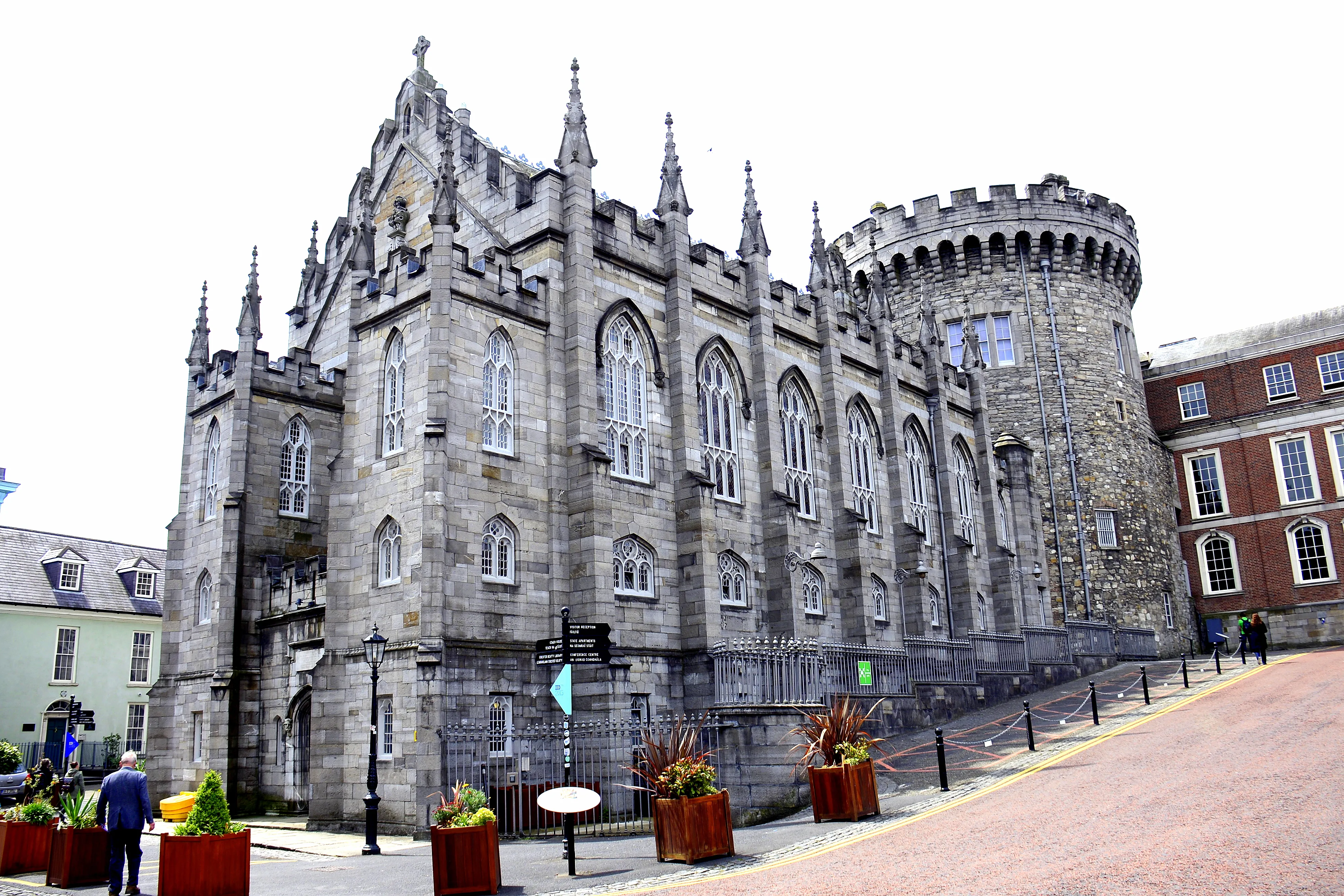
Francis Johnston finishes his neo-Gothic Chapel Royal in the Lower Yard, its exterior carrying more than 100 carved stone heads of monarchs and saints.
-
The Irish Crown Jewels vanish
The jewelled insignia of the Order of St Patrick are stolen from a safe in the Bedford Tower days before a royal visit — never recovered, and unsolved to this day.
-
Attacked in the Easter Rising
Insurgents of the Irish Citizen Army seize the Cork Hill gate at the outbreak of the Rising; the Castle becomes a military headquarters and Red Cross hospital for the week of fighting.
- 16 Jan 1922
Handed to Michael Collins
The Lord Lieutenant surrenders the Castle to the Provisional Government, ending seven centuries of British administration on the site.
Architecture
Dublin Castle is best read as four buildings in one plan: a vanished Norman fortress, a Georgian palace laid over its footprint, a Victorian Gothic chapel, and a modern museum wing. The medieval castle King John commissioned in 1204 was a rectangular curtain-walled fort with a massive drum tower at each corner and a moat drawn from the River Poddle; its outline survives, almost uncannily, in the shape of today's Upper Castle Yard. Only the Record Tower — the last intact medieval tower, its walls close to five metres thick at the base — still rises from that first fortress; the rest was cleared after the great fire of 1684.
The Upper Yard visitors enter is a formal Georgian quadrangle, and its composition repays a slow circuit:
- The north range centres on the Bedford Tower (c. 1761), a Palladian block with a clock stage and copper cupola, flanked by two triumphal gateways — the Gate of Fortitude and the Gate of Justice — each crowned by a lead statue by John Van Nost the Younger. (It was from a strongroom in this very tower that the Crown Jewels disappeared in 1907.)
- The south range holds the State Apartments, a processional enfilade of reception rooms designed to impress: the Throne Room with its 1780s throne, the intimate Wedgwood Room, and the great St Patrick's Hall.
- St Patrick's Hall carries the castle's finest single work of art — a ceiling of three vast canvases by the Italian painter Vincenzo Valdrè (late 18th century) depicting St Patrick lighting the Paschal fire, Henry II receiving the submission of the Irish chieftains, and George III enthroned between Liberty and Justice. The whole programme is, quite literally, colonial ideology painted overhead.
In the Lower Yard, Francis Johnston's Chapel Royal (1807–1814) is the architectural surprise: a slender neo-Gothic box whose plaster fan-vaulting imitates carved stone, whose galleries and pews are worked in dark oak, and whose exterior bristles with over one hundred carved heads of English kings and Irish saints by the sculptors Edward and John Smyth. Nearby, the medieval Bermingham Tower — once a state prison — and the Powder Tower Undercroft, with its Viking wall and Poddle sluice, close the circle back to the fortress the Georgians built over.
Historical Significance
For more than seven centuries Dublin Castle was the government of Ireland — not a symbol of it but the working seat of the Lord Deputy and, from the 17th century, the Lord Lieutenant (Viceroy) and the Chief Secretary. To speak of "the Castle" in Irish history is to speak of British administration itself: the intelligence networks, the patronage, and the coercion that governed the island were all directed from these yards. Every viceroy from 1204 to 1922 held court here, which is why the peaceful handover to Michael Collins on that grey January morning in 1922 carried such symbolic force for the young Irish state.
Two episodes give the Castle its sharpest edge for a visitor:
- The theft of the Irish Crown Jewels (1907). The diamond-and-emerald insignia of the Sovereign and Grand Master of the Order of St Patrick were lifted from a safe in the Bedford Tower's Office of Arms only days before a state visit by King Edward VII. The regalia were never recovered, no one was ever charged, and the case remains one of the great unsolved mysteries of Edwardian Europe — a scandal that reached into the royal household and ended the career of the herald Sir Arthur Vicars.
- The Easter Rising (1916). On Easter Monday a small party of the Irish Citizen Army rushed the Cork Hill gate and fatally wounded an unarmed Dublin Metropolitan Police constable — often counted as the first fatality of the Rising. Not realising how lightly the Castle was defended, the rebels fell back rather than storm it. For the rest of that week the Castle served as a British military headquarters and a Red Cross hospital.
Set against Kilmainham Gaol — where the Rising's leaders were executed weeks later — and Trinity College Library, which holds an original 1916 Proclamation, Dublin Castle completes a three-site arc that traces the whole trajectory from colonial administration to independent state within a single afternoon's walk.
When to Visit
Dublin Castle is open daily 9:45 AM–5:45 PM (last admission 5:15 PM); closed 24–26 December and Good Friday. The Chester Beatty is open Tuesday–Friday 10 AM–5 PM, Saturday 11 AM–5 PM, Sunday 1–5 PM; closed Mondays and, in winter, also on Sundays — check chesterbeatty.ie before a Monday or off-season visit. State Apartments tours depart regularly from the visitor entrance in the Upper Castle Yard; the guided tour lasts approximately 45 minutes, and self-guided admission to the same rooms is also available when ceremonial use does not close them (state events occasionally shut the Apartments at short notice, so confirm on the day at dublincastle.ie). The castle yards and the Dubhlinn Gardens are free to walk through at any time during opening hours.
Admission and Costs
Chester Beatty: Free — one of the few world-class museums in any European capital that charges nothing. State Apartments and Undercroft: €12 adults, €6 concessions, children under 12 free (self-guided or guided at the same price). Chapel Royal: €6, with combined tickets available. The recommended half-day programme pairs a free Chester Beatty visit with the paid State Apartments tour — budget €12 and 90–120 minutes for both. Because the site is run by the Office of Public Works, the Heritage Ireland OPW annual card (about €40) covers the State Apartments here alongside Kilmainham Gaol and forty-plus other sites — worthwhile for anyone touring Ireland for a week or more. Private guided tours of the castle arranged through Visit Dublin run €15–20 per person on top of admission.
The Case for a Guide
Dublin Castle's significance often eludes visitors who see only the Georgian interiors without the historical frame:
- The handover moment — A guide brings the 1922 Collins–FitzAlan handover scene to life in the very Upper Yard where it occurred, tracing the trajectory from Viking fortification through British colonial administration to Irish independence in a single courtyard
- St Patrick's Hall ceiling — Vincenzo Valdrè's three-canvas sequence encodes the ideology of colonial rule in oil paint (St Patrick, Henry II's Irish submission, and George III between Liberty and Justice); a guide decodes the iconographic programme and explains why the Irish state continues to inaugurate its Presidents beneath this imagery
- The Crown Jewels mystery — The 1907 theft from the Bedford Tower is the castle's best story, and a guide can walk you to the strongroom, lay out the suspects, and explain why the scandal touched the royal household itself
- Chester Beatty connections — The library's Egyptian papyri of the New Testament (200 CE) connect to the Book of Kells at Trinity — both early Christian manuscript cultures; a guide who covers both sites in a day can draw the thread taut
- Viking foundations in context — The Undercroft's section of Viking wall becomes meaningful only when a guide explains what the Dubh Linn settlement looked like and why the Normans chose exactly this point to build their castle on top of it
Tips for Visitors
Chester Beatty first — Open the visit with the museum (free, world-class, uncrowded) before buying State Apartments tickets. The castle yard is free — Walk the Upper and Lower Yards and the Dubhlinn Gardens at any time to see the Record Tower, the Chapel Royal exterior, and the Bedford Tower at no cost. Combination with Kilmainham Gaol — The two sites bookend Irish colonial history; castle in the morning, gaol in the afternoon (pre-book the gaol) creates a coherent narrative arc. Photography — Permitted throughout except where signposted in the Chester Beatty conservation galleries; the Chapel Royal interior and the St Patrick's Hall ceiling are the standout interior shots, and the Bedford Tower framed across the Upper Yard cobbles is the classic exterior view. Accessibility — The yards are level, and lifts or ramps reach the main floors of the State Apartments and Chester Beatty; the Undercroft has short stair sections, so ask staff for the step-free route. On foot — The castle is a five-minute walk from Trinity College Library; the medieval cathedral of Christ Church is five minutes further west along Lord Edward Street.
Frequently Asked Questions
What happened at Dublin Castle when independence came in 1922?
On 16 January 1922, the Lord Lieutenant of Ireland, Viscount FitzAlan, formally handed control of Dublin Castle to Michael Collins — the military commander of the IRA and chairman of the Provisional Government of the newly created Irish Free State. Collins reportedly arrived late (an audience of officials, journalists, and dignitaries had waited for some time) and, when the Lord Lieutenant remarked that he was seven minutes late, Collins replied: "We've been waiting seven hundred years; you can have the seven minutes." The line may or may not be apocryphal, but it captures the symbolic weight of the moment: the castle that had housed every British Viceroy of Ireland since 1204 was peacefully transferred to Irish control on a grey January morning. Collins was dead — shot in an ambush during the Civil War — within seven months.
What is the Chester Beatty Library and is it worth visiting separately?
The Chester Beatty, housed in the castle's Clock Tower Building, is one of the great small museums of the world — and it is free. Sir Alfred Chester Beatty (1875–1968) was an American-born mining magnate who spent four decades collecting manuscripts, printed books, and decorative arts from every literate civilisation on earth: Qur'anic manuscripts of the 9th century, Egyptian papyri (including one of the oldest surviving New Testament texts, dating to around 200 CE), Japanese woodblock prints, Chinese jade books, Burmese illustrated manuscripts, and medieval European illuminated Books of Hours sit alongside Tibetan scroll paintings and pre-Columbian decorated pottery. Beatty became an Irish citizen in 1957 and left his collection to the Irish state; it was voted Europe's leading museum by the World Travel Awards in 2015. Its holdings are catalogued on the museum's own site at chesterbeatty.ie. Allow at least 90 minutes; plan to return.
Can visitors see the Viking foundations inside Dublin Castle?
Yes — the castle's Undercroft exhibition (included with the State Apartments tour) exposes the medieval and Viking foundations of the castle complex, including a section of the original Viking longphort wall (ca. 900 CE), the base of the Powder Tower (the castle's original defensive structure), a portion of the medieval Dubh Linn moat, and the cobbles of a 13th-century street. The layers of stone visible in the Undercroft span roughly a thousand years of continuous building activity — Viking defensive works, Norman castle construction, and Georgian conversion of the castle into an administrative palace. It is one of the most compressed archaeological cross-sections visible to the public in any European capital.
How do I get to Dublin Castle, and is it accessible?
The castle sits at Dame Street / Cork Hill in the medieval core, a five-minute walk from Trinity College and the same distance from Temple Bar. The nearest Luas stops are Trinity and Westmoreland on the Green Line and Jervis on the Red Line, each under ten minutes on foot; dozens of Dublin Bus routes serve Dame Street and George's Street directly. The Upper and Lower Yards are level cobble and step-free, and the State Apartments, Chapel Royal, and Chester Beatty all provide lift or ramp access to their main display floors — confirm the current step-free route on the official dublincastle.ie visitor page, as parts of the medieval Undercroft involve short flights of stairs.