
City Palace Udaipur timeline
-
Udaipur founded, palace begun
Maharana Udai Singh II founds Udaipur on the shore of Lake Pichola and lays the first courtyard of the City Palace, seeking a defensible new seat for Mewar in the Aravalli Hills.
-
Chittorgarh falls, Udaipur made capital
After Akbar sacks the old Mewar capital at Chittorgarh, Udaipur formally becomes the dynasty's capital and the palace its center of power.
-
Battle of Haldighati
Maharana Pratap fights Akbar's army at Haldighati rather than submit; his sword and armor are displayed in the palace arms gallery today.
-
Treaty with the Mughals
Maharana Amar Singh I signs a treaty with Emperor Jahangir, ending decades of open war and letting later rulers turn their attention to expanding the palace.
-
Jagdish Temple consecrated
Maharana Jagat Singh I completes the great Jagdish Temple steps from the palace entrance, one of many additions successive rulers made over four centuries.
-
Fateh Prakash and Shiv Niwas wings
Under Maharana Fateh Singh the palace gains its grand later wings, including the Fateh Prakash Palace and its Crystal Gallery, now partly run as a heritage hotel.
-
City Palace Museum opens
The Maharana of Mewar Charitable Foundation opens the palace museum to the public, preserving the complex while the royal family retains a private residence.
-
Octopussy filmed in Udaipur
The James Bond film uses Udaipur's palaces and Lake Pichola as a setting, adding pop-culture fame to the palace's centuries of Mewar history.
Architecture
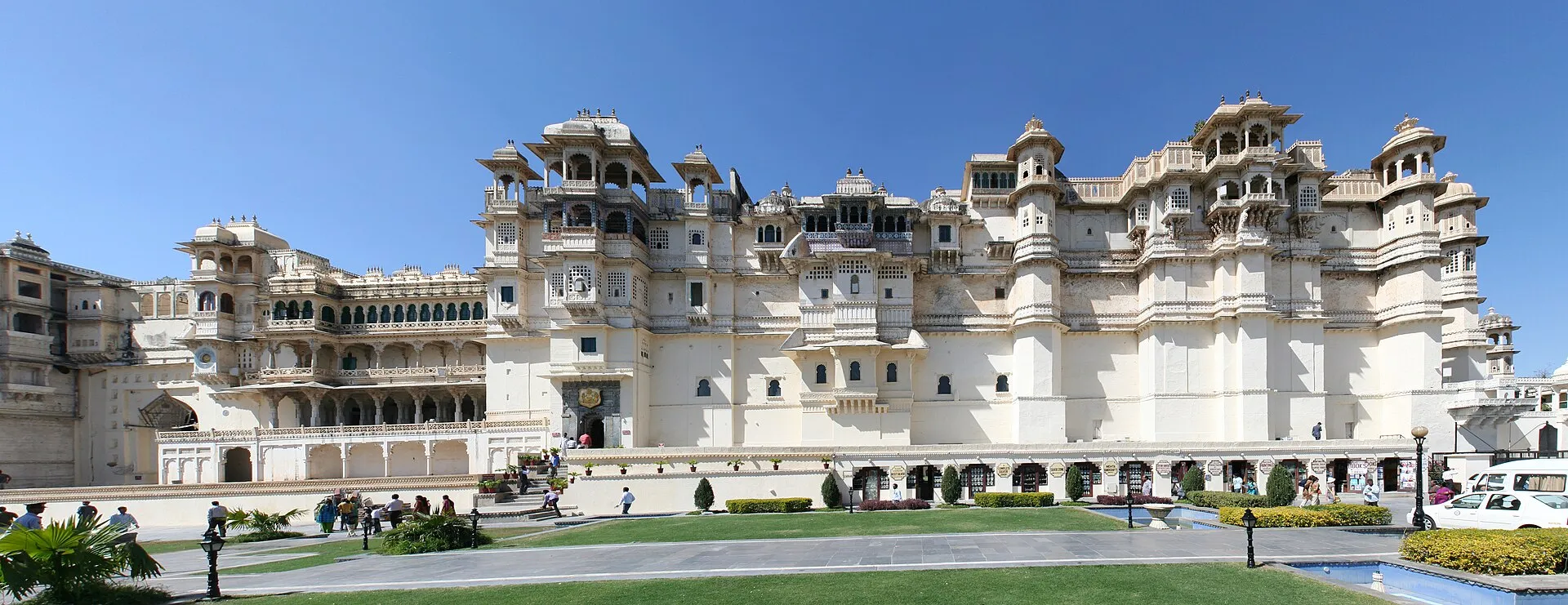
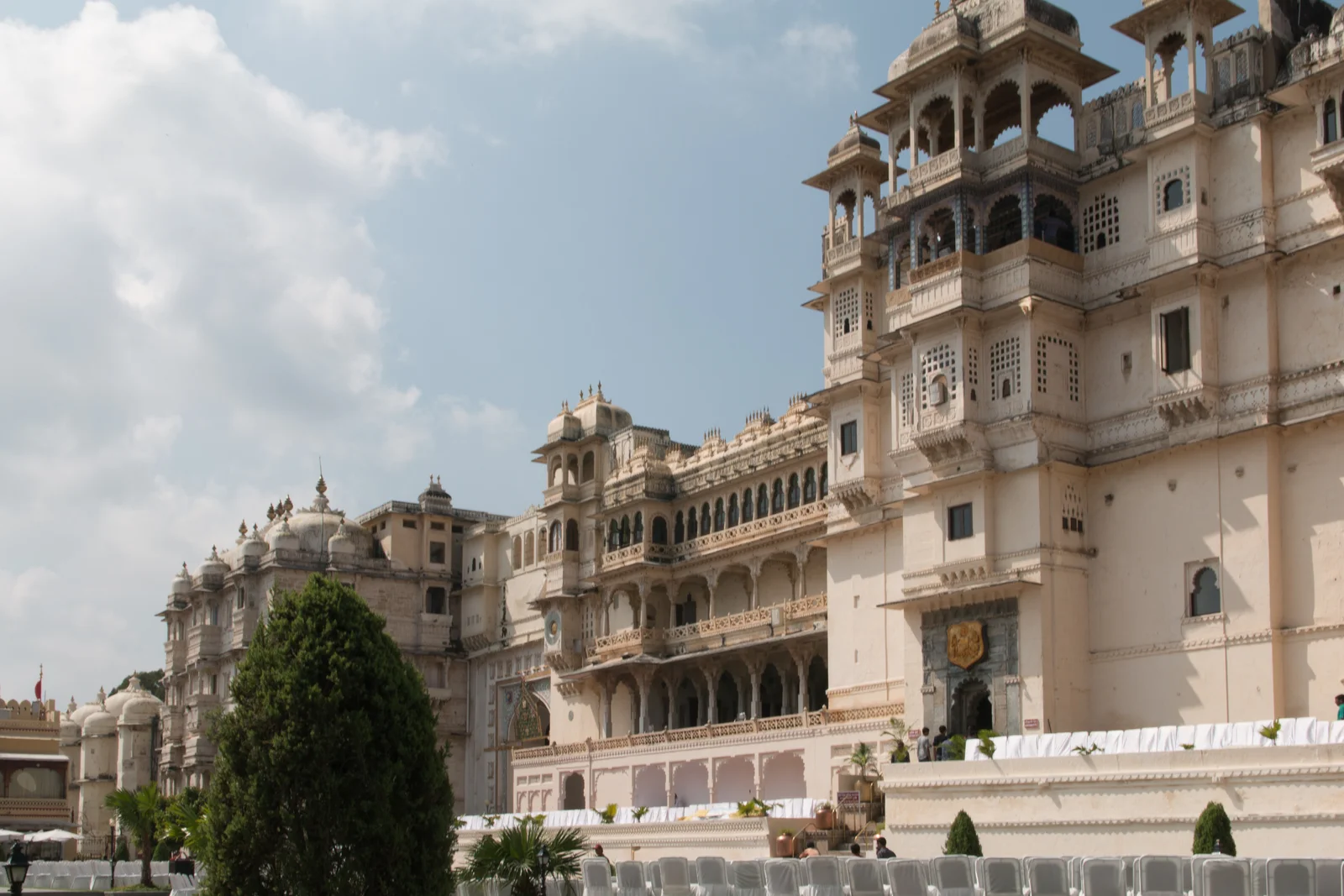
The palace is a labyrinthine complex of courtyards, pavilions, terraces, and corridors built across four centuries in a blend of Rajasthani, Mughal, and European styles. Entry is through the Badi Pol (Great Gate), whose heavy timber doors bristle with iron spikes set at elephant-forehead height -- the standard guard against a battering war-elephant on Rajasthan's fort gates -- and then the triple-arched Tripolia Gate. The stretch of wall between the two is punctuated by eight carved marble toranas (ceremonial arches), under which a maharana was weighed on his birthday first against gold and later against silver, the metal then distributed to his people; the ritual is why locals still read this as a gate of gifts rather than a mere passage. Beyond it the museum route opens into the vast Manek Chowk quadrangle used for cavalry parades. Set high into the eastern wall above Manek Chowk is the Surya Gokhada, a large gilt-brass sun face beneath which a maharana could appear to his people -- a fitting emblem for a Suryavanshi (Sun-dynasty) house, and, by tradition, a way to reassure subjects on overcast days when the real sun was hidden.
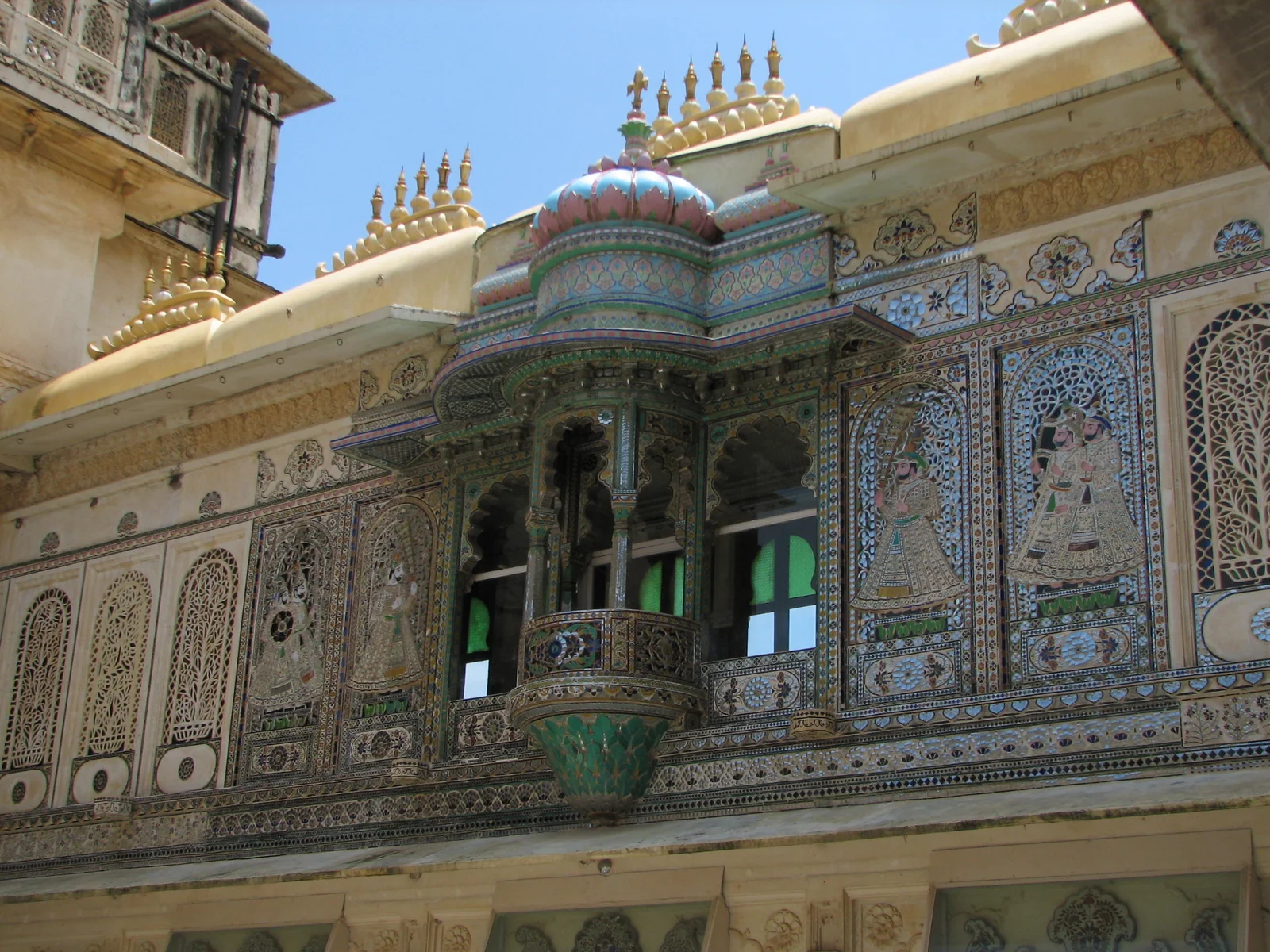
The Mor Chowk (Peacock Courtyard) features three exquisite glass-mosaic peacocks adorning the walls, each representing a different season, while the Sheesh Mahal (Mirror Palace) rivals Amber Fort's version, with mirrors arranged to create infinite reflections of a single flame. Higher up, the Badi Mahal (also called Amar Vilas) is a garden courtyard set on a natural rock some 27 meters above the entrance, with a central pool and trees growing at rooftop height, and the Bhim Vilas and Krishna Vilas chambers hold tightly detailed Mewar miniature paintings of Radha-Krishna and courtly processions. The Zenana Mahal, the former women's quarters wrapped around the Laxmi Chowk courtyard, now houses part of the government museum, whose galleries display the arms collection -- including the sword of Maharana Pratap -- alongside royal photographs and textiles.
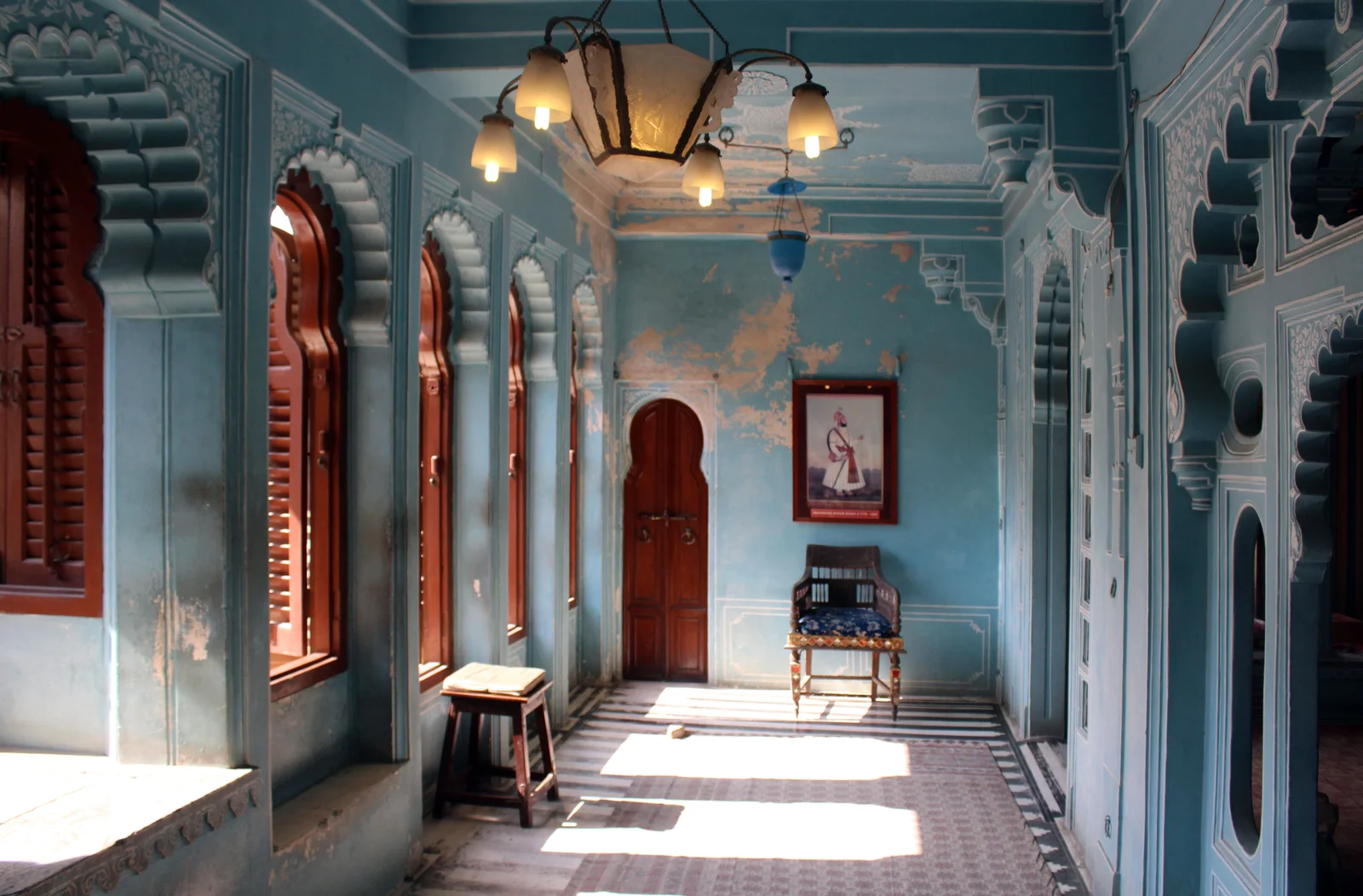
Two later flourishes reward slowing down: the Chini Chitrashala courtyard is faced entirely in blue-and-white Chinese and Dutch ornamental tiles, a rare survival of the Mewar court's nineteenth-century appetite for imported ceramics, and in the adjoining Fateh Prakash wing the Crystal Gallery holds a trove of cut crystal that Maharana Sajjan Singh ordered from F. & C. Osler of England in 1877 -- fountains, tables, even a crystal bed -- though he died before it arrived and the crates sat unopened for over a century until the collection was finally unveiled in 1994. The palace's terraces offer panoramic views of Lake Pichola, the Jag Mandir and Lake Palace islands, and the Aravalli Hills beyond.
Historical Significance
Construction began in 1559 under Maharana Udai Singh II, who founded Udaipur after the Mughal Emperor Akbar sacked the previous Mewar capital at Chittorgarh. By tradition, Udai Singh chose the ridge above Lake Pichola on the advice of a hermit he met while hunting; the spot where they met became the Rai Angan (Royal Courtyard), the palace's first courtyard and the point from which the whole complex grew southward and upward. Over 22 successive rulers expanded the palace across four centuries, each adding courtyards, towers, and gardens that reflected their era while maintaining the complex's architectural unity. The ruling Sisodia clan traces its descent from the Sun as a Suryavanshi dynasty, a claim of divine, unbroken continuity still proclaimed by the gilded sun face set into the wall above Manek Chowk.
The Mewar dynasty's defining characteristic was its refusal to accept Mughal suzerainty -- uniquely among the Rajput kingdoms -- and the palace embodies that fierce independence in its military architecture combined with artistic refinement. Maharana Pratap, the legendary warrior who fought the Mughal army at the Battle of Haldighati in 1576, remains the dynasty's most celebrated figure; his sword and armor are displayed in the palace museum. The arms gallery houses weapons spanning four centuries of Mewar resistance. Not every chapter is one of martial glory: the palace was also the setting of one of Mewar's most sorrowful episodes, when in 1810 the teenage princess Krishna Kumari, a daughter of Maharana Bhim Singh, was made to take poison so that neither the court of Jaipur nor that of Jodhpur -- each pressing to marry her and each ready to go to war over a refusal -- could claim her, a decision taken to spare Udaipur a ruinous conflict the weakened kingdom could not afford.
The complex passed into public stewardship in stages: the Maharana of Mewar Charitable Foundation, established in 1969, opened the museum wing and still runs the palace as a self-funding trust, while the family retains the private Shambhu Niwas residence and leases the Fateh Prakash and Shiv Niwas wings as heritage hotels. This arrangement is why a visit today threads between a working museum, a living royal household, and a luxury hotel within a single set of walls. That it is still a lived-in seat shows most clearly at festival time: on the eve of Holi each spring a royal procession and the lighting of the Holika bonfire fill the Manek Chowk courtyard, and during the springtime Gangaur festival images of the goddess Gauri are carried from the palace down to Gangaur Ghat on Lake Pichola for immersion -- ceremonies run by the same foundation that keeps the museum, and a reminder that the Mewar calendar is still observed inside these walls rather than only remembered in them.
City Palace Udaipur in Pictures
When to Visit
Museum: daily, 9:30 AM - 5:30 PM. Last entry: 4:30 PM. Best time: morning (10-11 AM) for softer light in the courtyards and smaller crowds.
Admission and Costs
Foreigners: ₹300 ($3.60). Indian nationals: ₹100. Camera fee: ₹200. Guide: ₹500-1,000 for a 1.5-2 hour tour.
The Case for a Guide
The palace floods first-timers with detail -- dozens of rooms, gates, and galleries with little on-site labeling -- so a licensed Mewar guide is the difference between a pretty walk and understanding what you are seeing. A good guide steers you efficiently through the maze so you do not miss the Mor Chowk peacocks, the Sheesh Mahal, or the terrace views, and reads the Mewar miniature paintings and arms gallery as chapters of the dynasty's resistance rather than glass cases. They also decode the symbolism most visitors walk past: why the maharanas were weighed against gold at the Tripolia Gate, how the layout separated the zenana (women's quarters) from public courts, and where Octopussy was filmed below on Lake Pichola. At ₹500-1,000 for a 1.5-2 hour tour it is inexpensive by any measure, and a guide can also fast-track ticketing, point you to the Jagdish Temple next door, and time your exit for a sunset boat ride from the jetty.
Tips for Visitors
Allow 2-3 hours: the palace is vast, and a guide prevents you from missing the best rooms in the maze of corridors. Sunset from the terrace: the upper terraces catch golden light on Lake Pichola -- time your visit to end there. Combine with the lake: exit through the palace to the jetty for a sunset boat ride.
Part of the palace is a hotel: the Fateh Prakash Palace and Shiv Niwas wings, both run by the HRH Group (the Mewar household's own hospitality arm), operate as luxury heritage hotels, so you can actually sleep inside the palace walls in what were once the royal guest suites -- do not confuse them with the separate island Taj Lake Palace on Lake Pichola, which belongs to a different company and is reachable only by its own boat. Overnight guests get quiet run of the courtyards and water's-edge terraces once the day-trippers have filed out, but you need not book a room to enjoy the setting: the wings' restaurants seat non-resident diners, so you can eat inside the palace walls on a day ticket -- the open-air Sunset Terrace at Fateh Prakash sits at the water's edge for an à la carte lunch or a sundowner straight across Lake Pichola to the island palaces, the Gallery Restaurant in the same wing pours a colonial-style high tea, and a small café near the museum entrance handles a quick chai mid-tour; these tabs are separate from the museum ticket, and the terrace is worth reserving ahead for a winter sunset.
Where to base yourself: if you would rather not book inside the walls, stay in the old-city lanes around Lal Ghat and Gangaur Ghat on the same east bank, a five-to-ten-minute walk from the Badi Pol gate and steps from Jagdish Temple, where budget-to-midrange heritage guesthouses stack rooftop restaurants overlooking Lake Pichola; for the classic head-on view of the palace's 244-metre facade mirrored in the water, cross to the quieter west bank around Hanuman Ghat and the Ambrai side, whose rooftop cafés frame the whole complex at sunset.
Sound-and-light show: after the museum closes, a roughly hour-long sound-and-light show in the Manek Chowk courtyard narrates the Mewar story from Bappa Rawal to Maharana Pratap, thrown across the walls you toured earlier -- there is an English slot (usually first, around 7 PM in winter and later in summer) and a separate Hindi one, so confirm the times and the modest ticket price at the Badi Pol gate on the day.
Vintage cars: a short walk south on Lake Palace Road, the Vintage & Classic Car Collection keeps the Mewar royal garage of around twenty restored vehicles -- among them the 1934 Rolls-Royce Phantom linked to the Octopussy shoot and a Cadillac convertible once used by the maharana -- on the grounds of the Garden Hotel, a half-hour add-on with its own modest ticket that suits car enthusiasts and Bond fans. Visit Jagdish Temple on the way in or out -- it is just steps from the palace entrance.
Extend to a second day: the Dharohar folk-dance and puppet show at Bagore Ki Haveli on Gangaur Ghat runs most evenings, the terraced Saheliyon Ki Bari (Garden of the Maidens) makes a shady midday break, and hilltop Sajjangarh (the Monsoon Palace) catches the classic sunset over the lakes and the Aravalli Hills. Time it with a festival if you can: catching the Holi-eve Holika procession in Manek Chowk or the Gangaur images being carried down to Gangaur Ghat turns the tour into a front-row seat on a still-living court, but book rooms weeks ahead and arrive early, as the old city and the ghats fill fast on those days.
Frequently Asked Questions
What is the best season for visiting City Palace Udaipur?
February is the peak month, with cool mornings, golden afternoon light cascading across the palace's sandstone facade onto Lake Pichola, and the lake full from post-monsoon rains. The November-through-February stretch is ideal overall, as the Mewar Festival in March and the Gangaur Festival in April add cultural vibrancy. Summer heat in May and June is intense, though the monsoon from July through August turns the Aravalli Hills emerald green and fills the lake to its most photogenic levels.
When can visitors tour City Palace Udaipur?
The museum opens daily from 9:30 AM to 5:30 PM, with the last entry at 4:30 PM, and it keeps these hours year-round including festival days. The palace still functions as the residence of the Mewar royal family, so only the museum wing is open to the public. Arrive at opening or in the 10-11 AM window for softer light in the courtyards and thinner crowds; the mid-afternoon tour-bus waves fill the narrow corridors, and the terraces are at their best in the last hour before closing when the sun drops toward Lake Pichola.
How much is the entrance fee for City Palace Udaipur, and where do you buy tickets?
Museum admission is ₹300 (about $3.60) for foreign visitors and ₹100 for Indian nationals, with a separate ₹200 camera fee if you want to photograph the interiors. A licensed guide runs ₹500-1,000 for a 1.5-2 hour tour, which is money well spent given how easily first-timers miss the best rooms in the maze. Tickets are sold at the counters just inside the Badi Pol (Great Gate); there is no online pre-booking for the main museum and little need for one, since the one-way circuit keeps visitors moving and even busy winter mornings rarely mean more than a few minutes in line. Carry small notes, as the gate card machines are unreliable. There is no single combined ticket -- the Crystal Gallery in the Fateh Prakash wing and the evening sound-and-light show in Manek Chowk are each ticketed separately (the show on the day at the Badi Pol) -- so budget for those add-ons individually. A guide arranged through your hotel can collect the tickets for you and steer you past the unlicensed touts who work the entrance lane.
What route do you follow inside City Palace Udaipur?
The museum is a one-way circuit, so pacing matters more than route-planning. You enter through the Badi Pol (Great Gate) and the triple-arched Tripolia Gate, pass through the Ganesh Deori into the Rai Angan (Royal Courtyard) -- the palace's oldest square, where Maharana Udai Singh II is said to have met the hermit who advised him to settle this ridge -- then step out onto the broad Manek Chowk quadrangle. From there the path climbs through the Mor Chowk peacock mosaics, the mirror-lined Sheesh Mahal, and the Badi Mahal (Amar Vilas) rooftop garden before winding down through the Zenana Mahal women's quarters into the government museum's arms and painting galleries. Allow two to three hours, wear firm shoes for the uneven stone stairways, and save some energy for the upper terraces near the end, where the sweep over Lake Pichola toward the Jag Mandir and Lake Palace islands is the payoff before you exit toward the Bansi Ghat jetty. Budgeting the whole visit is straightforward once you see how the add-ons stack: that two-to-three-hour circuit is the core, the separately ticketed Crystal Gallery adds roughly another half hour, and the evening sound-and-light show is its own after-dark slot rather than part of the daytime total. So the palace makes a comfortable half-day anchor -- open at 9:30 AM, walk the circuit while the courtyards are still soft-lit, then step straight from the jetty onto a Lake Pichola boat and up to Jagdish Temple on the way out, all in one loop with no backtracking.
How is City Palace Udaipur connected to the James Bond film Octopussy?
Udaipur doubled as a fairy-tale Indian setting in the 1983 Bond film Octopussy, and while the most famous scenes were shot at the Lake Palace on Lake Pichola, the City Palace and its lakefront jetty feature in the film's Udaipur sequences. Many guesthouses in the old town still screen Octopussy nightly, and the connection is part of why the palace and the lake below it draw film-buff visitors alongside history travelers.
Can you combine City Palace Udaipur with a Lake Pichola boat ride, and how do the two island palaces differ?
Yes, and it is the classic way to end a visit. The palace exits toward the Bansi Ghat jetty on Lake Pichola, where official boat rides depart for a loop past the lake's two island palaces, usually with a stop at Jag Mandir itself. It helps to know they are not the same place: the Lake Palace (Jag Niwas) is the white marble palace that seems to float mid-lake -- built as a royal summer retreat in the 1740s under Maharana Jagat Singh II, it is now the Taj Lake Palace hotel and is closed to anyone who is not a staying guest or dining reservation, so you only ever see it from the water. Jag Mandir, the other island further south, is open to day visitors, and the boat lands there so you can walk its gardens and domed pavilions, where the Mughal prince Khurram (later Emperor Shah Jahan) once sheltered. A late-afternoon boat also lets you photograph the City Palace's 244-meter facade glowing in the sunset from the water, a view you cannot get from inside the complex. Boat tickets are separate from museum admission and sell out on busy winter evenings.
Is the Crystal Gallery at City Palace Udaipur worth the extra ticket?
The Crystal Gallery, in the Fateh Prakash wing, displays cut crystal that Maharana Sajjan Singh ordered from F. & C. Osler of England in 1877 -- crystal fountains, dining tables, chairs, and even a crystal bed -- which stayed crated and unseen for over a century until it was unveiled in 1994. Admission is separate from the main museum, runs around ₹700-900 for foreigners (it usually includes a welcome drink or tea in the Durbar Hall below), and photography inside is not allowed. It is a niche stop rather than a must-see: worth it if you are fascinated by royal collections or want to see the ornate Durbar Hall, but skippable if your time and budget are tight after the main palace.
Where are the best photo spots at City Palace Udaipur?
Inside the complex, the Mor Chowk glass-mosaic peacocks, the Sheesh Mahal mirror work, and the tiled Chini Chitrashala courtyard are the standout close-up subjects, while the upper terraces and the Amar Vilas (Badi Mahal) hanging garden give the classic sweep over Lake Pichola with the Lake Palace and Jag Mandir islands. The palace's own 244-meter facade, however, photographs best from outside -- from a Lake Pichola boat at sunset, from the Ambrai or Lake Pichola ghats on the far bank, or from a rooftop cafe in the old town near Jagdish Temple. Interior photography carries a ₹200 camera fee and the Crystal Gallery bans cameras entirely.
How do you get to City Palace Udaipur?
The palace sits in the old city on the east bank of Lake Pichola, a short walk downhill from Jagdish Chowk. Maharana Pratap Airport at Dabok is about 22 km east, roughly a 45-minute taxi ride, and the Udaipur City railway station is about 3 km southeast, ten minutes by autorickshaw. Cars and rickshaws cannot enter the tight lanes right around the palace, so drivers drop you near the Badi Pol ticket gate and you finish on foot; the walk in from Jagdish Temple through the bazaar is pleasant and takes about ten minutes. Coming from the ghats, you can also arrive by the Lake Pichola boat that docks at the palace's Bansi Ghat jetty.
How suitable is City Palace Udaipur for wheelchair users, young children, and strollers?
The palace is partly accessible: its different levels and narrow stairways prevent a step-free route through every room, but it does have an accessible lift, ramps, and free wheelchairs. Ask at the Information Desk in Moti Chowk for wheelchair or lift assistance and a route that fits your needs; the museum accessibility FAQ explains the available facilities. Electric cars can cover the distance from the palace gates to the museum for a fee. Families can also ask the desk about baby-changing and feeding rooms. With a stroller, check the route before entering the stairway sections; a carrier may be more practical if your group can manage the steps. Choose a few stops, such as the Mor Chowk peacock mosaics, and take courtyard breaks instead of trying to see every gallery. Treat a Lake Pichola boat ride as a separate outing, with its own tickets and boarding-access arrangements.