
Amber Fort timeline
-
Meena hill settlement
The Meena clan held the original hill town of Amer, whose temple to the goddess Amba is often cited as the source of the name.
-
Kachwaha capital
The Kachwaha Rajputs took Amer and made it their seat, ruling the surrounding territory for the next seven centuries.
-
Man Singh I builds the palace
Akbar's general Raja Man Singh I began the present fortress-palace, fusing Rajput ramparts with Mughal courtly design.
-
Capital moves to Jaipur
Sawai Jai Singh II founded the planned city of Jaipur and shifted the court down from the hills, leaving Amber a heritage site.
-
UNESCO World Heritage
Amber was inscribed as one of the six components of the Hill Forts of Rajasthan on the UNESCO World Heritage List.
Fortification History
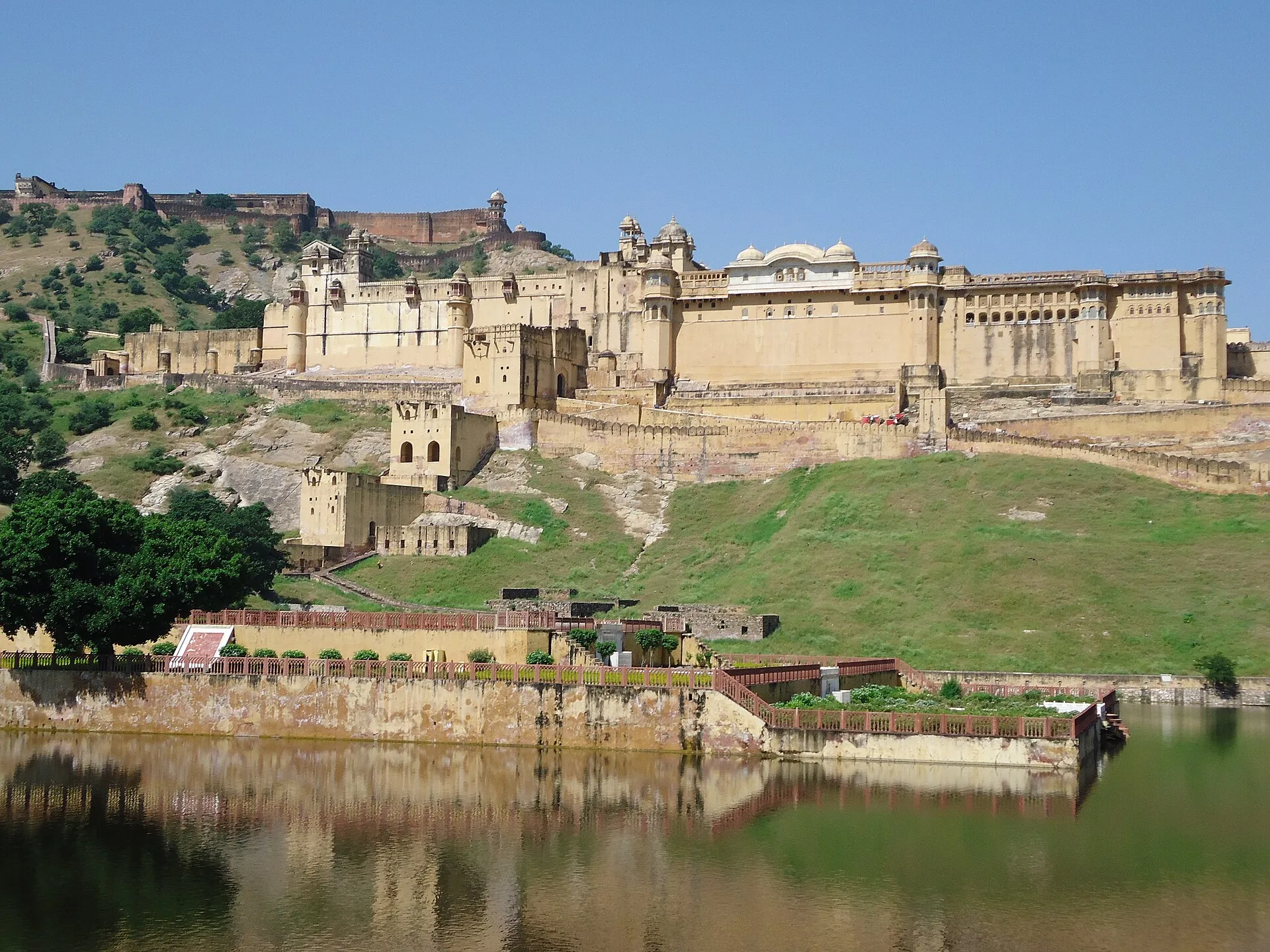
Amber was conceived as a working fortress first and a palace second, and its plan reads as a sequence of defences that gradually soften into royal luxury the deeper you climb. The outer walls run for kilometres along the ridgeline, tying the palace to Jaigarh Fort above through a fortified corridor and a hidden passage, so that garrison, treasury, and royal family formed a single defensible system rather than an isolated residence.
The approach and its four courtyards unfold in a deliberate order:
- Suraj Pol (Sun Gate) — the main entrance faces east to catch the morning sun, flanked by guardhouses; it opened only to returning armies and royal processions.
- Jaleb Chowk — the first courtyard, where the army once paraded and war elephants were stabled. It remains the arrival point today, and the only level, wheelchair-friendly space in the complex.
- Ganesh Pol — the most photographed gateway in Rajasthan, covered in frescoes of Ganesh, lotus flowers, and geometric patterns, with latticed jali screens above from which the women of the household watched arrivals unseen.
- Sheesh Mahal — the mirror palace, where convex glass pieces embedded in plaster turn a single flame into a canopy of stars.
- Sukh Niwas — the "Hall of Pleasure," cooled by water piped through the walls and cascaded over a marble channel: Mughal-era air conditioning that dropped the interior several degrees without a single moving part.
- Zenana (women's quarters) — a separate rear courtyard reached through one guarded door, where each queen had her own suite arranged so she could reach the shared central garden only through her own rooms.
Notable Rooms
Sheesh Mahal (Mirror Palace): the fort's most celebrated interior, its ceiling and walls encrusted with over a million convex glass fragments set into lime plaster — a single candle held at the centre illuminates the entire chamber like a night sky. Guides demonstrate the effect and explain why convex rather than flat mirrors were chosen for maximum light diffusion.
Ganesh Pol (Ganesh Gate): the most photographed gateway in Rajasthan, its facade painted in vibrant fresco depictions of Ganesh, lotus flowers, and geometric patterns in ochre, blue, and gold. The upper latticed jali screens concealed the women of the royal household who watched processions unseen.
Sukh Niwas (Hall of Pleasure): the summer palace with a Mughal-era cooling system — pipes routed water through the walls and over a stone cascade in the central hall, dropping the interior temperature by several degrees without electricity. One of the oldest recorded examples of architectural air conditioning.
Diwan-i-Aam (Hall of Public Audience): the open columned hall where the Maharaja received common petitioners, designed with deliberate acoustic properties so that the king's voice carried to the farthest standing visitor without raising volume.
Zenana (Women's Quarters): accessed through a single guarded entrance so that each queen could reach the shared central garden only through her own private rooms — a spatial system of privacy and surveillance that guides explain through the architecture of control.
When to Visit
Open: daily, 8:00 AM - 5:30 PM, with the ticket counter and the day's last entry closing around 5:00 PM. The sound-and-light show runs in the courtyard below in the evening — an English show usually at 7:30 PM and a Hindi show at 8:00 PM, though start times shift about half an hour earlier in winter when darkness falls sooner, so confirm the schedule the day you go. Best time to arrive: 8-10 AM, when the light is soft on the sandstone, the courtyards are cool for the uphill walk, and the first tour buses from Jaipur have not yet reached the ramparts. Allow a genuine 2-3 hours to work through all four courtyards without rushing.
Admission and Costs
Foreigners (composite ticket): ₹1,000 ($12) covering Amber Fort, Hawa Mahal, Jantar Mantar, Nahargarh Fort, and more. Indian nationals: ₹100. Sound-and-light show: ₹300. Guide: ₹800-1,500 for a 2-hour tour.
The Case for a Guide
Amber Fort's four courtyards hold architectural secrets, optical illusions, and political histories that only emerge with a guide who has spent years learning the building's logic from the inside.
- Elephant route vs. hidden foot path: The jeep road and the elephant path are the tourist routes; guides know the original royal foot path that approaches the fort from a different angle, revealing defensive watchtowers and reservoir systems that the main entrance completely bypasses.
- Sheesh Mahal mirror counting and technique: The chamber contains over a million convex glass fragments set into lime plaster using an interlocking technique; guides demonstrate how a single candle illuminates every surface simultaneously, explain why convex rather than flat mirrors were chosen, and describe the different coloured glass sections that change the light's quality in each corner.
- Secret tunnel to Jaigarh Fort: A subterranean passage connects Amber directly to Jaigarh Fort on the ridge above, used by the royal family to escape during sieges; guides explain the defensive logic of this dual-fort system and point out the tunnel entrance that most visitors miss entirely.
- Women's quarters vs. public audience halls: The Zenana's single guarded entrance meant that each queen could only reach the shared garden through her own room — a system of privacy and control that guides explain through the architecture of surveillance, comparing it to the open public design of the Diwan-i-Aam where common petitioners stood before the king.
- Mughal vs. Rajput architectural fusion: Raja Man Singh I served Emperor Akbar as a general and absorbed Mughal courtly aesthetics while maintaining Rajput martial identity; guides identify precisely which elements — the intricate pietra dura inlay, the cusped arches, the charbagh garden — reflect Mughal influence, and which features like the defensive towers and sun-facing gates are distinctly Rajput.
Tips for Visitors
A paved path takes 10-15 minutes to walk up, or a jeep (₹500 return) carries you straight to Jaleb Chowk if the climb or the heat is a concern. Skip the elephant rides: animal-welfare concerns make the ethical sanctuaries outside Jaipur a far better way to meet elephants. Carry water and a hat — the climb and the open, shadeless courtyards demand hydration, especially from March onward.
Build the visit into a wider Amer loop rather than a single stop:
- Jaigarh Fort on the hill above is linked to Amber by a fortified passage and guards Jaivana, the world's largest wheeled cannon.
- Panna Meena ka Kund, a symmetrical 16th-century stepwell a few minutes into Amer town, is a free and photogenic detour most tour buses skip.
- The Anokhi Museum of Hand Printing, set in a restored haveli nearby, explains the block-printed textiles sold across the city's bazaars.
Back in the walled city, combine the day with Hawa Mahal, City Palace, and Jantar Mantar for a full Jaipur heritage day — the same composite ticket covers all of them.
Frequently Asked Questions
What months are best for visiting Amber Fort?
November through February is peak season for good reason -- the Rajasthani sun is gentle enough for the uphill walk and the expansive open courtyards, with daytime temperatures around 20 to 25 degrees C. The evening sound-and-light show is most pleasant in the cool winter air. May through August brings extreme heat exceeding 40 degrees C followed by monsoon downpours that make the hillside paths slippery.
When can visitors explore Amber Fort?
Open: Daily, 8:00 AM – 5:30 PM. Sound-and-light show: Evenings (English show usually at 7:30 PM, Hindi at 8:00 PM). Best time: Morning (8–10 AM) before tour bus crowds arrive
What is the admission price for Amber Fort?
Foreigners (composite ticket): ₹1,000 ($12) — covers Amber Fort, Hawa Mahal, Jantar Mantar, Nahargarh Fort, and more. Indian nationals: ₹100. Sound-and-light show: ₹300. Guide: ₹800–1,500 for a 2-hour tour
How do visitors get up to Amber Fort?
Walk or jeep up: A paved path takes 10–15 minutes to walk up. Jeeps (₹500 return) are available for those who prefer to ride. Skip the elephant rides: Animal welfare concerns make the ethical sanctuaries outside Jaipur a better option.
Is Amber Fort accessible for wheelchair users or those with limited mobility?
Partially. The ramp from the road up to Jaleb Chowk (the first courtyard) can be managed by jeep, avoiding the cobbled walk, and that courtyard is broad and level. Beyond it, however, the fort is a four-terrace hillside palace connected by uneven stone ramps, worn steps, and steep staircases with few handrails, so the Sheesh Mahal, Sukh Niwas, and Zenana are difficult to reach for wheelchair users. Visitors with limited mobility can still enjoy Jaleb Chowk, the Ganesh Pol facade, and the Diwan-i-Aam. Go early, wear grippy shoes, and allow extra time.
What else is worth seeing around Amber besides the fort itself?
Several sights cluster below and above the fort. Jaigarh Fort on the ridge above is linked to Amber by a subterranean passage and guards Jaivana, the world's largest wheeled cannon. Panna Meena ka Kund, a symmetrical 16th-century stepwell a few minutes' walk into Amer town, is a striking (and free) photo stop, and the nearby Anokhi Museum of Hand Printing occupies a restored haveli. Down at road level, Maota Lake frames the classic reflection shot of the ramparts, with the Kesar Kyari saffron garden laid out on an island in the water.