
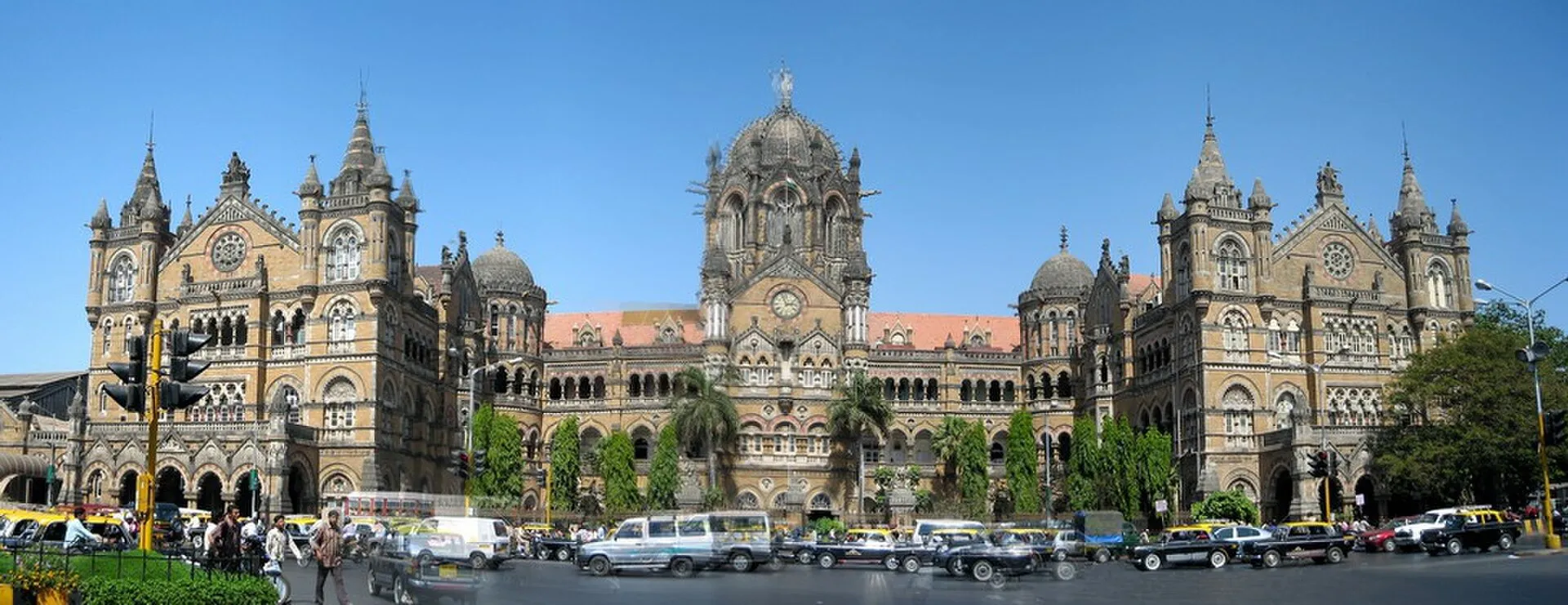
Architecture
Chhatrapati Shivaji Maharaj Terminus (CST), formerly Victoria Terminus, is a UNESCO World Heritage Site that serves as Mumbai's busiest railway station -- handling over 3 million commuters daily across 18 platforms. Designed by British architect Frederick William Stevens and completed in 1888, it took 10 years to build and combined Victorian Italian Gothic Revival architecture with traditional Indian palace elements. The result is a building that looks like a European cathedral crossed with a Rajput palace, topped by a statue representing "Progress." CST is not a museum -- it is a living, breathing, overwhelmingly busy transit hub where commuters sprint across marble floors under stained glass windows.
A guide helps you appreciate the architecture without getting swept away by the crowd. They point out the carved stone animals and birds climbing the facade (peacocks, monkeys, lions), the imported Italian marble staircases, the decorative tiles designed by students of the Bombay School of Art, and the star-shaped central dome with its stained glass windows. The facade stretches 300 meters along the street. The "Progress" statue atop the central dome holds a torch in one hand and a wheel in the other. The building was one of the first in India to use a steel frame combined with traditional stone construction. The central clock tower has kept Mumbai time since 1888, visible from blocks away. The building is best understood as an expression of Mumbai's identity: grandeur and chaos coexisting in the same space.
Historical Significance
Completed in 1888 after a decade of construction, CST was designed by Frederick William Stevens to celebrate the expansion of the Great Indian Peninsula Railway. The building cost £260,000 -- an astronomical sum at the time -- funded largely by profits from the cotton trade that made Mumbai one of the world's wealthiest port cities. Stevens blended British Gothic Revival with Indian decorative traditions to create a building that represented the colonial project's ambition to merge imperial authority with local artistic genius. The station was originally named Victoria Terminus after Queen Victoria and was renamed in 1996 to honor the Maratha warrior-king Chhatrapati Shivaji Maharaj. CST was inscribed as a UNESCO World Heritage Site in 2004 as an outstanding example of late 19th-century railway architecture. The building survived the devastating 2008 Mumbai terror attacks, when gunmen opened fire inside the station, killing 58 people -- a memorial inside marks the tragedy.
When to Visit
Exterior: visible 24 hours (illuminated at night). Interior: open as a functioning railway station 24/7. Heritage tours: organized tours available, check with the Mumbai Heritage Conservation Committee. Best for photos: early morning (6-7 AM) for the facade, or nighttime for dramatic illumination.
Admission and Costs
Viewing the exterior and interior: free (it is a public railway station). Heritage walk including CST: ₹100-500 depending on organizer. Platform ticket: ₹10 if you want to access the platforms beyond the main hall. Fort district guided walk: ₹1,500-3,000 per person, covering CST and surrounding colonial buildings.
Tips for Visitors
Avoid rush hours: 8-10 AM and 5-7 PM are intense. Visit mid-morning or afternoon for a calmer experience. Nighttime illumination: CST lit up after dark is one of Mumbai's most stunning sights. View from across the street near Flora Fountain for the best facade perspective. Combine with Fort district: CST anchors Mumbai's colonial heritage zone -- walk south to the Gateway of India (20 minutes) through Victorian buildings. Photography etiquette: the station itself has no photography restrictions, but avoid photographing security personnel. Stay alert for moving crowds and announcements; the platforms are active and fast-paced.
Frequently Asked Questions
What season works best for visiting Chhatrapati Shivaji Terminus?
October through March is most comfortable, with dry weather and cooler temperatures that make walking the Fort district heritage zone pleasant. January and February offer the clearest skies for photographing the Gothic facade, and the nighttime illumination is best appreciated without monsoon clouds. The June-through-September monsoon drenches Mumbai -- the station itself stays functional, but exploring the surrounding streets becomes a soaking affair.
When can visitors tour Chhatrapati Shivaji Terminus?
Exterior: Visible 24 hours (illuminated at night). Interior: Open as a functioning railway station 24/7. Heritage tours: Organized tours available, check with Mumbai Heritage Conservation Committee.
How much is the entrance fee for Chhatrapati Shivaji Terminus?
Viewing the exterior and interior: Free (it is a public railway station). Heritage walk including CST: ₹100–500 depending on organizer. Platform ticket: ₹10 if you want to access the platforms beyond the main hall.
What to know when exploring Chhatrapati Shivaji Terminus?
Combine with the Fort district as CST anchors Mumbai's colonial heritage zone. Walk south to Gateway of India through Victorian buildings. Avoid photographing security personnel and stay alert on the active platforms.