

Overview
Jantar Mantar is an open-air collection of 19 astronomical instruments built between 1724 and 1735 by Maharaja Sawai Jai Singh II -- the same ruler who founded the city of Jaipur. Frustrated by the inaccuracy of metal instruments, Jai Singh scaled them up to monumental size in stone and marble. The Samrat Yantra, the world's largest stone sundial at 27 meters tall, tells time accurate to two seconds. The Jai Prakash Yantra is an inverted hemisphere that maps the sky onto a marble bowl, allowing you to pinpoint any celestial body's position. Listed as a UNESCO World Heritage Site in 2010, it is the most significant and best-preserved of India's five historic observatories. The adjacent City Palace is where Jai Singh lived while supervising construction.
Architecture
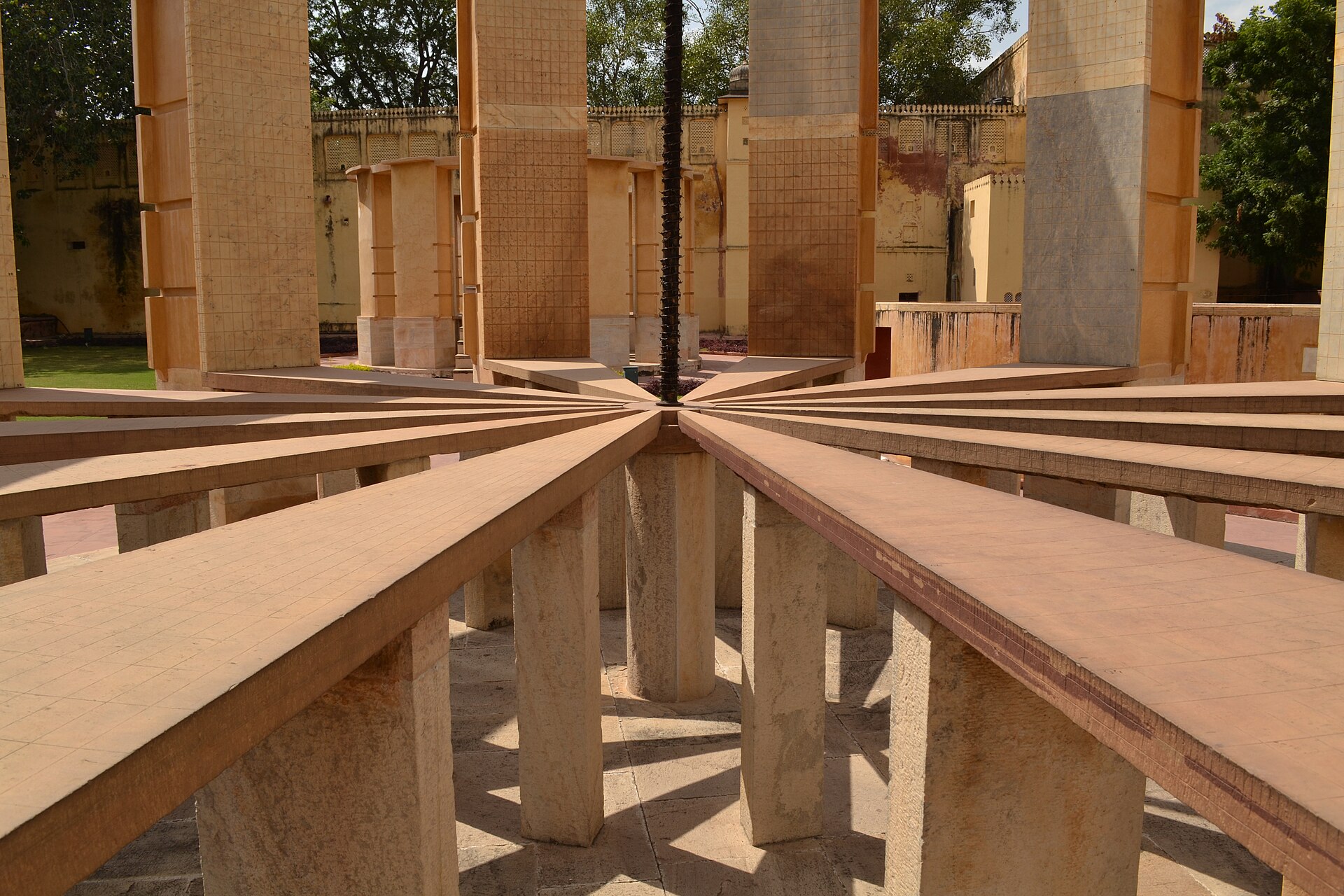
The 19 instruments look like abstract sculptures to modern eyes, but each has a precise astronomical function. The Samrat Yantra is the world's largest sundial -- a 27-meter-high triangular gnomon that casts a shadow moving 1 millimeter every 2 seconds, accurate enough to read local time to 2-second precision. The Jai Prakash Yantra consists of two hemispherical bowls sunk into the ground, mapping the entire celestial hemisphere -- you can walk inside and stand where a specific star would be at a given time. The Ram Yantra is two cylindrical structures for measuring altitude and azimuth, functioning day and night. The Rashivalaya Yantra comprises twelve instruments, one for each zodiac sign, each calibrated to observe a specific 30-degree segment of the ecliptic. The Laghu Samrat Yantra is a smaller sundial demonstrating the same principles for quick readings.
Historical Significance
Built between 1724 and 1735 by Maharaja Sawai Jai Singh II, the instruments were designed because the ruler was frustrated by the inaccuracy of existing metal astronomical tools. By scaling them to monumental proportions in stone and marble, Jai Singh achieved extraordinary precision that remains accurate three centuries later. Guides demonstrate the instruments in real time, using the sun's shadow to read the current time and showing how Jai Singh's calculations still work. The observatory reflects a remarkable moment in Indian scientific history when a Rajput ruler combined Hindu astronomical traditions with Islamic and European mathematical knowledge.
When to Visit
Open: daily, 9:00 AM - 5:00 PM. Best time: late morning (10 AM - noon) when the sun is high enough for sundial demonstrations. Night observations are occasionally organized during astronomical events -- check locally.
Admission and Costs
Foreigners: ₹200 ($2.40) individually, or included in the ₹1,000 composite ticket. Indian nationals: ₹40. Guide: ₹300-800 for a 1-hour demonstration tour -- highly recommended here.
Tips for Visitors
A guide is essential here: this is the one Jaipur attraction where a guide transforms the experience entirely. Without one, the instruments are abstract shapes. Sunny days are best since most instruments require direct sunlight to demonstrate; overcast days limit the experience. The City Palace entrance is adjacent -- plan to visit both together. The entire observatory fits in a compact area; 45 minutes to 1 hour is sufficient. Also combine with Hawa Mahal a short walk away and Amber Fort for a full Jaipur day.