
Collection Highlights
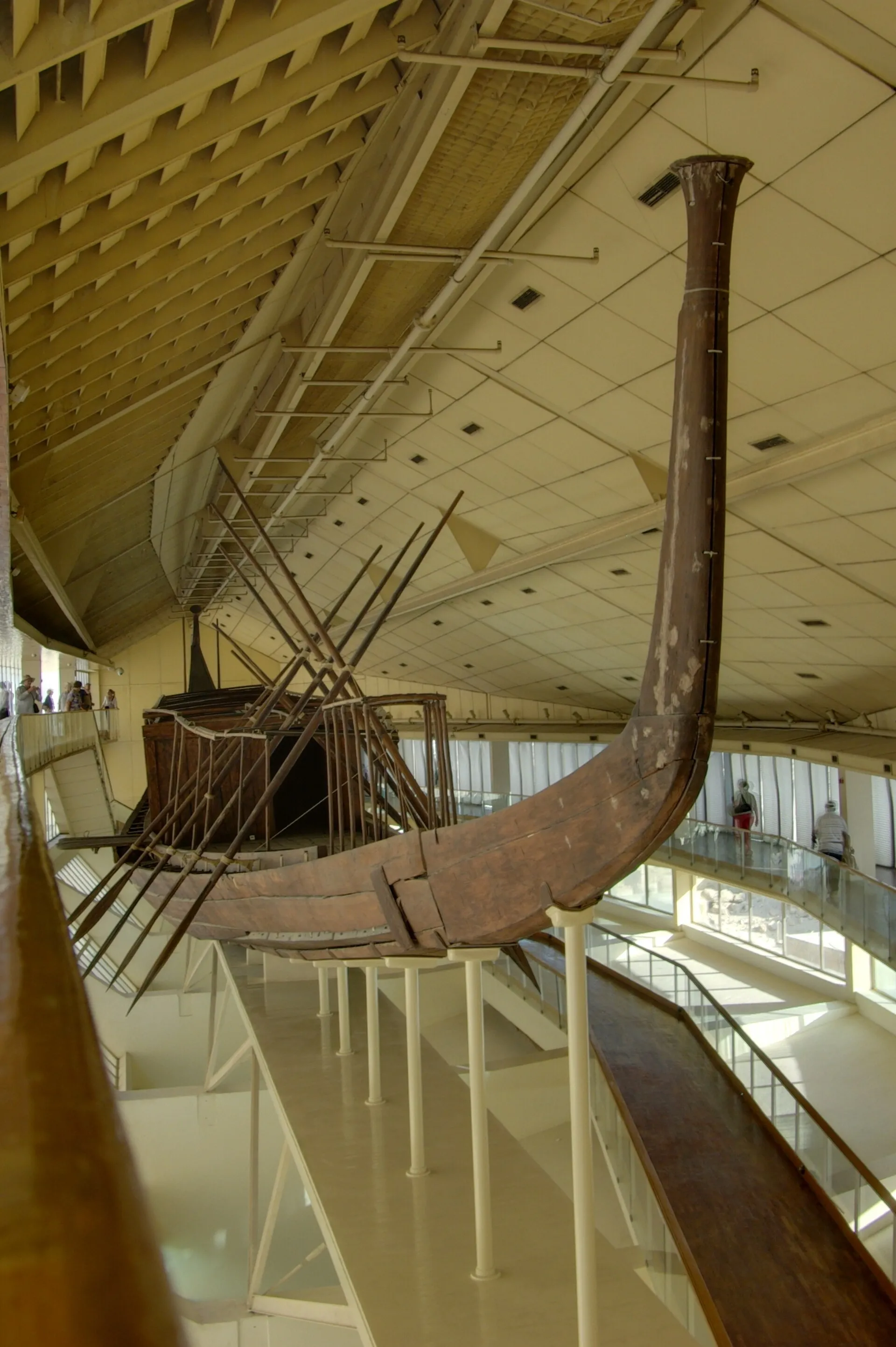
The Stitched Cedar Hull
The hull's Lebanese-cedar planks are laced together through drilled channels with halfa-grass rope and pinned with mortise-and-tenon joints -- no metal fasteners at all. This "sewn boat" design let the timbers flex with the water rather than crack against it, a technique that predates nailed construction by millennia.
The Papyriform Prow and Stern
Prow and stern sweep upward in the papyriform shape of the Nile's ancient reed boats, rendered here in heavy cedar that shipwrights steamed and bent into curves -- a graceful nod in royal carpentry to the humble papyrus craft that first plied the river.
The Columned Deckhouse
Amidships stands a slender cabin whose posts are topped with papyrus-bud capitals, echoing the architecture of temples and palaces and marking the vessel as fit for a king rather than a working ferry across the river.
The Steering Oars
Ten long oars lie along the deck in five pairs, their blades broader than a man's torso; the largest pair at the stern functioned as steering oars, guiding a hull that shows genuine signs -- rope wear, repairs, water staining -- of once having floated.
The Second Boat
A second dismantled vessel, detected in an adjacent sealed pit and recovered from 2011 by a team from Japan's Waseda University, is undergoing long-term conservation and adds a companion craft to Khufu's celestial fleet -- one boat, some believe, for the day voyage and one for the night.
Collections Highlights
The vessel stretches 43.6 metres from prow to stern and was built almost entirely from Lebanese cedar, its planks sewn together rather than nailed. Ancient shipwrights drilled channels through adjoining timbers and laced them with rope of halfa grass, letting the hull flex on the water instead of cracking under rigid resistance; mortise-and-tenon joints lock the planks in alignment. The curved prow and stern rise in the classic papyriform shape -- a deliberate echo in heavy wood of the humble papyrus reed boats of the Nile -- achieved by steaming and bending massive lengths of timber.
Amidships sits a columned deckhouse whose slender posts are crowned with papyrus-bud capitals, mirroring the architecture of temples and palaces and signalling that the passenger was no ordinary traveller. Ten long oars lie along the deck in five pairs, the largest serving as steering oars at the stern, their blades broader than a man's torso. The choice of a boat was theological as much as practical: the sun god Ra was believed to cross the sky each day in a barque, sinking into the underworld at dusk and sailing the realm of the dead before rising reborn at dawn, and the dead pharaoh expected to join that eternal voyage. Yet Khufu's barge is no mere symbol. Rope wear at the lashing points, small hull repairs, and water staining on some timbers all hint at a boat that once truly floated -- perhaps the very craft that carried the king's mummified body downstream from Memphis to the Giza necropolis.
Guided Tours
The boat's modern story is nearly as remarkable as its ancient one. In May 1954 the Egyptian archaeologist Kamal el-Mallakh was clearing debris along the Great Pyramid's south flank when he uncovered a line of limestone blocks sealed with gypsum mortar. Lifting one, he lowered a mirror to bounce sunlight into the darkness and caught the unmistakable scent of cedar -- a fragrance locked away for forty-six centuries. Excavating the pit took two years, every timber photographed, numbered, and lifted by hand.
Reassembly fell to the restorer Ahmed Youssef Moustafa, who worked without blueprints or any comparable surviving vessel to guide him. Reading each timber's grain, curvature, and ancient assembly marks, he test-fitted the pieces again and again -- once spending eight months on the single problem of how the deckhouse joined the hull. The work stretched across some 14 years, from 1957 to 1971. A second, parallel pit, detected by probing, was left sealed until 2011, when a Japanese team from Waseda University used remote sensing and then painstaking extraction to recover a second, far more fragile boat, now undergoing long-term conservation. A licensed Egyptologist on the elevated walkway turns this from an impressive but silent hull into a living account of ancient technology, religion, and the personality of the king who commissioned it.
When to Visit
The solar boat now keeps the Grand Egyptian Museum's hours rather than the old plateau schedule. GEM opens daily, generally from 9 AM, with extended evening hours on some days -- always confirm the current timetable before you travel, as the museum continues to refine its programme since its full opening. Unlike the exposed monuments outside, the gallery is fully climate-controlled, a genuine relief from the Giza heat.
Allow 45 minutes to an hour for the boat and its surrounding maritime displays, and considerably longer if you fold it into a full GEM visit. Come early in the day if you can: the galleries are quietest before mid-morning tour groups arrive, and softer light makes the towering hull easier to photograph. Across the wider Giza plateau, October to March brings the most comfortable weather, while June to August routinely exceeds 40°C -- but because the boat lives indoors, its appeal holds up far better in summer than the open-air pyramids and Sphinx nearby.
Admission and Costs
The move to the Grand Egyptian Museum was driven by conservation. The original 1980s pavilion beside the pyramid struggled to hold steady temperature and humidity, and rising groundwater and swelling visitor numbers only made matters worse; the boat's new, custom-built gallery gives it stable environmental controls and viewing from several levels at once. Admission to the boat is now folded into GEM's general ticketing rather than the separate EGP 200 (about $4) once charged at the old museum on top of the Giza Plateau's EGP 540 ticket.
Because pricing continues to shift as GEM settles into full operation, confirm the current rate when you book. Guided visits remain the norm here:
- Group tours typically bundle the boat into broader Giza coverage for $20-35 per person.
- Private Egyptologist guides charge roughly $80-150 for up to five people, with focused attention on the vessel's details.
- A comprehensive plateau day combining the boat with the Great Pyramid and the Great Sphinx runs about $150-300 for five to six hours.
The Case for a Guide
An unguided visitor sees a big old boat behind a barrier; a good Egyptologist reveals why it is one of archaeology's most extraordinary objects. On the elevated walkway that circles the hull, a guide makes sense of details that are otherwise invisible.
- Reading the stitched hull: Guides point out the drilled lacing channels, the halfa-grass ropes, and the mortise-and-tenon joinery that let the ship flex on water -- a shipbuilding logic entirely unlike nailed European hulls.
- The solar-boat theology: They connect the vessel to the daily voyage of the sun god Ra and explain why a king would need a boat sealed beside his tomb for the journey through the afterlife.
- Symbol versus working ship: A guide weighs the evidence of actual use -- rope wear, repairs, water staining -- against the purely ritual reading, letting you judge whether this barge ever truly sailed the Nile.
- The discovery and reconstruction: The story of Kamal el-Mallakh's 1954 find and Ahmed Youssef Moustafa's decade-plus reassembly turns the hull into a detective story of modern Egyptology.
- Placing the boat on the plateau: Guides tie the vessel back to the Great Pyramid, the second sealed pit, and the wider Giza funerary complex so the boat reads as one piece of a coordinated royal burial.
Tips for Visitors
Photography is welcome, but flash is prohibited to protect the ancient wood, so brace your camera or raise your ISO in the gallery's controlled light. Walk the full elevated circuit at least once before doubling back -- the stern view reveals the sweep of the steering oars, while the bow shows the papyriform curve at its most graceful. Wear comfortable closed-toe shoes; reaching the boat still means crossing the broad Grand Egyptian Museum campus, and most visitors combine it with hours of galleries.
Fold the boat into a wider itinerary rather than treating it as a standalone stop. It sits minutes from the Great Pyramid and Great Sphinx, and about twenty minutes from central Cairo and the antiquities collection at the Egyptian Museum. As everywhere on the plateau, ignore unlicensed "guides" and camel touts at the approaches; a licensed guide will steer you past them and make far better use of your time at the hull itself.
Frequently Asked Questions
What are the Solar Boat Museum's hours, and how long should I plan to stay?
Since 2021 Khufu's boat has been displayed at the Grand Egyptian Museum (GEM), so it now follows GEM's schedule -- generally daily from 9 AM, with extended hours on some evenings; confirm the current timetable before you visit. Allow 45 minutes to an hour for the boat and its maritime displays, and considerably longer if you tour the wider museum. The gallery is climate-controlled, so it stays comfortable even in high summer.
How much does it cost to see Khufu's solar boat?
Admission is now integrated into the Grand Egyptian Museum's general ticket rather than the separate EGP 200 (about $4) once charged at the old pavilion on top of the Giza Plateau's EGP 540 ticket. Check the current GEM rate when booking. Group tours usually bundle the boat into broader Giza coverage for $20-35 per person, while a private Egyptologist guide runs roughly $80-150 for up to five people.
What can visitors see at the Solar Boat Museum with a guide?
An elevated walkway rings the vessel, letting you study the stitched cedar seams, the columned deckhouse, the steering oars, and the papyriform curves of prow and stern up close. A licensed Egyptologist turns an impressive but silent hull into a window onto ancient shipbuilding, solar-boat theology, and the reign of the pharaoh Khufu.
Where is Khufu's solar boat displayed now?
The reassembled first boat was moved in 2021 from its 1980s pavilion beside the Great Pyramid to a purpose-built gallery at the Grand Egyptian Museum near the Giza plateau entrance, where stable climate control and multi-level viewing both protect and showcase it. The original site beside the pyramid no longer houses the vessel, so plan your visit around the GEM.
Who discovered the solar boat, and how was it reconstructed?
The Egyptian archaeologist Kamal el-Mallakh uncovered the sealed pit in 1954, finding the ship dismantled into 1,224 cedar pieces. The restorer Ahmed Youssef Moustafa then spent roughly 14 years (1957-1971) test-fitting the timbers by hand, without blueprints, to rebuild the 43.6-metre hull. A second boat from an adjacent pit was recovered by a Japanese team from Waseda University from 2011 onward and is still being conserved.