
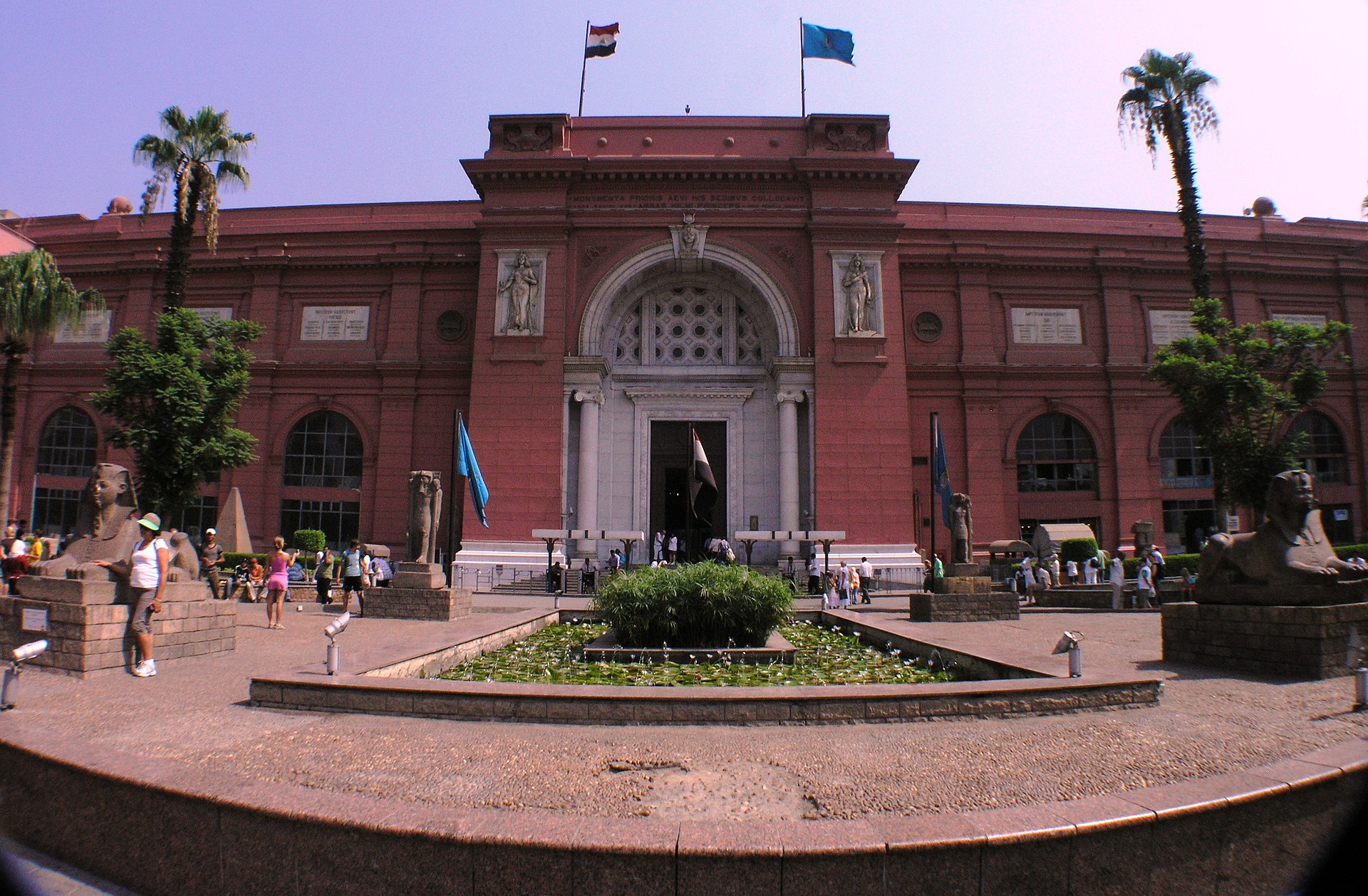

Overview
Opened in 1902 and designed by French architect Marcel Dourgnon, the Egyptian Museum occupies a distinctive pink neoclassical building on the north side of Tahrir Square. Its two floors and basement hold more than 120,000 objects spanning five thousand years of Nile Valley civilization, from predynastic flint tools to Greco-Roman funerary portraits. The sheer density of the collection is staggering: many corridors are lined floor-to-ceiling with sarcophagi, canopic jars, and limestone reliefs that in any other museum would be star exhibits. Without a trained Egyptologist to impose narrative order, visitors often leave dazed rather than enlightened. A guide who can read the hieroglyphic cartouches, explain the symbolism of the ba and ka, and trace the arc from the Old Kingdom through the Ptolemaic period transforms a warehouse of antiquities into a coherent story of human civilization.
Collections Highlights
The young king's funerary equipment fills several galleries on the upper floor, though the arrangement changes as pieces rotate to the new Grand Egyptian Museum near Giza. Howard Carter's 1922 discovery in the Valley of the Kings yielded over five thousand objects from a relatively modest tomb that had escaped ancient robbers. The centerpiece remains the golden death mask, eleven kilograms of solid gold inlaid with lapis lazuli and carnelian, its serene expression unchanged for thirty-three centuries. Nearby cases display the gilded innermost coffin, the alabaster canopic chest that held the king's preserved organs, and the golden throne depicting Tutankhamun and his wife Ankhesenamun in an intimate domestic scene. What strikes most visitors is not the gold itself but the craftsmanship. Artisans working around 1323 BCE achieved filigree work and cloisonné inlay that rivals modern techniques. The museum's layout follows a roughly chronological path. Ground floor galleries begin with the Old Kingdom in the atrium's left wing, where colossal statues of pharaohs like Khafre and Menkaure establish the artistic conventions that would endure for millennia. Proceeding counterclockwise, you encounter Middle Kingdom wooden models depicting daily life, New Kingdom military reliefs, and the distinctive elongated forms of the Amarna period. The upper floor houses smaller objects organized thematically: jewelry, papyri, wooden coffins, and the extraordinary finds from intact tombs. Standing before the Narmer Palette -- a five-thousand-year-old slate artifact depicting the unification of Upper and Lower Egypt -- a guide explains its significance as one of the earliest historical documents ever discovered.
Guided Tours
The young king's funerary equipment fills several galleries on the upper floor, though the arrangement changes as pieces rotate to the new Grand Egyptian Museum near Giza. Howard Carter's 1922 discovery in the Valley of the Kings yielded over five thousand objects from a relatively modest tomb that had escaped ancient robbers. The centerpiece remains the golden death mask, eleven kilograms of solid gold inlaid with lapis lazuli and carnelian, its serene expression unchanged for thirty-three centuries. Nearby cases display the gilded innermost coffin, the alabaster canopic chest that held the king's preserved organs, and the golden throne depicting Tutankhamun and his wife Ankhesenamun in an intimate domestic scene. What strikes most visitors is not the gold itself but the craftsmanship. Artisans working around 1323 BCE achieved filigree work and cloisonné inlay that rivals modern techniques. A guide who knows the excavation history can explain which objects were found in which chamber, how Carter spent a decade cataloging every bead and sandal, and what the placement of items reveals about New Kingdom beliefs concerning the afterlife. Standing before these treasures with expert commentary transforms mere sightseeing into genuine historical encounter.
When to Visit
The museum opens daily at 9 AM and closes at 5 PM, with last entry at 4:15 PM. During Ramadan, hours may be shortened, so confirm with your guide or check locally before arriving. General admission costs EGP 450 (approximately $9) for foreign visitors, while the Royal Mummies Hall requires an additional EGP 300 (~$6). Photography permits cost EGP 50, though flash is prohibited throughout to protect fragile pigments and textiles.
Crowds build steadily after 10:30 AM, particularly around the Tutankhamun galleries where tour bus groups congregate. Arriving right at opening allows you to reach the upper floor treasures before the rush. Most guided visits last between two and three hours, though dedicated enthusiasts with particular interests -- say, Amarna-period art or funerary papyri -- may want longer. Group tours typically cost $40-70 per person, while a private Egyptologist for up to five people runs $80-150 for the session. Large bags must be checked at the entrance security point, so keep your camera and essentials in a small crossbody bag.
The building predates modern climate control, meaning summer visits can be warm despite ceiling fans. Dress in light layers and carry water. Many visitors combine a morning museum session with an afternoon at the Saladin Citadel, a twenty-minute drive southeast. The gift shop near the exit offers a surprisingly good selection of replica scarabs, papyrus prints, and scholarly books worth browsing before departing.
Admission and Costs
General admission: EGP 450 ($9) for foreign visitors. Royal Mummies Hall: Additional EGP
300 ($6). Photography permit: EGP 50 (flash prohibited throughout). Group tours:
$40-70 per person. Private Egyptologist for up to five people: $80-150 per session.
Tips for Visitors
The Egyptian Museum rewards expertise more than perhaps any other site in Cairo. With 120,000 objects and minimal labeling, self-guided visitors inevitably miss context that transforms artifacts from pretty objects into historical documents. An Egyptologist reads hieroglyphic inscriptions on the spot, identifying which pharaoh commissioned a statue and what ritual purpose a particular amulet served. They explain how artistic conventions evolved across dynasties: why Old Kingdom statues appear rigid and idealized while Amarna-period works show soft bellies and elongated skulls.
Beyond translation, a guide imposes narrative structure on the overwhelming collection. They map efficient routes that connect the must-see galleries while bypassing less significant rooms. Standing before the Narmer Palette -- a five-thousand-year-old slate artifact depicting the unification of Upper and Lower Egypt -- a guide explains its significance as one of the earliest historical documents ever discovered. In the Yuya and Thuya gallery, they describe how the 1905 discovery of this largely intact tomb belonging to Tutankhamun's great-grandparents previewed the sensation that Carter's find would create seventeen years later. This continuous commentary weaves individual objects into a coherent story of human civilization along the Nile.