
Collection Highlights
Shiwan ceramic roof friezes
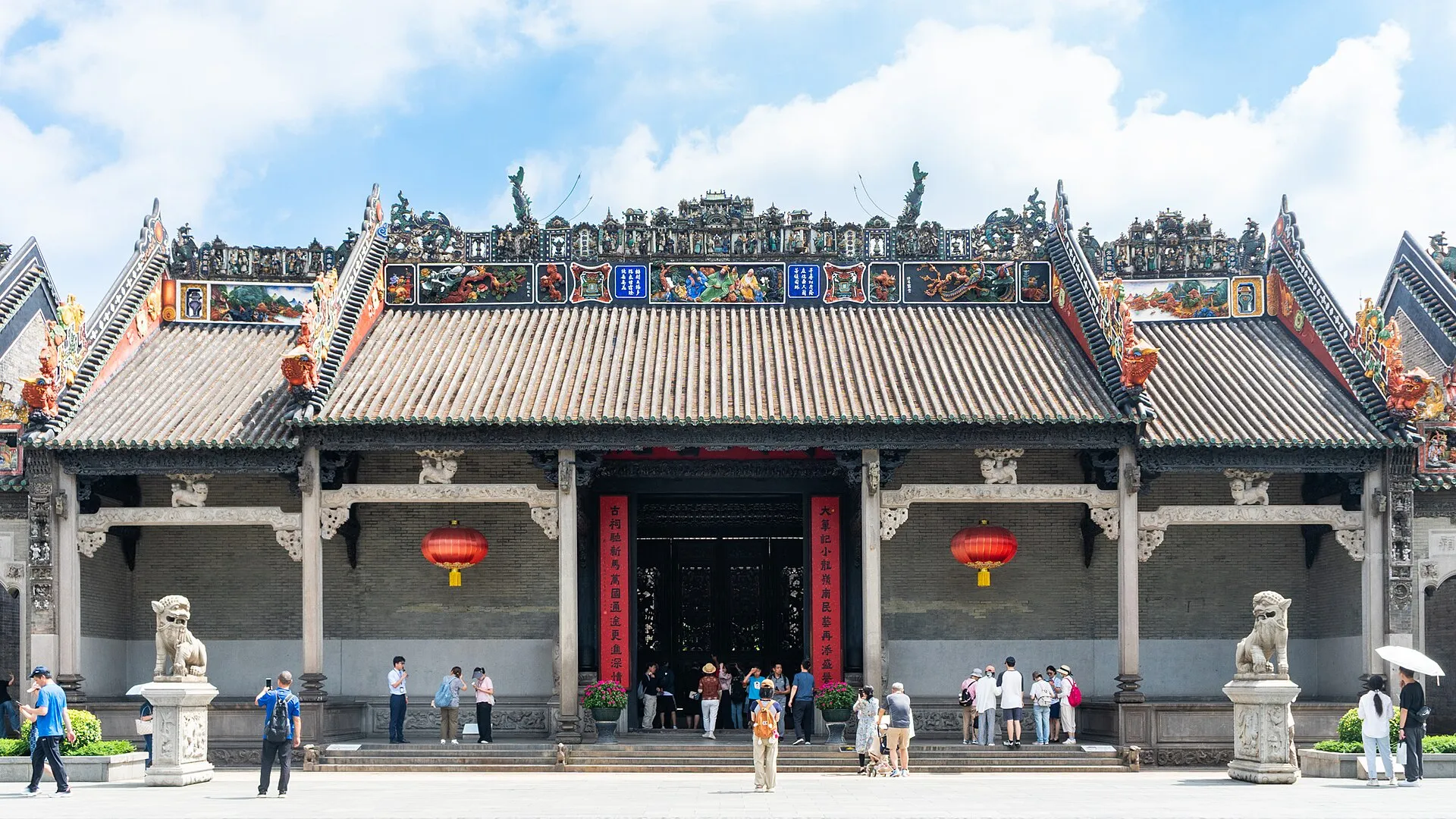
The eleven ceramic ridges that crown the halls are the hall's signature — hundreds of hand-modelled Shiwan pottery figures acting out scenes from Cantonese opera and classical legend, glazed in the bright yellows, greens, and cobalt blues that fire hot enough to survive a century of subtropical sun. Fired in the kilns of nearby Foshan and installed in the 1890s, each ridge reads like a frozen stage, best appreciated with binoculars from the front courtyard.
Juxian Hall woodcarved screens
The central Juxian Hall — the "Hall of Assembled Worthies" where the clan once gathered — is closed by folding screen doors carved up to eight layers deep in a single plank of wood. Blooming peonies, battle scenes, and auspicious animals emerge in pierced relief so fine that light passes between the layers, a tour de force of Cantonese cabinetmaking.
Grey-brick relief panels
Along the courtyard walls, artisans carved grey Dongguan brick into deep relief panels of landscapes, birds, and Confucian parables, several still bearing the incised signatures of their makers — a rare surviving record of the named craftsmen behind Lingnan brick carving.
Lime-plaster gable murals
The roof gables and eaves carry polychrome lime-plaster (huisu) sculptures — a fragile modelling art, built up wet over an iron armature, that depicts fruit, flowers, and mythical beasts in vivid relief and demands constant restoration in Guangzhou's humidity.
Wrought-iron courtyard railings
The connecting verandas are fenced with cast- and wrought-iron balustrades twisted into geometric and floral patterns — an unusual industrial flourish for an 1890s ancestral hall, showcasing metalwork techniques that have since nearly vanished from southern China.
Guangdong Folk Art Museum galleries
The rear halls house the permanent and rotating collections of the Guangdong Folk Art Museum — ivory ball carvings, Cantonese embroidery, jade, paper-cutting, and richly beaded opera costumes — turning the ancestral shrine into a living survey of Lingnan handicraft.
Collections Highlights
Shiwan ceramic roof ridges — Hundreds of miniature figures enact historical dramas and folk tales along the roof peaks, painted in bright yellows, greens, and blues and fired to survive a century of subtropical weather. They are the single most photographed feature of the hall.
Woodcarved entrance screens — Multi-layered panels up to eight layers deep depict blooming peonies, battle scenes, and auspicious animals in extraordinary pierced relief, closing the central Juxian Hall.
Brick carvings on courtyard walls — Relief panels show natural scenes and Confucian parables carved directly into grey Dongguan brick with surgical precision, several signed by their makers.
Lime-plaster gable sculpture — The huisu murals along the eaves and gables model fruit, flowers, and mythical beasts in vivid polychrome relief, a fragile art rebuilt repeatedly against Guangzhou's humidity.
Iron balustrade patterns — Wrought-iron railings throughout the complex feature geometric and floral designs that demonstrate metalwork techniques now nearly lost in southern China.
Guangdong Folk Art Museum galleries — Rotating exhibitions of ivory carving, embroidery, paper cutting, jade, and Cantonese opera costumes fill the rear halls, extending the visit from architecture into living craft.
Central courtyard symmetry — Standing on the main axis you can see through all three entrance gates and five successive halls, a deliberate expression of Confucian order that rewards a moment of stillness before the detail-hunting begins.
Guided Tours
Expert guides at Chen Clan Ancestral Hall offer specialized knowledge that transforms a casual visit into an education in Lingnan craft. Tours range from a general highlights loop to thematic deep dives — one guide might focus an hour entirely on the Shiwan ceramic roof ridges and the Foshan kilns that produced them, while another traces the woodcarving techniques of the Juxian Hall screens or the symbolism of the brick-relief parables. Because the hall is compact, guides commonly fold it into a wider Guangzhou itinerary, linking its Qing-dynasty craftsmanship to the modern engineering of Canton Tower and the colonial history of Shamian Island. For visitors touring the great sights of China, a guide here frames how Cantonese decorative arts differ from the imperial architecture of the north, adapting the commentary to each group's interests and expertise.
Chen Clan Ancestral Hall timeline
-
Construction begins
Chen clan families from 72 counties across Guangdong pooled funds to raise a combined academy and ancestral shrine.
-
Academy completed
The finished compound opened as the Chen Clan Academy, where clan sons prepared for the imperial civil-service examinations.
-
Imperial exams abolished
The Qing court ended the examination system, closing the academy's original teaching purpose after barely a decade.
-
Guangdong Folk Art Museum
The restored halls reopened as the Guangdong Folk Art Museum, dedicated to Lingnan craft traditions.
-
National heritage listing
The hall was designated a Major Historical and Cultural Site Protected at the National Level.
-
New Eight Views of Guangzhou
Citizens voted the hall onto the city's official scenic list under the name Gu Ci Liu Fang, "the ancient hall's lasting fragrance."
When to Visit
Open daily 8:30 AM to 5:30 PM, with last admission at 5:00 PM. Best time: weekday mornings, when tour groups are fewer and the low courtyard light rakes across the roof ridges for the sharpest photographs of the ceramic figures. The hall is busiest on weekend afternoons and during the biannual Canton Fair, when day-tripping delegates fill Guangzhou's sights. Guided English tours are sometimes offered around 10:00 AM and 2:30 PM — check at the entrance or arrange one through your guide in advance, as they are not guaranteed. Allow 1.5 to 2 hours to appreciate the decorative detail across all nine halls, six courtyards, and the Guangdong Folk Art Museum galleries in the rear. Seasonally, October through December brings the crispest, driest light of the year — reflected in the higher autumn ratings above — while the humid May-to-September monsoon leaves the plaster murals glistening but the courtyards sticky.
Admission and Costs
Entrance ticket: ¥10 (about $1.40) per person — one of Guangzhou's greatest cultural bargains, given the density of craftsmanship inside. Children under 1.2m: free entry. Audio guide rental: ¥20 (about $2.80), available in English and worth it for decoding the folk stories behind the panels. Getting there is almost free too: the Chen Clan Academy (Chenjiaci) metro station on Line 1 places you at the front gate for a ¥2-4 fare, and several buses stop on Zhongshan Qi Road just outside. Compared with the ¥150-¥298 skywalk tickets at Canton Tower, a morning here is the best value in the city — closer in spirit to the free colonial streets of Shamian Island.
The Case for a Guide
The carvings at Chen Clan Ancestral Hall are dense with meaning that is invisible without context — each roof figure, brick panel, and screen tells a specific story from Cantonese opera, dynastic history, or Confucian teaching, and almost none of it is captioned in English. A licensed local guide turns a beautiful but mysterious compound into a legible one.
- Decoding the roof theatre: A guide names the operas and legends staged along the Shiwan ceramic ridges — which figure is a loyal general, which a scholar, which a mythical beast — so the rooflines read as narrative rather than decoration.
- Reading the craft vocabulary: Guides explain the "three carvings, two moldings, one casting" system and point out where wood, brick, stone, ceramic, plaster, and iron each do their work, so you leave understanding how the hall was made.
- Clan culture and the exam system: A guide sets the hall in the world of the 72-county Chen lineage and the imperial examinations it was built to serve, explaining why an ancestral shrine doubled as a boarding academy.
- Spotting the signatures: Guides steer you to the signed grey-brick panels and the maker's marks most visitors walk straight past — a rare human trace in Chinese decorative art.
- Sequencing the museum: Beyond the architecture, a guide connects the front-hall carvings to the Guangdong Folk Art Museum's ivory, embroidery, and opera-costume galleries in the rear, so the visit builds instead of scattering.
Tips for Visitors
Start with the rooflines: many visitors rush inside and miss the exterior ceramic art, so spend your first fifteen minutes in the front courtyard looking up. Bring binoculars or a zoom lens: the finest Shiwan figures sit high on the roof ridges, and a telephoto lens reveals detail invisible to the naked eye. A guide transforms the visit: without context the carvings are beautiful but mysterious, while a guide decodes the folk stories and symbolic meanings behind every panel. Visit the on-site gift shop, which sells authentic Cantonese handicrafts — including miniature ceramic reproductions of the roof figures — at reasonable prices. Photographers should return late in the afternoon, when warm side-light models the plaster gable sculptures. Finally, pair the hall with Shangxiajiu Pedestrian Street, the bustling commercial avenue that starts a short walk south, for Cantonese street food and colonial-era shophouse architecture.
Frequently Asked Questions
What are the opening hours for Chen Clan Ancestral Hall?
Open daily 8:30 AM to 5:30 PM, with last admission at 5:00 PM. Best time: weekday mornings, when tour groups are fewer and the low courtyard light rakes across the roof ridges for the sharpest photographs. Allow 1.5 to 2 hours to cross all nine halls and six courtyards.
What does admission to Chen Clan Ancestral Hall cost?
Entrance ticket: ¥10 (about $1.40) per person — one of Guangzhou's greatest cultural bargains, given the density of craftsmanship inside. Children under 1.2m: free entry. Audio guide rental: ¥20 (about $2.80), available in English at the front gate.
What gear helps you appreciate Chen Clan Ancestral Hall's roof art?
Bring binoculars or a zoom lens: The finest Shiwan ceramic figures sit high on the roof ridges, and a telephoto lens or binoculars reveal astonishing detail invisible to the naked eye. Start in the front courtyard and spend your first fifteen minutes looking up.
What are the main things to see inside Chen Clan Ancestral Hall?
The star attractions are the Shiwan ceramic roof friezes, the eight-layer woodcarved screen doors of the central Juxian Hall, the signed grey-brick relief panels on the courtyard walls, the polychrome lime-plaster gable murals, and the wrought-iron railings — the celebrated "three carvings, two moldings, one casting, and painting" of Lingnan folk craft, now curated as the Guangdong Folk Art Museum.
How do you get to Chen Clan Ancestral Hall by metro?
Take Metro Line 1 to Chen Clan Academy (Chenjiaci) Station and use the exit signposted for the hall; the front gate is a two-minute walk. From the concourse the ornate main entrance is impossible to miss, and several bus routes stop on Zhongshan Qi Road just outside.
Is Chen Clan Ancestral Hall worth visiting?
Yes — for a ¥10 ticket you get the finest surviving example of Cantonese decorative architecture in southern China, a UNESCO-recognised style of craft packed into a single walkable compound. Pair it with Shangxiajiu Pedestrian Street a short walk south, or combine it with Canton Tower and Shamian Island for a full day in Guangzhou.