
Place Royale timeline
-
Champlain's habitation
Samuel de Champlain raised his fortified fur-trading post on this exact riverside ground, the seed of Nouvelle-France.
-
Named Place Royale
A bust of Louis XIV set in the old market square gave it the royal name it still carries.
-
Notre-Dame-des-Victoires
Construction begins on what is now the oldest stone church in North America, on the footprint of Champlain's habitation.
-
British bombardment
The siege of Quebec reduced the Lower Town to rubble; the square was slowly rebuilt under British rule.
- 1970s
Heritage restoration
A decades-long provincial campaign restored the merchant houses to their 17th- and 18th-century appearance.
-
UNESCO listing
Place Royale was inscribed with the Historic District of Old Québec as a World Heritage Site.
-
Fresque des Québécois
The 420-square-metre trompe-l'oeil mural was unveiled a step from the square, painting four centuries of history onto a blank wall.
Historical Significance
Place Royale represents the founding moment of permanent French settlement in the Americas. When Champlain constructed his habitation here in 1608, he established the fur-trading outpost that would grow into Nouvelle-France — a colonial enterprise spanning from the St. Lawrence valley to the Louisiana bayous. The square witnessed the full arc of that colonial drama: French traders negotiating beaver pelts with Indigenous nations, and British sieges that reduced the Lower Town to rubble during the 1759 campaign that culminated in the Battle of the Plains of Abraham just above the cliffs. From marketplace to military outpost to commercial hub to protected heritage site, the square's uses trace the whole trajectory of the colony.
Notre-Dame-des-Victoires carries that history in its very name. Begun in 1688, the church was first dedicated Notre-Dame-de-la-Victoire after the townsfolk repelled Admiral Phips's New England fleet in 1690, then pluralised to des Victoires following a second deliverance in 1711, when a British invasion fleet under Admiral Walker was wrecked by fog and reef in the St. Lawrence. The triumphalist naming that the British conquest of 1759 would render ironic within decades is thus written into the oldest stone church on the continent. The archaeological layers beneath the cobblestones constitute one of the most significant excavation sites in North America, with foundations of Champlain's 1608 habitation, French trade goods, British military artefacts, and Indigenous tools revealing four centuries of contact, conflict, and cultural exchange — a record now protected as part of the Historic District of Old Québec. The Louis XIV bust at the square's centre marks the spot where colonial governors once read royal proclamations to assembled crowds of fur traders and soldiers, a physical connection to the absolutist monarchy that governed Nouvelle-France from across the Atlantic.
Architecture
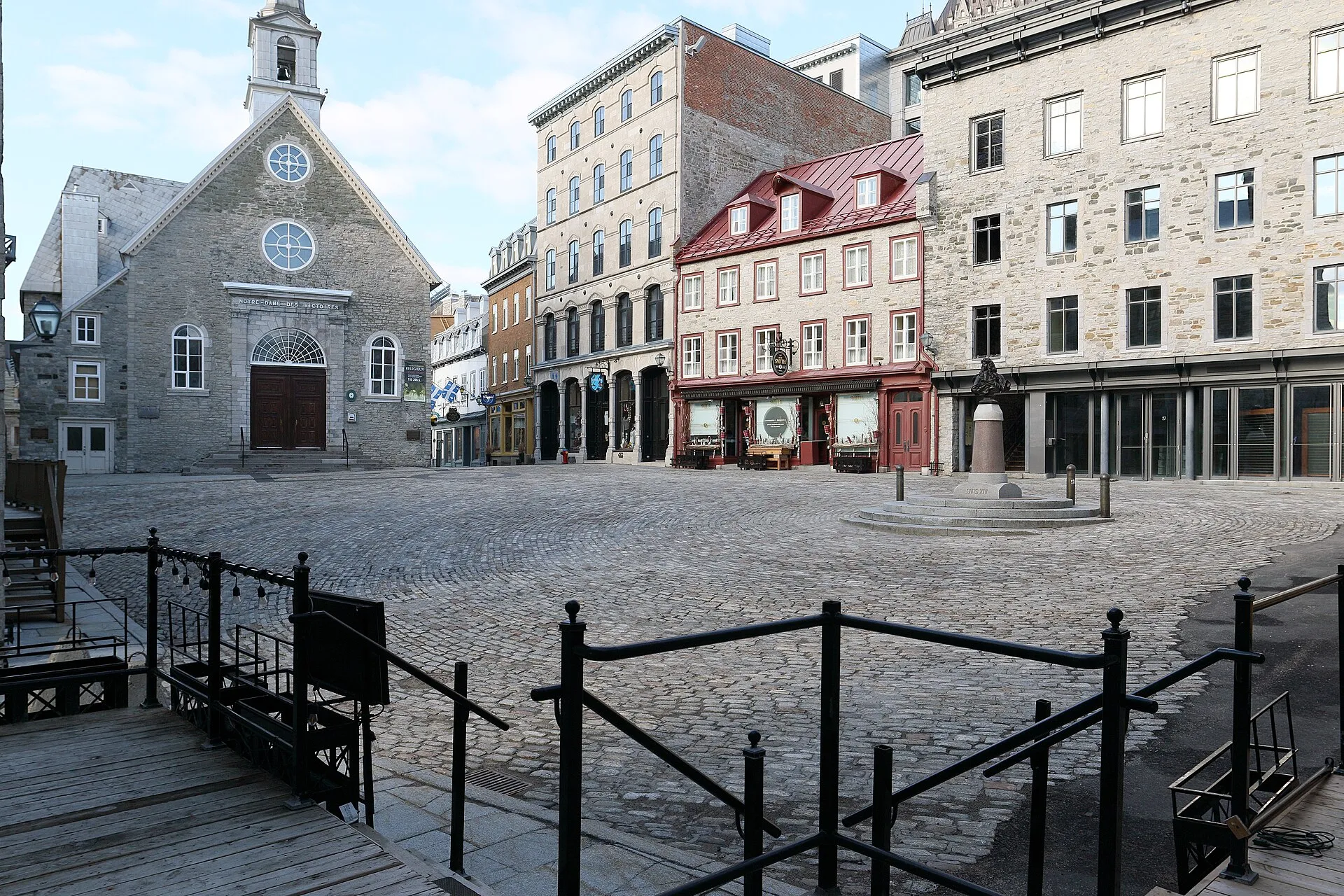
Notre-Dame-des-Victoires: Step inside the oldest stone church in North America, where a carved wooden ship — the Brézé — hangs from the ceiling as a votive offering, and the altarpiece reproduces a fortified castle, a reminder that faith and defence were inseparable in early Nouvelle-France. The compact nave and painted vault repay a slow look upward.
Fresque des Québécois: This 420-square-metre trompe-l'oeil mural wraps around a building façade on Rue Notre-Dame, rendering figures from Jacques Cartier to Félix Leclerc so convincingly that first-time visitors often mistake the painted balconies, stairs, and shopfronts for real ones. Completed in 1999, it is the single best photograph in the Lower Town and a lesson in four centuries of history in one glance.
Archaeological layers: Digs beneath the square have uncovered foundations of Champlain's 1608 habitation, French trade goods, and Indigenous tools; the interpretation centre lets you peer through glass floors at the excavated remains and read the stratigraphy of the site directly.
Merchant houses: The tight ring of greystone buildings surrounding the square dates to the late 1600s and early 1700s, each restored during the province's decades-long heritage campaign to its original proportions — slate roofs, iron fixtures, casement windows, and thick rubble walls that kept out river damp and British cannonballs alike. Their steep rooflines and firewall gables are textbook examples of the New France urban house.
Louis XIV bust: A bronze bust of the Sun King presides over the centre of the square, marking the spot where colonial governors once read royal proclamations to gathered crowds of fur traders and soldiers — and giving Place Royale the royal name it has worn since 1686.
When to Visit
Square access: Open at all times — Place Royale is a public square with no gates or fences, so it belongs to early risers and late-night wanderers alike. Notre-Dame-des-Victoires: Generally open daily 9:30 AM – 5 PM for visitors, with reduced hours during Mass and services and shorter winter openings; step in quietly if a celebration is under way. Interpretation centre: The Musée de la civilisation's Place-Royale exhibit runs roughly Tuesday through Sunday, 10 AM – 5 PM from late June through early September, with reduced days and hours in the off-season. Best time: Summer mornings before the cruise-ship passengers arrive, when the square belongs to pigeons, photographers, and the occasional street violinist. A single morning covers the church, the mural, and a slow loop of the merchant houses; add the interpretation centre and the neighbouring Petit-Champlain lane and the Lower Town easily fills a half-day.
Admission and Costs
- Exploring the square: Free — wandering the cobblestones, admiring the architecture, and viewing the Fresque des Québécois mural costs nothing.
- Place-Royale interpretation centre: about CA$5 (US$4) per adult for access to the archaeological exhibits and multimedia displays tracing the site's evolution from Champlain's fur-trading outpost to the present day; check the Musée de la civilisation for current rates and free days for under-18s.
- Notre-Dame-des-Victoires: Free to enter the church; small donations are welcomed.
- Old Quebec funicular (the easiest link to the Upper Town): CA$5 (about US$4) each way for the cliff-side ride between Dufferin Terrace and the Lower Town.
- Nearby Petit-Champlain shops and restaurants: budget for browsing — the artisan boutiques sell handcrafted jewellery, Québécois ceramics, and maple confections, while sit-down meals at the lane's bistros run CA$25–50 (about US$18–37) per person.
The Case for a Guide
Place Royale looks like a pretty cobblestone square to any passing visitor, but a guide reads it as the opening page of North American history — turning a fifteen-minute photo stop into the single most concentrated dose of the Nouvelle-France story anywhere on the continent.
- The exact spot, not a monument to it: A guide makes clear that this is literally where Champlain built in 1608 — the church's foundations are the habitation — rather than a plaque commemorating an event that happened elsewhere.
- Reading the merchant houses: Which firewall gables, casement windows, and rubble walls are original 17th-century fabric and which are 1970s restoration is invisible to the untrained eye; a guide traces the seams.
- The church's ironic name: The story of Notre-Dame-des-Victoires — named for French victories over the English in 1690 and 1711, only for the British to take the city in 1759 — is the kind of layered irony a guide unlocks that signage never does.
- Decoding the Fresque des Québécois: Each painted figure on the mural is a real historical person; a guide names them and explains why Cartier, Champlain, and Félix Leclerc share one wall.
- Bilingual context: In a city more francophone than Montreal, a bilingual guide translates the place-names, proclamations, and fur-trade vocabulary that give the square its meaning.
Tips for Visitors
- Reach the square from above: Take the funicular or the Breakneck Stairs (Escalier Casse-Cou) down from Dufferin Terrace, the public boardwalk beside the Château Frontenac in the Upper Town — the steep descent is half the experience.
- Morning light for photography: The square faces east, catching golden morning sun on the church façade; by afternoon the surrounding buildings cast deep shadows across the cobblestones, so shoot early.
- The classic upward frame: Stand at the square's centre near the Louis XIV bust and tilt the camera up — the turrets of the Château Frontenac loom over the Lower Town rooftops in a single composition you cannot get from the Upper Town.
- Combine with Petit-Champlain: The pedestrian lane begins steps from the square and leads south through a string of artisan shops, making it easy to spend an unhurried hour browsing after your historical visit.
- Winter ambience: The square takes on a hushed, snow-dusted beauty from December through March, with far fewer visitors and the church glowing warmly through frosted windows — pair it with the Christmas market in the Old Quebec Lower Town.
- Guided heritage tours: Several operators offer themed walks departing from Place Royale that cover the fur trade, the 1759 siege of Quebec, and the everyday lives of the colonists who once haggled over beaver pelts on these very stones.
Frequently Asked Questions
When is the best time of year to visit Place Royale?
June through September provides the most pleasant conditions for lingering in this compact cobblestone square and exploring Notre-Dame-des-Victoires church, with summer bringing open-air concerts and historical reenactments. The square sits in the Lower Town where cold winds funnel off the St. Lawrence in winter, making November through March visits brisk — though December's Christmas market and fresh snowfall on the 17th-century stone buildings create postcard-worthy scenes.
When can visitors tour Place Royale?
Square access: Open at all times — Place Royale is a public square with no gates or fences. Notre-Dame-des-Victoires: Generally open daily 9:30 AM - 5 PM for visitors, with reduced hours during services and in winter months.
How much is the entrance fee for Place Royale?
Exploring the square: Free — wandering the cobblestones, admiring the architecture, and viewing the Fresque des Quebecois mural costs nothing. The Place-Royale interpretation centre run by the Musée de la civilisation charges a modest admission (about CA$5 / US$4 per adult) for its archaeological exhibits.
What is the best way to reach Place Royale from the Upper Town?
Reach the square from above: Take the funicular or the Breakneck Stairs (Escalier Casse-Cou) down from Dufferin Terrace in the Upper Town — the descent is half the experience.
Why is it called Place Royale?
The open space began as the colony's marketplace, the Place du Marché, where fur traders and habitants bartered pelts and produce. It took the name Place Royale in 1686, when the intendant installed a bust of King Louis XIV at its centre to assert royal authority over Nouvelle-France — the bronze Sun King who still presides over the cobblestones is a later replica of that gesture.
How long should I plan to spend at Place Royale?
Most visitors need 45 minutes to an hour for the square itself: time to circle the merchant houses, step inside Notre-Dame-des-Victoires, and photograph the Fresque des Québécois. Add another 30 to 45 minutes for the Place-Royale interpretation centre, and budget an unhurried extra hour if you continue south into the artisan lane of Petit-Champlain — a half-day covers the whole Lower Town comfortably.