
Architecture
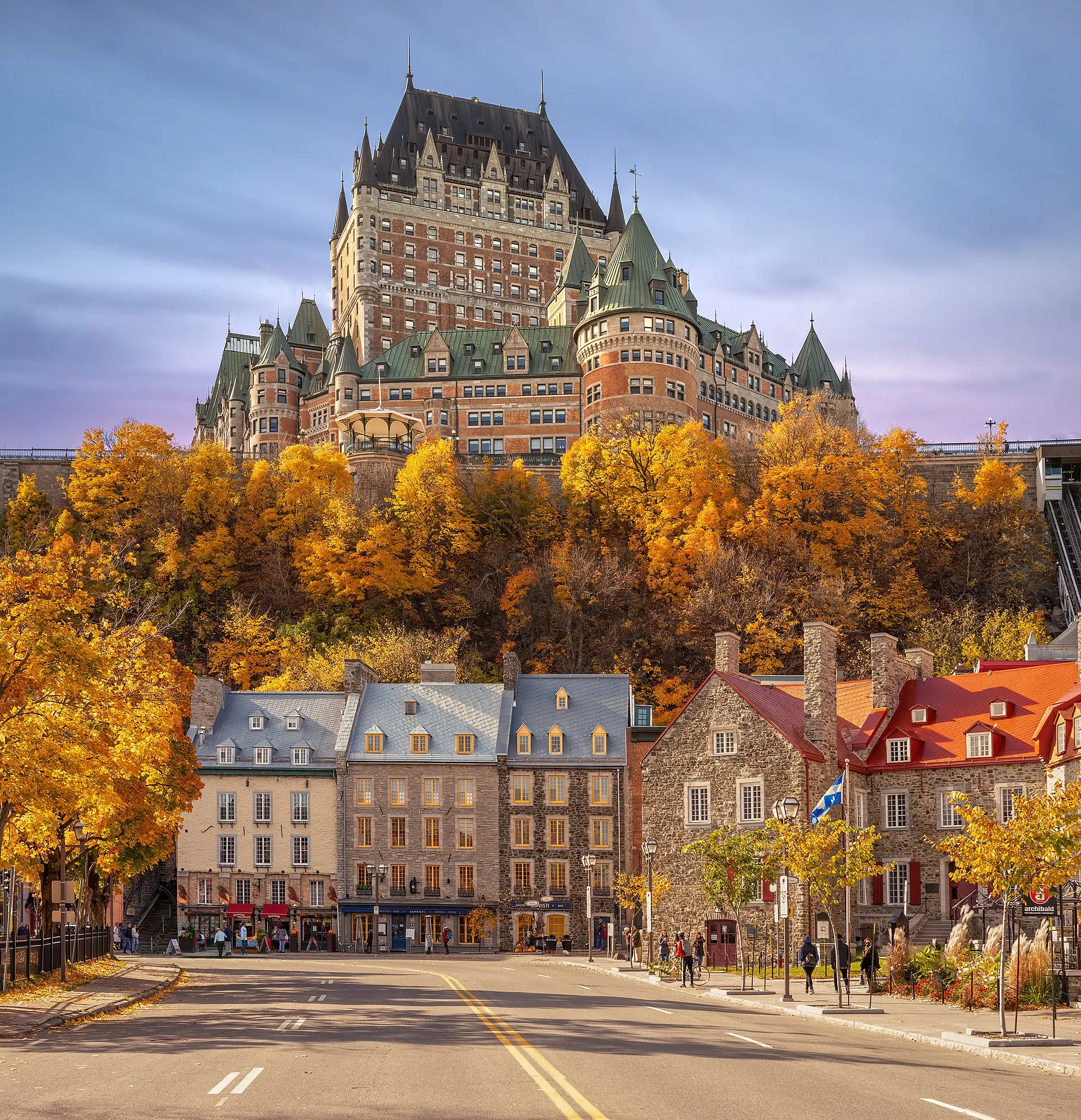
Château Frontenac is the defining example of the Châteauesque style that American architect Bruce Price adapted for the Canadian Pacific Railway, drawing directly on the Loire Valley châteaux of Renaissance France. Price wrapped the hotel in red-brick façades trimmed with grey Glenboig firebrick, then crowned it with the steeply pitched copper roofs that oxidised over decades into the signature blue-green patina visible across the river. Cylindrical corner turrets, machicolated parapets, dormer windows, and tall clustered chimneys lend the mass a fortress-like verticality that plays off its clifftop perch on Cap Diamant.
The building grew in deliberate stages rather than to a single master plan: Price's original horseshoe-shaped wing of 1893, the Citadel and Mont-Carmel wings that filled out the courtyard, and finally the central seventeen-storey tower designed by William Sutherland Maxwell and completed in 1924, which gave the château its soaring silhouette and briefly made it one of the tallest buildings in the city. Inside, the Renaissance-revival vocabulary continues through vaulted ceilings, a monumental stone lobby fireplace, heraldic shields, and dark-wood panelling. The composition — asymmetrical yet unified, medieval in feeling but thoroughly modern in its steel-framed tower — became the template for grand railway hotels across Canada, from the Banff Springs to the Empress in Victoria, establishing the château style as a distinctly Canadian architectural identity.
Historical Significance
The Canadian Pacific Railway commissioned Château Frontenac as a luxury stopover for transcontinental travellers, opening the first wing in 1893 on the site of the former Château Haldimand, near the ruins of the Château Saint-Louis — the colonial residence of New France's governors. Named for Louis de Buade, Comte de Frontenac, governor of New France in the seventeenth century, the hotel anchors the clifftop above the narrowing of the St. Lawrence that made Quebec a strategic prize contested by French and British forces for two centuries.
Its most consequential moment came during the Second World War, when Winston Churchill, Franklin Roosevelt, and Canadian Prime Minister Mackenzie King chose the château as the venue for the two secret Quebec Conferences of 1943 and 1944, where Allied leaders finalised the strategy for the D-Day landings behind its thick walls.
It stands at the heart of the Historic District of Old Québec, inscribed as a UNESCO World Heritage Site in 1985.
Over the decades the hotel has hosted royalty, heads of state, and film stars, and it was recognised as a National Historic Site of Canada in 1981. Reputedly the most photographed hotel in the world, the Frontenac has become the enduring emblem of the city — a symbol of both the French heritage of Canada and the railway age that knit the young nation together.
When to Visit
Guided tours run daily, typically 10 AM - 5 PM, with departures roughly every hour and both English and French narration (confirm the exact seasonal schedule when you book). The Dufferin Terrace boardwalk is open around the clock, year-round and never charges admission, so the single best-value visit is simply to arrive and walk it. Best time: late afternoon in summer, when the copper roofs glow amber in the low sun and the terrace fills with street musicians. Quietest period: weekday mornings in October and November, after the leaf-peeping crowds thin but before the holiday decorations draw new visitors. In deep winter the terrace hosts the Glissade de la Terrasse toboggan run, which operates only from roughly December through March — a fast, century-old wooden slide that sends riders hurtling past the chateau's façade.
Admission and Costs
- Guided historic tour — CA$22 (about US$16) per adult for a narrated walk through the hotel's corridors, ballrooms, and wartime conference rooms; children and seniors pay reduced rates.
- Dufferin Terrace boardwalk — Free. Stroll, photograph, or simply lean on the railing and watch cargo ships and the Louis Jolliet cruise boat pass below.
- Afternoon tea at Place Dufferin — around CA$60 (about US$44) per person for a tiered service of finger sandwiches, scones, and pastries inside the château.
- Room rates — from roughly CA$350 (about US$255) per night for a standard room; river-view suites climb well beyond that during peak summer and Carnaval de Québec season.
Reservations at the chateau's restaurants and the guided tour are open to non-guests, so you can experience the interior for the price of a tour ticket or a meal rather than an overnight stay.
The Case for a Guide
The chateau photographs beautifully from any angle, but a guide turns a pretty façade into a legible century of Canadian history — reading the building, the conferences, and the clifftop the way most visitors never can.
- The wartime Quebec Conferences — a guide walks you through the rooms where Churchill, Roosevelt, and Prime Minister Mackenzie King finalised the D-Day strategy in 1943 and 1944, explaining why a Canadian hotel became the secure venue for the most consequential Allied planning of the war.
- Reading the Châteauesque style — the guide points out which elements are French Renaissance quotation and which are pure railway-age theatre, and traces how the hotel grew from Bruce Price's 1893 horseshoe wing to the 1924 central tower.
- The layers beneath your feet — Dufferin Terrace sits atop the archaeological remains of the Château Saint-Louis, the colonial residence of New France's governors; a guide explains the excavated foundations you walk over without noticing.
- Why this cliff — the narrowing of the St. Lawrence below Cap Diamant made Quebec a strategic prize fought over for two centuries; a guide connects the chateau's perch to the military geography that shaped the whole city.
- Bilingual context — in a city more francophone than Montreal, a bilingual guide unlocks the Québécois stories, place-names, and rivalries that English signage alone never conveys.
Tips for Visitors
Booking and access:
- Book the tour ahead — guided history tours sell out on summer weekends; reserve online at least a day in advance to secure a slot.
- Non-guests welcome — you do not need a room reservation to enter the lobby, browse the shops, take the guided tour, or dine in the restaurants.
- Dining without staying — a table at one of the chateau's restaurants includes complimentary access to the lobby and public spaces, a low-cost way inside on a rainy day.
Best photo opportunities:
- The Lévis ferry — the crossing to the south shore delivers the definitive full-frontal shot of the château rising above the cliff; it is cheap, takes about ten minutes each way, and the returning angle is the one on the postcards.
- Terrasse Pierre-Dugua-De Mons — the quieter western extension of Dufferin Terrace frames the tower against the sky with far fewer people than the main boardwalk.
- Looking up from Place Royale — from the Lower Town cobblestones the turrets loom dramatically overhead, a very different composition from the wide river views.
- Winter light — snow on the copper roofs and low-angle January sun make the coldest months the most photogenic; combine a shoot with a run down the terrace toboggan slide.
Step out of the lobby and you are immediately on the cobblestone streets of Old Quebec; the funicular at the terrace's end drops you to the Lower Town in under a minute.
Frequently Asked Questions
When is the best season to visit Chateau Frontenac?
July and August offer the warmest weather for strolling the Dufferin Terrace boardwalk and watching ships on the St. Lawrence, while September-October wraps the surrounding landscape in fiery autumn color that makes the castle's copper-green turrets stand out even more dramatically. Winter turns the chateau into a fairy-tale scene dusted in snow, and the adjacent toboggan run on the terrace operates only from December through March — a seasonal treat unique to Quebec City.
When can visitors explore Chateau Frontenac?
Guided tours: Daily departures, typically 10 AM - 5 PM (check seasonal schedule for exact times). Dufferin Terrace: Open around the clock, year-round.
What is the admission price for Chateau Frontenac?
Guided historic tour: CA$22 (about US$16) per adult for a narrated walk through the hotel's corridors, ballrooms, and wartime conference rooms. Dufferin Terrace boardwalk: Free — stroll, photograph, or simply lean on the railing and watch ships pass below.
Do Chateau Frontenac tours require advance booking?
Book the tour in advance: Guided history tours sell out on summer weekends; reserve online at least a day ahead to secure your spot.
Where are the best spots to photograph Chateau Frontenac?
The full-frontal classic comes from the Lévis ferry mid-crossing, where the chateau rises above the cliff in a single sweep. For golden-hour glow, shoot from the Terrasse Pierre-Dugua-De Mons at the western end of Dufferin Terrace; for a dramatic upward angle, frame the turrets from the cobblestones of Place Royale in the Lower Town. Winter dustings of snow on the copper roofs make January and February the most atmospheric — if coldest — months for photography.
How do you get to Chateau Frontenac?
The chateau sits at the heart of Old Quebec's Upper Town, a flat ten-minute walk from the Gare du Palais train and bus station. From the Lower Town and Place Royale, ride the Old Quebec Funicular up to Dufferin Terrace, which delivers you to the hotel's doorstep. Drivers should use the paid garages on the periphery of the walled city, as on-street parking in the historic core is scarce.