
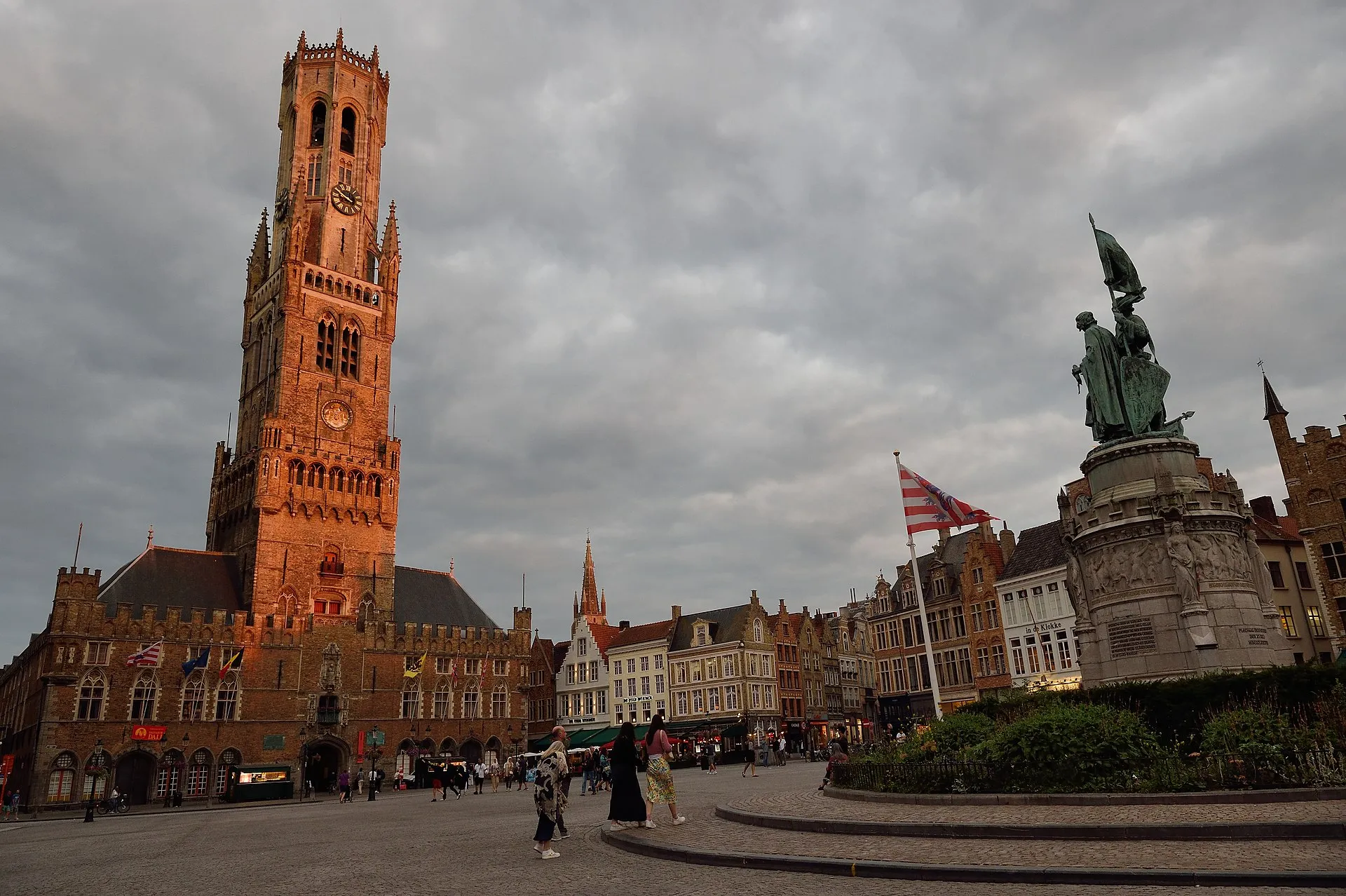
Architecture
Carillon concert: Stand beneath the tower during Monday/Wednesday/Saturday midday concerts to hear 47 bells played by a live carillonneur. The sound physically moves through you. Treasury room: Halfway up, see the chamber where Bruges stored its charter and seal behind a door requiring thirteen simultaneous keys — medieval security through forced consensus. Viewing platform: At 83 meters, the panorama reveals Bruges' medieval street plan perfectly preserved, three church towers, and canals threading toward the North Sea horizon. Provinciaal Hof: The neo-Gothic building on the south side (1887) replaced structures demolished during French occupation. Its deliberate historicism shows 19th-century romantic nationalism. De Coninck and Breydel statue: The central monument commemorates the 1302 Flemish revolt against French rule — placed in 1887 when Belgium needed medieval heroes for national identity. Wednesday market: Watch locals shop for vegetables, flowers, and prepared foods while tourists photograph the Belfry backdrop — two different versions of Bruges occupying the same space.
Historical Significance
The Belfry's construction beginning in 1240 marked Bruges' assertion of mercantile independence from feudal authority — a civic tower deliberately built to rival church spires in height and symbolic power. The 1302 Guldensporenslag (Battle of the Golden Spurs), when Flemish guild militias defeated French knights, cemented the Markt as a symbol of urban self-governance: the treasury chamber's thirteen-lock door system ensured no single authority could access the city's charters without collective consent. The 1695 French bombardment of Bruges (contemporaneous with the destruction of Brussels' Grand Place) damaged but did not destroy the Belfry, whose survival through wars, fires, and political upheavals over 780 years embodies the persistence of Flemish civic identity. UNESCO's 1999 World Heritage inscription recognized the Belfry not merely as architecture but as a political symbol — proof that medieval European democracy expressed itself through stone towers as much as through written charters.
When to Visit
Belfry hours: Daily 9:30 AM - 6:00 PM (last entry 5:15 PM). Carillon concerts: Monday, Wednesday, Saturday 11:00 AM - 12:00 PM; summer evening concerts July-August 9:00 PM. Best: Early morning (9:30-10:30 AM) before tour groups arrive, or late afternoon (4:30-5:30 PM) for golden hour light. Wednesday market: 8:00 AM - 1:00 PM — arrive early for best selection and thinner crowds. Avoid: Midday in peak summer (July-August) when cruise passengers flood the square. Winter: Shorter lines, dramatic light, and you have the viewing platform nearly to yourself.
Admission and Costs
Belfry admission: €14 adults, €12 seniors (65+), free for children under 12. Group tours including Belfry: €20-30 per person for 2-3 hour walking tours of central Bruges. Private guide: €180-250 for 2-hour private tour focusing on Markt, Burg, and medieval history. Carriage rides: €50-60 for 30-minute circuit (touristy but popular). Cafe terraces: Coffee €4-5, beer €5-7 — you're paying for square views; walk three blocks for half the price.
The Case for a Guide
Bruges' Markt Square looks like a perfectly preserved medieval chocolate-box city, and a guide reveals why that preservation is both extraordinary and historically complicated — the square's beauty conceals a story of economic collapse, Flemish nationalism, and one of medieval Europe's most radical artistic revolutions.
- Belfry carillon mechanics: The 47-bell carillon is played by a carillonneur sitting at a mechanical keyboard whose batons connect by rope to the bell clappers 83 meters above; a guide explains the instrument's unique touch sensitivity, why carillon repertoire developed independently of keyboard music, and how to position yourself in the square for optimal acoustics during Wednesday morning concerts.
- Flemish primitive painting revolution: Jan van Eyck worked in Bruges in the 1430s and developed the oil glazing technique that made photorealistic painting possible for the first time in European history; a guide traces which specific streets and guild buildings he would have known, and explains why this revolution in technique — not just style — emerged in this trading city specifically.
- Cloth hall medieval trade scale: The Hallen behind the Belfry was the commercial engine of a city that controlled European wool cloth distribution; a guide explains how Bruges coordinated the supply chain from English sheep farms to Flemish weavers to Italian merchant bankers financing the whole system, and why the cloth hall's storage capacity was the key logistical asset.
- Provincial court and Belgian independence: The neo-Gothic Provinciaal Hof facing the square was rebuilt in 1887 during the period when the newly independent Belgian state needed medieval Flemish heritage as a national identity foundation; a guide explains what was actually destroyed and why the replacement was designed to look older than it was.
- Bruges' decline when the Zwin silted up: The city was Europe's wealthiest trading port until the Zwin inlet silted shut in the late 15th century, making deep-draft ships unable to reach the harbor; a guide traces the exact waterways that connected the city to the sea and explains why Antwerp's rise was a direct consequence of Bruges' geographical misfortune.
Tips for Visitors
Climbing strategy: 366 steps sounds daunting but there are rest platforms. Pace yourself, read the informational panels, and your lungs will recover before the next section. Photography: The viewing platform has wire mesh safety barriers that interfere with photos. Shoot through the gaps or bring a lens hood to minimize reflections. Skip the horse carriages: They're expensive (€50+), provide minimal commentary, and the routes stick to the same over-touristed circuits. Walk instead and you'll see more. Carillon timing: Check concert schedules online before visiting. Standing in the square during a performance transforms the experience from sightseeing to sensory immersion. Café advice: The terraces ringing the Markt charge tourist premiums. Walk to 't Brugs Beertje on Kemelstraat (5 minutes south) for 300+ Belgian beers at local prices. Combine with Basilica of the Holy Blood: The Burg square is a 3-minute walk south via Breidelstraat — see both in one morning circuit. Weather check: The viewing platform is exposed to wind and rain. On stormy days, views get dramatic but you'll be cold. Dress accordingly. Evening return: Come back after dinner (9:00 PM in summer) when the Belfry is floodlit and the square empties. The same view transforms under artificial light and stars.
Frequently Asked Questions
What is the best season for climbing the Bruges Belfry?
May through September offers the clearest skies for spotting the North Sea glinting 15 kilometers away from the viewing platform, and summer evening carillon concerts in July-August add a magical auditory dimension. Winter has its own appeal — shorter queues, dramatic light on the medieval facades, and the December Christmas market with an ice rink installed below the tower — though the exposed platform at 83 meters can be bitterly cold.
When can visitors tour Markt Square & Belfry?
Belfry hours: Daily 9:30 AM - 6:00 PM (last entry 5:15 PM). Carillon concerts: Monday, Wednesday, Saturday 11:00 AM - 12:00 PM; summer evening concerts July-August 9:00 PM.
How much is the entrance fee for Markt Square & Belfry?
Belfry admission: €14 adults, €12 seniors (65+), free for children under 12. Group tours including Belfry: €20-30 per person for 2-3 hour walking tours of central Bruges.
What should visitors know before visiting Markt Square & Belfry?
Climbing strategy: 366 steps sounds daunting but there are rest platforms. Pace yourself, read the informational panels, and your lungs will recover before the next section.