
Engineering Facts
The Reie river system that feeds Bruges' canals was extensively engineered during the 12th-13th centuries to serve both commercial and defensive functions. Medieval hydraulic engineers diverted natural watercourses into concentric loops around the city center, creating navigable channels wide enough for flat-bottomed cargo barges while simultaneously forming a defensive moat system. The stone bridges — including the Bonifacius Bridge, Meebrug, and Augustijnenbrug — were built with precisely calculated arch clearances that allowed loaded barges to pass while keeping the bridges low enough for horse-drawn cart traffic above. The canal walls use Flemish brick bonding techniques, with foundations driven into clay subsoil on wooden piles that remain sound after 700+ years due to constant water saturation preventing rot. Water level management relied on a system of sluizen (sluice gates) at the city perimeter, controlling flow from the Reie and preventing both flooding during spring rains and stagnation during summer droughts. The canal system's gradual silting after the 15th century — as the Zwin inlet connecting Bruges to the sea filled with sediment — directly caused the city's economic decline, preserving its medieval character by removing the commercial incentive to modernize. That frozen townscape — a complete medieval canal city rather than a scatter of isolated monuments — is precisely the quality UNESCO singled out when it inscribed the Historic Centre of Brugge on the World Heritage List in 2000, so a boat loop past the water gates along the Dijver doubles as a tour of working medieval infrastructure rather than mere scenery.
Observation Points
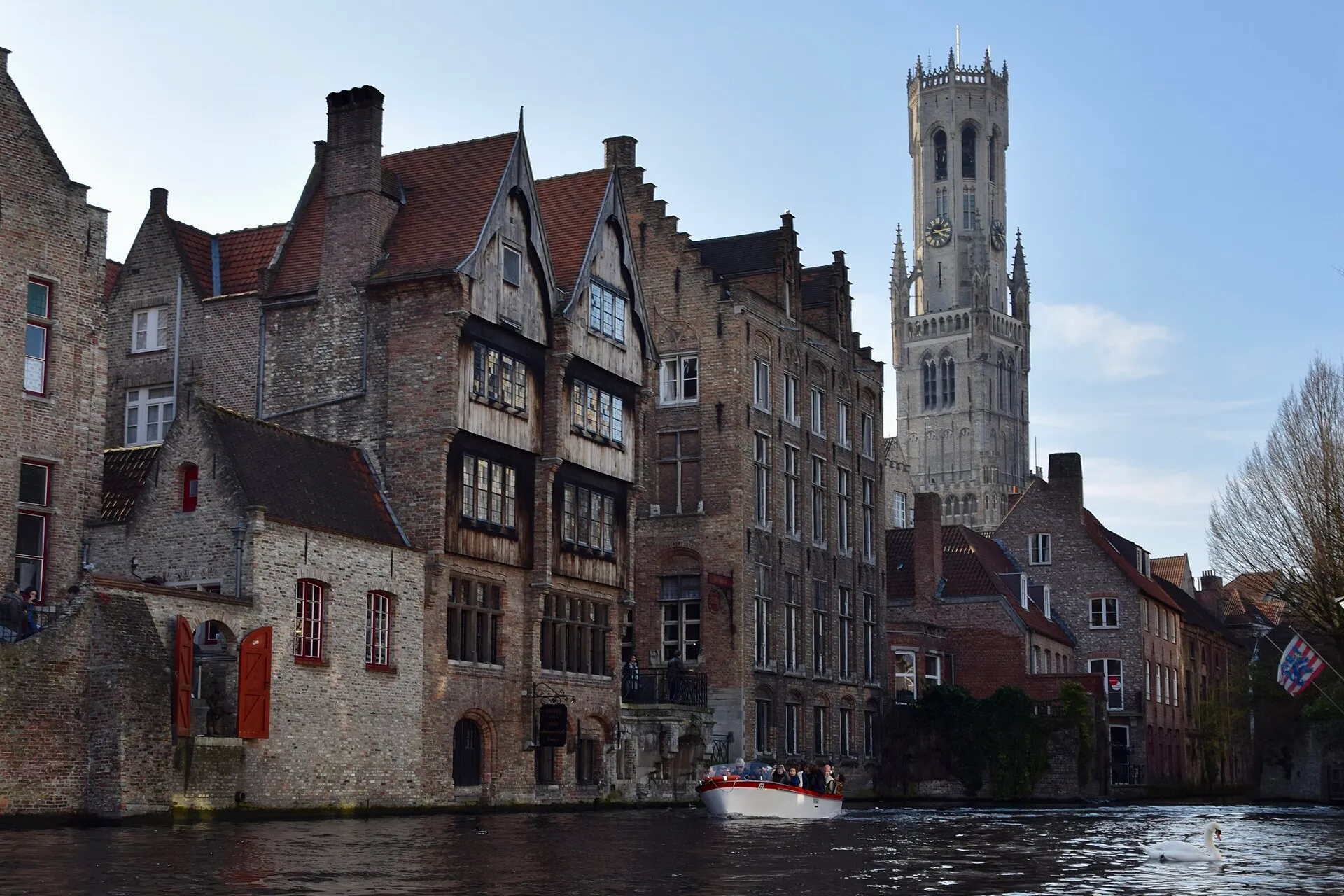
Rozenhoedkaai: The most photographed spot in Bruges, where the canal junction frames the 83-meter Belfry rising behind stepped gables — seen from boat level, the perspective reverses the classic postcard view. Bonifacius Bridge: The stone footbridge creates a perfect arch framing medieval gables beyond — boats pause here for photographs. Church of Our Lady view: The 122-meter tower rises behind stepped gables reflected in water — the composition that defines Bruges' silhouette. Willow tunnels: Along the Dijver and near the Begijnhof, overhanging willows create green curtains boats glide through in spring and summer. Swan encounters: Bruges maintains a population of mute swans on the canals — municipal symbols since 1488, often aggressive, and completely fearless around boats. Water gates: Medieval warehouses built with canal-level loading doors are still visible along the Dijver — the same stretch that fronts the Groeningemuseum — where guides point out original cranes and pulley mechanisms. Begijnhof approach: The convent's white-gabled houses and garden walls seen from water form a cluster separate from the city center, revealing its original function as enclosed religious community.
When to Visit
Operating season: Daily March through November 10:00 AM - 6:00 PM (extended to 8:00 PM June-August). Winter schedule: December-February hours reduced; some companies close entirely — check individual operators. Best: Early morning (10:00-11:00 AM) or late afternoon (5:00-6:00 PM) for softer light and smaller crowds. Avoid: Midday (12:00-3:00 PM) in July-August when cruise passengers create 30-45 minute waits. Spring bonus: Late March through April — willows leaf out, birds nest, water reflects perfect mirror images before summer haze arrives. Evening tours: July-August only, some companies offer evening departures with underwater lighting — romantic but you miss architectural details in darkness
Admission and Costs
Standard tour: €10-14 per adult depending on company and season — all tours are approximately 30 minutes. Children: €6-8 (ages 4-11), free under 4 if sitting on laps. Group discounts: €9-12 per person for groups of 20+ booking in advance. Private boat charter: €150-200 for entire boat (capacity 30-40) — useful for groups wanting customized commentary. Combo tickets: Some companies offer packages with museum admission (€25-30) — check if museums included are ones you planned to visit anyway
The Case for a Guide
Anyone can buy a €12 ticket and glide the same 30-minute loop, so the honest question is not whether the boat is worth it — it almost always is — but whether a guide adds anything the boatman's rehearsed patter does not. For the canals specifically, the answer is that a good guide converts a pretty float into a reading of medieval hydraulic engineering, and that reading is exactly what the onboard commentary skips. The five companies compete on landing-stage location, not scholarship; their narration is calibrated for a multilingual crowd and rarely ventures past the "Venice of the North" headline. A knowledgeable walking guide who works the quaysides fills the gaps the boat leaves.
- Reading the water as infrastructure: The Reie channels were engineered from the 12th century as a working port, not decoration. A guide traces which stretches were dug for cargo access versus flood control, and explains how the silting of the Zwin inlet after 1500 stranded Bruges inland and accidentally froze the city in its medieval form — the same slow decline that earned the historic centre its UNESCO World Heritage inscription in 2000.
- Timing the boat, not just booking it: Guides who work the center daily know that the Rozenhoedkaai and Vismarkt landings back up first, and will steer you to the quieter Huidenvettersplein or Beguinage stages — advice worth more than any operator's marketing, since every company covers essentially the same circuit.
- Decoding the warehouse façades: The water gates, hoist slits, and canal-level loading doors along the Dijver are invisible from the street and unexplained from the boat; a guide points out which gables are genuine 15th-century fabric and which are 19th-century restorations rebuilt after French Revolutionary damage.
- Separating swan folklore from record: The municipal swans are tied by legend to the 1488 execution of Pieter Lanchals, and a guide can mark where the story ends and documented civic history begins — precisely the distinction an onboard script blurs for effect.
- Combining water and foot: The single best itinerary is a boat loop first for orientation, then a guided walk of the same banks to inspect detail at leisure — pausing at the canal-side Groeningemuseum to see how the Flemish Primitives painted the very waterways you have just drifted along, detouring to the Basilica of the Holy Blood on the nearby Burg, and climbing the Belfry afterwards to trace the whole circuit from above.
Tips for Visitors
Skip the queue: Rozenhoedkaai and Vismarkt landings get longest waits. Walk to Huidenvettersplein or the landing near the Beguinage for shorter lines. All companies cover similar routes: Don't agonize over which boat company to choose. Guide quality varies by individual, not company — you're taking a chance either way. Sit at the back: Rear seats get better views passing under bridges and looking back at what you've just cleared. Front seats duck lowest to avoid hitting arches. Bring a waterproof bag: Spring and autumn bring rain; even without rain, passing under some bridges drips moss and condensation onto passengers. Photography strategy: Shoot continuously as you pass under bridges — the framed views last only seconds. Forget about perfect composition; quantity over quality captures the best moments. Combine with walking: Take a boat tour first to get oriented, then walk the canal banks on foot to appreciate details the guide pointed out. The Groeninge Museum sits right on the Dijver canal; from there it is a few minutes on foot to the Markt and its Belfry or across the Burg to the Basilica of the Holy Blood, letting you chain the waterside sights into a single morning circuit. Language check: Guides announce commentary languages before departure. If you need English and the guide is doing Flemish/French only, wait for the next boat. Winter closure: Many companies shut down December-February. If visiting off-season, check websites before planning your itinerary around a canal tour that might not be running.
Frequently Asked Questions
What months are ideal for a Bruges canal boat tour?
Late April through June is the sweet spot, when overhanging willows leaf out into green tunnels, nesting birds ride the water, and the reflections of medieval gables are mirror-perfect before summer haze sets in. Boats operate March through November, but July-August brings 30-45 minute queues at popular landing stages from cruise ship passengers, while autumn's rust-and-ochre reflections in October offer a quieter alternative with dramatic photography opportunities.
What days of the week is Bruges Canal Boat Tours open?
Operating season: Daily March through November 10:00 AM - 6:00 PM (extended to 8:00 PM June-August). Winter schedule: December-February hours reduced; some companies close entirely — check individual operators.
What does a visit to Bruges Canal Boat Tours cost?
Standard tour: €10-14 per adult depending on company and season — all tours are approximately 30 minutes. Children: €6-8 (ages 4-11), free under 4 if sitting on laps. Group discounts: €9-12 per person for groups of 20+ booking in advance.
How can visitors avoid queues on a Bruges canal boat tour?
Skip the queue: Rozenhoedkaai and Vismarkt landings get longest waits. Walk to Huidenvettersplein or the landing near the Beguinage for shorter lines. All companies cover similar routes: Don't agonize over which boat company to choose.
Do you need to book a Bruges canal boat tour in advance?
No — the five licensed companies sell standard 30-minute tickets on a walk-up, first-come basis at their landing stages, and none of them take reservations for individual seats, so there is no skip-the-line ticket to buy online. Simply turn up at a landing and join the next departure, which usually leaves as soon as the boat fills. Advance booking applies only to private charters of a whole boat (roughly €150-200), which are arranged directly with an operator. To dodge the worst midday queues in July-August, arrive at opening (10:00 AM) or in the last hour before close rather than trying to pre-book your way around the wait.
Are Bruges canal boat tours wheelchair accessible?
Access is limited. Every landing stage reaches the water by a short flight of stone steps with no ramp, and the flat-bottomed boats have fixed bench seating and a low roofline, so boarding requires managing a few steps and a step down into the hull. Passengers who can walk short distances with assistance are usually helped aboard by the crew, but wheelchairs and mobility scooters generally cannot be accommodated and there is no level boarding. Travellers with reduced mobility who still want a water-level perspective often do better contacting an operator in advance about a private charter, where crew can plan assistance and choose a quieter landing.