
Walking Route
Walking Routes
The Ancient Town's two principal streets — Tran Phu (the historic main trading spine) and Nguyen Thai Hoc (parallel, one block south) — contain the highest density of heritage buildings and are the core of any guided walk.
Classic 2-hour circuit:
- Start at the ticket office near the Japanese Covered Bridge on Nguyen Thi Minh Khai, and step into Phung Hung Old House (4 Nguyen Thi Minh Khai) right beside the bridge — its two-storey balcony was the town's flood refuge and shows the Japanese, Chinese, and Vietnamese roof influences side by side
- Walk Tran Phu Street east: Phuc Kien Assembly Hall (#46, most impressive of the six), then Cantonese Assembly Hall (#176), then Chaozhou Assembly Hall
- Turn south to Nguyen Thai Hoc: Tan Ky Old House (#101), the most-visited private house in the town
- Follow the riverfront (Bach Dang Street): Thu Bon riverside, boat jetties, the Central Market
- Return west along Le Loi Street through the tailoring district back to the bridge
Full Moon Festival route (evenings):
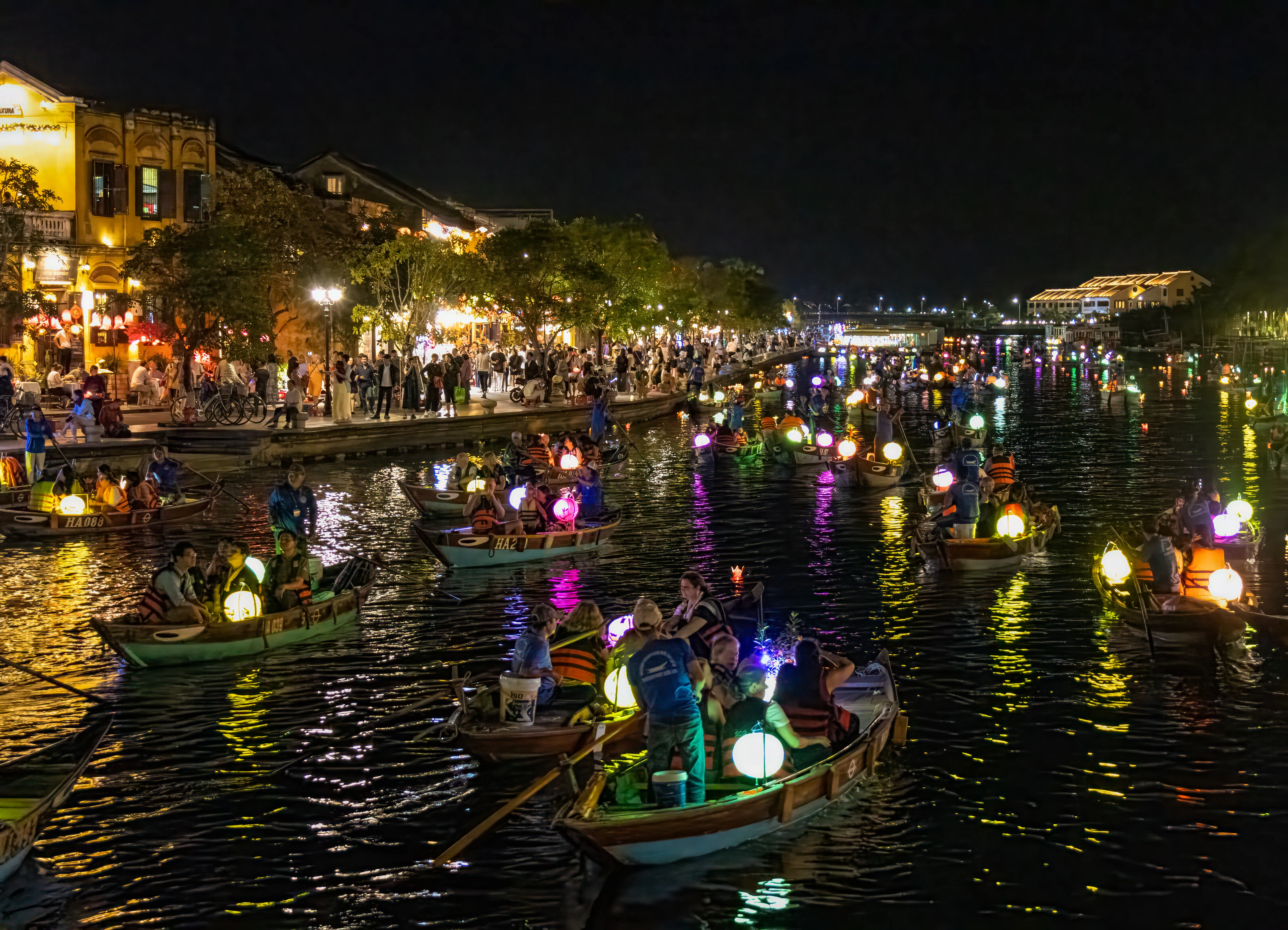
- The entire circuit above, but supplement with: Nguyen Hoang Street for lantern stall concentration; the Thu Bon riverbank for best reflection views; Le Loi Street at 8–9 PM when lanterns are densest
Local Life
Despite its tourism intensity, Hoi An's Ancient Town contains residential tube houses where family life continues exactly as it has for generations — vendors preparing cao lau at 5 AM, elderly women selling banh mi from baskets balanced on shoulder poles, tailors sewing by hand in open-fronted workshops.
- Morning market hours (5–8 AM): The Central Market and the lanes behind it operate at full local intensity before tourist foot traffic builds — the best time to see the town as a working community rather than a heritage attraction
- Tailoring culture: Several hundred tailor shops operate in the Ancient Town; the best source handmade garments using Vietnamese silk, Indian cotton, or imported Italian linen — a guide who knows the quality operators saves you from the tourist-trap shops charging full price for machine-sewn garments. Our guide to Hoi An's lantern and tailoring tours explains how the 24–48 hour fitting cycle works and how to judge a shop by its measuring and construction rather than its price
- Well water for cao lau: The distinctive earthy, mineral flavour of cao lau noodles depends on water from a specific ancient well (Ba Le Well) within the Ancient Town — visitors can taste this at restaurants that still source the water traditionally; a guide knows which establishments maintain the authentic practice
- Lantern-making workshops: Several family-run workshops along Nguyen Thai Hoc Street teach lantern-making to visitors; booking through a guide ensures you reach workshops that teach genuine traditional technique rather than pre-assembled tourist kits
Hoi An Ancient Town timeline
- 2nd–15th c.
Champa's port of Lâm Ấp Phố
Long before the Vietnamese arrived, the Thu Bon estuary served the Cham kingdom as a harbour trading in spices, ivory, and silk with Arab, Indian, and Chinese vessels — the mercantile foundation the later town inherited.
-
Đại Việt annexes the region
Emperor Lê Thánh Tông's southern campaign brings the Thu Bon valley under Vietnamese rule, and a fishing settlement the Japanese would call Faifo begins to grow at the river mouth.
- c. 1590s
The Japanese build the covered bridge
Japanese merchants raise the timber-framed Chùa Cầu (the Japanese Covered Bridge) to link their quarter to the Chinese one — still the town's signature monument and the emblem on Vietnam's 20,000-đồng note.
- 17th century
Faifo's golden age
Under the Nguyễn lords, Hoi An becomes the premier international port of Đàng Trong (Cochinchina), hosting Japanese red-seal ships and Chinese, Portuguese, and Dutch traders until Japan's 1630s isolation edicts end the Japanese presence.
-
Phúc Kiến Assembly Hall founded
Fujian merchants establish the grandest of the six clan halls on Trần Phú Street, dedicated to the sea goddess Thiên Hậu — a marker of how completely the Overseas Chinese had come to dominate the port's trade.
- 19th century
The river silts and Đà Nẵng rises
As the Thu Bon shoals and French colonial trade shifts to the deep-water port of Tourane (Đà Nẵng), Hoi An is economically frozen — the accident of decline that spared its old streets from redevelopment.
-
Inscribed by UNESCO
Hoi An Ancient Town joins the World Heritage List as an exceptionally well-preserved example of a South-East Asian trading port, protecting all 845 listed buildings from demolition.
When to Visit
Open: The Ancient Town streets are accessible at all times. Combined ticket sites: Daily 7 AM – 9 PM. Best time: Early morning (6–8 AM) before tour groups arrive, and the 14th of each lunar month for the Full Moon Lantern Festival when electric lights are replaced by paper lanterns after 7 PM.
Recommended duration: Allow 3–4 hours for a thorough walk covering the main streets, two or three assembly halls, and one or two old houses. A full-day visit with lunch allows exploration of the market area and riverside as well.
Admission and Costs
Combined Heritage Ticket: 120,000 VND ($4.80 USD) grants entry to five heritage sites chosen from a menu of 21 listed monuments — valid for one day. Full Moon Lantern Festival entry: 120,000 VND (same ticket, separate window on festival nights). Street-level and riverfront areas are free to explore without a ticket.
| Visit Type | Cost |
|---|---|
| Combined ticket (5 sites) | 120,000 VND ($4.80) |
| Group walking tour | 200,000–350,000 VND ($8–14) per person |
| Private half-day guide | 800,000–1,500,000 VND ($32–60) |
| Cooking class (includes market) | 400,000–700,000 VND ($16–28) |
The Case for a Guide
Hoi An Ancient Town is architecturally beautiful to any visitor who walks its streets. The guide's role is to transform architectural tourism into cultural literacy.
- Assembly hall iconography: The six Chinese clan assembly halls contain altars, relief sculptures, and ceramic installations that encode the complete mythological system of Fujian, Cantonese, Chaozhou, Hainan, and Hakka merchant communities — the patron deities, the protective spirits, the maritime navigation rituals conducted before each trading voyage. Without a guide, these are impressive decorative objects; with one, they become a social history of the Overseas Chinese merchant class
- Architectural hybrid reading: Understanding why Tan Ky House's columns are Japanese hinoki cypress on Chinese stone plinths, or why the roof line switches from Japanese curved to Vietnamese flared at the second storey, requires knowledge of the building contracts and trading relationships between Hoi An's three primary merchant communities. This is the specific knowledge that turns a walk through a pretty street into an understanding of how multiculturalism actually worked in 17th-century Southeast Asia
- Cao lau and the Cham well: The noodle dish's origin story — that it requires water from a specific Cham-built well within the town, and that this cannot be replicated outside the town boundary — is disputed by some food historians and defended by others. A guide who knows both the food chemistry argument and the oral tradition presents a genuinely interesting question about food geography and culinary identity
- Flood history and building adaptation: The Ancient Town floods regularly during October–November, and the buildings were deliberately designed with raised thresholds and impermeable lower-wall treatments to accommodate seasonal inundation. A guide can point to the flood-level marks on specific buildings and explain how the architectural adaptations reveal a centuries-old relationship between the town and its river
Tips for Visitors
Footwear: Wear comfortable walking shoes — cobbled lanes and old house thresholds are uneven. Cash: Ticket offices and most heritage houses are cash-only. Photography: Many assembly halls and old houses restrict flash photography; ask guides before shooting altar areas. Tailor advice: For custom garments, allow at least 24–48 hours for fitting and completion. Flood season: October–November brings flooding that can cover the lower streets — check conditions before visiting; the raised old-house thresholds keep interiors dry. Combine with: Hoi An Central Market opens at 5 AM and is most lively before 8 AM — pairing an early market visit with the Ancient Town when it opens at 7 AM covers the best of Hoi An in a single morning.
Frequently Asked Questions
What makes Hoi An Ancient Town a UNESCO World Heritage Site?
UNESCO inscribed Hoi An Ancient Town on the World Heritage List in 1999 based on its outstanding universal value as an exceptionally well-preserved example of a South-East Asian trading port from the 15th to 19th centuries. The inscription recognised the town's unique architectural fusion — Japanese merchant houses built on Chinese structural systems with Vietnamese decorative elements and French colonial additions — as evidence of the multicultural trading community that made Hoi An the most cosmopolitan port between the Chinese coast and the Strait of Malacca during its peak years. The 845 protected buildings span six distinct architectural typologies: communal assembly halls, traditional Vietnamese tube houses, pagodas, temples, French colonial commercial buildings, and the unique Japanese covered bridge that connected the Japanese and Chinese merchant quarters. The conservation authority has prevented demolition of any listed building since the 1980s — an achievement in a country where rapid urbanisation has obliterated comparable historic urban fabric in almost every other city.
How do I use the combined Ancient Town ticket?
The 120,000 VND ($4.80 USD) combined ticket grants admission to five heritage sites chosen from a menu of 21 listed monuments. Tickets are sold at official booths on Nguyen Thi Minh Khai Street and at the main ticket office near the Japanese Covered Bridge. The five categories to choose from are: Old Houses (Tan Ky House and Phung Hung House are the most architecturally significant), Assembly Halls (Phuc Kien, Cantonese, Chaozhou, Hainan, and Hakka halls), Museums (Trade Ceramics Museum and Museum of History and Culture), Handicraft Workshop, and Performing Arts (traditional music at the Hoi An Art Performing House). The ticket is valid for one day, and entry inspectors are at every listed site — you cannot enter without it. Electric lights in the Ancient Town are extinguished on the 14th of each lunar month for the Full Moon Lantern Festival; the atmosphere on these nights is unlike any other experience in Vietnam.
Which five sites are worth choosing with the combined ticket?
With only five punches from a menu of 21, a good default balances one of each type rather than clustering on similar buildings. Start with the Japanese Covered Bridge, the town's emblem and the only monument that appears on Vietnam's 20,000-đồng note. For an assembly hall, pick the Phúc Kiến (Fujian) Hall at 46 Trần Phú — the grandest of the six, with its triple gate and shrine to the sea goddess Thiên Hậu. For an old house, Tấn Ký at 101 Nguyễn Thái Học is the most complete example of the Japanese-Chinese-Vietnamese hybrid tube house and is still lived in by the founding family's seventh generation. Add the Museum of Trade Ceramics at 80 Trần Phú, a restored timber house displaying shards from the wrecks that supplied Hoi An's export porcelain, and finish with a traditional-music performance at the Hoi An Art Performing House for a non-architectural fifth punch. Swap the museum for Quan Công Temple (24 Trần Phú) if you would rather spend the slot on the eastern end near the market. Because each site is inspected at the door, save your five choices until you know which streets your walk actually reaches.
Can I walk the entire Ancient Town on my own?
Yes — the Ancient Town is pedestrianised (no motorbikes 7 AM–9 PM) and covers only 1 km², making it easy to walk independently. You can complete a circuit of the major streets in 60–90 minutes on foot. The combined ticket covers the entry fees for specific buildings. However, the architectural depth — understanding why a particular building's roofline reflects Japanese timber framing over Chinese foundation techniques, or what the iconography on a clan assembly hall's altar means, or which well in the market area is the only one that produces the correct mineral water for cao lau noodles — is entirely inaccessible without a guide who has studied Hoi An's mercantile history. The streets look beautiful to any visitor; they become legible only with interpretation.
How do I get to Hoi An Ancient Town, and can I drive into it?
Hoi An has no airport and no railway station — the gateway is Da Nang International Airport, about 30 km (45 minutes) to the north. A metered taxi or Grab car from the airport runs roughly 350,000–450,000 VND ($14–18 USD); shared tourist shuttles and hotel transfers cost less, and the public bus (Da Nang–Hoi An route) is cheapest of all if you have time. Nha Trang and Ho Chi Minh City connect to Da Nang by domestic flight or the north–south railway, then road for the final leg. Crucially, you cannot drive into the heritage core — it is pedestrianised 7 AM–9 PM. Drivers drop you at car parks on Nguyễn Thị Minh Khai Street (beside the Japanese Covered Bridge ticket office) or near Hoi An Central Market, and you walk in from there. See the Hoi An city guide for how the Ancient Town fits with the beaches and countryside around it.
What is the best time of year to visit Hoi An Ancient Town?
The most reliable window is the dry season from February to April: warm days, low rainfall, and the town before the peak summer heat and the tour-group crush. May to August is hot and humid, often in the mid-30s °C, though the long evenings suit riverside dining. The wet season runs September to November, and this is when the Thu Bon regularly overflows onto Bạch Đằng Street — the old houses were built with raised thresholds precisely to survive these floods, but low-lying lanes can be knee-deep after heavy rain. Whatever the month, try to align your visit with the 14th day of the lunar month for the Full Moon Lantern Festival, the single most atmospheric night in the Ancient Town.
When is the Hoi An lantern festival, and how do the dates work?
The Full Moon Lantern Festival happens on the 14th day of every lunar month — the eve of the full moon — so it recurs monthly, not once a year. From around 7 PM the Ancient Town switches off its electric street lighting and the yellow-washed lanes and the Thu Bon River are lit only by silk lanterns and floating paper candles that visitors set adrift from the boat jetties on Bạch Đằng Street. Because the festival follows the lunar calendar, its Gregorian date shifts each month, so check a lunar-calendar converter before you book rather than assuming a fixed weekend. The same 120,000 VND combined heritage ticket covers festival evenings; the streets are busiest between 8 and 9 PM, so arrive at dusk if you want photographs before the crowds peak.