
Walking Route
Local Life
What sets this neighborhood apart is that its beauty is systematic — a shared design grammar repeated across hundreds of facades until the whole strip reads as a single composition. Tropical Deco developed its own vocabulary of eyebrows, racing stripes, and porthole windows, and once you can read it, the district stops being a backdrop and becomes a text. The horizontal shading eyebrows were engineered to deflect the subtropical sun before air conditioning was universal; the nautical motifs on doorways and railings tied these landlocked hotels to the ocean just across Lummus Park; and the pastel palette — beige and cream until designer Leonard Horowitz reimagined it in the 1980s — is younger than the buildings themselves.
The neighborhood also keeps a working, everyday life beneath the postcard surface. Ocean Drive's cafes trade on the view, but a block west on Collins and Washington Avenues you find the ventanita coffee windows, corner delis, and neighborhood restaurants where residents actually eat, plus the flagship Books & Books and the design shop at the Wolfsonian-FIU. News Cafe at 800 Ocean Drive has anchored the strip since 1988, and the pedestrianized Espanola Way offers shaded tables under Mediterranean Revival arches. For visitors wanting to understand how art and preservation remake cities, the district pairs naturally with the Wynwood Walls, where a later generation transformed another Miami neighborhood through sheer creative vision, and with the Cuban rhythms of Little Havana a short drive inland.
Walking Routes
The district rewards a slow north-and-back loop rather than a fixed march. Starting from the Art Deco Welcome Center at 1001 Ocean Drive, these are the landmarks most guided routes string together, roughly south to north:
- The Colony Hotel — Henry Hohauser's 1935 hotel carries the district's most iconic vertical neon sign, a blue beacon featured in films and postcards since the 1930s.
- The Waldorf Towers & The Breakwater — a pair of Ocean Drive hotels whose rooftop "lighthouse" ornament and porthole-studded central tower distill the maritime Streamline Moderne look.
- The Carlyle and The Cardozo — flanking 1300 Ocean Drive, these Streamline landmarks (both linked to Hollywood and, in the Cardozo's case, to Gloria and Emilio Estefan) show the style at its most confident.
- Ocean Drive facades between 5th and 15th Streets — walk slowly through the concentrated stretch where the finest examples stand shoulder to shoulder above Lummus Park.
- Espanola Way — a Mediterranean Revival lane of 1925 between 14th and 15th, originally built to rival the bohemian cafes of Europe.
- Washington Avenue — one block west, the Old Miami Beach City Hall tower of 1927 and the Wolfsonian-FIU museum reward a detour off the beachfront.
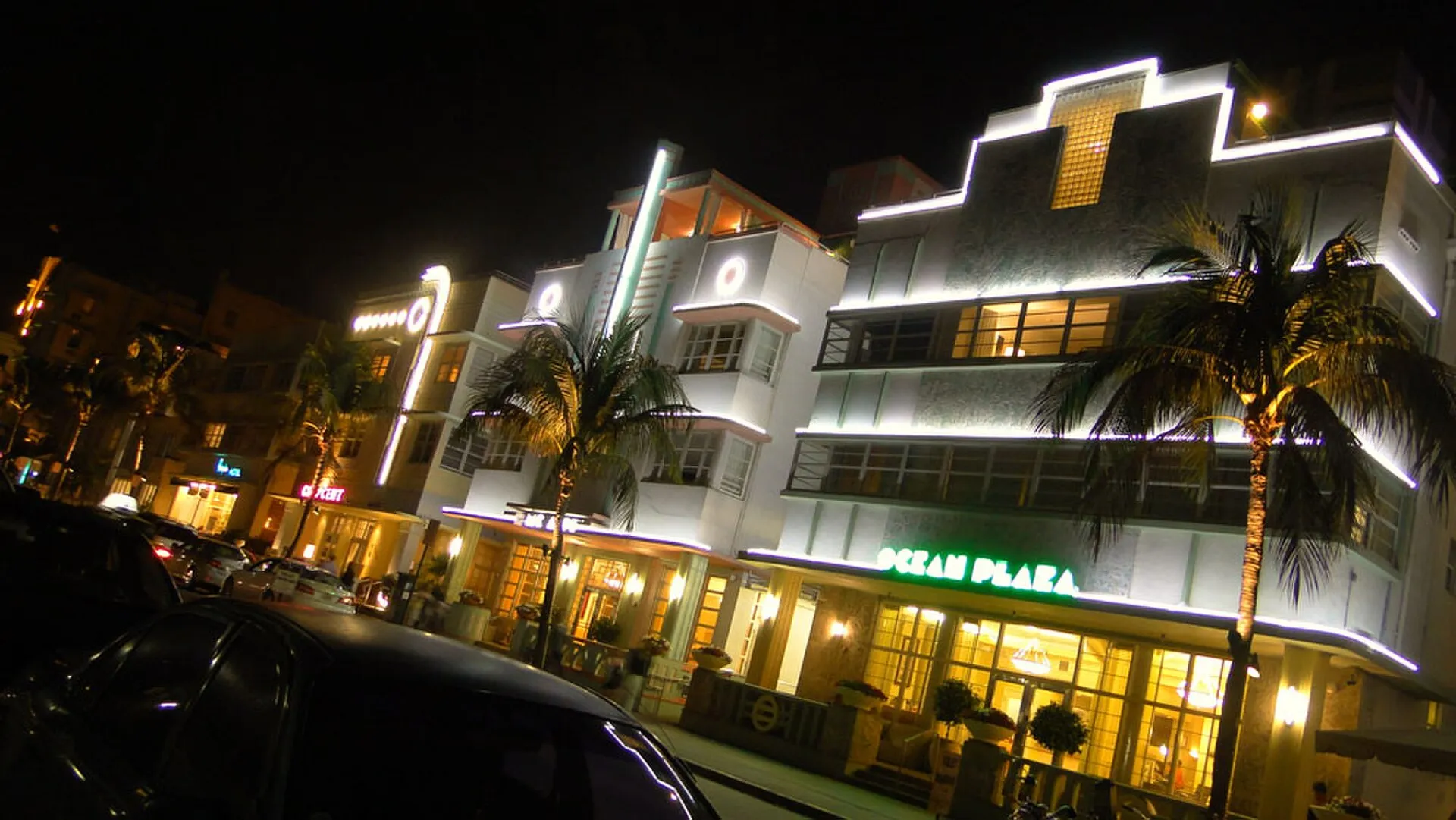
- Neon at night — return after sunset to see the buildings lit by their original neon and newer LED accents, an entirely different experience from daytime.
When to Visit
The district is a living neighborhood, so its streets never close, but the tour infrastructure and the light both reward a little planning:
- District access: The streets and building exteriors are open 24 hours a day as a public neighborhood, entirely free to walk.
- Art Deco Welcome Center: Open daily, generally 9 AM to 5 PM at 1001 Ocean Drive, with exhibits, maps, a gift shop, and tour bookings — confirm current hours with the Miami Design Preservation League before a special trip.
- Guided walking tours: The MDPL runs docent-led architectural walks daily (the flagship departs late morning); self-guided audio tours can be started any time the Welcome Center is open.
- Best light for photography: Early morning between 7 and 9 AM, when the low sun rakes the pastel facades, the eyebrow shades throw crisp shadows, and the streets are nearly empty.
- Neon at dusk: Ocean Drive's original neon and newer LED accents switch on at sunset, transforming the strip into a glowing spectacle best experienced from a Lummus Park bench or a sidewalk cafe.
Allow two to three hours for an unhurried loop of Ocean Drive, Collins Avenue, and Washington Avenue; architecture enthusiasts with a guide often stay a half-day and add the Wolfsonian-FIU museum.
Admission and Costs
The district is one of the great free attractions in the United States — the architecture is the exhibit, and the sidewalks are the gallery. The typical costs are:
- Walking the district: completely free at all times.
- MDPL guided walking tour: $30 per person for a 90-minute architectural walk led by trained Miami Design Preservation League docents.
- Self-guided audio tour: $20 from the Welcome Center, available in multiple languages and started at your own pace.
- Private architecture guide: $200-350 for a customized two-hour tour covering specific buildings and restored interiors for up to six people.
- Wolfsonian-FIU admission: $12 adults (free on Friday evenings), for the design museum that gives indoor context to the district's decorative arts.
Budget separately for the premium sidewalk dining on Ocean Drive, and read the street dining trap note under tips before you sit down.
The Case for a Guide
Most visitors walking Ocean Drive notice the pastel colors but miss the architectural language that makes these buildings unique in the world. A knowledgeable guide is the difference between photographing pretty facades and reading a neighborhood that hides its logic in plain sight.
- Decoding Tropical Deco: A guide names the vocabulary facade by facade — the horizontal eyebrow shades built to deflect the subtropical sun, the vertical fins and racing stripes, the porthole windows and ship's-railing motifs, and the "rule of three" that governs windows, awnings, and floors across the strip.
- The stories behind the buildings: Guides recount how Barbara Baer Capitman stood between bulldozers and the blocks developers had already slated for demolition, and how designer Leonard Horowitz's pastel palette rebranded a dying neighborhood — connecting individual hotels to the bootleggers, hoteliers, and snowbirds who first filled them.
- Access most visitors miss: Some tours enter restored hotel lobbies that independent visitors cannot easily reach, revealing terrazzo floors, etched-glass doors, and keystone fireplaces preserved to museum standards.
- The wider story of the city: Guides weave the district into the transformation of South Beach, explaining how 1980s fashion photographers discovered these photogenic blocks and launched a cultural renaissance that pairs naturally with the creative reinvention on show at the Wynwood Walls.
Tips for Visitors
- Start at the Welcome Center: Pick up a free map at 1001 Ocean Drive so you can identify key buildings by name, architect, and style before you set out.
- Pair with South Beach: The Art Deco District and South Beach overlap physically across Lummus Park, making a combined architecture-and-beach morning the ideal half-day itinerary.
- Stay hydrated: Miami's heat and humidity are intense, especially May through September, and shade is limited on the open streets — carry water and use the Lummus Park palms.
- Street dining trap: Ocean Drive restaurants charge premium prices for middling food and often add an automatic service charge — walk one block west to Collins or Washington Avenue for better meals at lower prices.
- Photograph early: The east-facing facades glow in the first two hours after sunrise, before crowds and harsh midday sun flatten the detail.
- Art connections: After the district's 1930s elegance, head to the Wynwood Walls to see how Miami's creative energy evolved from Deco symmetry to contemporary street art.
- Cultural contrast: Pair a morning in Art Deco with an afternoon in Little Havana to experience two entirely different dimensions of Miami's identity.
Frequently Asked Questions
When is the best season to explore the Art Deco Historic District?
December through March is peak season for a reason: dry skies, low humidity, and temperatures in the mid-70s make walking the open streets comfortable, and the morning light on the pastel facades is at its sharpest. The middle weekend of January brings Art Deco Weekend, the Miami Design Preservation League street festival that has celebrated the district since 1976 with tours, vintage cars, and lectures. September is the least appealing month, sitting at the heart of hurricane season with heavy afternoon thunderstorms and oppressive heat. Art Basel in early December brings a surge of creative energy to the broader Miami scene that pairs well with an architecture walk.
What time of day is best for exploring Art Deco Historic District?
Best for photography: Early morning between 7 and 9 AM, when the low sun rakes across the pastel facades, the eyebrow shades throw crisp shadows, and Ocean Drive is nearly empty. Evening atmosphere: the neon signs switch on at dusk, turning the whole strip into a glowing spectacle best watched from a Lummus Park bench or a sidewalk cafe.
How much should visitors budget for Art Deco Historic District?
Walking the district: completely free at all times, since the streets are a public neighborhood. MDPL guided walking tour: $30 per person for a 90-minute architectural walk led by trained docents. Self-guided audio tour: $20 from the Art Deco Welcome Center at 1001 Ocean Drive, available in multiple languages. A private architecture guide runs $200-350 for a customized two-hour tour that can include restored hotel lobbies.
Where should visitors start exploring the Art Deco Historic District?
Start at the Art Deco Welcome Center at 1001 Ocean Drive, run by the Miami Design Preservation League. Pick up a free map, book a docent-led or audio tour, and browse the gift shop before you set out, so you can identify key buildings by name, architect, and style rather than simply photographing facades from the sidewalk.
How do you get to the Art Deco Historic District, and how do you get around once there?
The district sits on the eastern edge of Miami Beach, roughly a 15-minute ride-share from downtown or 20 minutes from Miami International Airport across the MacArthur Causeway. Once you arrive, everything is walkable: the free Miami Beach Trolley loops along Collins and Washington Avenues, and the whole historic core spans barely a square mile. Metered street parking and municipal garages exist but fill fast on winter weekends, so most visitors leave the car behind. It combines naturally with a morning on South Beach next door.
Is the Art Deco Historic District accessible for wheelchairs and strollers?
The core streets are flat and mostly walkable, with curb cuts along Ocean Drive, Collins Avenue, and Washington Avenue and a paved promenade through Lummus Park. Many hotel lobbies raise their ground floors a few steps above the sidewalk in the Deco fashion, so interior access varies building by building; the Art Deco Welcome Center and the Wolfsonian-FIU museum are step-free. Historic terrazzo and tile can be uneven, so wheels roll most smoothly on the promenade and the main avenue sidewalks.