
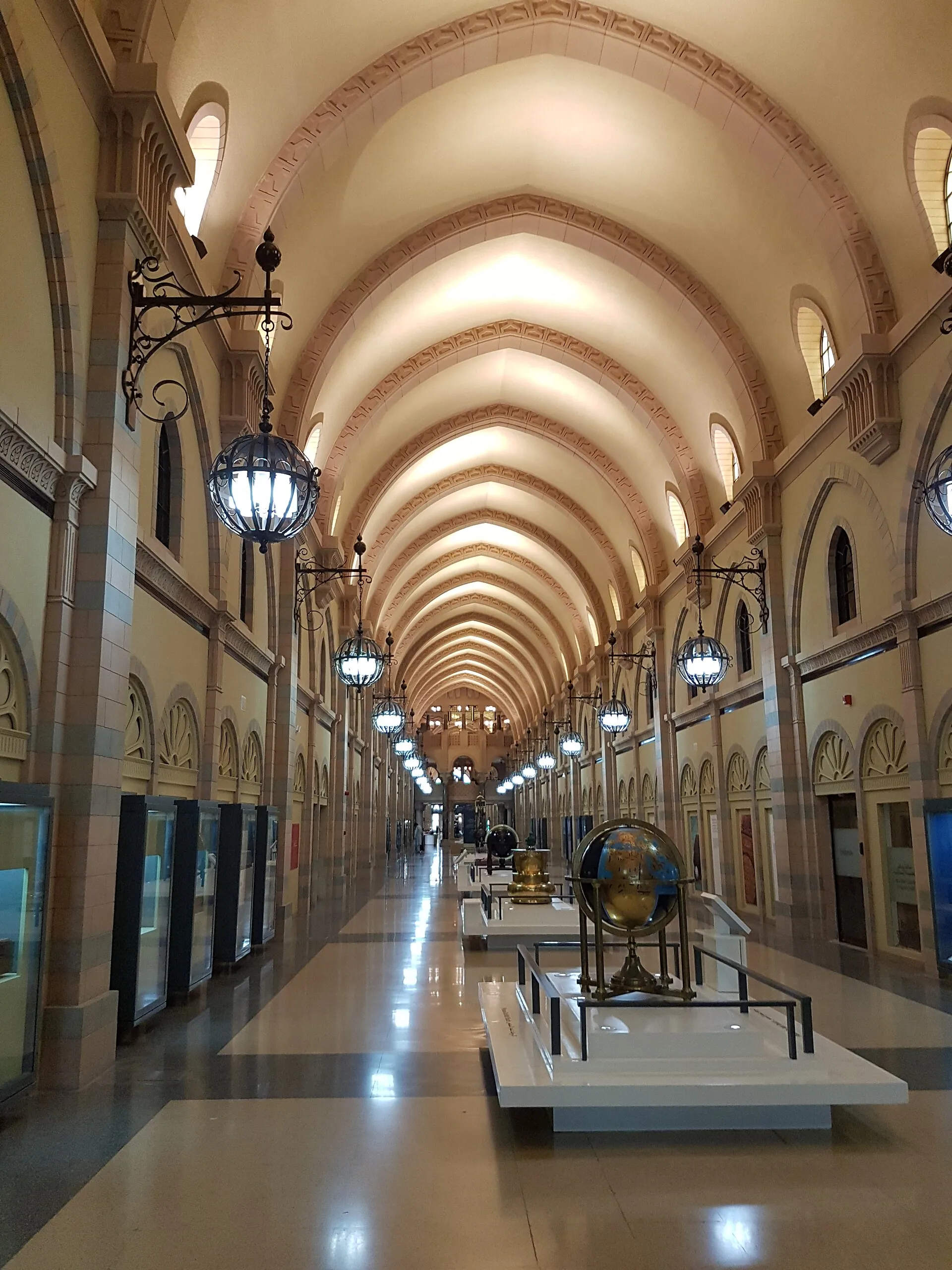
Collection Highlights
Museum of Islamic Civilisation's astronomical dome
The golden dome crowning the Corniche museum is lined inside with a gold-leaf mosaic of the zodiac and the lunar calendar, a reminder that medieval Islamic astronomers charted the stars long before Europe. Stand beneath it before touring the 5,000-plus artefacts below.
Sharjah Art Museum's Orientalist collection
The ruler's personal gathering of 18th- and 19th-century Orientalist paintings depicts the Gulf, Arabia and North Africa through European travellers' eyes, hung alongside major works of contemporary Arab art in the UAE's largest art museum.
Archaeology Museum's Mleiha finds
Gold jewellery, coins, pottery and a reconstructed Iron Age tomb trace 7,000 years of settlement from the desert site of Mleiha, giving the Gulf's pre-oil past a tangible, human scale that rewards an unhurried visit.
Heritage Museum's majlis and pearling galleries
Set in a restored Heart of Sharjah house, the galleries recreate Emirati customs, wedding traditions, traditional medicine and the dangerous pearl-diving economy that underpinned the coast before oil transformed the region.
Sharjah Calligraphy Museum
The only museum of its kind in the UAE displays Arabic calligraphy as fine art, from classical Qur'anic manuscripts in flowing thuluth and naskh scripts to bold contemporary interpretations by Arab and international artists.
Al Hisn Fort
The Al Qasimi family's 19th-century coral-and-gypsum fort, carefully reconstructed, guards the edge of the Heart of Sharjah quarter and tells the emirate's political story through weapons, documents and period rooms.
Classic Car Museum
Around a hundred vintage vehicles from the ruler's collection, including pre-war European marques and early Gulf imports, are displayed in a spacious hangar on the airport road — an easy crowd-pleaser for all ages.
Maritime Museum and Sharjah Aquarium
Beside the Al Khan lagoon, the Maritime Museum documents dhow-building and pearl diving while the adjoining aquarium walks visitors through Gulf reef, mangrove and shoreline habitats — a natural pairing for families.
Guided Tours
With more than 20 museums scattered across the Corniche and the Heart of Sharjah quarter, a guided tour helps visitors prioritise and avoid wasting time on transport between districts. Guides curate routes that connect thematically related venues and sequence the day around prayer-time closures and the heat.
Art-focused tours pair the Sharjah Art Museum's contemporary Arab works with the Calligraphy Museum's historic manuscripts. History tours combine the Archaeology Museum's roughly 7,000-year regional timeline with the Heritage Museum's recreations of traditional Emirati life. Family itineraries link the Science Museum and Discovery Centre with the Aquarium and the Arabian Wildlife Centre.
The real value is interpretation. Bilingual labelling conveys the what, but a guide supplies the why — the political and social backdrop behind a contemporary Arab canvas, the trade routes that carried an astrolabe to the Gulf, or the pearl-diving economy that shaped the coast before oil. That context is hardest to self-source and is where a specialist earns their fee.
Collections Highlights
The Museum of Islamic Civilisation anchors the circuit. Housed in a converted waterfront souq on the Corniche and crowned by a golden dome, it holds over 5,000 artefacts across themed galleries that move from Islamic faith and ritual to Islamic contributions in science, astronomy, medicine and the decorative arts. Its dome interior is lined with a gold-leaf astronomical mosaic mapping the signs of the zodiac — a highlight in its own right.
The Sharjah Art Museum, opened in 1997 and the largest in the UAE, pairs the ruler's collection of 18th- and 19th-century Orientalist paintings of the Gulf with a strong body of contemporary Arab art. The Sharjah Archaeology Museum traces a 7,000-year human story, drawing on finds from the desert site of Mleiha that run from Stone Age settlement through the Bronze and Iron Ages to the Islamic period.
In the restored Heart of Sharjah quarter, the Heritage Museum recreates Emirati customs, pearl diving and majlis (gathering) culture, while the Calligraphy Museum and the 19th-century Al Hisn Fort — the ruling Al Qasimi family's restored seat — sit within a short walk. The Classic Car Museum displays vintage vehicles from the ruler's personal collection.
Down on the coast at Al Khan, the Maritime Museum documents dhow-building and the pearling trade that sustained the Gulf before oil, beside the Sharjah Aquarium. For families, the Science Museum and Discovery Centre offer hands-on exhibits, and the Arabian Wildlife Centre shows desert species in naturalistic settings. Travellers comparing the Gulf's flagship museums often continue to the Louvre Abu Dhabi in Abu Dhabi.
Sharjah Museums timeline
-
Sharjah Art Museum opens
The purpose-built museum opened on the edge of the Heritage Area, becoming the largest art museum in the UAE and home to the ruler's Orientalist collection.
-
Arab cultural capital
UNESCO named Sharjah Cultural Capital of the Arab World, cementing the emirate's long-term investment in museums and heritage.
-
Museums Authority formed
The Sharjah Museums Authority was established by Emiri decree to manage and unify the emirate's growing network of museums.
-
Islamic Civilisation museum opens
A converted Corniche souq reopened as the Museum of Islamic Civilisation, housing over 5,000 artefacts beneath its gold astronomical dome.
-
World Book Capital
UNESCO designated Sharjah World Book Capital, underlining the cultural identity its museums express.
When to Visit
Most museums open 8:00 AM to 8:00 PM, Saturday through Thursday, with Friday hours of 4:00–8:00 PM because many close on Friday morning for prayers. A handful take a weekly closing day on Monday or Tuesday, so check the specific venue on the Sharjah Museums Authority site before setting out.
Weekday mornings between 9:00 and 11:00 AM are the quietest and best for photography, before school groups and the midday heat arrive. Plan a realistic two to three museums per day, allowing 60–90 minutes at each for a meaningful visit rather than a rushed circuit.
During Ramadan opening shifts later into the evening and daytime hours contract, so an after-iftar visit becomes the safe assumption. Winter (November–March) is the ideal season: the walk between the Corniche and Heart of Sharjah venues is pleasant, whereas from June to August you will want to move between air-conditioned buildings by taxi.
Admission and Costs
Sharjah keeps culture affordable. Most museums charge free or AED 10 (~$2.70) admission; the Museum of Islamic Civilisation is AED 15 (~$4), the Sharjah Aquarium AED 25 (~$7), and the Discovery Centre (a children's science museum) AED 15. Children's and family rates are lower still, and under-twos are generally free.
The Sharjah Museums Authority sells discounted multi-museum and annual passes that quickly repay themselves once you visit three or more sites — worth buying at your first stop if you intend a full cultural day.
Guided museum tours covering several venues run AED 400–700 (~$109–190) for three to four hours, usually with air-conditioned transport between sites included. Pairing museums with the free Al Noor Mosque tour and the low-cost Al Noor Island keeps a full day inexpensive by regional standards.
The Case for a Guide
With over 20 museums spread between the Corniche and the Heart of Sharjah quarter, the hardest part of a visit is choosing well and routing efficiently. A knowledgeable local guide solves both and adds the interpretation that labels alone cannot.
- Curated selection: A guide narrows 20-plus options to the three or four that match your interests, whether that is Islamic science, contemporary Arab art, archaeology or family-friendly hands-on exhibits.
- Efficient routing: Guides sequence venues around prayer-time closures, the midday heat, and the gap between the Corniche and the Heart of Sharjah, minimising taxi hops and backtracking.
- Cultural context: Specialists explain the political and social backdrop behind a painting, the trade routes behind an astrolabe, or the pearl-diving economy behind the Heritage Museum's displays.
- Logical pairings: A guide can thread the museums together with the Al Noor Mosque Monday tour and Al Noor Island into one coherent day around Khalid Lagoon.
Tips for Visitors
Begin at the Museum of Islamic Civilisation for the clearest overview of regional culture before branching out by interest. Photography is usually permitted, but check each museum's policy and never use flash near textiles or manuscripts. Dress modestly with shoulders and knees covered — Sharjah enforces stricter standards than Dubai, and the emirate is entirely alcohol-free.
The Heart of Sharjah heritage quarter clusters the Archaeology, Heritage and Calligraphy museums alongside Al Hisn Fort in restored old-city buildings, making a compact, shaded walking itinerary; the Corniche museums are a short taxi hop away. Many venues close Friday morning for prayers and reopen in the afternoon, so build your route around that.
Getting there matters: with no metro, a taxi or Careem/Uber ride-hail is simplest, and the Dubai–Sharjah drive balloons at rush hour on Al Ittihad Road. Combine the museums with the Al Noor Mosque Monday tour and an evening at Al Noor Island for a well-rounded, contemplative day — Sharjah's museums are far quieter than Dubai's headline attractions.
Frequently Asked Questions
What are the opening hours for Sharjah's museums?
Most venues run by the Sharjah Museums Authority open 8:00 AM to 8:00 PM, Saturday to Thursday, with a shorter Friday session of 4:00–8:00 PM because the morning is reserved for prayers.
A few museums take a weekly closing day on Monday or Tuesday, and Ramadan hours shift later into the evening. Always confirm the specific venue's timetable on the Authority website before a special trip, as individual sites occasionally vary.
How much does admission cost, and is there a combined pass?
Admission is deliberately low: most museums are free or AED 10 (~$2.70), the Museum of Islamic Civilisation is AED 15 (~$4), and the Sharjah Aquarium is AED 25 (~$7).
The Sharjah Museums Authority sells discounted multi-museum and annual passes that pay off quickly if you plan to visit three or more sites, which makes the city one of the best-value cultural days in the United Arab Emirates.
Which museums should I prioritise on a first visit?
Start with the Museum of Islamic Civilisation on the Corniche for the broadest overview of regional art, science and faith, then choose by interest.
Art lovers should add the Sharjah Art Museum; history-minded visitors the Archaeology and Heritage museums in the Heart of Sharjah quarter; families the Science Museum and Aquarium. Two or three museums in a day, at roughly 60–90 minutes each, is a comfortable pace.
How do I reach Sharjah's museums from Dubai?
Sharjah has no metro, so a taxi or a Careem/Uber ride-hail is the simplest option. The drive from central Dubai takes 25–40 minutes off-peak, but the Al Ittihad Road corridor between the two emirates clogs badly at rush hour.
Aim to cross before 7:00 AM or after 10:00 AM. Once in the Heart of Sharjah and Corniche area, the main museums sit within a walkable cluster.
Are Sharjah's museums suitable for children?
Yes — the Sharjah Science Museum and the hands-on Discovery Centre are built for children, and the Sharjah Aquarium and the Arabian Wildlife Centre reliably hold younger visitors' attention.
The Classic Car Museum appeals to all ages, while the Islamic Civilisation and Art museums suit older children who can engage with the exhibits. Pushchairs are easy to use in the modern, air-conditioned buildings, a welcome relief from the Gulf heat outside.