
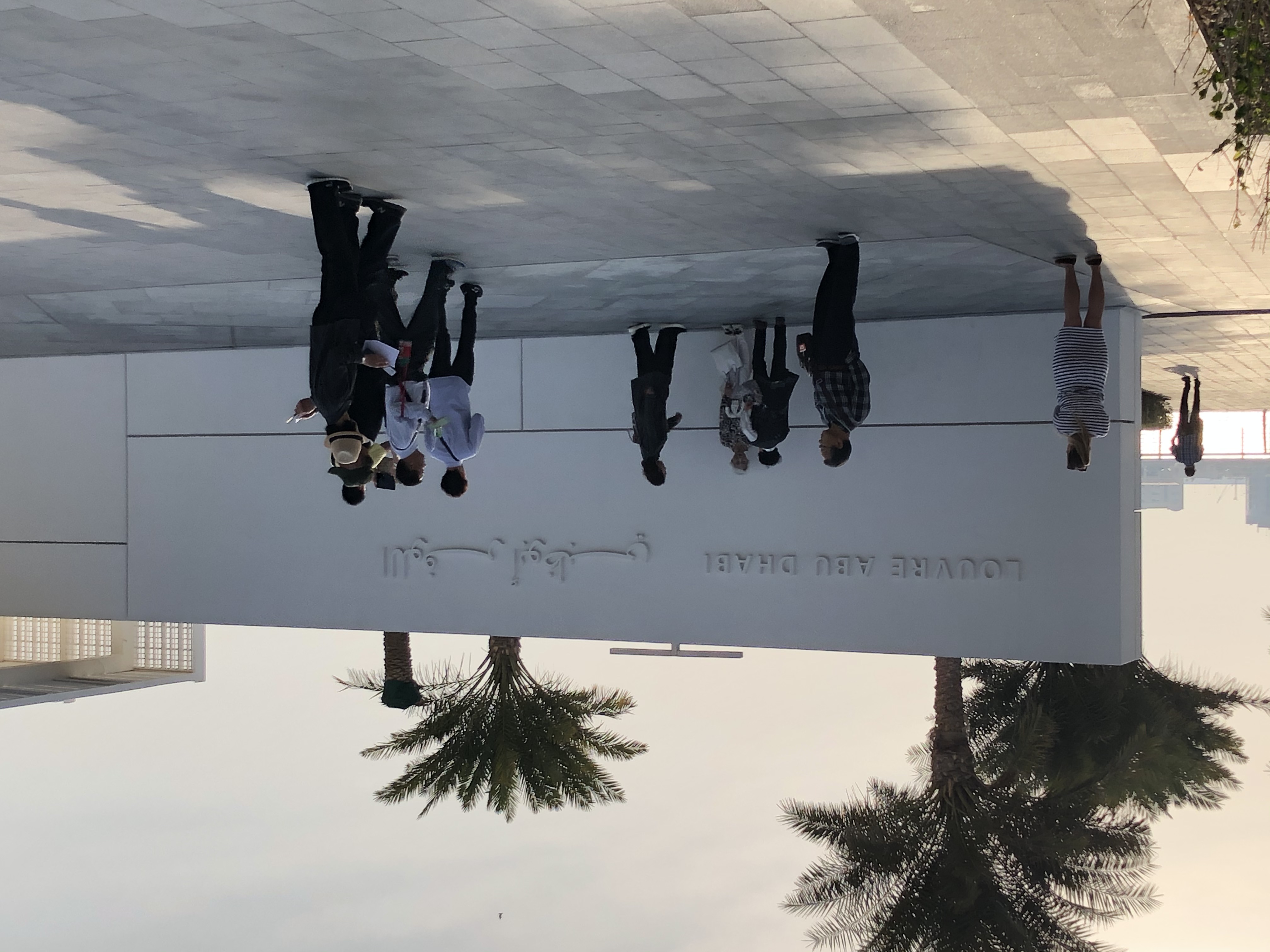

Overview
Standing on the western tip of Saadiyat Island, Louvre Abu Dhabi opened in November 2017 as the Arab world's first universal museum. The project grew from a 2007 intergovernmental agreement between the UAE and France, a thirty-year cultural partnership valued at over one billion euros. Pritzker Prize-winning architect Jean Nouvel conceived the building as a "museum city" beneath a vast dome spanning 180 metres in diameter, inspired by the interlocking palm fronds of traditional Arabian architecture.
The permanent collection houses more than 600 artworks and objects spanning 12,000 years of human creativity. Rather than separating works by origin, the galleries arrange them chronologically so that a Mesopotamian clay tablet sits alongside an Egyptian funerary mask and a medieval Bible, revealing shared themes across civilizations. Temporary exhibitions rotate works on loan from thirteen partner French institutions, including the Louvre in Paris, the Musee d'Orsay, and the Centre Pompidou. For visitors exploring Abu Dhabi, Louvre Abu Dhabi pairs naturally with the nearby Sheikh Zayed Grand Mosque and the adrenaline of Ferrari World.
The museum sits on Saadiyat Island, connected to Abu Dhabi's mainland by a bridge. It is roughly 25 minutes by car from downtown Abu Dhabi and about 80 minutes from Dubai. The building's design earned worldwide acclaim for its innovative approach to desert architecture and its integration of water features throughout the complex.
If you enjoy museum visits with a guide, several other world-class collections across this site may interest you. The Louvre in Paris holds the parent collection with 380,000 objects compared to Abu Dhabi's more focused 600-piece selection. The British Museum in London takes a similarly universal approach to world cultures but organizes by geography rather than chronology. Each rewards a guided visit in its own way.
Guided Tours
Louvre Abu Dhabi's twelve galleries are arranged as a chronological walk through civilization. Each "chapter" juxtaposes objects from different cultures to highlight universal human themes rather than geographic boundaries.
Galleries 1-2 -- The First Villages and First Great Powers: Neolithic tools, early pottery, and monumental sculptures from Mesopotamia, Egypt, and the Indus Valley. Look for the Bactrian Princess figurine (late 3rd millennium BCE), one of the museum's signature acquisitions. Galleries 3-4 -- Civilizations and Empires: Greek bronzes, Roman marble busts, and Chinese ritual vessels sit together, illustrating how empires developed parallel artistic languages for depicting power. Galleries 5-6 -- Universal Religions and Asian Trade Routes: Sacred texts from Islam, Christianity, Buddhism, and Hinduism displayed side by side, with Silk Road artefacts tracing the movement of goods and artistic techniques between East and West.
Galleries 7-8 -- The Magnificence of the Court and A New Art of Living: Ottoman ceramics, Mughal miniatures, and European Renaissance paintings share space. Leonardo da Vinci's La Belle Ferronniere, on long-term loan from the Paris Louvre, is the centrepiece. Galleries 9-10 -- A Modern World and Challenging Modernity: Japanese ukiyo-e woodblock prints, Impressionist canvases by Monet and Manet, and early photography document a world in rapid transformation. Paul Gauguin's Tahitian works hang near Osman Hamdi Bey's Ottoman realism. Galleries 11-12 -- A Global Stage and A Contemporary Stage: Post-war abstraction, contemporary installations, and video art from artists across Africa, Asia, and the Americas. Ai Weiwei and Jenny Holzer works feature alongside pieces by Middle Eastern artists gaining international recognition.
Collections Highlights
The Rain of Light dome is the museum's defining architectural feature: 7,850 metal stars arranged in eight overlapping layers create slowly shifting light patterns across the water channels and gallery walls, an experience that changes with every visit depending on the sun's angle.
Leonardo da Vinci's La Belle Ferronniere, a portrait of a Milanese noblewoman on long-term loan from the Paris Louvre, is one of fewer than twenty surviving paintings attributed to Leonardo. The Bactrian Princess (late 3rd millennium BCE), a composite figurine from Central Asia carved in chlorite and calcite, represents a figure whose identity still puzzles archaeologists.
The Impressionist and Post-Impressionist galleries offer a concentrated survey of late 19th-century painting: Monet's Saint-Lazare Station, Manet's The Gypsy, and Gauguin's Tahitian scenes. The Islamic art wing displays Qur'an manuscripts in Kufic script, Persian lustre-ware tiles, and Ottoman court textiles tracing the evolution of Islamic artistic traditions across a thousand years. The waterfront promenade and sculpture park features outdoor installations by artists including Giuseppe Penone along the Gulf shoreline -- free to access and at their most atmospheric during sunset. The children's museum offers hands-on galleries designed for young visitors, with rotating interactive exhibitions that connect to the main collection's themes.
When to Visit
The museum is open Tuesday-Sunday, 10:00 AM - 6:30 PM, with last entry at 5:30 PM. It is closed on Mondays. For the quietest galleries, visit on weekday mornings between 10 and 11 AM, before tour groups arrive.
The dome's light effect is most dramatic around midday, when sunlight pours through the 7,850 perforated metal stars, casting shifting constellations of light on the water and walls below. Peak season runs from November through March, when cooler Gulf weather draws the highest visitor numbers. Allow 2-3 hours for the permanent collection, or 4-5 hours to include temporary exhibitions and the outdoor promenade.
Admission and Costs
General admission is AED 63 (~$17) for adults. Children under 18 enter free. An audio guide is included with every ticket and available in multiple languages. Group guided tours cost AED 50 (~$14) per person on top of admission for a 45-minute gallery highlights tour.
Private tours with an art historian run AED 600-1,200 (~$163-327) for a 2-3 hour session tailored to your interests. The children's museum is free with admission, featuring interactive spaces designed for ages 4-12.
Tips for Visitors
Book timed tickets online at louvreabudhabi.ae -- walk-up visitors may face multi-hour waits during peak periods. Photography is permitted throughout the museum without flash, though a few loaned works are marked with no-photo signs.
Dress code: Modest attire (shoulders and knees covered) is respectful and appreciated, though enforcement is relaxed compared to religious sites like the nearby Sheikh Zayed Grand Mosque. Family visit: Pick up a free activity backpack at the entrance desk -- it includes games and a scavenger hunt aligned with the gallery themes. Dining: The museum cafe serves light meals with an outdoor terrace overlooking the Gulf. A full-service restaurant offers a longer menu for post-visit dining. Saadiyat Island Cultural District: The Zayed National Museum and a Guggenheim outpost are both under construction nearby, gradually transforming the island into a major cultural corridor. Combine visits: Saadiyat public beach is a short walk from the museum -- a welcome contrast after hours in the galleries. Museum shop: Well-curated selection of art books, local designer collaborations, and exhibition catalogues near the exit.